What You’ll Learn
- Where the “AI will replace all jobs” narrative actually comes from and why it keeps getting amplified
- How AI dental tools like X-ray analysis create more work rather than eliminate it
- The labor economics principle that explains why automation increases the value of human judgment
- A research-backed framework called the “three B’s” for understanding your relationship with AI
- Why robotic implant demos aren’t what they appear to be and what to actually watch for
The Story You Keep Hearing Isn’t Based on Research
Every few months, another headline declares that AI is coming for your job. Dentists watch robotic implant demos at conferences and wonder if they’re witnessing the end of their profession. Practice owners read predictions about fully automated dental offices and feel a knot in their stomach.
Helen Edwards has spent years studying how people actually interact with AI tools. She’s a researcher, keynote speaker, and co-founder of the Artificiality Institute, where she and her husband Dave run research programs examining the intersection of human performance and artificial intelligence. Their work has included studying thousands of people over hundreds of hours in workshops.
What she’s found consistently challenges the loudest claims coming out of Silicon Valley.
“One of the VCs put out a chart that said here’s SaaS, Salesforce and whatnot, and we’re not going to make our money back from AI investments if we just target that,” Helen told Adrian Lefler on a recent episode of the Byte Sized Podcast. “Here’s the whole labor market, whatever trillions, and that’s where we’re going to make our money back.”
The entire story of AI rapidly became a story of competing with human cognition and replacing humans. Not because research proved it would happen. Because that’s how venture capital justified the investment.
Follow the Money, Not the Headlines
The “AI will replace everyone” narrative isn’t emerging from research labs or labor economists. It’s coming from a handful of venture capitalists who need to justify massive infrastructure investments in data centers, chips, and electricity.
Helen and her team ran back-of-the-envelope calculations after that VC chart went viral. The break-even point for these investments required replacing roughly a third of the US workforce.
“That shows you that this is big and it’s real,” Helen said. “What got me to be a little bit more activist and outspoken about this is that I started to worry about a year ago that this narrative was becoming causal. It was actually starting to drive behavior in a way that was pathological to everything good we like about humans.”
The narrative creates fear. Fear creates paralysis. Paralysis prevents the nuanced conversations that would actually help people use AI well.
When you hear predictions about AI taking over, consider the source. Are they selling something? Are they raising capital? Are they generating clicks? The people doing actual research on human-AI interaction are telling a very different story.
| Narrative Source | Their Incentive | What They Claim |
| Venture capitalists | Justify trillion-dollar investments | AI will replace most human labor |
| Media outlets | Generate clicks and engagement | Extreme outcomes (utopia or extinction) |
| AI researchers | Understand what’s actually happening | It’s complicated and context-dependent |
| Labor economists | Study historical patterns | Automation typically creates complementary value |
The Labor Economics That Silicon Valley Ignores
There’s a well-established principle in labor economics that rarely makes it into AI headlines: when you automate one task in a chain, you create scarcity in the complementary tasks. And scarcity increases value.
“As certain tasks get cheaper, certain prediction tasks like predicting there’s a hole in that tooth from an X-ray, as those predictions get cheaper, you can make more of them,” Helen explained. “But as you make more of them, you need to make more judgments and you need to take more actions.”
This is sometimes called the “cream and sugar” effect. When coffee gets cheap, more people drink coffee, so the value of cream and sugar goes up.
In dentistry, AI tools analyzing X-rays can identify caries and disease with remarkable accuracy. Pearl, one of the leading companies in this space, discovered something interesting when they first went to market. Their initial pitch was essentially “let AI do your X-ray analysis.” That got rejected quickly because it undercut the perceived value of the clinician.
They pivoted to positioning AI as a second opinion. But here’s what matters: when AI finds more caries, that’s more work to do. More treatment plans to create. More clinical decisions to make. More patient conversations to have.
“Think of all those teeth out there that need to be fixed and can’t be fixed right now for whether it’s cost or whether it’s access or whether it’s the fact that no one read that X-ray,” Helen said. “There’s so much more that we can do that we don’t even do.”
The prediction task gets automated. The judgment and action tasks become more valuable because there’s more of them to do.
The Three B’s Framework for Understanding Your AI Relationship
Helen’s research identified three ways that AI changes how people think and work. Understanding where you fall on each dimension helps you use AI intentionally rather than reactively.
Blending is where your reasoning merges with AI in ways that become hard to separate. We already have distributed cognition across humanity. We get ideas from our communities. But with AI, when ideas permeate to the point you can’t tell where they originated, it’s a fundamentally different situation.
Bonding is where your identity connects with the tool. You start imagining yourself as a different professional identity because of what AI enables. This can be positive (expanding what you’re capable of) or negative (feeling like you can’t function without it).
Bending is where your meaning-making and sense-making frameworks become more flexible. You’re able to enter different learning states and professional states than before. This dimension actually moderates how the other two work.
Picture these three dimensions as a cube. At the bottom corner where everything is low, you’re using AI as a simple doer. It just does stuff for you. You’re not changing. You’re not learning. You might actually be atrophying skills you already had.
At the opposite corner where everything is high, you’re using AI as a co-author. Your identity has started to shift. You’re able to do more. You’re genuinely growing through the process.
“If you use AI in a way where you’re getting lots of different new ways to see an existing problem, every single one of those is a frame,” Helen explained. “Our minds are tuned for novelty. We’ll instantly look at those ten ideas and pass judgment. One and two, I really like those. Three, eh. But we have some bias towards a new idea. The seventh idea might be the most efficient in relationship to the team, but we go with the novel one.”
The framework helps you catch yourself. Are you mistaking the novel frame for the best frame? Are you over-relying on AI in ways that atrophy important skills? Are you under-utilizing AI in areas where it could genuinely expand your capabilities?
What Robotic Implant Demos Aren’t Showing You
If you’ve watched a robot placing an implant at a conference, your brain probably did something automatic: it assumed you were watching autonomous intelligence. We’re hardwired to perceive movement as aliveness and agency.
“What we don’t look for is where something has been carefully staged and controlled so that you perceive this degree of intelligence and autonomy that we’re just hardwired to see,” Helen said.
The mental model she suggests is to think in terms of augmented dexterity rather than autonomous intelligence.
“You go to an event and they’ve got a robot placing an implant and you’re like, oh shit, I’m out of work,” Adrian said during the conversation. “And the reality is the entire thing is structured in a way where it doesn’t make a mistake.”
Robotics in healthcare remains in a similar place to where self-driving cars were in 2016. Impressive demonstrations in highly controlled environments. Real technological progress. But the gap between controlled demo and messy reality is enormous.
Ten years after those early self-driving promises, Waymo is genuinely impressive. But it’s not full autonomy. There’s still human oversight behind the scenes. It took all that time for the data to be gathered, and we’re still not at the endpoint people predicted.
Humans handle the unpredictable. And there’s far more unpredictability in the real world than any demo suggests.
Staying the Author of Your Own Mind
Helen’s research points to three principles that help people maintain what she calls “cognitive sovereignty” while using AI tools.
Awareness means actually understanding how you’re using the tool. Can you name it? Can you describe an idea without access to the tool that gave you the idea? Which parts do you care about versus which parts are you happy to outsource entirely?
Helen gave a personal example. She doesn’t care about crafting emails to people who have annoyed her. She’ll always get AI to do that first cut because she tends to react too strongly. That’s a conscious decision to let a skill atrophy because she’s decided it’s not worth maintaining.
Agency means having genuine choices. What decisions are you making? Some employers require AI use. Some prohibit it. Understanding where you have agency and where you don’t is part of using AI intentionally.
Accountability means showing up for other people and explaining yourself. Allowing colleagues, patients, and community members to understand how you’re using these tools. Checking in with humans to make sure you’re still making sense.
“If you go too far with that co-author pattern and you don’t check in with other humans, you can literally think that you’ve come up with a new scientific theory when you know absolutely nothing,” Helen warned.
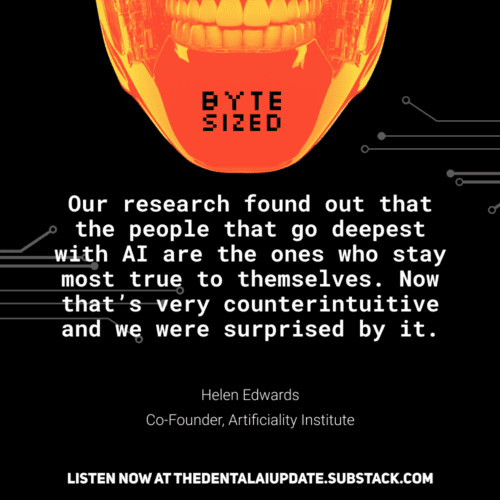
The researchers who go deepest with AI are the ones who stay most themselves. Not because they avoid the tools, but because they use them with awareness, agency, and accountability.
The Efficiency Ceiling vs. The Capability Sky
The fundamental problem with the replacement narrative is that it’s a 100% efficiency story. Do what we already do, but faster and cheaper.
Efficiency has a ceiling. At some point, you’ve optimized everything you currently do.
Capability has no ceiling. You can solve new problems. Serve patients who couldn’t access care before. Offer treatments that weren’t economically viable. Expand what’s possible.
“That’s the stay human story,” Helen said. “What are the things that are best automated? And what do I do around that which I couldn’t do before?”
The dental practices that thrive with AI won’t be the ones that simply automate their current workflows. They’ll be the ones that ask better questions. What couldn’t we do before that we can do now? What patients weren’t we reaching? What clinical decisions weren’t we making because we didn’t have the information?
AI creates more work, not less. The question is whether you’re positioned to capture that expanded opportunity.
In This Episode:

Helen Edwards, Co-founder of the Artificiality Institute
Helen Edwards is co-founder and researcher at the Artificiality Institute, a nonprofit research organization studying the relationship between human performance and artificial intelligence. She and her co-founder and spouse, Dave Edwards (former Apple software product manager and early internet executive), have conducted research with over a thousand participants across hundreds of hours of workshops. Helen is a visiting researcher at UC Berkeley’s Center for Human-Compatible AI (CHAI) alongside Stuart Russell. She is also a sought-after keynote speaker and one of the more compelling voices on TikTok challenging the binary narratives around AI and the future of work.

Adrian Lefler, CEO and Co-founder of My Social Practice
Adrian Lefler, CEO of My Social Practice, is a seasoned expert in the dental marketing industry with 14 years of experience. He is widely recognized for his engaging and informative presentations. Based in Suncrest, Utah, Adrian shares his life with his wife, four children, and a lively mix of pets. My Social Practice is a leading dental marketing company, and Adrian is passionate about helping dental professionals succeed in this dynamic field.
Frequently Asked Questions
Will AI actually replace dentists?
No. The “AI will replace everyone” narrative is driven more by venture capital investment justification than by research. Labor economics consistently shows that automating prediction tasks increases the value of complementary human tasks like judgment, action, and patient relationships. AI dental tools create more work to do, not less.
Where does the fear about AI taking jobs actually come from?
Much of it traces back to venture capitalists needing to justify trillion-dollar infrastructure investments. The break-even math requires replacing a significant portion of the workforce, so that became the story. Researchers studying actual human-AI interaction tell a much more nuanced story about augmentation rather than replacement.
Should I be worried about robotic dental procedures?
Not in the way headlines suggest. Current robotics demonstrations are carefully staged and controlled. Think of it as augmented dexterity rather than autonomous intelligence. The technology is roughly where self-driving cars were in 2016: impressive in controlled environments, but far from the full autonomy being predicted.