Updated: October, 2026
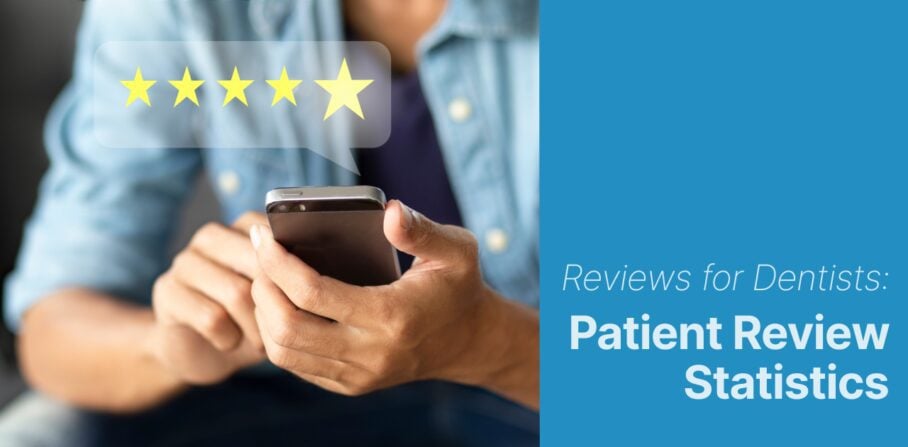
Quick Answer: Online reviews are one of the biggest factors in which dentist a patient chooses. BrightLocal’s 2026 survey found 97% of consumers read reviews for local businesses, 31% will only use a business rated 4.5 stars or higher, and 74% only care about reviews from the last three months. Winning practices pair a high rating with a steady flow of fresh reviews and a reply to every one.
How much do online reviews influence which dentist a patient chooses? More than almost anything else on your profile. In BrightLocal’s 2026 Local Consumer Review Survey, 97% of consumers said they read reviews for local businesses, 41% always read them (up from 29% in 2025), and 31% will only use a business rated 4.5 stars or higher. Consumers also use an average of six review sites and care most about recent reviews. To stay in the running, a dental practice needs a high Google rating, a steady flow of new reviews, and a reply to every review.
Table of Contents
- Key dental review statistics for 2026
- How many patients read reviews?
- Which review sites do patients use?
- How many reviews does a practice need?
- What star rating do patients expect?
- How recent do reviews need to be?
- Do patients care about review replies?
- Are patients using AI to vet dentists?
- What should your practice do next?
- FAQ
What are the most important dental review statistics for 2026?
These eight findings from BrightLocal’s Local Consumer Review Survey 2026 show how consumers research and choose local businesses:
- 97% of consumers read online reviews for local businesses.
- 41% always read reviews when looking for a business, up from 29% in 2025.
- 31% say they will only use a business with a rating of 4.5 stars or higher, up from 17% in 2025.
- 68% say they will only use a business with a rating of 4 stars or higher, up from 55% in 2025.
- 47% say they won’t use a business with fewer than 20 reviews.
- 74% look for reviews written in the last three months.
- 80% say they are likely to use a business that responds to all of its reviews.
- 45% had used ChatGPT or another AI tool for local business recommendations in the previous 12 months.
About the data: BrightLocal surveyed a representative panel of 1,002 US adults through SurveyMonkey. The report was published on February 11, 2026, and the page was updated on September 14, 2026. The survey covers local businesses in general. Its findings offer useful context for dental practices, but the percentages are not specific to dental patients.
How many patients read online reviews before choosing a dentist?
Nearly all of them. 97% of consumers read reviews for local businesses, and 41% read them every single time they look for one. That “always” group jumped 12 percentage points in a single year.
Reviews also carry real weight once they’re read:
- 49% of consumers trust online reviews as much as recommendations from people they know.
- 85% say positive reviews make them more likely to use a business.
- 77% say negative reviews make them less likely to use one.
What it means for your practice: Every new patient checks your reviews, even the ones referred by friends. That’s why reviews come before marketing spend: ads and SEO send people to your profile, and your reviews decide whether they call. Reviews are also the most visible form of social proof for dentists, the “people like me trust this office” signal that calms a nervous patient.
Which review sites do patients use to find a dentist?
Google is still number one, but it’s no longer the only stop. In 2026, 71% of consumers used Google for reviews, down from 83% in 2025, and the average consumer used six different review sites.
Here’s how the landscape shifted:
- Google remains the most-used review source by a wide margin, even after its dip.
- Facebook holds second place for local recommendations.
- AI tools like ChatGPT jumped to third place, used by 45% of consumers.
- Healthgrades, Apple Maps, Trustpilot, and the Better Business Bureau all gained users. Apple Maps nearly doubled, from 14% to 27%.
- Video platforms (YouTube, Instagram, and TikTok) are growing as places people look for recommendations.
Why is Google still on top? Because that’s where the shopping happens. A patient searches “dentist near me,” sees three practices on the map, and compares stars and review counts side by side before visiting a single website. Most patients land on your Google Business Profile (the free listing that shows your hours, photos, and reviews in Search and Maps) before booking, wherever they first heard of you.
What it means for your practice: Keep Google as your priority, then claim and monitor your profiles on Healthgrades, Facebook, and Apple Maps. Apple Maps is worth a look: it ranks fourth for where consumers write reviews (17%), likely because it only asks for a quick rating.

How many reviews does a dental practice need?
At least 20, and realistically more. 47% of consumers won’t use a business with fewer than 20 reviews, and only 9% would consider one with five or fewer.
Patients look for patterns, not one-off praise. The most important review factor in the 2026 survey, cited by 56% of consumers, was whether a review was backed up by other reviews with similar sentiment. One five-star review is a nice compliment. Fifty that all mention your gentle hygienists is a reputation.
What it means for your practice: Treat 20 reviews as the floor, not the finish line. Then look at the top three practices in your area and aim to match or beat their counts. On our podcast, local SEO strategist Guido Tebano shared his 33-and-100 review thresholds for Google Maps, a useful benchmark from his work with dental clients rather than a survey finding.
What star rating do patients expect from a dentist?
At least 4 stars, and increasingly 4.5. In 2026, 68% of consumers will only use a business rated 4 stars or higher (up from 55% in 2025), and 31% will only use one rated 4.5 or higher (up from 17%).
That 4.5-star group grew by 14 percentage points in one year, the biggest shift in the survey. Overall, 92% of consumers care about star ratings.
The good news for perfectionists who lose sleep over a single four-star review: only 10% of consumers insist on a perfect 5.0.
What it means for your practice: A 4.3 rating that felt safe last year now keeps you off nearly a third of patients’ shortlists. If you’re below 4.5, the fastest fix is usually more reviews from your many happy patients, not a fight over the one unhappy one.
How recent do dental reviews need to be?
Very recent. 74% of consumers only care about reviews written in the last three months, 32% look for reviews from the last two weeks (up from 20% in 2025), and 18% are only swayed by reviews from the last week.
Recency also made the top three review factors: 44% of consumers said it matters that a review was posted within the last month.
What it means for your practice: A pile of glowing reviews from 2023 won’t carry you. You need new reviews coming in every week. This is also why review velocity matters more than total volume for both patients and Google Maps rankings.
Do patients care whether dentists reply to reviews?
Yes, and they expect it fast. 89% of consumers expect business owners to respond to reviews, and 80% are likely to use a business that responds to all of its reviews.
The details matter:
- Selective replies fall short. Only 45% are likely to use a business that replies to positive reviews only, and 47% to one that replies to negative reviews only. That’s 33 to 35 percentage points below the “reply to everything” approach.
- Silence costs you. 42% are unlikely to use a business that never replies.
- Templates backfire. 50% say generic or templated responses make them unlikely to choose a business.
- Speed is rising. 19% expect a same-day reply (up from 6% in 2025), 32% expect one by the next day, and 81% expect one within a week.
What it means for your practice: Reply to every review within a day or two, and vary your wording. Dentists have one extra rule: never confirm someone is a patient or mention their treatment, even in a thank-you. Our guide to HIPAA-compliant review responses shows exactly what to say and what to avoid.
Are patients using AI to find and vet dentists?
Yes, and fast. 45% of consumers used ChatGPT or other generative AI tools for local business recommendations in 2026, up from 6% the year before, which makes AI the third most popular source behind Google and Facebook.
Trust is growing too:
- 40% of consumers trust AI platforms to recommend businesses (32% don’t).
- 42% trust AI recommendations as much as traditional reviews.
- 82% read AI-generated review summaries, like the ones Google shows above individual reviews.
- 23% would make a decision from the AI summary alone.
What it means for your practice: AI tools summarize what patients say about you, so the content of your reviews now matters as much as the count. Recent, detailed reviews that mention specific services give AI something accurate to work with.
What should a dental practice do with these numbers?
Focus on three things: volume, recency, and replies.
- Build a steady review flow. Ask happy patients every day, not in occasional bursts. Here’s how to get more Google reviews without making it awkward.
- Reply to every review quickly and personally. Same-day replies are becoming the expectation, and HIPAA-safe wording protects you.
- Watch more than Google. Monitor Healthgrades, Facebook, Apple Maps, and how AI tools summarize your practice.
My Social Practice has helped dentists build online reputations since 2009. For a broader look at the fundamentals, start with our reputation-building basics. If you’d rather hand off the asking, monitoring, and replying, our dental reputation management services automate the whole process.
Frequently Asked Questions
How many Google reviews should a dentist have?
A dentist should have at least 20 Google reviews, since 47% of consumers won’t use a business with fewer, according to BrightLocal’s 2026 survey. Twenty is the minimum, though. To compete, aim to match or exceed the review counts of the top-ranked practices in your area, and keep new reviews coming in every week.
What is a good Google rating for a dental practice?
A good Google rating for a dental practice is 4.5 stars or higher. In BrightLocal’s 2026 survey, 31% of consumers said they’ll only use a business rated 4.5 or above, and 68% require at least 4 stars. A perfect 5.0 isn’t necessary: only 10% of consumers insist on one.
How often should a dental practice get new reviews?
A dental practice should get new reviews every week. In 2026, 74% of consumers only care about reviews from the last three months, and 32% look for reviews posted within the last two weeks. A steady weekly flow keeps your profile current for patients and signals an active practice to Google.
What percentage of patients read online reviews?
About 97% of consumers read online reviews for local businesses, according to BrightLocal’s 2026 Local Consumer Review Survey. And 41% read them every time they look for a business, up from 29% in 2025. The survey covers local businesses in general, but dental patients follow the same pattern when vetting a new practice.
Which review sites matter most for dentists?
Google matters most, used by 71% of consumers for reviews in 2026. Beyond Google, dentists should monitor Facebook, Healthgrades, and Apple Maps, which all gained users in 2026. AI tools like ChatGPT now rank third for local recommendations, so how your reviews read across platforms affects what AI says about you.
Do patients trust online reviews as much as personal recommendations?
About half do. BrightLocal’s 2026 survey found 49% of consumers trust online reviews as much as recommendations from friends and family. Reviews also move decisions both ways: 85% say positive reviews make them more likely to use a business, while 77% say negative reviews make them less likely.
Do fake reviews hurt a dental practice?
Yes, they can backfire badly. In 2026, 97% of consumers said businesses caught using fake reviews should face consequences, and 57% said those businesses should be banned from review platforms. Fake reviews also break Google’s policies and the FTC’s rule on fake reviews. Here are more dental review mistakes that sink practices.

Adrian Lefler is the CEO and Co-Founder of My Social Practice and a recognized dental marketing expert with nearly two decades of experience. He is a trusted voice in dental marketing, AI in dentistry, and emerging technology, and he hosts BYTE SIZED, a podcast focused on dental AI, innovation, and technology.