What You’ll Learn
- Why interviews alone are weak predictors of on-the-job performance
- How structured interview questions with scoring rubrics remove guesswork from hiring
- What pre-assessments should cover and what passing scores to expect
- How to build a lean onboarding system without a dedicated training department
- What AADOM is developing to help practices with foundational dental education
The Confidence Gap
Every dental practice has hired someone who interviewed beautifully and fell apart by week two. They seemed sharp. They answered questions well. They had experience on paper. And then they struggled with the basics.
Chavelle Galton-Rice has seen this pattern from every angle. She started in dentistry at 18 as a front office coordinator in Kansas, became a registered dental assistant in Iowa, directed a dental assisting program at a college in Des Moines, and eventually joined the learning and development team at a large DSO. There, she helped build the assessments and 30-day onboarding program for new hires across the organization.
Now the Director of Membership and Education at AADOM (American Association of Dental Office Management), Chavelle joined Adrian Lefler on the Byte-Sized Podcast to break down what actually works when it comes to hiring and training dental team members.
Her core message is that an interview shows you how someone communicates. A short competency test shows you what they actually know.
Why Interviews Fall Short
Interviews are useful for understanding a candidate’s experience, communication style, and personality. They are not useful for proving someone can perform a skill.
“People aren’t necessarily trying to mislead us in an interview,” Chavelle explained, “but they may have learned a different way because every doctor is different on how they like things done.”
A dental assistant who excelled in one practice may have been trained on workflows that don’t match yours. A front office coordinator with five years of experience may have gaps in insurance knowledge because their previous office handled claims differently. The interview doesn’t reveal any of this.
Chavelle has seen candidates who looked great on paper, interviewed well, and even performed well on initial assessments, but then struggled with day-to-day expectations. The problem wasn’t deception. It was that the interview measured the wrong things.
Structured Questions Change Everything
One of the biggest problems Chavelle identified, both in DSO environments and private practices, was the lack of structured interview questions.
“Just kind of asking questions on the fly or basing everything on feelings doesn’t always necessarily work,” she said. “You definitely want to trust your gut in some circumstances, but something that really helped working in a larger organization was our HR department providing us managers with a guide.”
That guide included specific questions tied to the abilities, communication skills, and traits the organization was looking for. It also included a rubric for evaluating answers. Instead of each manager inventing their own approach, everyone used the same framework.
For practices without an HR department, Chavelle recommended looking at resources from Gallup, the same organization behind the Clifton Strengths assessment. Their interview question frameworks can serve as a starting point. AI tools like ChatGPT can also help generate structured questions based on a practice’s mission, vision, and values.
| Traditional Interview | Structured Interview |
| Questions vary by manager | Consistent questions for every candidate |
| Evaluation based on gut feeling | Scoring rubric guides assessment |
| Hard to compare candidates | Apples-to-apples comparison |
| Gaps discovered after hire | Gaps identified during process |
The Role of Pre-Assessments
At the DSO where Chavelle worked, every new hire took pre-assessments after being brought on board. These weren’t designed to catch people or call them out. They were designed to identify what kind of support each person needed.
The assessments covered foundational topics: dental terminology, tooth anatomy, and role-specific knowledge like insurance for administrative team members. Candidates who demonstrated competency could skip that portion of training and move directly to company-specific workflows. Everyone else got targeted support in the areas where they needed it.
“We didn’t want to waste anyone’s time because time is valuable,” Chavelle said. “If we can bypass some of the training that they are already well-versed in, then absolutely, why not just have them show us that they are competent in those things and then move them along to the next level.”
Experienced hires could test out of fundamentals, but no one could skip company-specific training. Learning how the doctors liked things done, understanding the practice’s systems and SOPs, and verifying hands-on competency were non-negotiable for everyone.
What Passing Looks Like
Chavelle recommended a passing threshold of 85 to 90 percent for general knowledge assessments. But passing doesn’t mean ignoring the remaining 10 to 15 percent.
“I would want to know what the employee missed,” she said. “That way then we can set time aside, even though they’re pretty competent, to look at that other 15 percent just so then we can make sure that they are confident and competent in those areas.”
Some people are simply not great test takers. Others may have misunderstood a question. A quick one-on-one review of missed items can clarify whether the gap is real or situational.
Patient safety and regulatory competencies require a stricter bar. For anything where a mistake could harm a patient or create compliance issues, the expectation should be higher than 85 percent.
When Someone Fails
Chavelle believes in second chances. And third chances. But not unlimited chances.
When someone fails an assessment, the first step is figuring out why. Did the trainer explain something in a way that didn’t land? Did the new hire not grasp the information? Was it test anxiety? The answers shape what happens next.
“If someone failed and you just kicked them out the door, what good is that going to do?” Chavelle said. “You’ve just told someone, ‘Okay, you’re not good enough. Bye.'”
Instead, she recommended pairing the employee with a mentor, sitting down one-on-one to review the missed questions, and retraining on the specific areas where they struggled. Document every coaching session.
At some point, though, a decision has to be made. If repeated coaching sessions aren’t producing improvement, the documentation becomes the foundation for a clear, fair conversation about next steps. Maybe the person is in the wrong role and would thrive in a different position. Maybe the fit just isn’t there.
“I do believe that at some point you have to make a call,” Chavelle said. “That’s where documentation and communication is really important.”
Hire for Attitude, Train for Skill
Throughout the conversation, Chavelle returned to a core philosophy: hire for attitude, train for skill.
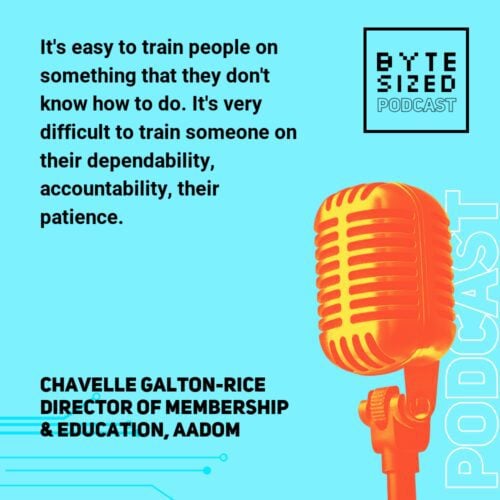
“It’s easy to train people on something that they don’t know how to do,” she said. “It’s very difficult to train someone on their dependability, accountability, their patience, their personality, their willingness to collaborate.”
This doesn’t mean skill doesn’t matter. It means that when you have a solid training system in place, you can afford to prioritize attitude and culture fit. Without that system, you’re forced to hire only people who can hit the ground running, and that’s a much smaller pool.
Building a Lean System Without a Training Department
The DSO where Chavelle worked had a seven-person learning and development team. They converted a thick training manual into video modules, created assessments, and built out a full LMS. That’s not realistic for most independent practices.
But the principles scale down.
“You don’t necessarily need a dedicated learning and development department to start,” Chavelle said. “You can build clear checklists. You can set priorities. You can assign maybe a mentor in your office. Maybe block out short blocks in your schedule for training.”
For tracking progress, an Excel spreadsheet works fine. Create a column for each competency the new hire needs to demonstrate, and check them off as they’re verified. It’s not fancy, but it’s a system.
The goal is building a process that a manager can realistically maintain. Start there. Refine as you go.
What AADOM Is Building
Chavelle shared a preview of something AADOM has been developing: 25 foundational dental education courses as part of a new certification program, planned for launch in early 2027.
The courses will cover introductory topics like dental anatomy, terminology, and common procedures. They’re designed for people new to dentistry or new to management roles, but they’re also a resource for experienced managers who need to onboard new hires without building training from scratch.
“Instead of every practice out there developing basic dental education from scratch, managers could use these types of resources and focus their very limited time on mentorship and practice-specific workflows,” Chavelle said.
For practices that don’t have the bandwidth to create their own training materials, this could be a significant help.
The Retention Payoff
When Chavelle’s team rolled out the new onboarding program at the DSO, employee retention improved significantly. Part of that was the structure. Part of it was something less tangible.
“It wasn’t just online courses,” she said. “We actually built in in-person training or virtual training where you are actually meeting with people from other offices. You’re connecting with other people in the company. You actually get to meet with your specific learning and development manager. So there’s a connection.”
When new hires feel supported and connected, they stay. When they feel thrown into the deep end with a binder and a “good luck,” they don’t.

In This Episode:

Chavelle Galton-Rice, Director of Membership and Education at AADOM
Chavelle Galton-Rice is a dental operations and education leader with more than two decades of experience across clinical support, front-office management, multi-site operations, and professional development. She serves as Director of Membership and Education for AADOM (American Association of Dental Office Management), where she focuses on member engagement and building learning experiences that support dental office leaders at every stage of their careers. With a Master of Education in Education Technology and Instructional Design, Chavelle brings a practical, people-centered approach to education and leadership development. Her career includes leadership roles in both private practices and dental support organizations, where she partnered with doctors and management teams to promote operational consistency, team growth, and positive patient experiences across multiple locations.

Adrian Lefler, CEO and Co-founder of My Social Practice
Adrian Lefler, CEO of My Social Practice, is a seasoned expert in the dental marketing industry with 14 years of experience. He is widely recognized for his engaging and informative presentations. Based in Suncrest, Utah, Adrian shares his life with his wife, four children, and a lively mix of pets. My Social Practice is a leading dental marketing company, and Adrian is passionate about helping dental professionals succeed in this dynamic field.
Frequently Asked Questions
Is a job interview a reliable way to evaluate a new dental team member's skills?
Not on its own. An interview shows communication, personality, and experience, but it doesn’t prove someone can perform a skill. Candidates may have learned different methods from different doctors. Pairing the interview with short knowledge assessments and skill demonstrations shows what a new hire knows and where training gaps exist.
Should experienced dental assistants be allowed to skip onboarding training?
They should be able to test out of foundational topics like dental anatomy, terminology, and tooth numbering by passing a pre-assessment. They should never skip company-specific processes, doctor preferences, or hands-on competency verification. The goal is personalizing onboarding, not shortcutting it, so experienced hires get to patients faster without missing what matters.
What passing score should a dental training assessment require?
A score of 85 to 90 percent is a reasonable target for general knowledge assessments like terminology and anatomy. Patient safety and regulatory competencies need a stricter bar. Even when someone passes, a manager should review the missed 15 percent with them one-on-one, because a passing score still leaves gaps worth closing.
What should a dental practice do when a new hire fails a training assessment?
Find out why first. Review the missed questions together, pair the employee with a mentor, and retrain. Document every coaching session. If repeated coaching still doesn’t produce improvement, consider whether the person fits a different role better. If not, that documentation supports a clear, fair decision to part ways.
How can a small dental practice build a training program without a big budget?
Start with what a manager can realistically maintain: clear role checklists, set priorities, an assigned mentor, and short training blocks on the schedule. Track each new hire’s progress in a simple Excel sheet. Use outside foundational courses for dental basics so in-office time goes to mentorship and practice-specific workflows.