What You’ll Learn
- Why oral inflammation is linked to systemic disease and what that means for patient care
- How salivary diagnostics are evolving beyond what practices use today
- What it looks like when dental and medical data live in the same chart
- How an AI health agent can help patients understand and act on their lab results
- Why clinician adoption, not patient demand, is the real barrier to integrated care
The Waiting Room of the Future
Picture a healthcare facility where primary care and oral care share the same reception area. The same chart. The same team of clinicians working together. Where a blood panel, a saliva test, and a CBCT scan all feed into one dashboard that tracks your health over time. And where an AI agent inside an app helps you understand what all those numbers actually mean.
That’s what PDS Health is building right now.
Joe Feldsien, who leads technology strategy at PDS Health, joined Adrian Lefler on the Byte-Sized Podcast to describe what patient care looks like once dental and medical data finally live in one place. Joe has spent more than 33 years in dentistry, joined PDS in 2004, and previously helped build PDS Health Medical from its inception. Now he’s focused on an integrated patient platform that brings blood work, salivary diagnostics, wearable data, and an AI health assistant into Epic’s MyChart.
The vision is ambitious and the timeline is not as far off as most people think.

The Mouth-Body Connection
The foundation of everything PDS Health is building is the mouth-body connection, meaning the link between oral inflammation and systemic disease.
“What we know is that oral inflammation is a significant contributor to overall inflammation and a significant contributor to the leading killers in the systemic space,” Joe explained.
This isn’t new science. The relationship between periodontal disease and conditions like heart disease, diabetes, and stroke has been documented for years. What’s new is the infrastructure to actually do something about it at scale.
PDS Health has integrated dental and medical care so that both teams can see the full picture. Primary care and oral care share a chart. Clinicians collaborate. And the diagnostics go deeper than what most practices offer today.
Saliva Is the New Blood
Joe called saliva “the new blood.” Salivary diagnostics are about to take on a role far beyond what dental practices currently use.
New technologies can measure the most toxic bacteria in a patient’s mouth in about 10 minutes. But it goes further than that. Those bacterial levels can be aligned to the patient’s specific periodontal profile, and the test can show how they will respond to various types of care.
“The amount of data that we’re going to have access to in the future is considerable,” Joe said.
Paired with blood work that goes well past the standard panel, looking at inflammation markers, cytokines, and deeper cardiovascular indicators, saliva gives dentists and patients a shared, data-driven path to better oral and overall health.
| Diagnostic Type | What It Measures | Why It Matters |
| Salivary test | Harmful oral bacteria levels | Connects to periodontal risk and treatment response |
| Advanced blood panel | Inflammation, cardiovascular markers | Goes beyond standard workup |
| CBCT imaging | 3D view of oral structures | Patient can see and understand what dentist sees |
| Wearable data | Heart rate, sleep, activity | Real-time health monitoring integrated into chart |
3 Million CBCT Scans and Counting
PDS Health has passed 3 million CBCT scans since 2020. Joe’s point about CBCT isn’t just the diagnostic value. It’s trust.
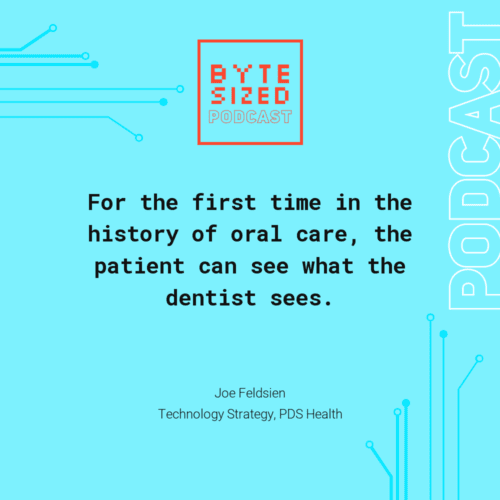
“For the first time in the history of oral care, the patient can see what the dentist sees and can understand it,” he said.
When a patient can look at a 3D image of their own mouth and actually comprehend what’s happening, the conversation changes. They believe the diagnosis and they understand the treatment plan. They become partners in their own care instead of passive recipients of recommendations they don’t fully grasp.
That trust compounds over time as more data points get added to the picture.
One Chart to Rule Them All
All of this data, blood, saliva, dental records, medical records, eventually wearables, lives in Epic.
Epic is the largest EHR in healthcare. Joe noted that roughly 70% of patients in the country now have an Epic chart in some form. That makes it the logical hub for integrated care.
PDS Health runs its own dental-optimized instance of Epic, built for scaled organizations. Very few DSOs use Epic for dentistry, and Joe said he doesn’t know of any unsupported private practices using it. But the medical side is already there, and that’s where most patient data lives.
For patients whose physicians aren’t on Epic, PDS Health is working with LabCorp and Quest to pull blood panel data directly. The saliva diagnostics will flow in as well. So even if a patient’s primary care doctor uses a different system, the core health data can still populate the dashboard.
The Patient Dashboard
Outside of Epic’s core system, PDS Health has built what Joe calls a patient dashboard. It’s based on longitudinal data, tracking health markers over time rather than showing isolated snapshots.
“You’re going to be able to actively participate in your healthcare,” Joe said. “The good news is that all of these data points can be changed generally through a change in behavior. Diet, exercise, flossing.”
Patients can see how their numbers move as they make changes. Clinicians can see the same thing. And the feedback loop becomes a tool for motivation rather than a source of anxiety.
Joe expects this kind of longitudinal patient dashboard to become an industry standard within two to three years.
The AI Health Agent
Starting in January with PDS Health’s own employee community, the organization is launching an app that includes an AI agent. The agent walks alongside the patient, helping them interpret data and make decisions.
“My ApoB is 95. What do I need to do to get it under 80?” That’s the kind of question the agent can answer, pulling from blood and saliva results, the doctor’s input, and behavioral recommendations.
Joe described the problem this solves: “If we’re honest, there’s a lot of people that are like ostriches. They put their head in the sand. ‘I don’t want to know when I have cancer. That’ll be soon enough.’ Their mindset is just, I don’t want to know. Well, they don’t want to know because they don’t know what to do. When they just get a number in isolation, it’s intimidating.”
The agent removes the intimidation by putting the number in context and offering a path forward. Diet changes. Exercise. Flossing. Whatever moves the needle.
Wearables Are Coming
The app doesn’t integrate wearable data yet, but Joe said that’s less than two years away.
The vision would look like this. A patient opts in to share wearable data with their chart. The system monitors for irregularities. If something looks off, an alert goes to the clinician. Another agent reaches out to the patient to schedule a follow-up.
“Hey, Dr. Smith would like to see you as soon as possible. We’re seeing some irregularities in your wearable data.”
The technological capability already exists. The remaining work is integration, opt-in workflows, and HIPAA-compliant data sharing. Joe emphasized that the patient must remain in total control of what gets shared and with whom.
Why Clinicians Are the Bottleneck
Patient demand isn’t the barrier to integrated care. Clinician adoption is.
Joe has watched this dynamic for more than three decades. The issue comes down to fear and peer pressure.
“The Hippocratic oath is above all do no harm,” he said. “So what that means is there are standards of care that dentists feel very comfortable living within. As a result, when we start talking about the mouth-body connection, dentists get nervous. Their big fear is: what if I miss something?”
If a dentist stays in their lane, they feel safe. Stepping outside the standard of care, even to deliver more value, feels risky. And peer pressure reinforces the hesitation. If other dentists aren’t doing it, why should I?
But the dentists who do adopt these tools, CBCT, salivary diagnostics, integrated care models, reap significant rewards. Patient loyalty. Patient advocacy. Full schedules. They deliver a level of value that most practices simply don’t offer.
What Will Push Adoption Forward
Joe sees two forces that will accelerate change.
First, large health systems are starting to see the relevance of oral care to systemic outcomes. When they understand that addressing oral inflammation can drive down overall healthcare costs, they’ll want to partner with organizations that understand the mouth-body connection.
Second, self-insured employers will reach the same conclusion. Companies that bear their own healthcare costs have strong incentives to invest in preventive care that actually works. If oral health interventions reduce cardiac events, reduce diabetes complications, and keep employees healthier, those employers will seek out integrated care models.
“When they understand the impact that oral care can have on systemic health, they’re going to be like, you know what, we are going to partner with the best organizations who understand the mouth-body connection because we know that when we get these two working together, we can drive the cost of healthcare way down,” Joe said.
Health systems and employers will help pull more dentists into the water. And once enough clinicians are there, the peer pressure dynamic flips.
The Team Behind the Vision
Joe was careful to credit the team at PDS Health: Steve Thorne, David Baker, the legal team led by Dan Burke, and the clinicians who lead the platform. Building something this complex requires everyone working toward a shared vision.
“One of our ‘we believes’ is we believe in the power of teamwork,” Joe said. “There’s no one person who’s responsible. It is a team.”
That’s worth noting for any organization considering a similar path. Integrated care isn’t a technology project. It’s an organizational transformation that touches clinical workflows, compliance, data infrastructure, and patient experience all at once.
In This Episode:

Joe Feldsien, Sr. Vice President of Integrated Care at PDS Health
Joe Feldsien leads technology strategy at PDS Health, the Henderson, Nevada-based healthcare support organization formerly known as Pacific Dental Services. With more than 33 years in dentistry, he joined PDS in 2004 and previously served as president of PDS Health Medical, which he helped build from its inception to connect primary care with dental practices. He is now building an integrated patient platform that brings blood work, salivary diagnostics, wearable data, and an AI health assistant into Epic’s MyChart.

Adrian Lefler, CEO and Co-founder of My Social Practice
Adrian Lefler, CEO of My Social Practice, is a seasoned expert in the dental marketing industry with 14 years of experience. He is widely recognized for his engaging and informative presentations. Based in Suncrest, Utah, Adrian shares his life with his wife, four children, and a lively mix of pets. My Social Practice is a leading dental marketing company, and Adrian is passionate about helping dental professionals succeed in this dynamic field.
Frequently Asked Questions
What is the mouth-body connection, and why are dental and medical care being integrated?
The mouth-body connection is the link between oral inflammation and systemic disease, including several leading causes of death. Organizations like PDS Health are integrating dental and medical care so primary care and oral care share a chart, a reception area, and collaborative clinicians, giving both teams a complete view of the patient’s health.
How will salivary diagnostics change the way dentists assess oral health?
Salivary testing is moving well beyond what practices use today. New tests can measure the most harmful bacteria in a patient’s mouth in about 10 minutes and connect those levels to periodontal risk and how the patient will respond to treatment. Paired with blood work, saliva gives dentists and patients a shared, data-driven path to better oral and overall health.
Can an AI health assistant help patients understand their lab results?
Yes, and that may be its biggest value. Most patients see a number like ApoB in isolation, feel intimidated, and do nothing. An AI agent inside a patient app can put that number in context alongside blood and saliva results and the doctor’s input, then suggest behavior changes in diet, exercise, and flossing that bring the number down.
Why are dentists slow to adopt new diagnostic technology?
The biggest barrier is fear of stepping outside the accepted standard of care. Dentists worry about missing something, and peer pressure keeps many of them doing what colleagues do. Those who adopt tools like CBCT and salivary diagnostics tend to earn stronger patient loyalty, patient advocacy, and fuller schedules because they deliver value most practices don’t.
How many US patients have an Epic chart, and can dental practices use Epic?
Roughly 70% of US patients now have an Epic chart in some form, making it the largest EHR in healthcare. Few DSOs and almost no unsupported private practices use it for dentistry. PDS Health runs its own dental-optimized Epic instance, and lab results from LabCorp and Quest can still flow in when a patient’s physician isn’t on Epic.