What You’ll Learn
- Why Google Ads has become a cutthroat auction most dentists do not understand
- The banned keyword that can silently destroy your website traffic
- How missed calls and slow scheduling waste 80% of your marketing leads
- Why AI search will not kill paid advertising but will reshape it
- The single most durable marketing investment for the next three years
The Auction You Did Not Know You Were Losing
Google Ads used to be simple. Gary Bird of SMC National remembers setting up campaigns on his phone. Entrepreneurs with no marketing background could figure it out over a weekend. Those days are long gone.
“Google Ads now is super complicated,” Gary told Adrian Lefler on a recent episode of the Byte Sized Podcast. “Anybody who says, ‘Oh yeah, I just go in there and you’re going to learn it on a weekend,’ you’re just not.”
The platform has evolved into a bidding auction where dentists compete against each other for a fixed supply of patients. There are only so many people searching for dental services in any market each month. Everyone wants them, and Google rewards the highest bidder with the best positioning.
However, there’s another consideration. Dentists aren’t competing in isolation. When someone clicks your ad and lands on your Google Business Profile with 50 reviews and outdated photos, they also see your competitor with 2,000 reviews and same-day availability. They click on the competitor instead.
“Your competition mopped you up,” Gary explained. “They didn’t even click on that person’s ad, but it showed up right next to you because they rank. And they went there.”
The ad worked, the conversion failed, and the dentist blames the advertising.

Words That Tank Your Traffic
There are hundreds of keywords that trigger automatic penalties from Google. Most dentists have no idea they exist.
Botox is one of them.
“Did you know that if you put the word Botox on your website, Google instantly flags you, will begin to derank you, and stop serving your ads?” Gary asked. “But it doesn’t tell you that it’s doing that.”
Google has categorized Botox alongside controlled substances like Vicodin. Special licensing is required to advertise these products, and dental licenses do not qualify. The moment that word appears on your site, traffic starts dwindling. Rankings drop. Ads stop performing.
Gary learned this the hard way. A client asked to add Botox to their website. Within a month, everything fell apart. Traffic dried up. They spent weeks trying to diagnose the problem before realizing the new content had triggered an automatic penalty.
“We removed it and then all of a sudden it started to work,” Gary said. “Any client coming in to work with us, they have Botox on their site, it’s the first thing we remove.”
For practices interested in offering Botox, the workaround involves building a landing page that is deindexed from Google entirely. Visitors can read it, but Google cannot see it. Ads can then run through Facebook, which does not have the same restriction.
The Real Reason Leads Disappear
Most dental practices lose 80% of their marketing leads before those leads ever become patients. The problem happens after someone clicks.
The math breaks down like this. Industry average shows 35% of calls go unanswered. Front desk teams converting marketing leads hover around 50% at best, far below the near-perfect conversion rates on patient referrals. Average time to first appointment is 28 days, which pushes no-show rates to roughly 40%.
“Right off the bat, around industry average, I know that about 80% of the leads are going to slip through down the drain,” Gary explained.
A practice wanting 20 new patients per month might need to generate 50 leads just to hit that number. Without fixing the phone coverage, the team training, and the scheduling delays, that same practice might see only five patients from those 50 leads.
| Leak Point | Industry Average | Impact |
| Missed calls | 35% | Lead never connects |
| Poor phone conversion | 50% | Caller chooses competitor |
| 28-day wait for appointment | 40% no-show | Patient finds another option |
Even when advertising does its job, inadequate infrastructure fails.
The Price Question
One conversation happens constantly in dental offices, and it costs practices thousands of dollars in lost production.
A potential patient calls and asks how much an implant costs. The front desk responds that they do not give prices over the phone. The caller hangs up and finds a practice that will.
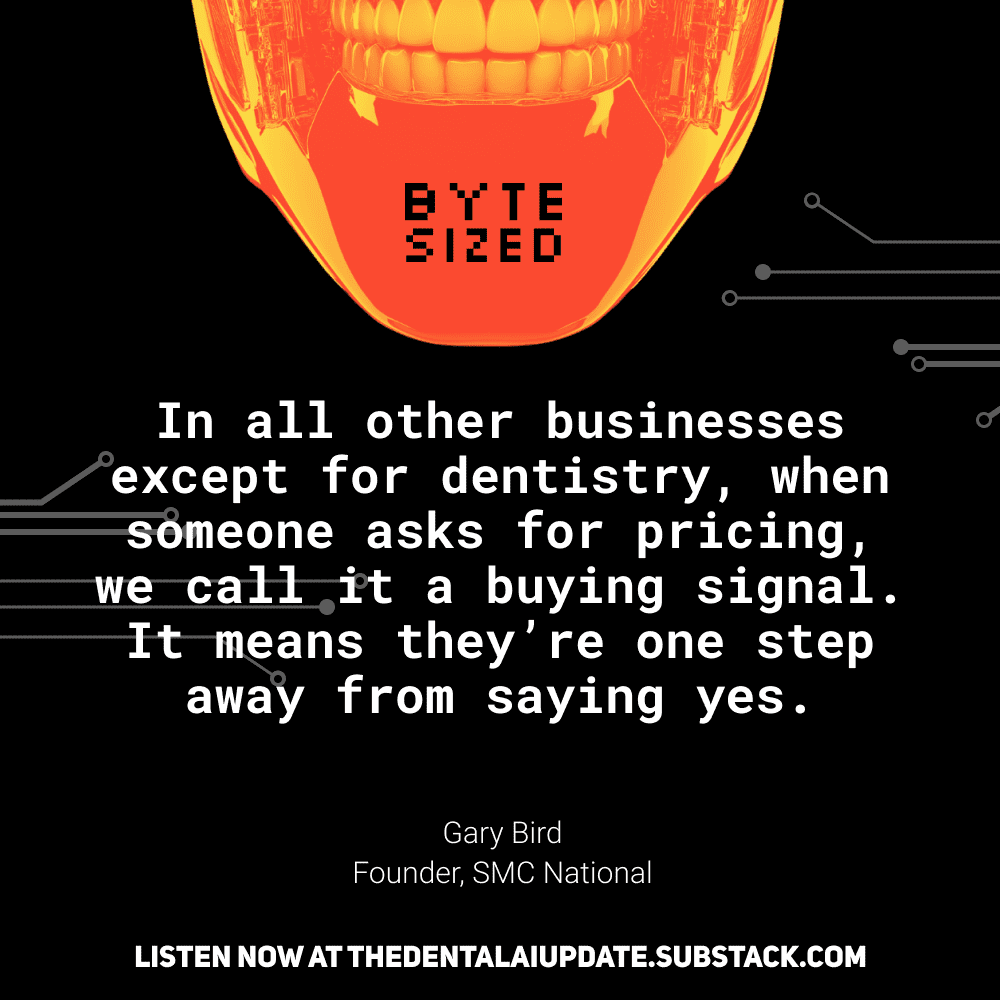
“In all other business worlds, when someone asks for pricing, we call it a buying signal,” Gary said. “It means they’re one step away from saying yes.”
The fix is simple. Train the team to redirect with a question. “Great question. Do you know if the tooth is impacted? No problem. Let’s just get you in for a free consultation and we’ll tell you exactly what’s going on. What works better for you, morning or afternoon?”
Gary shared an example of tracking a lost lead. The caller had a Porsche in the driveway. They asked about implant pricing. The front desk refused to engage. The lead went to a competitor.
“Doc, when you called me for marketing, you shopped me,” Gary pointed out. Every business owner shops before buying. Expecting patients to behave differently is unrealistic.
What AI Search Actually Changes for Google Ads
The shift to AI-powered search has marketers speculating about the death of paid advertising. Gary sees the opposite happening.
“I think the people who are actually at risk here are not the people who understand ads,” he said. “I think it’s the SEO people.”
Google and every other platform need revenue. They make money from advertising. If AI search becomes the primary interface, ads will simply move inside the AI-generated responses. Users will describe their problems in longer queries, possibly with photos or videos, and the AI will recommend solutions with sponsored placements woven in.
The platforms will test different placements. Some will be obvious. Others will blend into the response. Google is already rolling out variations in major markets, watching what optimizes for clicks.
“Google’s really good at figuring this out,” Gary noted. “They roll little things out. They’re testing it in a big market and then it’ll disappear. They just keep testing and testing.”
An Investment That Survives Everything
When asked what dentists should do to future-proof against unpredictable changes in AI search, Gary gave a single answer.
Google reviews.
“If you work on those and you set a goal to be the number one rated dentist on Google in your immediate area, I think that will carry no matter what happens,” he said.
Every platform needs some signal of quality to rank recommendations. User-generated content is the most trustworthy signal available. Reviews serve every area of the practice simultaneously.
More reviews mean more patient referrals. Better team members want to work at highly-rated practices. Practice valuations increase. And when a competitor pays for a postcard campaign, recipients who search online see the practice with 1,500 reviews next to the advertiser with 50. They call the one with more reviews.
“You just grab market share,” Gary said. “They paid for the marketing, but you grab the opportunity.”
The trick to generating reviews is not incentivizing patients. Instead, incentivize your team! When a hygienist says the practice is trying to hit a goal this month and asks for help, patients say yes almost every time. People love helping individuals.
Making Google Ads Work in 2026
If you want to get the most value out of your Google Ads, create an environment that supports your ad spend all the way through your infrastructure. Answer every call, train your team to convert price shoppers, get patients scheduled within days instead of weeks, and stack Google reviews faster than competitors. The advertising is just the top of the funnel. Everything underneath determines whether that spend turns into production or waste. Fix the infrastructure first, then scale the ads, and watch your ROI increase.
In This Episode:

Gary Bird, CEO and Founder of SMC National
Gary Bird is the founder and CEO of SMC National, one of the most data-driven dental marketing agencies in the country. With over 15 years in dental marketing, Gary has built proprietary tracking infrastructure and a custom CRM that follows a patient journey from the first ad click all the way through treatment acceptance and re-care. He has navigated every major shift in dental marketing, from yellow pages to Facebook ads to AI-driven search, and is known for his blunt, numbers-first approach to measuring marketing ROI. Gary is based in Los Angeles and speaks regularly on dental practice growth, conversion optimization, and the future of paid advertising in dentistry.

Adrian Lefler, CEO and Co-founder of My Social Practice
Adrian Lefler is the CEO and Co-Founder of My Social Practice and a recognized dental marketing expert with nearly two decades of experience. He is a trusted voice in dental marketing, AI in dentistry, and emerging technology, and he hosts BYTE SIZED, a podcast focused on dental AI, innovation, and technology.
Frequently Asked Questions
Why are Google Ads getting more expensive for dental practices?
Google Ads operates as a bidding auction where practices compete for a fixed supply of patients searching each month. As more practices advertise and competition intensifies, the cost per click rises. Seasonality also affects pricing, with the beginning of each month and week being more competitive as budgets reset.
Will AI search eliminate the need for Google Ads?
No. Platforms like Google generate revenue through advertising. As AI search becomes the primary interface, ads will move inside AI-generated responses rather than disappear. The platforms will test placements to optimize clicks. Practices that understand paid advertising will adapt. Those relying solely on organic SEO face greater disruption.
What is the best long-term marketing investment for a dental practice?
Google reviews. They improve patient referrals, attract better team members, increase practice valuations, and provide the user-generated content signals that AI search engines use for recommendations. Becoming the highest-rated practice in your immediate area creates durable competitive advantage regardless of how search interfaces evolve.