Updated: Sept 20, 2026
Quick Answer: Yes, adding an online scheduler to a dental practice’s advertising can dramatically increase new-patient appointments. When one multi-doctor family practice paired strategic dental advertising with an online scheduler built for dentists, it booked 819 new appointments and about $97,500 in revenue in four months, a 4,210% increase over its old “request a time” form. The scheduler lets patients self-book real open slots 24/7 and syncs with Dentrix, Eaglesoft, and Open Dental. Here is exactly how the campaign was built and what drove the results.
Now for the part that still surprises a lot of practice owners. Think about the last time you ordered dinner, booked a flight, or reserved a table. You did it in a few taps, at whatever hour was convenient, and you got instant confirmation. Patients expect that same experience from their dentist. Yet most dental websites still greet a ready-to-book patient with a form that says “request an appointment” and then makes them wait for a callback during office hours. That gap between what patients expect and what practices offer is exactly where new patients slip away, and it is the gap this case study set out to close.
Table of Contents
- Why don’t appointment request forms work anymore?
- How do dental ads and an online scheduler work together?
- How much can an online scheduler grow dental appointments?
- Why does pairing ads with scheduling work so well?
- What does this mean for your practice?
- Ready to see these results for your practice?
- Frequently Asked Questions
Why don’t appointment request forms work anymore?
Appointment request forms lose patients because a “request” is not a booking. It is a promise to play phone tag. The patient fills out a form, then waits for someone at the front desk to call back, confirm a time, and finally lock it in. Every hour of that delay is a chance for the patient to book with a competitor who let them schedule instantly.
The friction shows up at the worst possible moment: right after a patient clicks your ad and decides they are ready to commit. Ask them to wait, and many simply move on.
A few reasons request forms leak new patients:
- They add a delay. Patients want confirmation now, not a callback tomorrow.
- They depend on staff availability. A form submitted at 9 p.m. sits untouched until morning.
- They shift the work to the patient. People increasingly expect to self-serve, and a form that leads to a phone call feels like a step backward.
- They give competitors an opening. The practice that offers instant online scheduling for dentists often wins the patient who was on the fence.
The takeaway is simple. Getting a patient to your website is only half the job. If they cannot book on the spot, you paid for a click and lost the patient.
How do dental ads and an online scheduler work together?
They work together by pairing demand with an instant way to act on it. Ads create the intent, and the scheduler captures it the moment it peaks. One without the other leaves money on the table: ads with no easy booking waste clicks, and a great scheduler with no traffic sits empty. This practice ran both at once, and that combination is what produced the results.
1. Online Scheduler for Dentists
An online scheduler for dentists lets patients see real open time slots and book themselves, instantly, without a phone call. Behind the scenes it connects to your practice management software so the times patients see are the times you actually have available.
Here is what set this system apart:
- Real-time availability. Patients book genuine open slots, not placeholder times a staffer has to confirm later.
- 24/7 self-booking. The schedule fills overnight and on weekends, when your front desk is closed but patients are browsing.
- Practice management integration. The My Social Practice online scheduler syncs with Dentrix, Eaglesoft, and Open Dental, so appointments land directly on your calendar.
- Instant confirmation. The patient walks away with a booked appointment, not a pending request.
If you want to see how the tool fits into a full booking workflow, our overview of online dental scheduling breaks it down step by step. It also helps to know the pitfalls in advance, which is why we put together a guide to the most common online scheduler problems and how to avoid them.
2. Strategic Dental Advertising
Strategic dental advertising means putting the right offer in front of the right local patients and sending every one of those clicks to a page where they can book immediately. It is not about spending more. It is about spending with intent.
For this campaign, that meant tightly targeted local ads, clear messaging built around new-patient offers, and a direct path from the ad to the scheduler. If you want the full playbook behind campaigns like this, our guide to dental advertising covers the strategy in depth.
The practice invested about $9,000 in ads across the four-month campaign. Every dollar of that spend was aimed at driving qualified local traffic to a page where booking took seconds.
How much can an online scheduler grow dental appointments?
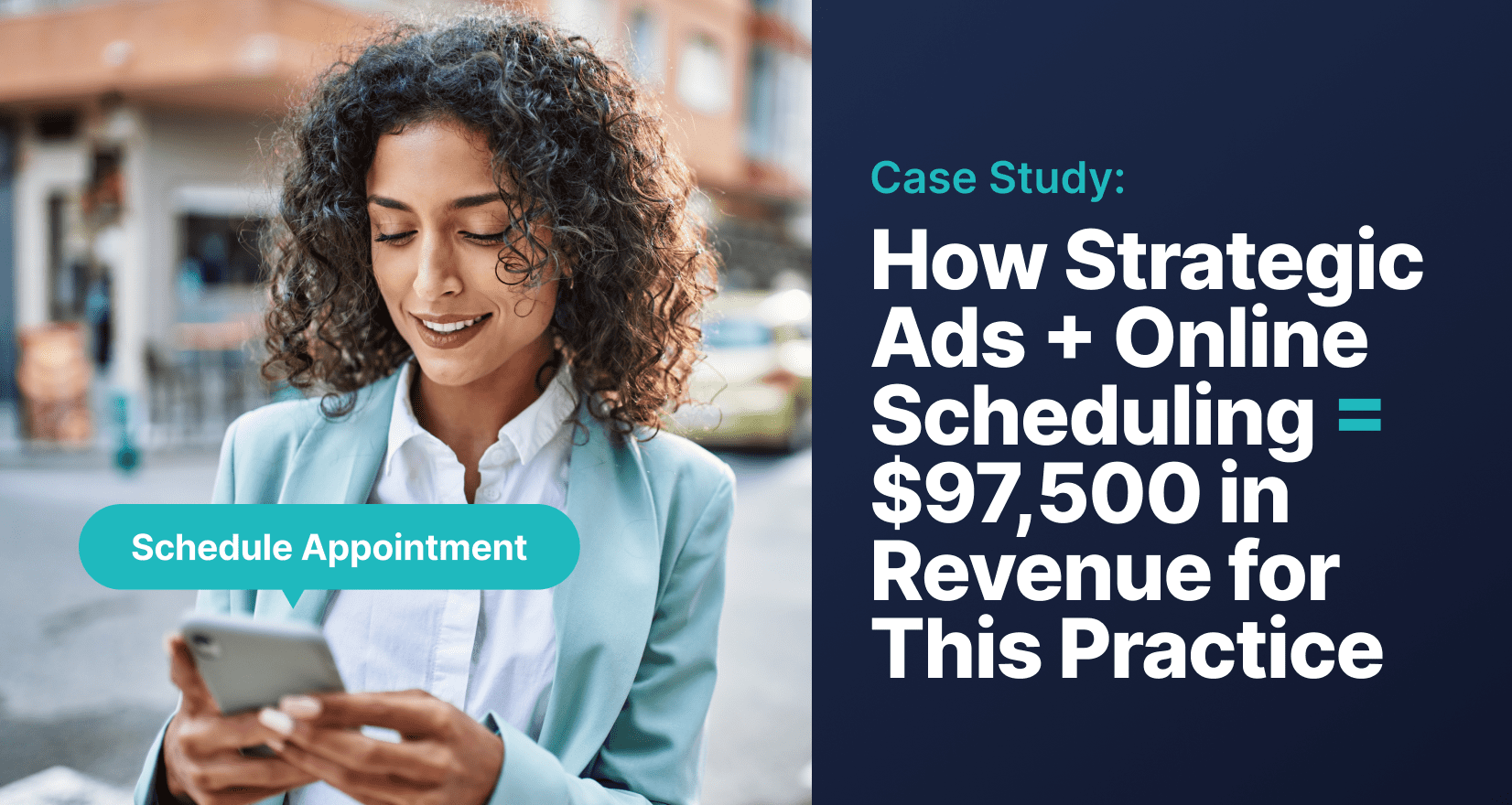
A lot, when it is paired with the right ads. For this South Independence, Missouri family practice, monthly new appointments jumped from 19 to 819 over four months, a 4,210% increase, while new patients grew from 14 to 132 and revenue climbed from $4,750 to $97,500.
Here is the before-and-after at a glance:
| Metric | Before (request form) | After (ads + online scheduler, 4 months) |
|---|---|---|
| New appointments | 19 | 819 |
| New patients | 14 | 132 |
| New-patient revenue | $4,750 | $97,500 |
| Ad investment | n/a | about $9,000 |
The headline number is the 4,210% jump in appointments, but the revenue line is what makes the case: roughly $97,500 in new-patient revenue on about $9,000 in ad spend. That is the difference between paying for clicks and turning clicks into booked, paying patients.
Why does pairing ads with scheduling work so well?
It works because it removes friction at the exact moment intent is highest. The ad captures a patient who is actively looking, and the scheduler lets them act before that intent cools. Everybody wins:
- Patients win because they book in seconds, on their own schedule, and get instant confirmation.
- The front desk wins because the calendar fills without a stack of callbacks and voicemails to chase down.
- The practice wins because more of the traffic it already pays for converts into real appointments.
Instant booking also helps keep those appointments. Patients who choose their own time are more invested in showing up, which is one of several ways practices can reduce online scheduling no-shows.
What does this mean for your practice?
It means the booking experience is now part of your marketing, not separate from it. You can run excellent ads, but if the path from click to booked appointment has friction in it, you are funding a leak. Close that gap and the ad budget you already spend starts working harder.
This is really about meeting patients where they already are. The modern new-patient journey is fast, mobile, and self-directed. Practices that make booking instant are the ones capturing patients who would otherwise scroll on to the next result.
What are the key takeaways for dentists?
- Getting the click is only half the job. What happens after the click decides whether you win the patient.
- Appointment request forms add delay and cost you bookings. Instant online scheduling removes that friction.
- Ads and scheduling multiply each other. Together they turned 19 appointments into 819 in four months.
- The math favors the practice: about $97,500 in new-patient revenue on roughly $9,000 in ad spend.
- Integration matters. A scheduler that syncs with your practice management software keeps your calendar accurate and your team sane.
Ready to See These Results for Your Practice?
If you want ads that fill your schedule instead of just filling your website with traffic, we can help. Learn more about our dental advertising services, or book a demo to see how the online scheduler works with your practice management system.
Frequently Asked Questions
What is the difference between an appointment request form and an online scheduler?
An appointment request form collects a patient’s preferred time and sends it to your front desk, who then has to call back to confirm. An online scheduler shows real open slots and books the appointment instantly, with confirmation on the spot. The scheduler removes the callback delay where many new patients are lost.
How do dental ads and online scheduling work together?
Ads bring in local patients who are actively looking for a dentist, and the online scheduler lets them book the moment they land on your page. The ad creates the intent and the scheduler captures it instantly, before the patient moves on. Running both is what drove this practice’s 4,210% increase in appointments.
Is an online scheduler secure and compatible with my practice management system?
Yes. The scheduler integrates securely with major practice management platforms, including Dentrix, Eaglesoft, and Open Dental, and syncs availability in real time so patients only book slots you actually have open.
How much ad spend do I need to see results?
It varies by market and goals, so there is no single number. For reference, the practice in this case study invested about $9,000 over four months to generate 819 appointments and roughly $97,500 in new-patient revenue. The right budget depends on your local competition and how many new patients you want.
How quickly can my practice get set up?
Most practices launch within about a week once setup is complete. The online scheduler is configured to match your availability and connect to your practice management software, then it goes live on your website so patients can start booking right away.
Do you offer marketing services that include online appointment scheduling for family dental practices?
Yes. We combine strategic advertising with an online scheduler built specifically for dentists, so the traffic your ads generate can convert into booked appointments instantly. You can explore the scheduling side at online dental scheduling and the advertising side at our dental advertising services, or book a demo to see both working together for your family practice.

Adrian Lefler is the CEO and Co-Founder of My Social Practice and a recognized dental marketing expert with nearly two decades of experience. He is a trusted voice in dental marketing, AI in dentistry, and emerging technology, and he hosts BYTE SIZED, a podcast focused on dental AI, innovation, and technology.