Updated Sept 18, 2026
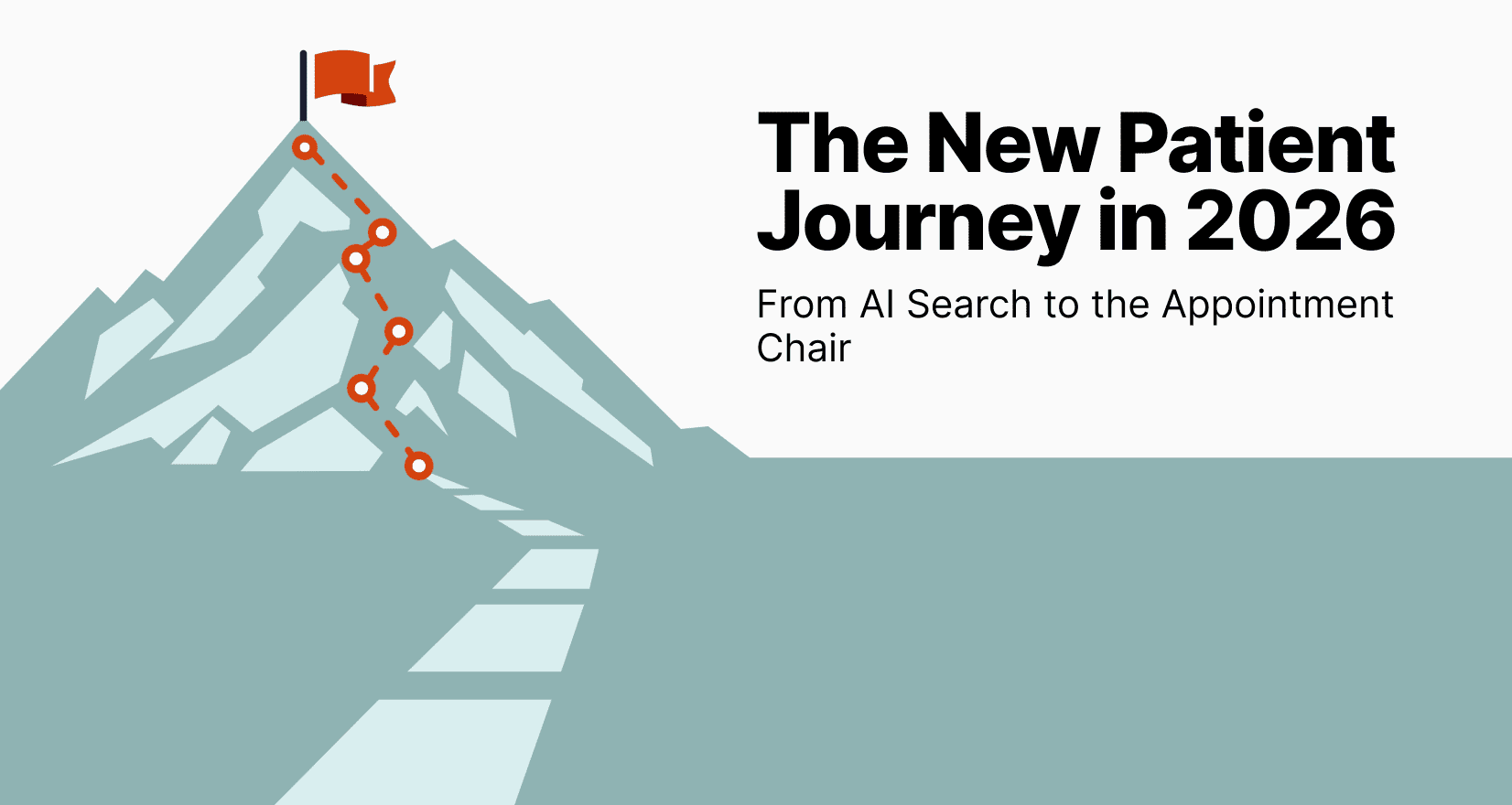
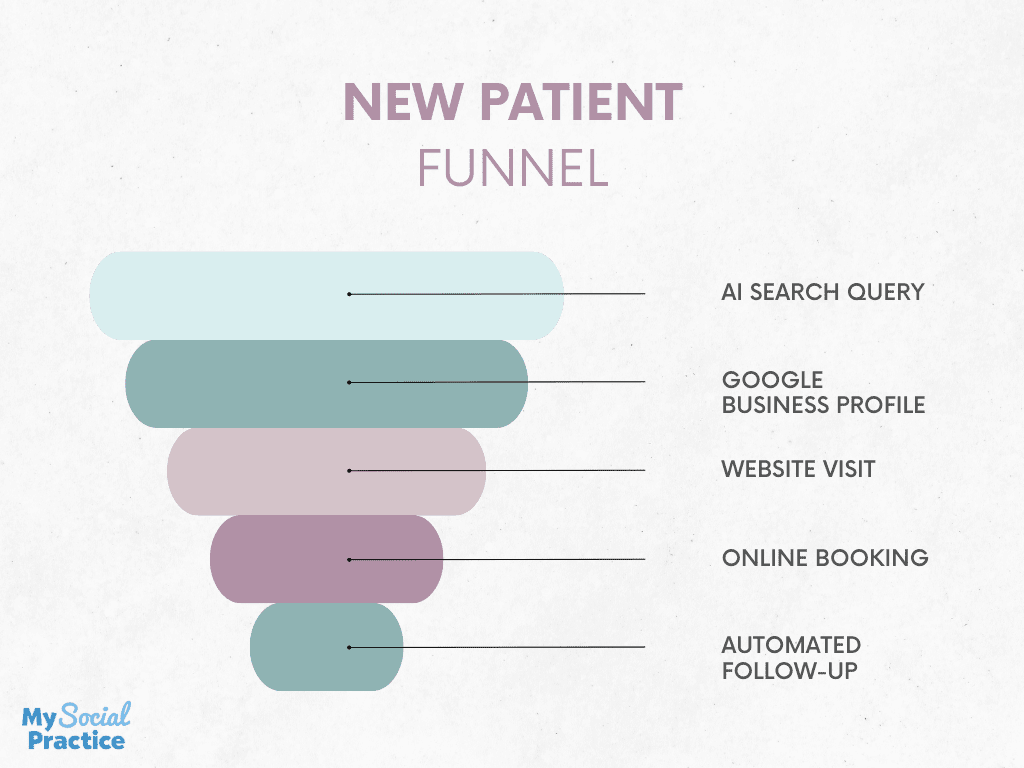
Quick Answer: In 2026, the dental new patient journey runs through five stages before anyone calls your office: (1) an AI search query in ChatGPT, Gemini, or Google’s AI Overviews; (2) a first impression from your Google Business Profile; (3) a fast judgment of your website; (4) real-time online booking, often late at night from a phone; and (5) automated text or email follow-up. A practice wins or loses the patient at each step.
Not long ago, finding a dentist meant flipping through the phone book, asking a neighbor, or trusting whoever your insurance listed first. That world is gone. The patient who becomes your next new patient in 2026 may form a complete opinion of your practice, compare you against two competitors, and book an appointment at 11 PM, all before a single staff member knows they exist. The path they travel is the new patient journey, and it looks nothing like it did five years ago.
This guide walks that journey stage by stage, shows you where practices quietly lose patients along the way, and points to the fixes that recover them.
Table of Contents
- How do patients find a dentist through AI search in 2026?
- Why does your Google Business Profile decide the first impression?
- What makes a patient trust your website in seconds?
- What happens when a patient tries to book online?
- How does automated follow-up keep patients coming back?
- Where are most practices losing new patients?
- Frequently Asked Questions
Stage 1: How do patients find a dentist through AI search in 2026?
More and more, the dental new patient journey now begins inside an AI tool, not a traditional search bar. Patients open ChatGPT, Gemini, Perplexity, or Google’s AI Overviews and ask a full question the way they would ask a friend: “Who’s a good dentist near me who takes Delta Dental and is good with anxious patients?” The AI reads across websites, reviews, and directories, then hands back a short list of two or three practices with reasons attached.
This shift is most pronounced among millennials and Gen Z, the same patients who are aging into being the household decision-makers for family dental care. They trust a synthesized answer that already did the comparison shopping for them.
What decides whether your practice makes that short list is the quality and clarity of your online presence. AI engines favor practices that answer real patient questions in plain language, that have consistent information everywhere they appear, and that carry credible reviews. Thin websites, outdated hours, and pages stuffed with jargon are effectively invisible. The AI has nothing clean to quote, so it quotes someone else.
The practical takeaway: the content on your website is no longer just for humans skimming a page. It is the raw material an AI uses to decide whether to recommend you at all. That is why AI SEO for dentists has become foundational rather than optional.
Stage 2: Why does your Google Business Profile decide the first impression?
Your Google Business Profile is the single most important piece of digital real estate your practice owns, because it is usually the first detailed impression a patient forms. Long before someone reaches your website, they see your star rating, your review count, your recent photos, your hours, and whether there is a booking button, all in one glance on the map.
That glance is often decisive. A practice with 300 reviews at 4.8 stars will beat a practice with 40 reviews at 4.2 stars, regardless of who is the better clinician. Patients cannot judge your dentistry from a search result, so they judge the signals they can see, and volume plus recency of reviews is the loudest signal there is.
Three things move this stage in your favor. First, a complete, current profile: correct hours, real photos, a full service list, and a working booking link. Second, strong local rankings, so you actually appear in the map pack when someone searches. Third, a steady flow of fresh reviews, which is where reputation management and a consistent system for asking happy patients to leave feedback earn their keep. A profile that looks active and well-reviewed tells both the patient and the AI that you are a safe choice.
Stage 3: What makes a patient trust your website in seconds?
Patients decide whether your website feels modern and trustworthy almost instantly, and that snap judgment shapes everything that follows. Research on web design has long shown that people form a first impression of a page in well under a second, and they rarely give a site that feels dated a second chance.
A slow-loading page, a cramped layout on mobile, or a design that looks like it was built a decade ago reads to patients as a signal about the practice itself. Fair or not, they assume a careless website means a careless office.
What keeps a visitor on the page is the opposite: fast load times, a clean mobile-first layout, and content written for patients rather than for search engines. Real team photos, honest testimonials, and clear answers about insurance, financing, and what a first visit is actually like all build the trust that turns a browser into a booker. And because most of this traffic is on a phone, the single most important element is an obvious, frictionless path to book. If a patient has to hunt for how to make an appointment, you have already lost some of them. A modern dental website treats booking as the main event, not a footnote.
Stage 4: What happens when a patient tries to book online?
This is the conversion point, the moment the whole journey has been building toward, and it is where friction does the most damage. Nearly one in five patients abandon the booking process when it feels like too much work.
The difference usually comes down to two very different experiences. An appointment request form asks the patient to submit their information and then wait for someone to call them back, often during business hours they are not free. That delay is a gap, and prospects disengage inside it. They booked with the competitor who let them lock in a time on the spot.
Real-time online dental scheduling removes that gap entirely. The patient sees live availability, picks a slot, and gets an instant confirmation, no callback required. The results can be dramatic: one family practice booked more than 800 appointments in four months after switching to real-time scheduling, compared with just 19 in the four months before.
The mechanics matter here, because not every scheduler delivers this. If you are weighing options, it helps to understand online scheduling for dentists, how to choose the right online scheduler for your practice, and the common online scheduler problems that quietly cost practices bookings. Practices running paid campaigns should also make sure they are pairing dental ads with an online scheduler, so the clicks they pay for do not dead-end at a request form.

Stage 5: How does automated follow-up keep patients coming back?
The journey does not end when the appointment is booked; automated follow-up is what protects the patient you just earned and turns them into a repeat, referring one. It runs quietly in the background across three moments.
First, confirmations and reminders. A confirmation text right after booking and a reminder before the visit are the simplest, highest-return way to cut no-shows, which is exactly why reducing no-shows with online scheduling starts with automated messaging. Second, post-visit review requests, which feed straight back into Stage 2 by keeping your Google profile fresh and growing. Third, recare and re-engagement, the outreach that catches patients before they drift to a competitor.
This is where Annie AI extends what a practice can do without adding staff. Annie follows up with unscheduled hygiene patients, answers common questions after hours, and makes sure inquiries that arrive at 9 PM do not sit unanswered until morning. Every message that goes out on time is a patient who stays in the chair and, often, a review or referral that starts the next patient’s journey.
Where are most practices losing new patients?
Most practices are not losing patients everywhere; they are losing them at one or two specific stages, and finding that leak is the fastest path to more new patients. The journey is only as strong as its weakest step, and a patient lost at any stage never reaches the next one. Here is where the gaps usually hide and how to close them.
| Funnel stage | Common gap | Fix |
|---|---|---|
| AI search | Thin or outdated website content | Original, patient-focused content strategy |
| Google Business Profile | Too few reviews, incomplete listing | Reputation management and consistent local SEO |
| Website visit | Slow load times, poor mobile experience | Modern, mobile-first website design |
| Online booking | Request forms with callback delays | Real-time online scheduling |
| Automated follow-up | Manual reminders, no recare outreach | Automated messaging and AI follow-up |
The pattern most practices see is that the biggest leak sits at Stage 2 or Stage 4: an under-reviewed Google profile that never gets chosen, or a request form that loses patients who were ready to book. Start there. If you want help mapping your own funnel and fixing the weak point first, our dental marketing services are built around exactly this journey.
Frequently Asked Questions
How are new dental patients finding practices differently in 2026 compared to previous years?
The most significant shift is that AI tools are now the starting point for patient research. Instead of scrolling a list of blue links, patients ask ChatGPT, Gemini, Perplexity, or Google’s AI Overviews a full question and get a short, ranked recommendation. Your content, reviews, and overall online presence decide whether you make that list.
How do patients find a dentist using AI search in 2026?
Patients type or speak a natural question, such as “best dentist near me for nervous patients who takes my insurance,” into an AI tool. The AI pulls from websites, reviews, and directories to name a few practices with reasons. Clear, question-based website content and strong, recent reviews are what get you cited.
Why is Google Business Profile so important for attracting new dental patients?
Your Google Business Profile is usually the first detailed impression a patient forms, showing ratings, reviews, photos, hours, services, and booking in one place. Many patients choose between practices right there in the map results, without ever visiting a website, so a complete and well-reviewed profile does a lot of the selling for you.
What role does reputation management play in the new patient funnel?
Reputation management drives the reviews that carry weight at two stages at once. A steady stream of recent, positive reviews lifts your Google Business Profile in Stage 2 and gives AI engines the credible, independent social proof they favor in Stage 1. It is one of the highest-leverage investments in the entire journey.
How does automated follow-up help with patient retention after the first appointment?
Automated follow-up reduces no-shows with timely reminders, builds your reputation through post-visit review requests, and prevents patient drift with recare outreach. Tools like Annie AI go further by answering after-hours questions and proactively contacting unscheduled hygiene patients, so no inquiry slips through the cracks.
How should a dental practice prioritize improvements to its new patient funnel?
Find your single biggest gap first, which for most practices is either an under-reviewed Google Business Profile or a high-friction booking process, and fix that before anything else. Addressing the weakest stage delivers the fastest gain in new patients, because that is where the most of them are being lost today.

Adrian Lefler is the CEO and Co-Founder of My Social Practice and a recognized dental marketing expert with nearly two decades of experience. He is a trusted voice in dental marketing, AI in dentistry, and emerging technology, and he hosts BYTE SIZED, a podcast focused on dental AI, innovation, and technology.