What You’ll Learn
- Why Google changed from a waypoint to a destination and what that means for dental practices
- How Performance Max (PMax) works and why 30% of your search budget should go there
- What AI Max does to your campaigns without asking permission
- How much a dental practice should actually spend on paid ads
- Whether ChatGPT ads are worth experimenting with yet
The January Massacre
In January of this year, dental marketing companies watched their organic search traffic collapse.
Adrian Lefler was tracking over 1,100 keywords for My Social Practice. The company was outranking every competitor in the dental marketing space. Then January 21st hit. Google’s algorithm shifted, and from January through midsummer, search traffic across the dental industry tanked.
“I just watched the legs get chopped off out of everybody,” Adrian said on a recent episode of the Byte Sized Podcast. “It was rough for a lot of other companies that I talked to. A lot of CEOs were like, I don’t know what’s going on.”
Mitchell Leiman, CEO of iPromote, has spent more than a decade helping small and medium-sized businesses navigate digital advertising. He grew up in a small business family, worked at Bain & Company, then held leadership roles at Constant Contact, VistaPrint, and WordStream before leading iPromote. His explanation for what happened is simple. Google stopped being a waypoint and became a destination.
“It essentially became a page of links that you had to click on them, often many of them, and then you went somewhere,” Mitchell said. “Now it’s a destination. You usually start and end there versus before you were continuing your journey elsewhere.”
The Destination Problem
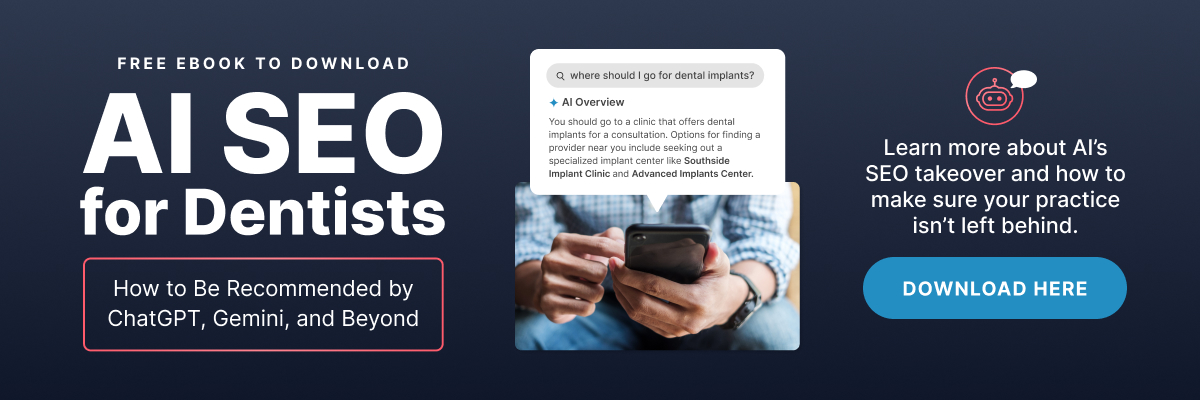
The AI overview at the top of Google’s search results now answers many queries directly. People get what they need without clicking through to a website. Total search volume is actually increasing. People are searching more than ever. But the traffic that leaves Google is shrinking.
“The volume that’s leaving Google to a destination is going down,” Mitchell said. “But search total search occasions is going up. We’re searching more and more.”
This creates a brutal reality for dental practices that depend on dental marketing and being found online. If Google’s AI doesn’t pull your information into the overview, you’re invisible to a growing percentage of searchers. They got their answer. They never saw your website.
The shift wasn’t malicious. Mitchell takes the positive view, saying that Google is trying to improve the experience for searchers. The old model of clicking through five sites to find an answer wasn’t great. Getting the answer directly is often better.
“I think they’re trying to improve the experience of the searcher,” he said. “Oftentimes it is a far superior experience as the consumer, as the searcher.”
But for businesses that relied on organic traffic, the experience improvement came at their expense.
Paid Ads Are More Important Than Ever
Adrian has spent years telling dentists not to spend $10,000 a month on SEO alternatives. Do the organic work. Build the foundation. That advice is shifting.
“I have said for years, don’t spend $10,000 a month. Do SEO,” Adrian said. “I am saying it now. I have to change my mind because I don’t think you’re going to be able to resist it. You’re going to have to spend money on ads if you want to be found.”
Mitchell agrees. Unless a practice has exceptional word of mouth and reputation, paid advertising for dentists is now the primary path to visibility for new patient acquisition.
“Paid advertising is probably more important now than ever for small and medium-sized business,” Mitchell said. “Organic visibility, if I don’t know you and I’m looking, paid ads is more important than ever.”
Emergency patients are the clearest example. Someone with a dental emergency probably hasn’t been to a dentist in years. They don’t know anyone to ask. They search, and if the AI says “here’s the emergency dentist you want to go see,” that doctor cleans up.
The foundation still matters. Google Business Profile, reviews, and dental website quality remain critical. But ads are now the fuel on top of that foundation, not an optional add-on.
What Is Performance Max?
Performance Max, known as PMax, is a Google Ads campaign type that works differently from traditional search campaigns.
In the old model, you picked specific keywords, set exact match types, controlled your bids, and managed every detail. Lots of knobs and dials. Today, PMax asks what you’re trying to accomplish, then takes your headlines, images, and video and decides where to place ads across Google’s properties: Search, Maps, YouTube, Gmail, Display, and Discover.
“You’re giving it assets,” Mitchell explained. “It’s not just your ad copy. It’s like here’s some images, here’s some video, here’s my style guide. And then you’re taking that on behalf of your client and you’re putting it into their account and you’re saying, all right, run with this.”
PMax is the main door Google has built for getting ads in front of patients inside or around AI overviews. In iPromote’s testing, dental ads have shown up around AI overviews but not directly inside them yet, though that could change any week.
The tradeoff is that you have less control. You can see how Google allocates your budget across channels now, but you can’t tell it to put 80% here and 5% there. The platform decides.
“The platform is designed to spend your money,” Mitchell said. “Sometimes you don’t have the feedback loop configured. Sometimes the learning is delayed or can’t happen because the volumes you’re running at aren’t sufficient.”
Big brands spending hundreds of thousands of dollars generate enough data to train the algorithm. A single dental office may not get enough conversions to learn effectively.
What Is AI Max?
AI Max is a setting on a standard search campaign, not a separate campaign type. Turn it on and it modifies your ads automatically.
It expands your keywords, matches searches to intent, and captures traffic you didn’t explicitly target. Mitchell gave an example: a campaign targeting “dentist near me” started capturing searches for a specific dentist’s name because AI Max decided that was the same intent.
“Your keyword is this, but what you really mean is this,” Mitchell said. “And so people that could search for very different phrases, it’s going to capture that.”
However, AI Max doesn’t give recommendations. It makes changes. Until recently, advertisers had no visibility into what it was doing. Google just added the ability to see illustrative examples of AI Max changes, but you still don’t have full transparency or control.
“It’s doing it,” Mitchell said. “And sometimes it’s doing it really well. Sometimes it’s not. You don’t have a lot of control over it.”
| Feature | Performance Max | AI Max |
| What it is | Campaign type | Setting on search campaigns |
| Control level | Low | Very low |
| Visibility | Can see channel allocation | Recently added examples |
| Best for | Reaching people still exploring | Expanding keyword reach |
| Recommended allocation | ~30% of search budget | Monitor closely |
How Much Should a Dental Practice Spend?
Mitchell offered two frameworks for thinking about ad budgets.
Top down: Spend 3% to 7% of revenue on marketing. For a million-dollar practice, that’s roughly $30,000 to $50,000 a year, or $2,000 to $3,500 a month on digital ads.
By patient value: You can afford to spend about a quarter to a third of what a new patient is worth to acquire one. If a new patient is worth $1,200 to your practice, you can spend $300 to $400 to get them.
For a $3,000 monthly budget, Mitchell recommends allocating across search and social, with about 70% of the search portion going to traditional search campaigns and 30% to PMax.
The minimum budget question comes up constantly. Many marketers say you need at least $1,500 a month to generate enough data to train the algorithm. Mitchell acknowledges that you might need 30 or 50 conversions to learn effectively. At smaller budget levels, the spend happens but probably not optimally.
The Foundation Still Matters
Paid ads work best on top of a solid foundation. Google Business Profile, reviews, and website quality are still critical inputs that affect how Google evaluates your practice.
“What’s still incredibly important is that foundation of your Google Business Profile, your reviews, your website,” Mitchell said. “Those are still really important to get right. And then ads are going to be the fuel on that foundation.”
Adrian has a multi-hour presentation on what dentists need to do to be found by AI search engines. He doesn’t talk about ads in it. By the end, doctors are drained because the checklist is a hundred tasks long.
“Most doctors are not going to want to do the tasks,” Adrian said. “They’re probably not going to want to hire a marketing company or an internal person to do it. They may not have the budget. And so ads become the obvious solution to breaking through the noise and being found in the search engine.”
The organic work matters. But ads have become the practical path to visibility for practices that can’t execute a hundred-item SEO checklist.
ChatGPT Ads: Worth Experimenting?
OpenAI launched a self-service advertising platform for ChatGPT in early 2026. They built a billion-dollar ad business in months. Healthcare advertisers, including dentists, can apply, but approval is case by case.
“Each practice has to apply,” Mitchell said. “The volumes, the metrics are still very unknown.”
The ads are currently basic. Text-oriented, sitting outside the core answer, with some images starting to appear. But OpenAI is moving fast.
Mitchell’s recommendation is to experiment if you’re an early adopter with a larger budget. Take a small slice and test. Don’t go all in with your marketing budget on a platform with thin performance data.
“Is it interesting? Absolutely,” he said. “Am I saying go all in with your marketing budget? No. But keeping a close eye on it, if you’re more of an early adopter and you’ve got a larger budget, taking a small part of it and experimenting, I think it’s a good time to try that.”
The New Reality
Google’s shift to AI-first search isn’t reversing. The company has floated moving to full AI mode with no more blue links. That may not happen, but the direction is clear.
“I am pretty freaking convinced that it’s never going to be like it was,” Adrian said. “I think the search traffic ultimately is going to continue to drop, maybe slowly over time.”
For dental practices, the implication is straightforward. The organic traffic model that worked for years is weakening. Paid advertising has moved from optional to essential for new patient acquisition.
The fundamentals of running a great practice haven’t changed. Word of mouth, reputation, and patient experience still matter. But for patients who don’t already know you and are searching for a dentist, paid ads are now the primary path to visibility.
“Buy Google stock,” Adrian joked. “Where this is going is Google’s going to have so much advertising capability because nobody’s going to want to go do their own research on a website. They’re just going to ask the AI.”
In This Episode:

Mitchell Leiman, CEO of iPromote
Mitchell Leiman is the CEO of iPromote, a digital advertising platform that helps partners manage paid advertising for small and medium-sized businesses. Before iPromote, he was a consultant at Bain & Company and held leadership roles at Constant Contact, VistaPrint and WordStream. He grew up in a small business family and has spent more than a decade helping small advertisers succeed online.

Adrian Lefler, CEO and Co-founder of My Social Practice
Adrian Lefler, CEO of My Social Practice, is a seasoned expert in the dental marketing industry with 14 years of experience. He is widely recognized for his engaging and informative presentations. Based in Suncrest, Utah, Adrian shares his life with his wife, four children, and a lively mix of pets. My Social Practice is a leading dental marketing company, and Adrian is passionate about helping dental professionals succeed in this dynamic field.
Frequently Asked Questions
Why did organic search traffic drop for dental practices in 2026?
Google changed from a waypoint into a destination. The AI overview at the top of the page now answers many searches directly, so more people stop at the results page instead of clicking through to a website. Search volume is still growing, but the share of clicks that leave Google keeps shrinking. Practices that depended on organic traffic are seeing less of it reach their websites.
Can dentists run ads inside Google's AI overviews?
Not yet, at least not consistently. In iPromote’s testing, dental ads show up around AI overviews but not directly inside them, even though other industries are seeing ads placed inside. The best move for a dental practice today is to use Performance Max campaigns to compete for the real estate around the AI overview. Google is still experimenting, so placement options could expand.
What is Performance Max and should a dental practice use it?
Performance Max is a Google Ads campaign type where you supply headlines, images, and video, and Google decides where to show your ads across Search, Maps, YouTube, Gmail, Display, and Discover. It reaches people who are still exploring and gets you access to placements around AI overviews. Mitchell Leiman recommends putting about 30% of your search budget in PMax, with the rest in core search campaigns for high-intent patients.
How much should a dental practice spend on digital ads?
Two ways to think about it. Top down: spend 3% to 7% of revenue on marketing, which for a million-dollar practice is roughly $2,000 to $3,500 a month on digital ads. Or by patient value: you can afford to spend about a quarter to a third of what a new patient is worth to acquirev one. Smaller budgets may not generate enough conversions to train Google’s algorithms effectively.
Should dentists advertise on ChatGPT?
It’s worth experimenting with, but not with your whole budget. ChatGPT ads are new, healthcare advertisers go through a case-by-case approval process, and the performance data is still thin. The ads are currently basic and text-oriented. If you’re an early adopter with a larger budget, testing a small slice now could provide useful learning. Otherwise, keep a close eye on the platform as it develops.