What You’ll Learn
- Why most dental AI rollouts fail at the human level, not the technology level
- The psychology behind team resistance and why money never creates lasting motivation
- How to get buy-in after you’ve already purchased the technology
- Why the cost of ignoring team psychology far exceeds the cost of addressing it
- What separates practices that successfully adopt AI from those falling behind
Look For the Pattern
A dentist attends a conference. They see a demonstration of some incredible AI tool. They get excited. They buy it on the spot. They bring it back to the practice and announce the change.
Three months later, nobody is using it.
Julieanne O’Connor and Michael Keeter have seen this pattern hundreds of times. As co-founders of Influential Dental, they work with high-performing dentists, group owners, and DSOs on the human side of practice growth. And they have identified the real reason AI implementations keep failing.
“Most dental practices that struggle with AI and technology adoption don’t have a tech problem,” Adrian Lefler noted at the top of the conversation. “They have a people problem. And most dentists never see it coming because it never makes it to their desk.”
The technology works. The onboarding materials exist. The vendor support is available. But the team sitting in the operatory every day has already decided this tool is not for them.

Why Resistance Runs Deeper Than You Think
The obvious assumption is that team members fear losing their jobs to AI. That fear is real, but it is rarely the whole story.
“We go into it assuming that’s the reason, but in some cases there might be completely different reasons altogether,” Julieanne explained. “Some people may really want it. They just don’t want to do extra work and actually implement it. In some cases it might be something entirely unknown.”
The deeper issue is that leaders rarely dig into why their team reacts the way they do. They see resistance and assume the worst. They push harder. The resistance increases.
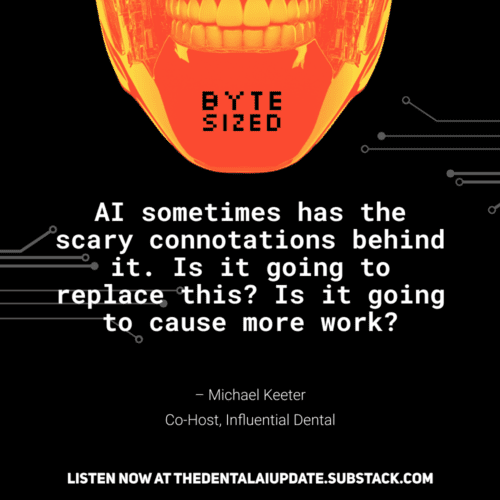
Michael framed the foundation differently. “It goes back to trust and the track record of that doctor or office manager. If that foundational trust has been laid in that office and they know that person is going to make the best decision for them and the team, they’re not challenging things.”
Trust is built over time through consistent behavior. When a leader announces a major change without any prior discussion, they withdraw from that trust account whether they realize it or not.
The Real Cost of Skipping Psychology
Adrian shared a personal example that illustrated exactly how expensive this mistake can be.
His dental marketing company does hundreds of pages of copywriting every month. He identified a way to use AI that would reduce the time per piece from six hours to five minutes. The math was obvious. The efficiency gains were massive.
“I met with my SEO manager,” Adrian explained. “I said here’s what we want to do. I mapped it out. This is why we’re going to do it. And I think I have buy-in.”
He pushed forward on a project he expected to take four or five months. It took nine or ten.
“What I didn’t recognize is that my manager was more concerned about the effect this would have on the two copywriters on her team and the change in their job descriptions than concerned about the profitability and streamlining of the company.”
The manager was protecting her people. That instinct was not wrong. But without surfacing those concerns explicitly, the entire project stalled. Fear went underground. Feet dragged. Progress crawled.
“I finally get seven, eight months in and I’m like, why is this taking so damn long?” Adrian said.
The answer was never the technology. It was always the psychology.
Why Money Never Creates Lasting Change
Leaders often assume that compensation should be sufficient motivation. The team agreed to do a job for a certain wage. New tools are part of that job. End of discussion.
Julieanne pushed back hard on this assumption.
“There are plenty of leaders who say, I pay them, that should be sufficient,” she acknowledged. “But that is not how human beings behave. If you lead humans and you want them to be bought into your mission, you have to buy into their mission. Money is not a sustainable motivator. Never will be.”
What matters to people is what money represents. And for many people, money carries negative associations from childhood. Hard work. Exhaustion. Scarcity. Lack.
“They’ve been told and taught things that are not necessarily true about who they are, what their worth is,” Julieanne said. “Our job as leaders is either we learn how to do this or we hire somebody who’s a master at the psychology behind it.”
The alternative approach sounds soft, but it produces hard results. Ask team members how they want to contribute. Ask what they would do with freed-up time. Get them to bring ideas to the table rather than receiving directives.
“It’s powerful,” Julieanne said. “They all know there’s something more for them. And if you can show them how, they’re going to hold each other accountable.”
The Conversation That Should Happen First
The ideal scenario involves the team before any purchase happens. But that is not how the industry works.
Technology companies invest heavily in conferences. Salespeople are compensated based on deals closed at events. Every objection a dentist raises gets handled on the spot. The pressure to buy now is structural.
“When a doctor is at an event, the sales rep for that company, whether they realize it or not, is going to downplay the difficulty of implementation,” Adrian observed. “It’s just inevitable.”
Doctors buy on emotion. They return to the practice with a product and expectations that were shaped by a sales pitch.
Julieanne offered a path forward even after the purchase has been made.
“Post sale, there’s still a way to get your team involved in decision-making,” she said. “The accountability is on the decision maker to come back and represent that they have been sold this technology and that they don’t know exactly what the implementation process will be. They should not resell a salesperson’s pitch.”
The honest version sounds like this: “I got excited about this. I don’t know exactly what implementation will look like. I would love to get everybody’s input. Let’s see how we can make this work together.“
That vulnerability creates space for the team to engage rather than resist.
Self-Selection Happens Faster Than You Expect
One concern leaders carry is that addressing psychology will surface problems they cannot solve. What if someone on the team simply refuses to change?
Michael and Julieanne report that this rarely happens the way leaders fear.
“If we get called in to work with a really dysfunctional team, you’ll find that everybody’s a good person,” Julieanne said. “But habits are deep. Some people will see in themselves what they’re capable of and want that. Other people would rather stay under the ceiling of comfort.”
When the whole team receives the same invitation to step into their potential, something interesting happens. The people who want growth hold each other accountable. The ones who resist become obvious.
“People end up self-selecting out,” Julieanne explained. “I can’t remember the last time somebody had to be let go after we’ve come in and done training. It just doesn’t happen.”
The math on turnover supports investing in psychology first. Adrian cited a conversation with an orthodontist running 13 practices who calculated the cost of replacing a single team member at $80,000 to $100,000 when accounting for hiring, training, team disruption, and morale damage.
“You can’t pretend that the person who left under uncomfortable terms isn’t talking to the other employees,” Adrian said. “It’s the first phone call they make.”

What Separates Practices That Succeed
The practices best positioned for AI adoption share common traits. They do not try to handle major changes alone. They involve outside perspectives. They invest in relationships before they need them.
“If I were a practice owner, I would never try to do this within my own practice without having a third party involved who’s overseeing and has a vested interest in your success,” Julieanne advised. “They’re not stuck in your practice. They can help you pivot quickly.”
Michael reinforced the point. “You don’t have to do it by yourself. Look outward as much as you look inward. Don’t fall in love with bad money or hold yourself back because you’ve invested in something where investing in something new can take you to the next level.”
The speed of AI development makes this even more critical. Products launched today may be outdated in six months. The practices that thrive will be those with cultures built for continuous adaptation rather than one-time implementations.
That culture starts with psychology. It starts with trust. And it starts with conversations that most leaders have never been trained to have.
| Leadership Approach | Team Response |
| Announce change without discussion | Resistance, fear, foot-dragging |
| Involve team before or immediately after purchase | Engagement, ownership, creative problem-solving |
| Push harder when resistance appears | Deeper entrenchment, silent sabotage |
| Surface concerns and address psychology | Self-selection, accountability, faster adoption |
In This Episode:

Julieanne O’Connor, Co-founder of Influential Dental
Julieanne O’Connor is a leading Influence Coach for high-achieving dental professionals and a driving force behind the Mindset Movement in dentistry. A bestselling and award-winning author, TEDx speaker, Super Bowl commercial actor, and media personality featured in The Wall Street Journal, CNN, USA Today, and more, Julieanne is internationally recognized for creating sustainable change rooted in potential, fulfillment, and high performance grounded in quality of life. Julieanne is the co-founder of Influential Dental and is the founder of INFLUENCE élevé, the first mindset and lifestyle magazine created exclusively for dental professionals who elevate others and the industry.

Michael Keeter, President and Co-founder of Influential Dental
Michael Keeter is the President and Co-Founder of Influential Dental, a leadership and media platform dedicated to elevating professionals across the dental industry. The platform includes INFLUENCE élevé, the first mindset and lifestyle magazine created exclusively for dental professionals who elevate others and the industry.

Adrian Lefler, CEO and Co-founder of My Social Practice
Adrian Lefler, CEO of My Social Practice, is a seasoned expert in the dental marketing industry with 14 years of experience. He is widely recognized for his engaging and informative presentations. Based in Suncrest, Utah, Adrian shares his life with his wife, four children, and a lively mix of pets. My Social Practice is a leading dental marketing company, and Adrian is passionate about helping dental professionals succeed in this dynamic field.
Frequently Asked Questions
Why do dental teams resist AI implementation even when the technology clearly helps?
Resistance rarely stems from a single cause. Some team members fear job loss. Others dislike the extra work of learning something new. Many simply were never included in the decision and feel the change was imposed on them. Leaders who assume the reason without asking usually guess wrong and make the resistance worse.
Why doesn't paying employees more solve adoption problems?
Money is not a sustainable motivator because what matters is what money represents to each person. For many people, money carries associations with scarcity, exhaustion, and lack. Lasting motivation comes from feeling valued, having input, and seeing a path to personal growth. Leaders who rely solely on compensation miss the psychology driving behavior.
What separates practices that successfully adopt AI from those that fail?
Successful practices involve outside perspectives, build cultures of trust before changes happen, and address psychology rather than pushing through resistance. They understand that friction is normal and that team members need to feel safe to engage with new tools. They also remain flexible as AI continues to evolve rapidly.