Every week, the MSP team breaks down the dental marketing news that actually matters, from Google updates and AI search changes to social media trends, SEO shifts, and reputation management surprises.
This Week’s Drilldown:
- Google’s Q3 earnings call casts a shadow over classic search
- Semrush confirms “poisoned” Google results are impacting SEO tools
- AI-cited pages more often got straight to the answer
- Quick hit: Google confirms AI-generated review summaries in Search ads
- Quick hit: A Google AI opt-out test finds an unexpected drop in organic clicks
- Quick hit: WordPress announces another security release, version 7.1.4
Google’s Earnings Call: AI Mode Is Booming, but It Doesn’t Pay as Well
What happened: On Alphabet’s third quarter earnings call, Google reported its strongest year-over-year query growth in five years and tied it to AI Mode, which is pulling in more searches, including commercial ones. Sundar Pichai said search has “strong momentum.” But there was a catch in the fine print, though. Executives acknowledged that AI Mode’s fast growth weighed on results because it earns less money per search than classic results. Google’s answer is more ads. It said ad experiments in AI Overviews and AI Mode look promising and that it is scaling them to more users, more queries, more countries, and multi-turn ads in the U.S.
The bigger headline for local businesses came from Pichai’s description of AI agents as the next stage of search. He talked about agents helping people complete tasks like booking reservations, filling in forms, scheduling appointments, and making purchases, and said Google plans to bring these features to Search and to the Gemini app, which it says has a billion users. It’s worth noting that the two outlets we read disagreed on the revenue numbers (one reported search revenue up 12% to $63 billion, the other called it flat), so we are leaving the dollar figures out.
Why dentists should care: Two things stand out. First, more ads are coming to AI answers, which means the places patients see your practice (and your competitors) are about to get more crowded and more paid. Second, an AI that can schedule appointments needs reliable information to schedule against. If your hours, services, insurance details, and booking options are out of date or inconsistent, an AI agent trying to book a patient with you is going to hit a wall. Nothing about this is live for dental practices today, but it is where Google says it is headed.
What to do next:
- Audit your hours, phone number, services, and booking links across your website, Google Business Profile, and major directories
- Make booking easy to find and easy to complete online, since agents will go where booking is simple
- If you run Google Ads, ask your ads manager how they plan to handle ads in AI Overviews and AI Mode as they roll out
- Think about phone coverage too. If an AI agent or a patient calls and nobody answers, you lose the booking. Our AI Receptionist is one way to make sure calls get picked up
“Poisoned” Google Results: Now Confirmed by Multiple Rank Tracking Tools
What happened: Two issues ago we mentioned a rank tracking company’s claim that Google was serving scrambled results to rank trackers. Since then, the story has gotten much bigger. Semrush confirmed that Google is returning inaccurate search results to some automated ranking tools, and called it an industry-wide problem. Ahrefs, AccuRanker, BrightLocal and other platforms have reported similar issues since September.
Semrush described two kinds of bad results: pages with results that don’t match the search at all (sometimes on page one), and pages that look normal at first but include loosely related results further down. Its example is a delightfully weird one, detailing a search in Brazil for a specific baby stroller model that returned a dental supply store’s equipment page, because both products shared the Portuguese word “carrinho.”
Different companies measured the problem in different ways. Ahrefs said 5% to 20% of results were affected depending on the data provider. DemandSphere flagged 6.7% of collected results, and SEOmonitor reported about 8% of its daily results were inaccurate or incomplete. Nozzle, which analyzed 56.1 million search results across 53 countries, flagged 22.6% of results since mid-September, up from 0.28% in its baseline period, with a peak of 43.5% on September 30. About two thirds of the affected results went back to normal within three days. AccuRanker said 40% of its initial desktop requests on October 24 returned suspected bad first-page results, dropping to 3.2% after its checks and below 1% the next day. These numbers came from different samples and methods, so they can’t be compared directly.
Google has not commented or confirmed that it intentionally serves altered results to ranking tools. Semrush and others have suggested the changes may be tied to Google’s efforts to limit large-scale automated data collection, but that explanation is unconfirmed.
Why dentists should care: If your dental marketing report says your practice suddenly dropped, or jumped, for a bunch of keywords, there is a decent chance it is the tool and not your actual ranking. BrightLocal said the problem mostly affects results below position 10, though several other companies documented problems on page one as well. The takeaway is simple and a little reassuring. Before you panic about a ranking report (or celebrate one), check it against something more trustworthy.
What to do next:
- Compare any big ranking swing against Google Search Console and your own historical numbers before acting on it
- Judge success by calls, form fills, and booked appointments, not by one tool’s dashboard
- Ask your dental marketing company how their tools detect and filter suspicious results. A good provider should have a clear answer. Our SEO team can walk you through what your reports mean
- Be patient with sudden changes, since most affected results in one analysis bounced back within a few days
What Gets Pages Cited by AI? Two Studies Say: Answer First, Be Known
What happened: Two new studies, both from companies that sell AI search services, add to the growing pile of research on why AI tools cite some pages and not others.
The first, from analyst TJ Robertson, compared pages cited in AI answers (from ChatGPT, Google AI Mode, and AI Overviews) with pages that weren’t. It looked at 193,507 AI answers across more than 4,000 questions. Cited pages more often opened with a direct answer to the question: 23% versus 14% for pages the AI retrieved but didn’t cite, and 20% versus 5% for Google top-10 pages the AI never pulled up. Looking at which features raised the odds of a citation:
- A year in the title: more than double the odds
- A date within the past 12 months: 88% higher odds
- Tables: 69% higher odds
- First-hand experience: 45% higher odds
- Prices: 28% higher odds
- Schema markup: 13% higher odds
- Author byline: 28% lower odds
- Call to action: 12% lower odds
Cited pages were no less promotional than the ones that were passed over. The analysis found associations, not proof that any one feature causes citations, and a separate Ahrefs test found that adding schema to previously cited pages did not produce a statistically significant increase.
The second study, from the agency Graphite, found that brands ChatGPT rarely names on its own also tend to be named rarely when it searches the web, even when they appear on many of the pages it cites. In other words, being a known name seems to matter a lot, and it is not something you can fix overnight. Graphite’s data is correlation, not causation, and it did not control for how well-known each brand already was.
Why dentists should care: The most useful and least risky takeaway is the simplest. Your best bet is to answer the question first. A patient (or an AI) asking “how much do dental implants cost?” or “does teeth whitening hurt?” shouldn’t have to scroll through a long intro to find out. Dates, real prices or price ranges, and genuine first-hand experience (like your own team’s perspective) all showed up as positives. The byline finding is odd, and we would not take it as a reason to remove doctor names from your content, since trust matters for health topics. The Graphite findings are a reminder that consistent, repeated, accurate mentions of your practice online build familiarity over time.
What to do next:
- Open your top service pages and blog posts and check whether the answer is in the first few lines
- Add a clear “last updated” date and refresh older pages, especially those covering costs and procedures
- Include real price ranges where you can, and use simple tables for comparisons like treatment options
- Share first-hand experience: what patients can expect, how long it takes, what your team sees most often
- Keep your practice information consistent everywhere, since familiarity builds over time
Quick Hit: Google Puts AI-Written, Positive-Only Review Summaries in Search Ads
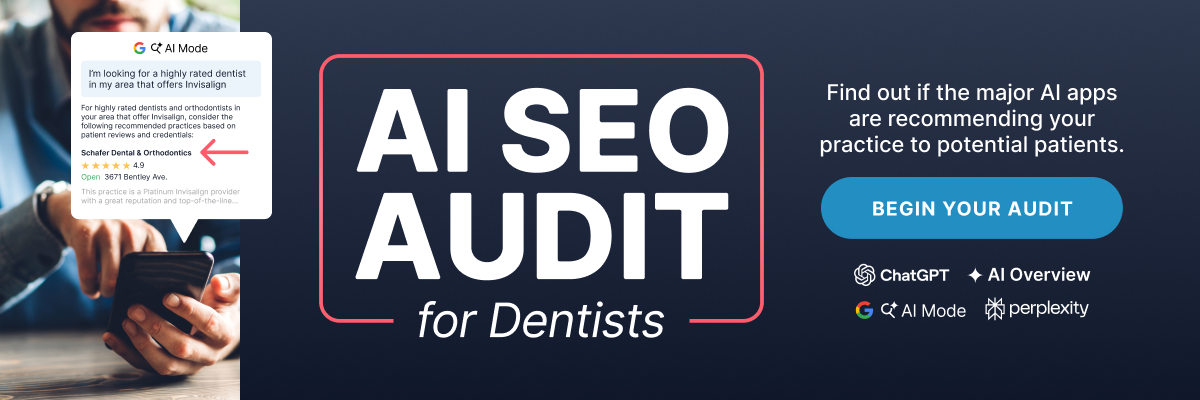
Google published a help page describing AI-generated summaries of online reviews that can appear inside Search ads. The summaries pull from reviews across the web, are positive only, and cannot be edited by advertisers. They are available for Search campaigns in the U.S., U.K., Australia, and India (in English), and Google says it shows one only when it predicts the summary will help ad performance. The page doesn’t say whether advertisers can opt out. For dental practices running Google Ads, the practical angle is that your reviews can now end up inside your paid ads in words you didn’t write, which is one more reason to keep your review profiles healthy and accurate. Ask your ads manager how this appears on your account.
Quick Hit: Opting Out of Google’s AI Features Might Cost You Organic Clicks (Maybe)
SEO consultant Cyrus Shepherd shared a small case study in which a website opted out of Google’s AI search features. AI impressions dropped to zero right away, and traditional organic clicks also declined. Shepherd estimated the AI click-through rate at just 0.9% and suggested a possible “halo effect,” where showing up in both the AI answer and the regular listings builds trust and earns more clicks overall. He cautioned that the test is small and did not share the site’s traffic, test dates, the size of the drop, or how the opt-out was done, so we would not treat this as proof. But it is a useful reminder that AI visibility may be worth more than the clicks it sends directly. It is not a reason to block anything on your site.
Quick Hit: WordPress 7.1.4 Patches 22 Security Vulnerabilities
Following last issue’s UpdraftPlus story, WordPress released version 7.1.4 as a security update fixing 22 vulnerabilities. The most serious reported issue is a race condition in the core update process that could, in theory, allow remote code execution during an upgrade, which could lead to a full site takeover. Some of the flaws date back to WordPress 4.7. Many of the other issues require a logged-in user with Contributor-level access or higher. Have whoever manages your website confirm you are on 7.1.4, and take a moment to review who has editor and admin access to your site.
Action Items
| Update | What It Means | What To Do | Priority |
| Google Q3 earnings and AI agents | AI Mode is growing, ads are coming to it, and agents may start booking appointments | Audit hours, services, and booking info across all listings | Medium |
| “Poisoned” results confirmed by Semrush and others | Ranking reports may show fake swings | Check rankings against Search Console and real leads | High |
| AI-cited pages answer first | Pages that open with a clear answer get cited more often | Put the answer at the top of key service pages and posts | Medium |
| AI review summaries in Search ads | Your reviews can show up in your ads in words you did not write | Ask your ads manager how this appears, and keep reviews strong | Medium |
| AI opt-out case study | AI visibility may help regular organic clicks too | Do not block AI features without a reason | Low |
| WordPress 7.1.4 security release | 22 vulnerabilities were patched | Confirm your site is updated and review user access | High |
MSP Take
If this week had a motto, it would be “check the source.” Rank trackers are showing bad data, AI answers are citing pages that lead with the answer, and Google is quietly working out how to earn money from AI answers. The common thread is that the signals you see are noisier than they look, and the best defense is to anchor on things you can verify. Rely on your real calls, your real bookings, your real reviews, and a dental website that is kept current and secure. Put clear answers on your pages, keep your information consistent everywhere, and treat any single dashboard as one data point, not the whole story.
Learn More
- Google’s Q3 earnings call casts shadow over classic search – Search Engine Journal
- Google says AI chatbots are hurting its bottom line – Social Media Today
- Semrush confirms “poisoned” Google results are impacting SEO tools – Search Engine Land
- AI-cited pages more often got straight to the answer – Search Engine Journal
- ChatGPT brand mentions and cited pages (Graphite analysis) – Search Engine Journal
- Google confirms AI-generated review summaries in Search ads – Search Engine Land
- Google AI-written positive-only review summaries in Search ads – PPC Land
- Google AI opt-out test finds unexpected drop in organic clicks – Search Engine Land
- WordPress announces another security release, version 7.1.4 – Search Engine Journal
Frequently Asked Questions
Why does my SEO ranking report show sudden jumps or drops?
It may be the tool, not your rankings. Semrush, Ahrefs, AccuRanker, and others have reported that Google is returning inaccurate results to some automated ranking tools. Check any big swing against Google Search Console and your real call and booking numbers before reacting, and talk to your dental marketing company for detailed information.
How do I get my dental website cited in AI answers?
There are no guarantees, but recent research suggests cited pages more often open with a direct answer, carry a recent date, include tables and prices, and share first-hand experience. Put the answer at the top of your key pages and keep them updated. These findings are correlations from companies that sell AI search services, so treat them as a good starting point.
Could AI agents really book dental appointments?
Google’s CEO described AI agents that book reservations, fill in forms, and schedule appointments, and said they will come to Search and the Gemini app. Nothing is live for dental practices today, but accurate hours, services, and easy online booking will put you in a better position when it is.
Will my Google reviews show up in my ads?
Possibly. Google says it can show AI-written, positive-only review summaries in Search ads in the U.S., U.K., Australia, and India. Advertisers cannot edit them, and the help page does not say how to opt out, so ask whoever manages your ads how it appears on your account.
Do I need to update WordPress right now?
Yes, if your site runs on WordPress. Version 7.1.4 fixes 22 vulnerabilities, including a serious flaw in the update process. Ask your web team to confirm the update, and review who has editor or admin access.

Adrian Lefler is the CEO and Co-Founder of My Social Practice and a recognized dental marketing expert with nearly two decades of experience. He is a trusted voice in dental marketing, AI in dentistry, and emerging technology, and he hosts BYTE SIZED, a podcast focused on dental AI, innovation, and technology.