What You’ll Learn:
- The three core criteria behind our rankings — design and aesthetics, cost-value, and technical performance — and how they combine to define a great dental website.
- Why aesthetic design choices like color, typography, photography, and layout shape a dental practice’s first impression more than any other marketing investment.
- How 15 standout dental practices solved real design challenges, from balancing professional credibility with kid-friendly appeal, to making minimalist design feel warm, to using authentic photography in place of stock imagery.
- The design patterns that consistently set top dental websites apart from average ones, and how to apply those patterns to your own practice’s redesign or refresh.
- How design, brand identity, and technical performance interact, and why beautiful sites that load slowly still underperform.
Table of Contents
How We Evaluate Dental Website Design
Graded by the design and marketing team at My Social Practice
Finding the most beautifully designed dental websites takes more than a quick scroll. Our team of designers, copywriters, and dental SEO specialists evaluated hundreds of practice websites to identify the 15 standout designs featured below. Each one was graded across three criteria that together define what separates an exceptional dental website design from an average one.
What Else We Look For

Beyond the three scored criteria, we also reward design choices that signal operational maturity. Two patterns consistently surface in our top-ranked sites: thoughtful multi-location architecture (parallel phone numbers, location-specific tour pages, Areas We Serve hubs) and authentic in-practice photography that replaces stock imagery throughout. Sites that handle these well earn editorial credit even when their formal scores are competitive rather than dominant.
Additionally, any dental practice can choose a brand centerpiece, like a metaphor, a color, or a regional identity. What separates the websites below isn’t the choice of centerpiece, but how each practice’s personality shapes the execution. Two practices on this list (Sunshine Family Dentistry in Bismarck and Sunshine Children’s Dentistry in Santa Rosa) built their brands around the same sunshine metaphor and produced almost nothing in common. Personality, not concept, is what makes a brand identity original.
Grand Street Dental
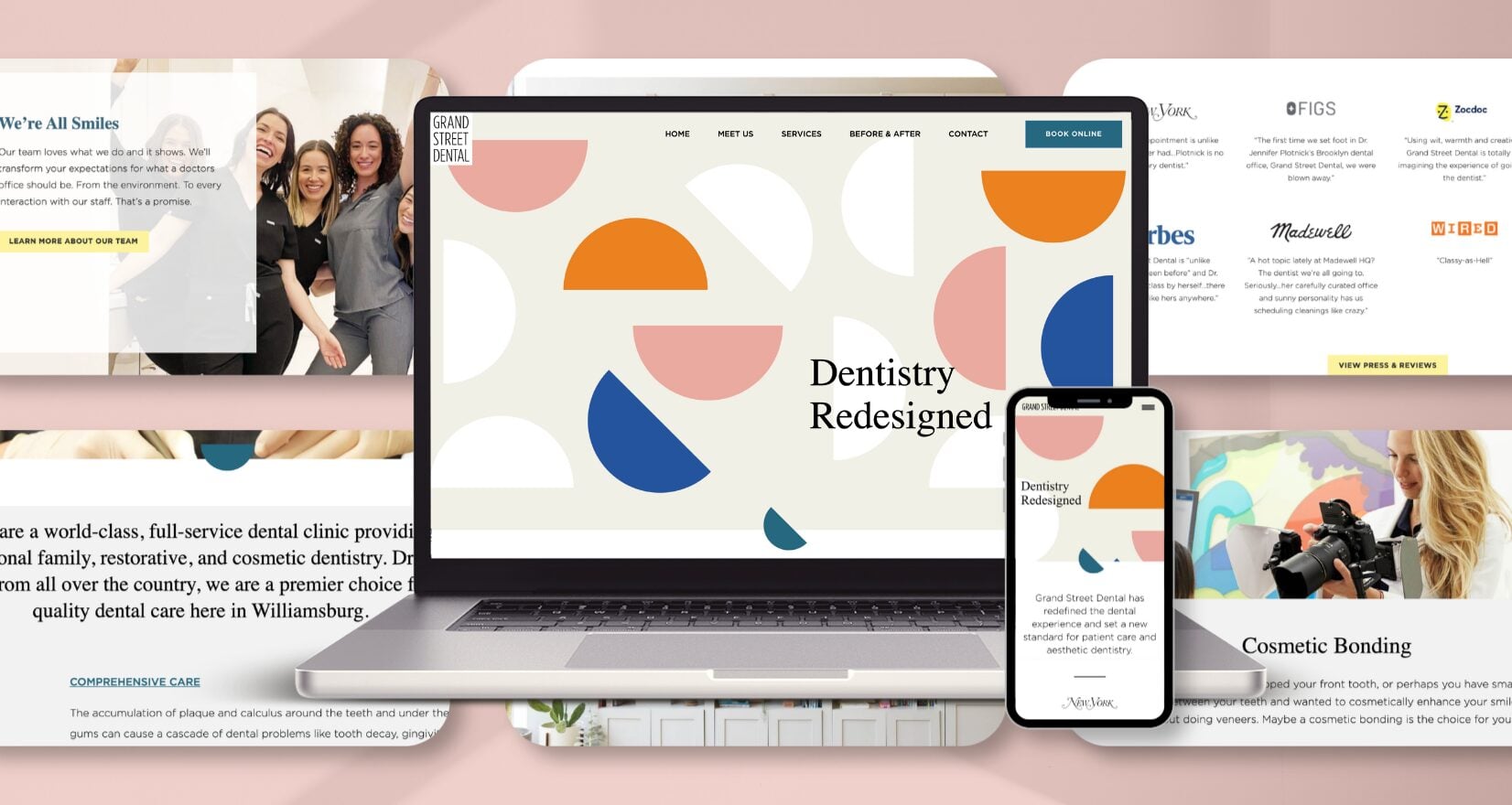
Grand Street Dental sets the bar for what a cosmetic dental practice’s website can be when design is treated as a competitive asset rather than a brochure. The site opens with a confident two-word tagline — “Dentistry Redesigned” — that reads more like a fashion brand statement than a dental headline. A rotating press carousel featuring pull-quotes from New York Magazine, Forbes, Wired, Club Monaco, and Madewell follows immediately — a social-proof strategy borrowed from luxury retail that almost no dental site uses. Editorial photography runs throughout, including an Instagram-style “Patient Stories” grid and a prominently featured before-and-after gallery. Bold serif typography, generous whitespace, and a minimal three-item primary navigation reinforce the editorial restraint.
The takeaway: when a practice competes in the luxury cosmetic space, the website should look like a lifestyle brand, not a dental office.
GT Dental Centre
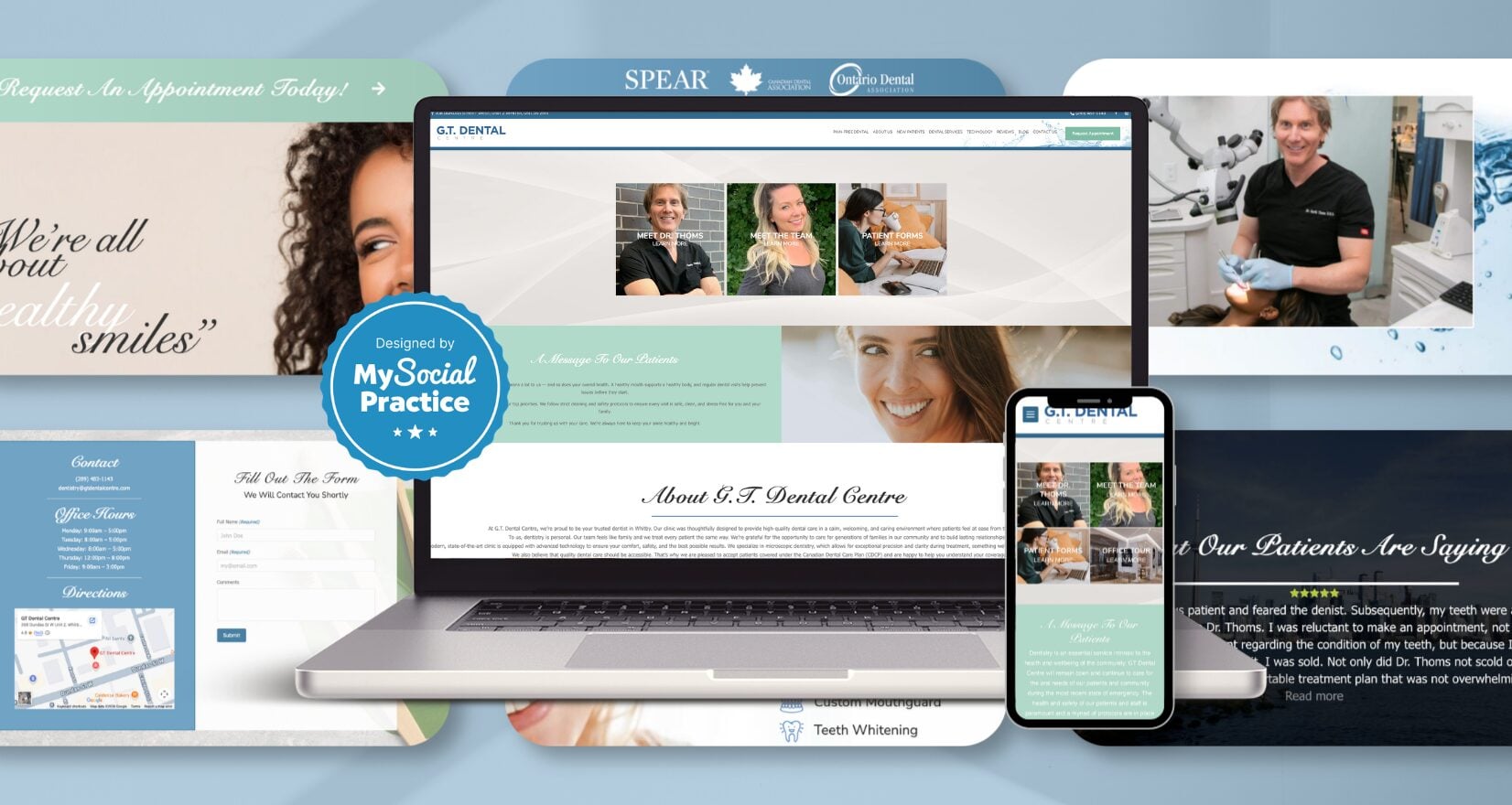
GT Dental Centre’s design reflects a confident editorial restraint that’s increasingly rare in dental marketing, featuring calm composition, generous whitespace, and a soft blue-and-white palette that mirrors the spa-like atmosphere Dr. Thoms set out to create. The most distinctive design choice is structural: “Pain-Free Dental” sits as a top-level navigation item alongside “About Us” and “Services,” elevating a patient experience promise to brand-level prominence rather than burying it as a service subcategory. Microscopic dentistry, a technical specialty Dr. Thoms has practiced for over 20 years, receives similar treatment, presented as a defining philosophy rather than as an equipment list. Authentic practice photography replaces stock imagery throughout, reinforcing the bespoke feel of the Whitby office itself. A clean six-icon services grid keeps the homepage uncluttered.
The takeaway: when a practice has a genuine differentiator, design should give it real estate in the navigation, rather than sub-pages.
Sunshine Family Dentistry
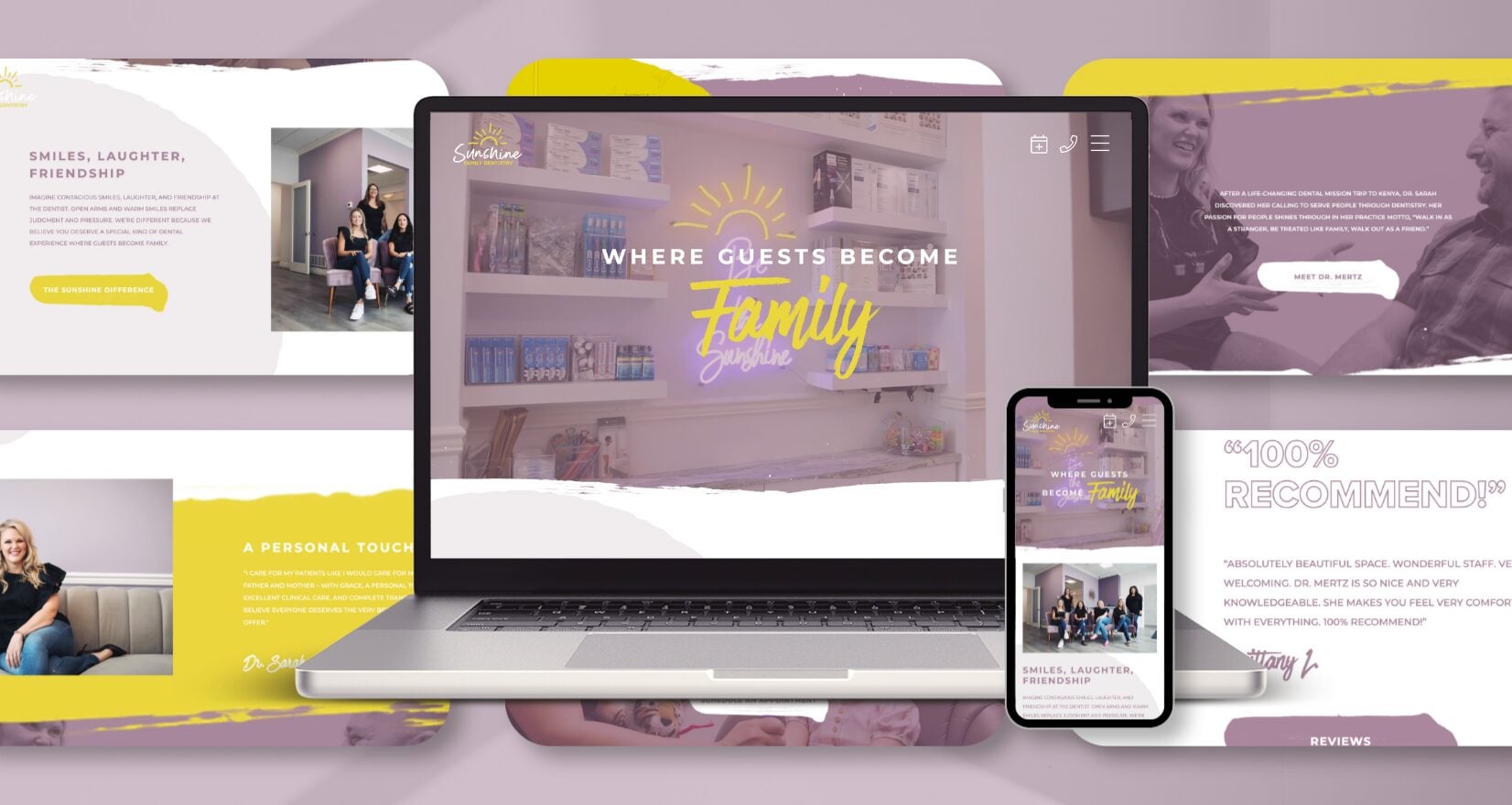
Sunshine Family Dentistry shows what happens when a single brand metaphor is carried through every layer of a site’s design rather than treated as a logo decoration. The yellow accent palette ties directly to the practice name; navigation labels (“The Sunshine Difference,” “Your First Visit,” “Family Smile Services,” “Paying For Your Visit”) are written in the brand’s voice rather than in clinical categories; and even the URL itself (sunshinefamily.dentist) reinforces the editorial consistency. A full-width hero video opens the homepage, replacing the static-image opening most dental sites default to. Custom photography of Dr. Sarah Mertz, the lounge, and patients runs throughout, and her personal origin story — including a life-changing dental mission trip to Kenya — gives the brand a genuine human anchor. Her practice motto (“Walk in as a stranger, be treated like family, walk out as a friend”) earns its place by being lived out in the design’s specificity.
The takeaway: a brand metaphor only works when the practice’s actual personality shapes how it’s executed. Dr. Mertz’s Kenya mission story and warm community voice are what turn “sunshine” from a marketing concept into a real practice’s identity, and not the same identity as the other Sunshine practice on this list.
Hilgers Orthodontics
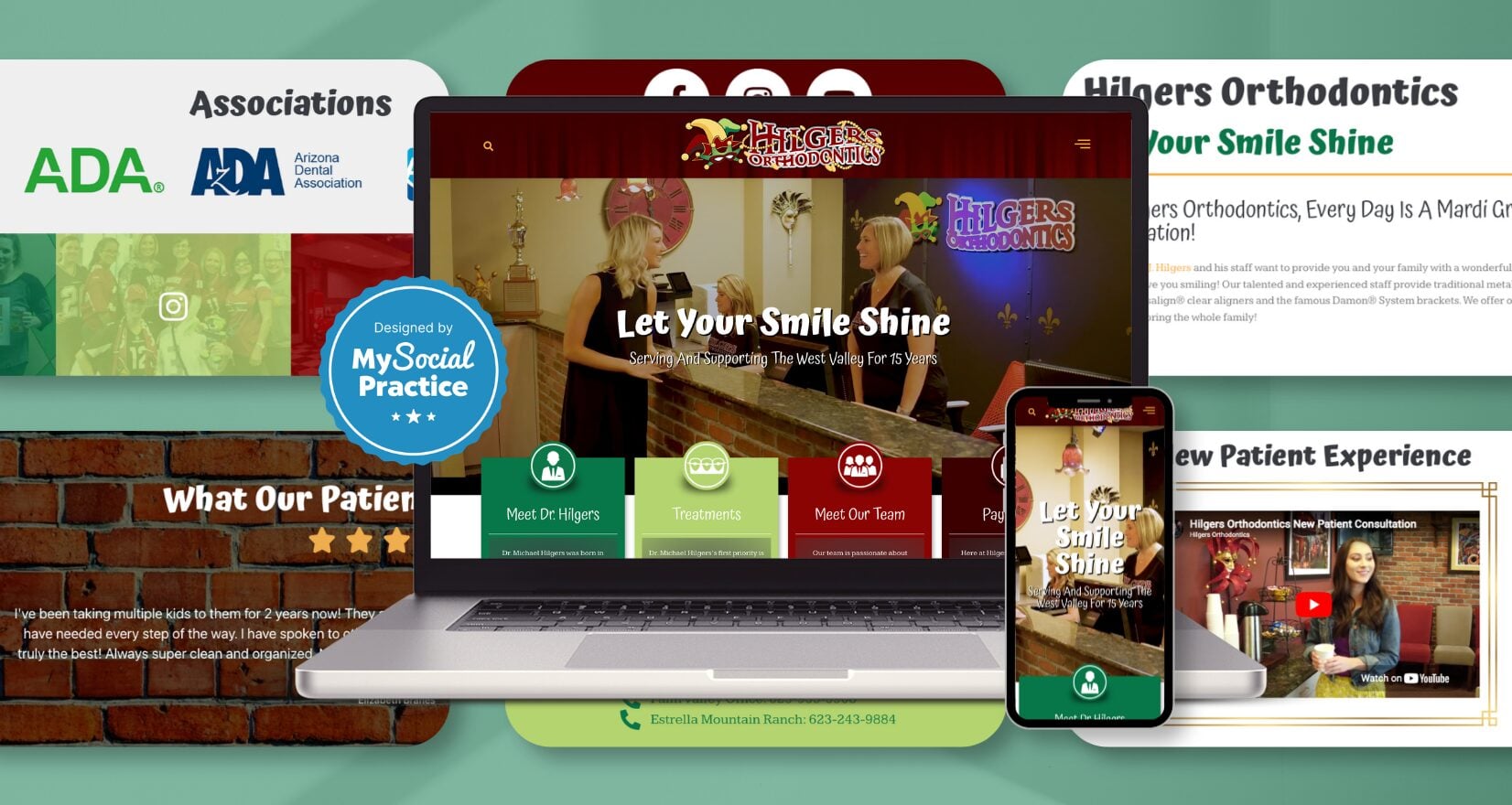
Hilgers Orthodontics shows how a distinctive cultural identity can carry a website when the design commits to it without apology. The practice has built its brand around an explicit theme — “At Hilgers Orthodontics, every day is a Mardi Gras celebration!” — and the design lives up to the promise rather than just stating it. Custom photography of the in-office game room and exam areas surfaces an arcade-style waiting experience most orthodontic practices wouldn’t think to feature, turning the office itself into a brand asset. A clean four-card homepage architecture (Meet Dr. Hilgers / Treatments / Meet Our Team / Pay Online) keeps navigation simple while the visual identity does the heavy lifting. The “Serving and Supporting the West Valley For 15 Years” subhead anchors community trust, and a dual-location structure maintains parallel phone numbers and dedicated office-tour pages for each.
The takeaway: orthodontic practices win design when they commit to a cultural identity strong enough to influence what the office actually looks like.
Sunshine Children’s Dentistry
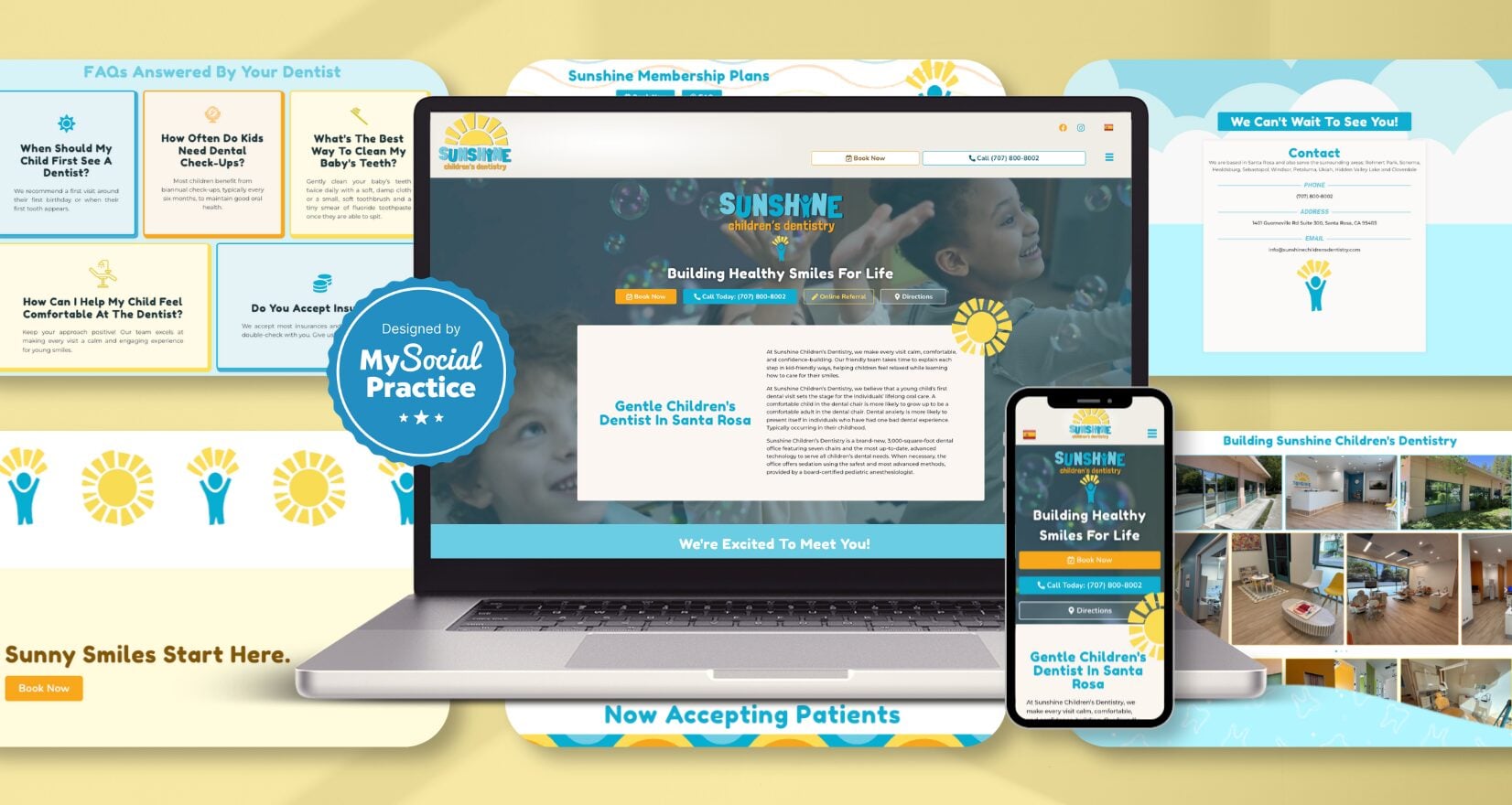
Sunshine Children’s Dentistry shows what happens when a pediatric practice commits to a single brand metaphor with unusual thoroughness. The sunshine identity extends through every layer: the practice name, the URL, an animated rotating sun mascot anchoring the hero, and even the membership plan names (Sunshine Minis for ages 0–2, Sunshine Littles for ages 3–13). Dr. Navid Mehdipour’s bio leans fully into the metaphor — “brings sunshine to every smile,” “kids shine brighter,” “even on cloudy days” — language that would feel saccharine if the design didn’t earn it. A distinctive “Building Sunshine Children’s Dentistry” photo gallery shows the actual construction of the brand-new 3,000-square-foot practice, turning the office build-out itself into a brand asset that creates emotional investment before patients ever walk in. An Areas We Serve architecture surfaces nine Sonoma County communities for broad local SEO reach, and Medi-Cal acceptance signals accessibility most pediatric sites don’t address.
The takeaway: the same brand centerpiece — sunshine — can produce entirely different websites when each practice’s personality shapes the execution. Personality, not concept, is what makes a brand identity original.
Smile & Co.
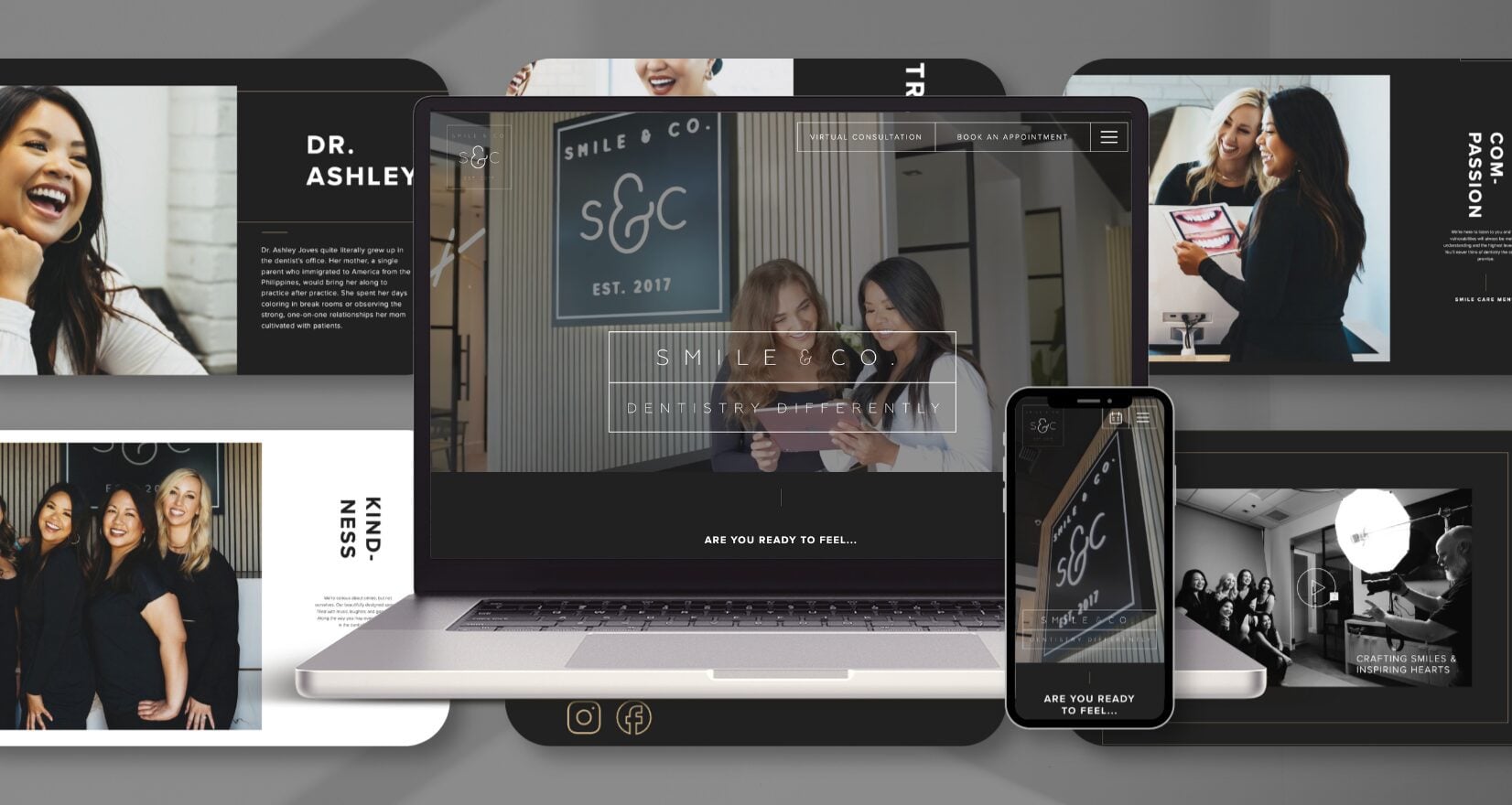
Smile & Co. shows what happens when a dental practice commits to brand voice as a design discipline. The site opens with a hero video and a distinctive three-pillar structure — Trust, Kindness, Compassion — each anchored by editorial photography of the all-black-clad team and copy that reads more like a lifestyle brand than a dental office (“Hello Gorgeous, let’s be friends”). Typographic playfulness turns words into design elements (line breaks across “Kind-/ness” and “passion com-/compassion”) in a way few dental sites attempt. Navigation labels reinforce the editorial positioning: “The Experience,” “Smile Care Services,” “Patient Stories” rather than clinical category names. A two-location architecture maintains parallel phone numbers and dedicated location pages.
The takeaway: when brand voice is treated as a design discipline rather than ad copy applied to a clinical template, the entire website feels polished and cohesive.
Young Dentistry for Children
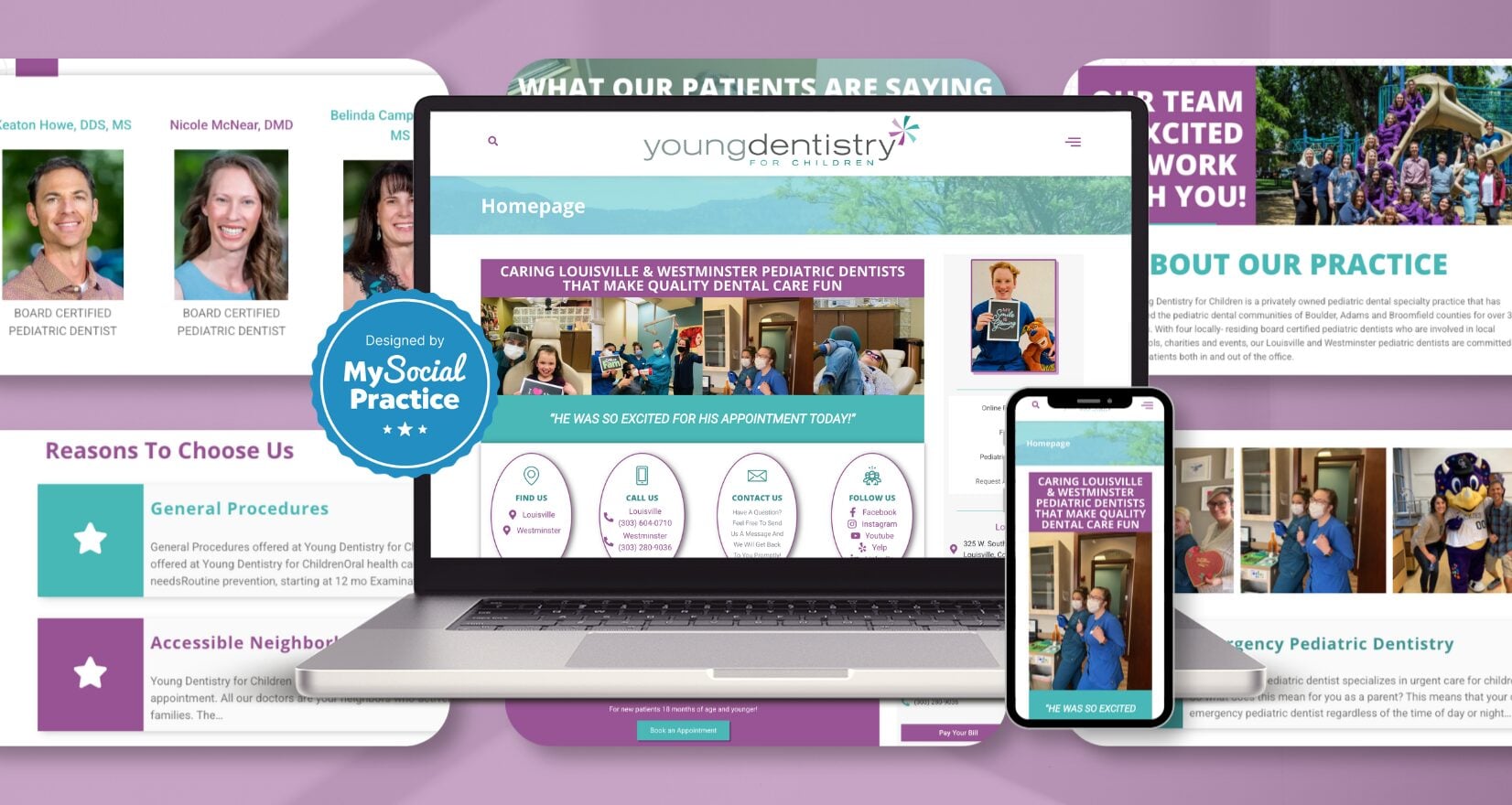
Young Dentistry for Children shows how a multi-doctor pediatric practice can scale without losing personal warmth. The homepage features four board-certified pediatric dentists — Drs. Howe, McNear, Campbell, and Leff — given equal visual weight rather than positioning one as the “lead,” signaling the partnership model directly. A scrolling band of brief patient quotes (“You’re all so nice!”, “He was so excited for his appointment today!”) replaces the standard testimonial block, creating quick visual evidence that reads more like overheard kindness than curated reviews. Custom team photography, including candid moments and staff anniversary callouts, replaces the polished stock imagery most pediatric sites default to. Stacked 5280 Magazine “Top Pediatric Dentists” badges anchor authority in the lower fold, and two locations maintain parallel phone numbers without subordinating either.
The takeaway: pediatric design works when it captures the practice’s actual personality, not a polished marketing version of it.
LK Anderson, DDS
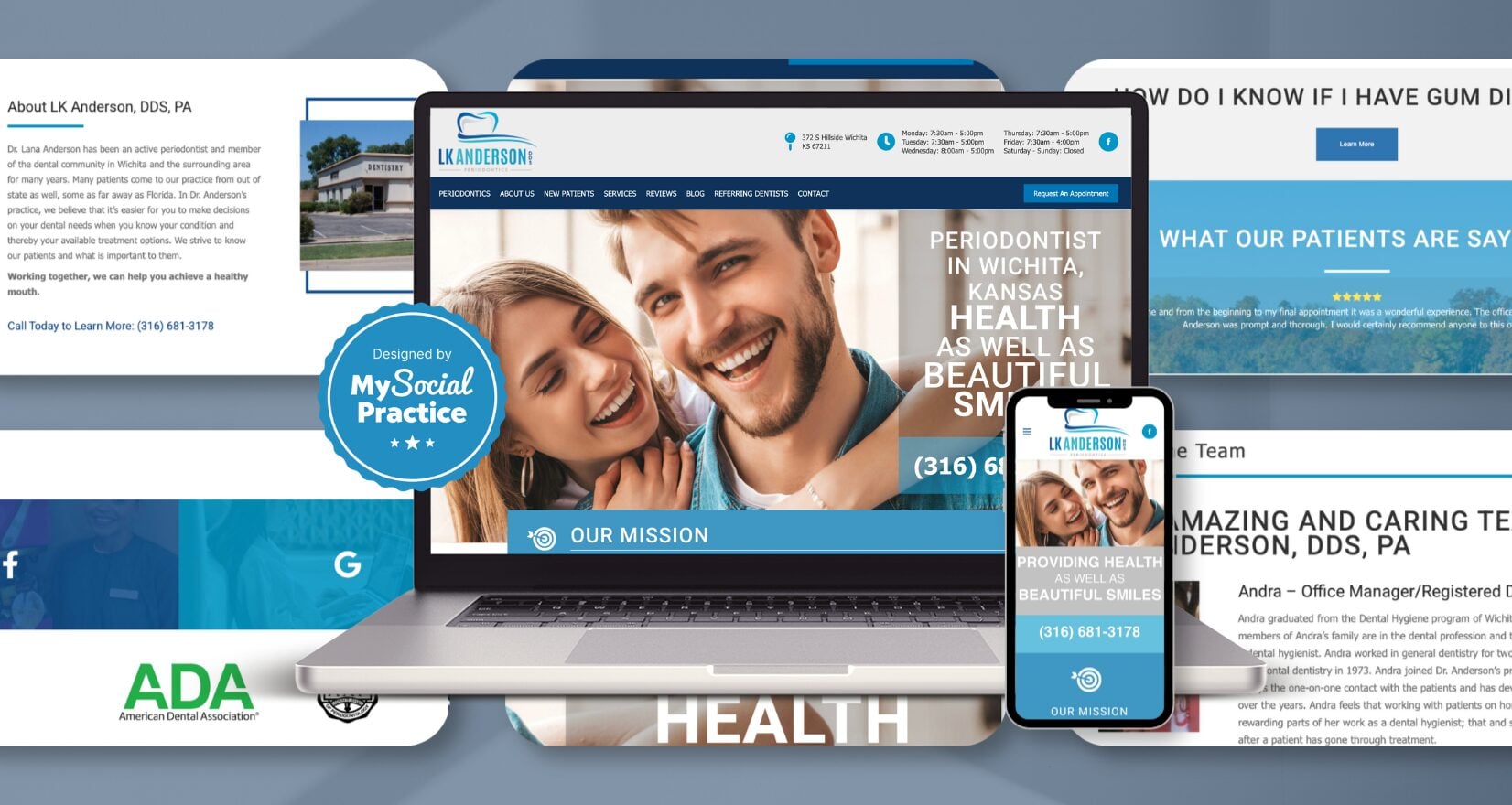
LK Anderson DDS shows what happens when a specialty practice treats typography as its primary design element. The homepage hero stacks an all-caps phrase — “PROVIDING / HEALTH / AS WELL AS / BEAUTIFUL / SMILES” — into a vertical composition that turns the practice’s mission into a visual statement rather than burying it as marketing copy. A custom mission-statement icon and the calming teal palette anchor the page directly below, reinforcing the practice’s positioning as a periodontics specialist where health, not just cosmetics, drives the work. Dr. Lana Anderson is joined by Dr. Smith to form a two-doctor specialty team featured on dedicated bio pages, alongside an Areas We Serve architecture and a periodontics-specific service taxonomy that goes topically deep. Vatech PaX-i3D Green Imaging gets its own technology page, signaling the practice’s investment in advanced diagnostics.
The takeaway: specialty practices win when their domain expertise becomes the brand identity, not a footnote.
Heidi Brandenburg, DDS
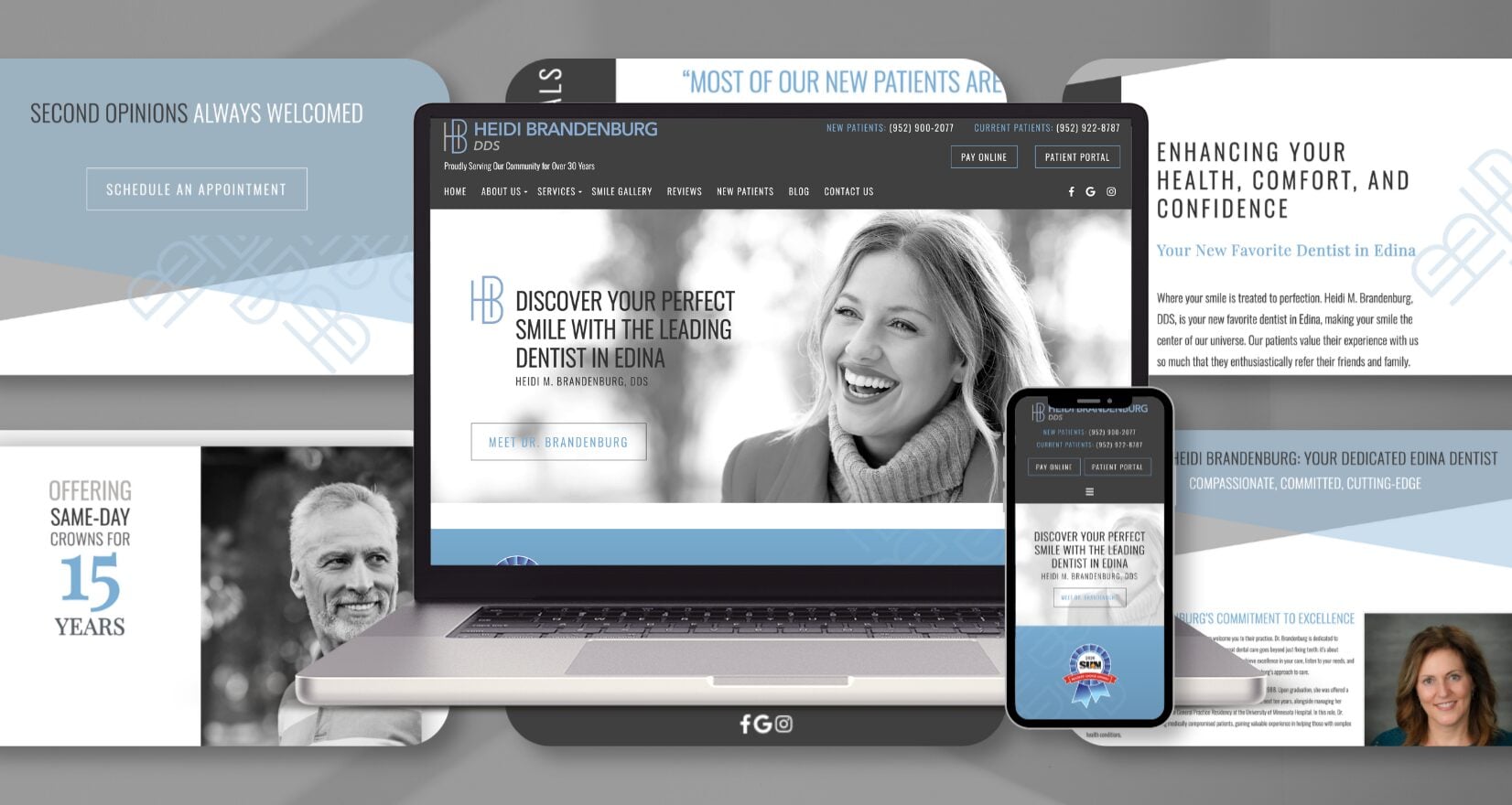
Dr. Heidi Brandenburg’s site shows how a single-dentist practice can project the depth and authority typically reserved for larger groups. The most distinctive structural choice is operational rather than visual: two phone numbers in the header — one for new patients, one for current patients — signaling a practice mature enough to separate intake from existing-patient service. A scroll-driven homepage layers credibility in deliberate progression with a “Best Dental Practice 15 Consecutive Years” Sun Readers badge, an “Offering Same-Day Crowns for 15 Years” vertical-typography callout, and a stacked award block. A distinctive “BE | YOU | Tiful” typographic treatment anchors the cosmetic positioning, and the comfort menu translates abstract claims into specific amenities like neck pillows, cozy blankets, movie glasses, warm towels.
The takeaway: solo practices succeed at website design when their site demonstrates accumulated authority rather than just claiming it.
Sea & Smiles Pediatric Dentistry
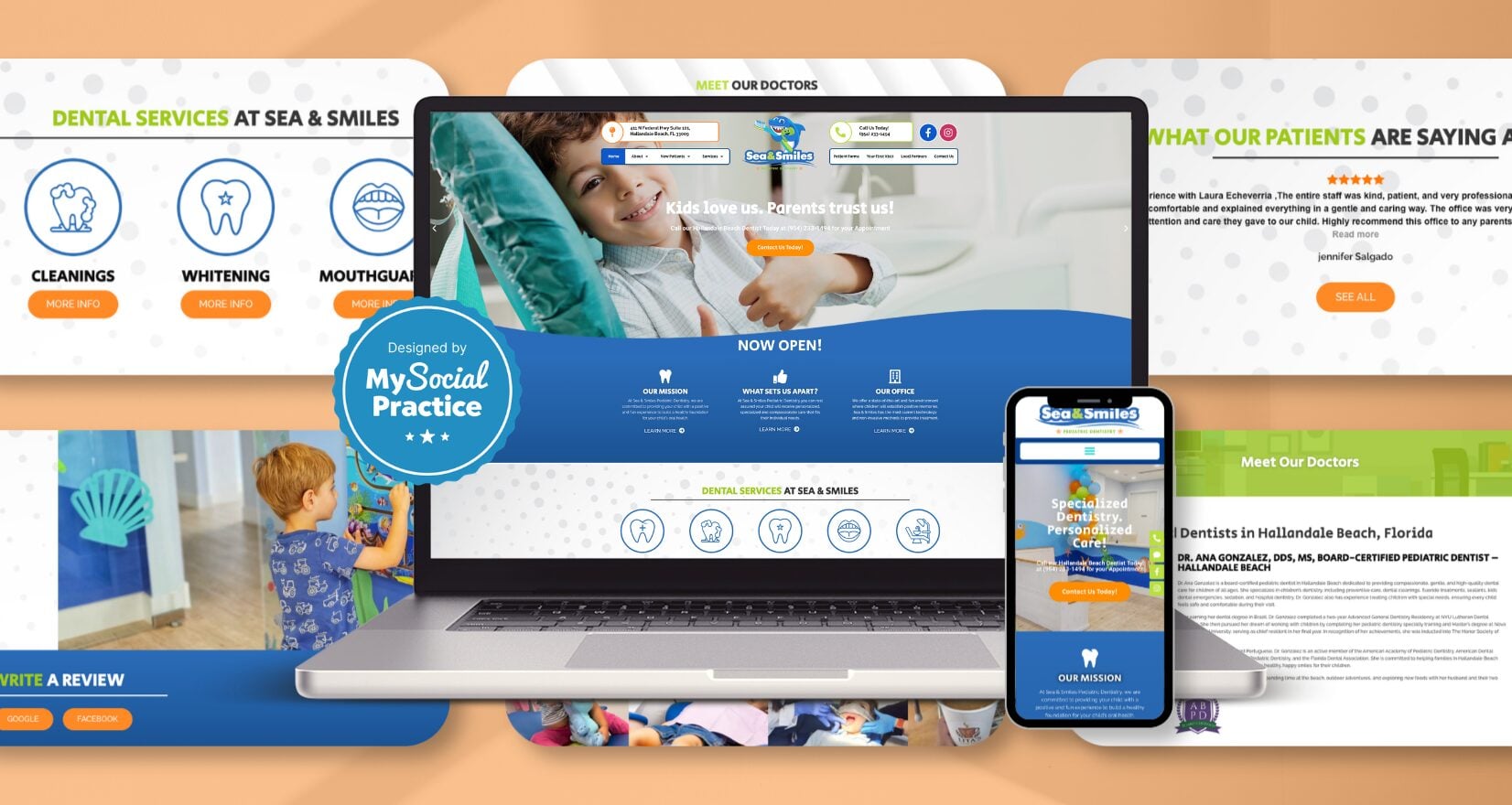
Sea & Smiles Pediatric Dentistry shows how a strong brand concept — in this case, an oceanic shark-character pediatric identity — can carry a homepage when extended consistently across every visual touchpoint. The shark logo, the wave-inspired teal palette, the URL itself (seasmilespd.com), and the practice’s location (Hallandale Beach, FL) are all aligned around a single coherent metaphor. The homepage opens with a rotating banner carousel (“For a lifetime of healthy smiles!”, “Kids love us. Parents trust us!”, “Specialized Dentistry. Personalized Care!”) that establishes the practice’s positioning quickly, followed by a three-column architecture surfacing Our Mission, What Sets Us Apart, and Our Office — relationship-first navigation rather than service-first. A five-icon service grid keeps the rest of the homepage uncluttered. The doctor section now features two pediatric dentists — Dr. Ana Gonzalez (board-certified, trilingual in English/Spanish/Portuguese) and Dr. Laura Echeverria (specialty-trained at University of Puerto Rico) — with detailed credentials and personal context.
The takeaway: pediatric design works when the brand metaphor is carried into every layer of the experience, not just the logo.
Cobble Creek Dental
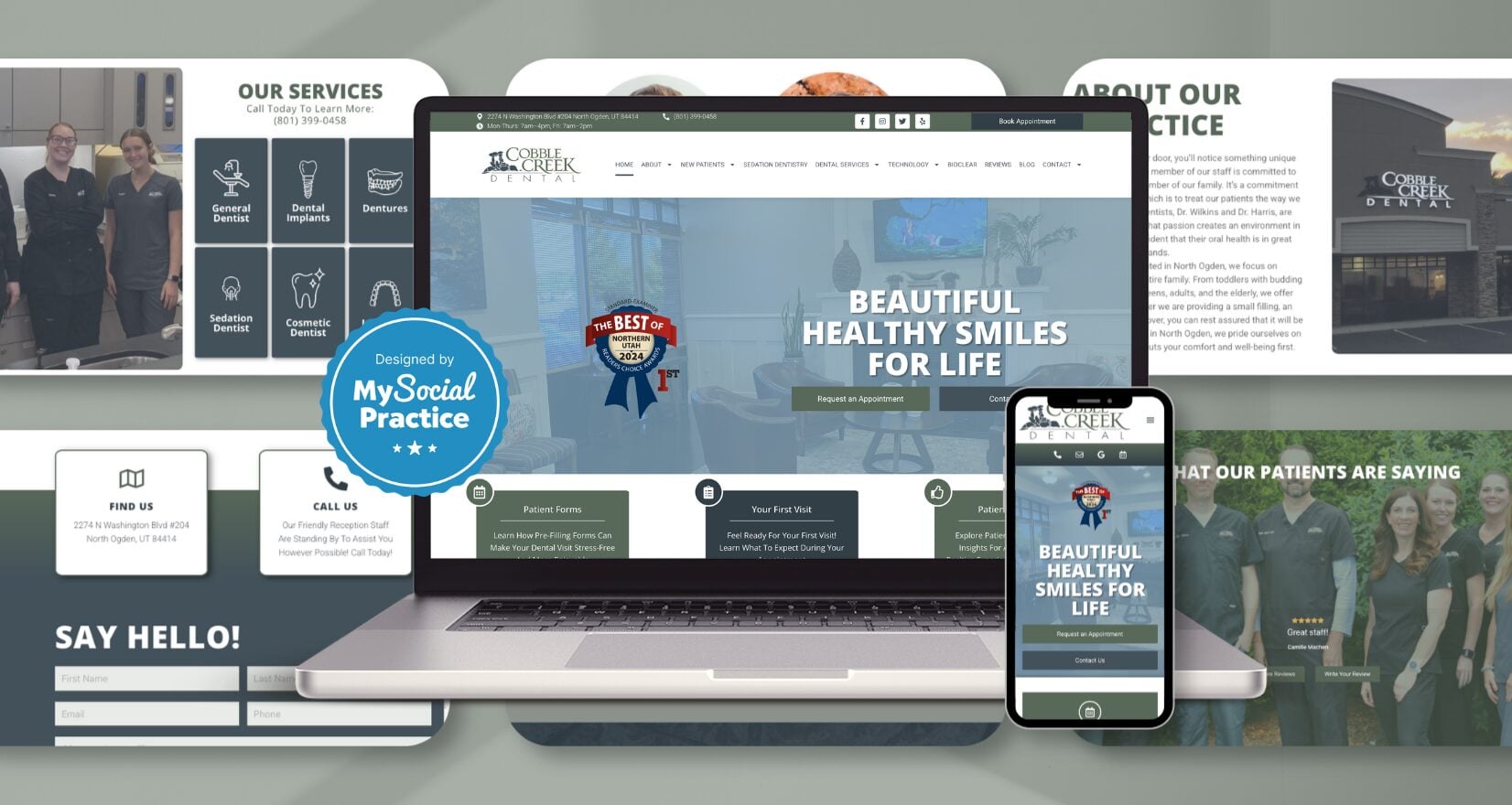
Cobble Creek Dental shows what a family practice’s website can look like when the design takes its cues from the place itself rather than from a template. The color palette draws from the Wasatch Front — warm earth tones and soft mountain blues — anchoring the brand to North Ogden’s actual geography rather than to generic dental palette defaults. A “Best of 2024 Northern Utah” ribbon at the top of the hero immediately establishes local authority, and the homepage’s three primary entry points (Patient Forms, Your First Visit, and Patient Reviews) are organized around what new patients actually need rather than service categories. Custom team and dentist photography replaces stock imagery throughout, and the deep technology page surfaces unusual specifics (Medit i700 intraoral scanner, Disney Plus on overhead TVs, Bioclear, PerioProtect) that turn equipment into experience signals. A Smile Savings Club membership plan addresses uninsured patients directly.
The takeaway: small-town family practices stand out when their design carries the community’s geography into the brand instead of borrowing one.
Southland Children’s Dentistry
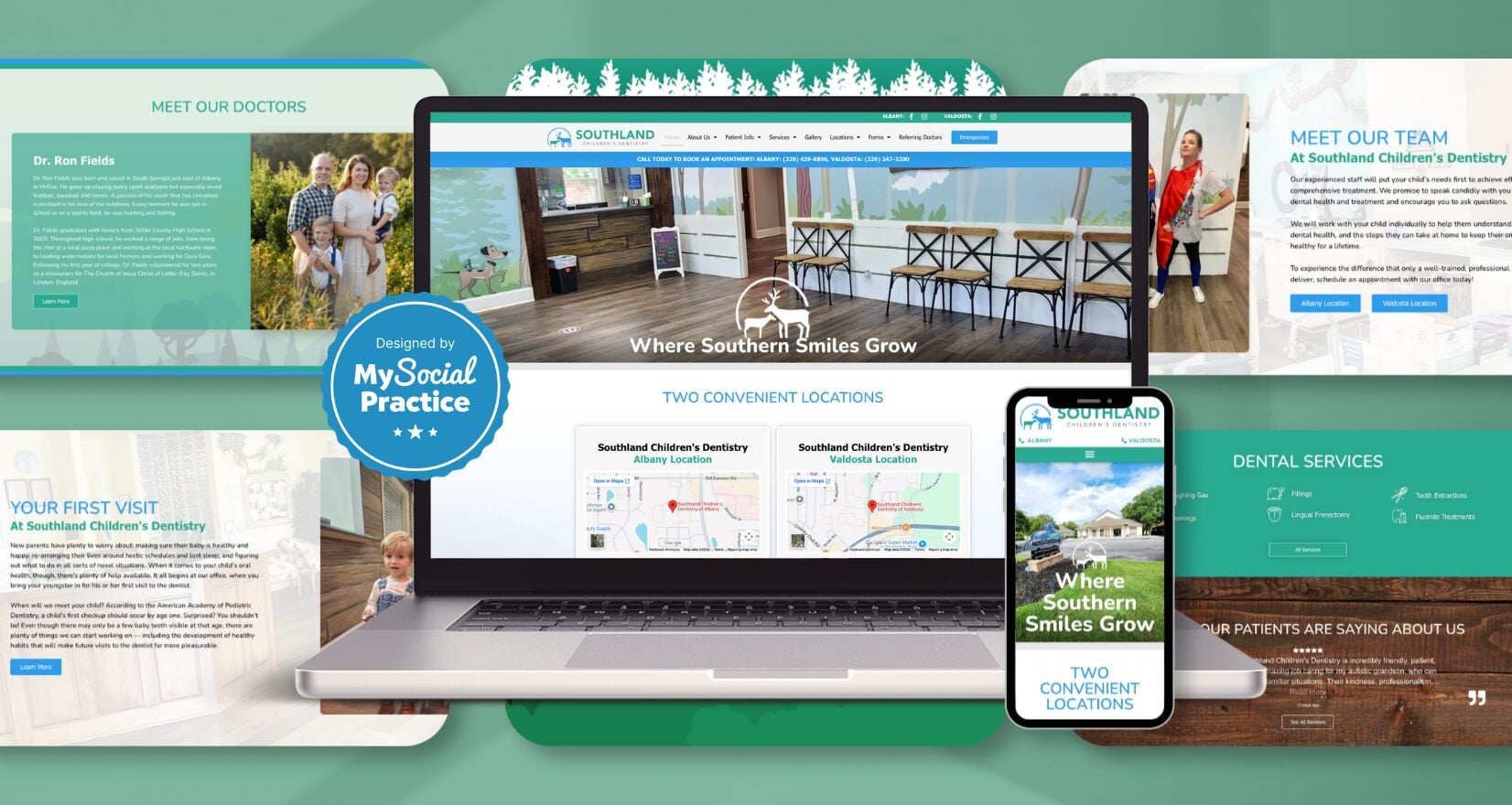
Southland Children’s Dentistry shows how a pediatric practice can build distinctive brand identity through illustration and regional voice. Custom illustrated woodland characters anchor the homepage’s lower fold, giving the site visual ownership of a forest theme that pairs naturally with the “Where Southern Smiles Grow” tagline. Tree-line separator graphics divide homepage sections and reinforce the same metaphor throughout. A two-location architecture maintains parallel phone numbers, dedicated meet-the-team pages, and office-tour pages for each office. Five pediatric dentists are featured with detailed personal biographies — Dr. Sellers’ unconventional path from cabinet-company owner to dentist, Dr. Carly’s chief residency at Florida, Dr. Sydney’s hospital dentistry training.
The takeaway: pediatric design wins when a region’s character — here, rural Southern Georgia — gets carried into the brand identity rather than being scrubbed out for generic appeal. Cobble Creek Dental, just above, follows the same strategy but with a Wasatch Front palette anchored to Northern Utah. Same approach, completely different visual results because the practices’ personalities are different.
William L. Ingram, DMD
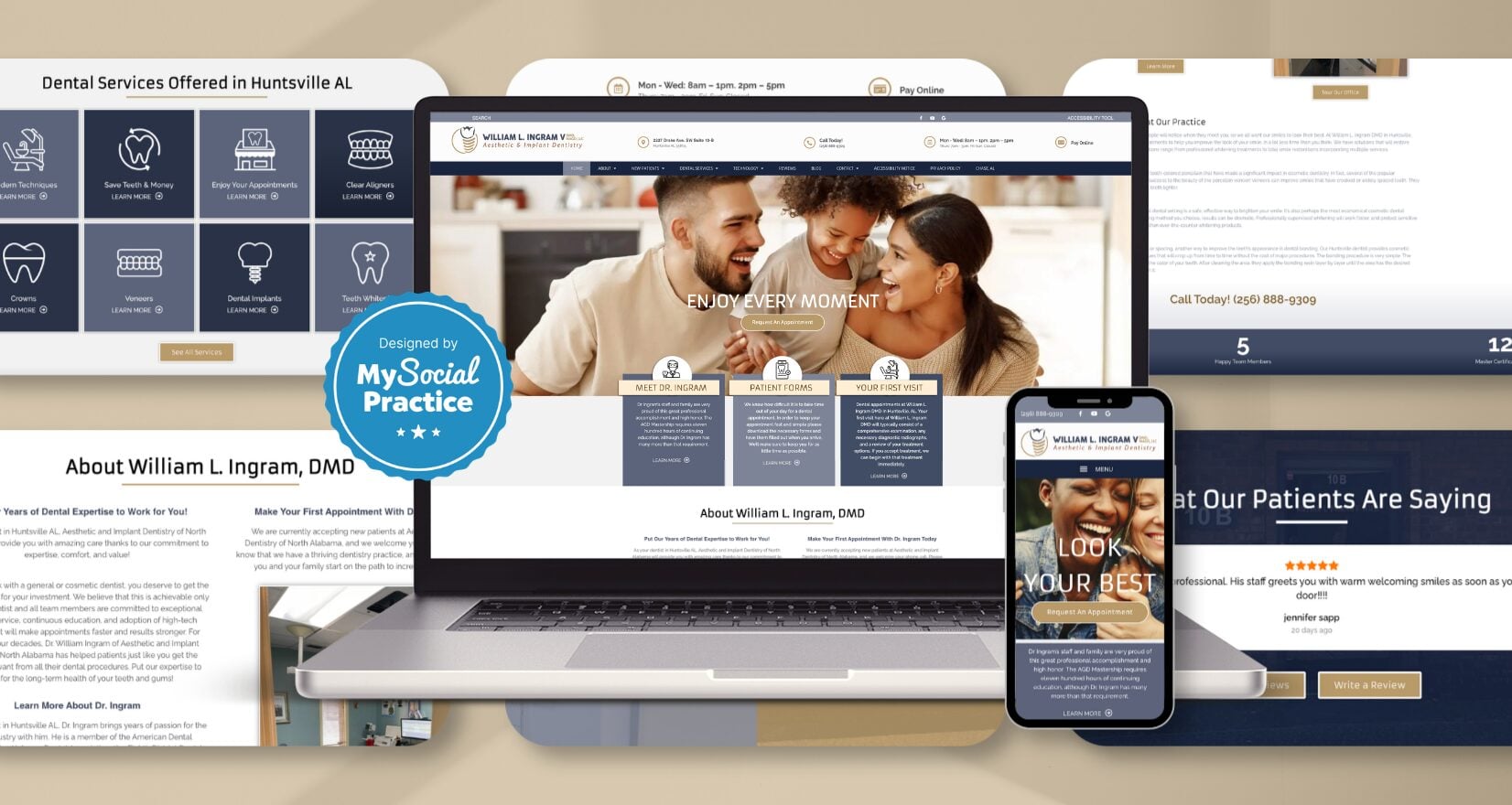
Dr. William L. Ingram’s site shows how a solo general dentistry practice can foreground credentials without making the design feel resume-like. The practice’s full brand identity — Aesthetic and Implant Dentistry of North Alabama — is treated as a confident anchor for a four-decade career, with Dr. Ingram’s distinction as one of only three Alabama dentists to earn the Academy of General Dentistry Life Learning and Service Recognition Award called out directly rather than buried in an About page. The homepage’s four-pillar design pattern (“Modern Techniques / Save Teeth & Money / Enjoy Your Appointments / Clear Aligners”) reframes services as patient outcomes rather than clinical category names. A persistent accessibility tool in the header signals design discipline most dental sites skip. The lower fold stacks professional association logos as a credibility wall. An Areas We Serve architecture surfaces five Huntsville neighborhoods through dedicated pages, capturing the broader North Alabama search market from a single office.
The takeaway: when accumulated authority is treated as a structural feature, solo-practices build credibility rather than sounding as if they’re spouting marketing copy.
Lombardo & Cho Dentistry
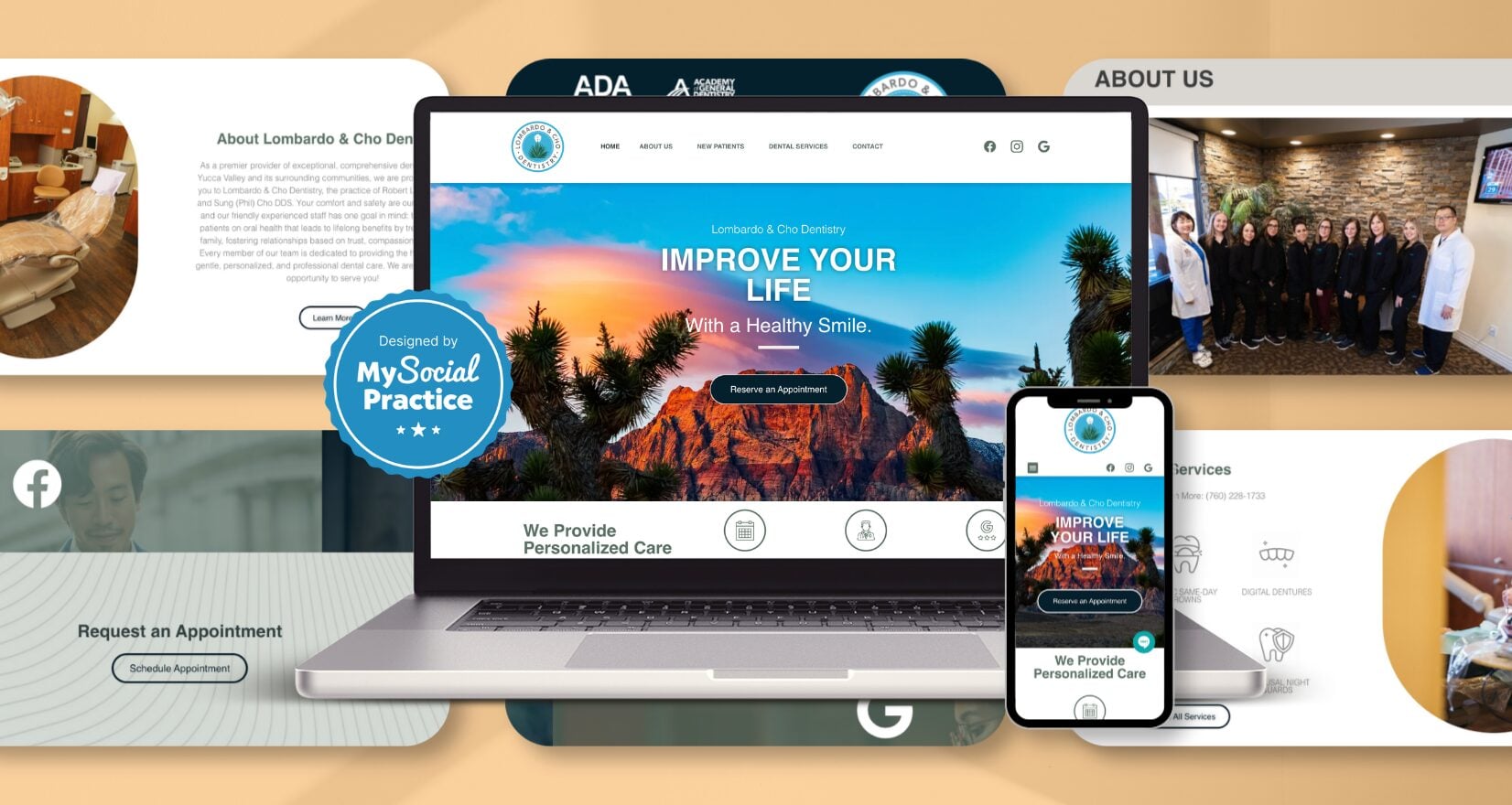
Lombardo & Cho Dentistry shows what design polish looks like when a small-town practice positions itself with the depth of a metropolitan one. Located in Yucca Valley, the site carries the visual restraint of much larger practices, featuring a clean tagline (“Improve Your Life With a Healthy Smile”), a tight six-icon service grid, and custom practice photography in place of stock imagery. The design also handles a practice rebrand gracefully. Dr. Lombardo’s solo practice has grown into a two-doctor partnership with Dr. Sung Cho, and the brand carries both names equally without abandoning the original community URL. A dedicated Areas We Serve architecture surfaces Joshua Tree and Twentynine Palms alongside Yucca Valley, capturing the broader Morongo Basin search market.
The takeaway: small-market practices look professional and trustworthy when their websites refuse to look like small-market sites.
Legacy Pediatric Dentistry
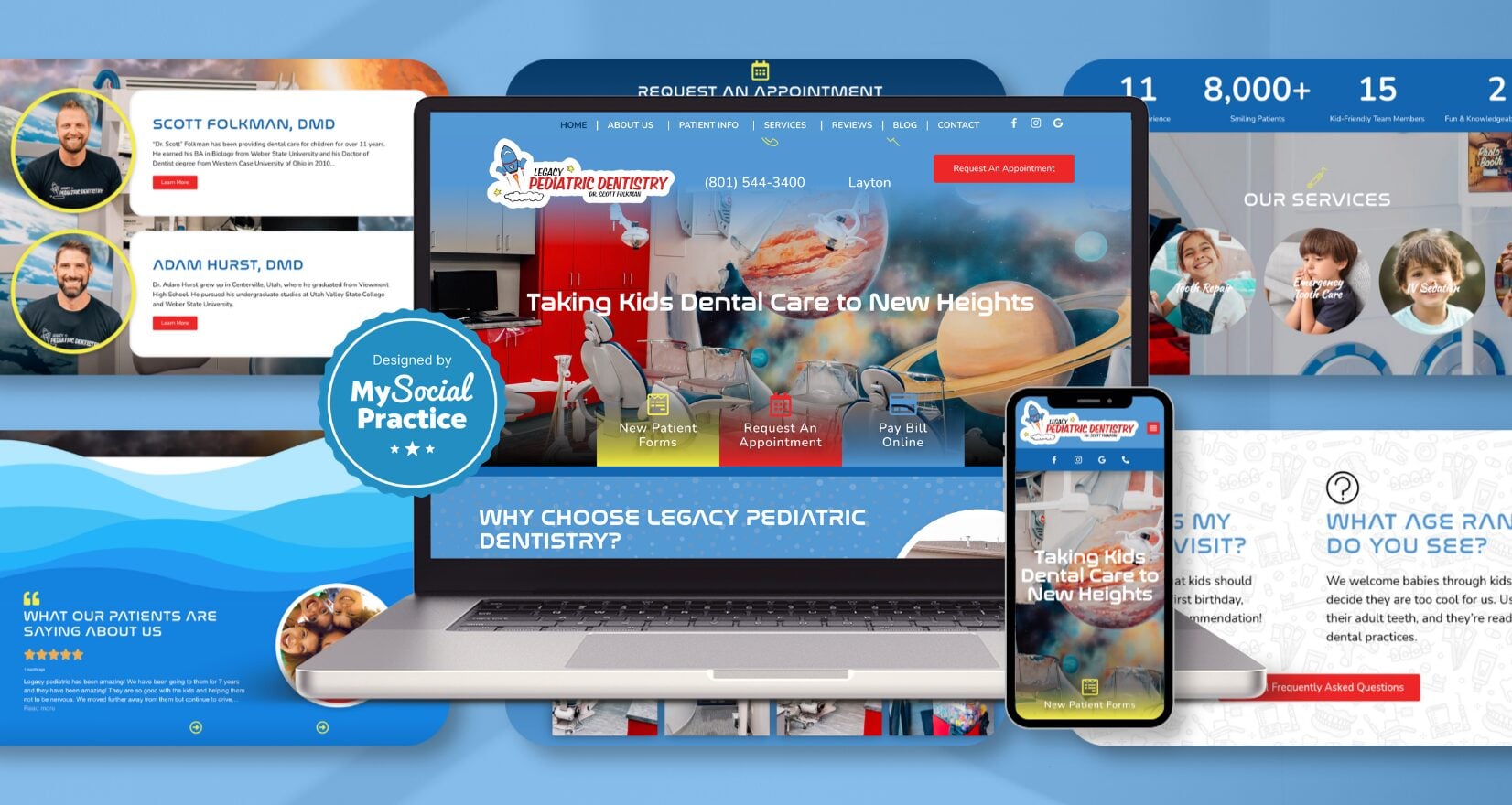
Legacy Pediatric Dentistry balances pediatric warmth with editorial restraint — a difficult combination for kid-focused sites, which often default to oversaturated playfulness. The homepage leads with a short, evocative tagline (“Taking Kids Dental Care to New Heights”) and Dr. Scott Folkman’s personal founding story from 2012, framed around his mission to create a new generation of comfortable dental patients. A Dr. Seuss quote (“A person’s a person, no matter how small”) adds personality without veering into saccharine territory. Custom photography of the actual office and team replaces stock imagery throughout, and the services section keeps focus tight with just five clearly named categories. A ¡Hola! indicator opens the practice to Spanish-speaking families in Layton, Utah.
The takeaway: pediatric dental sites work best when warmth is conveyed through specificity (a real founder story, a real practice, a real point of view) rather than through visual volume.
Yerra Family Dentistry
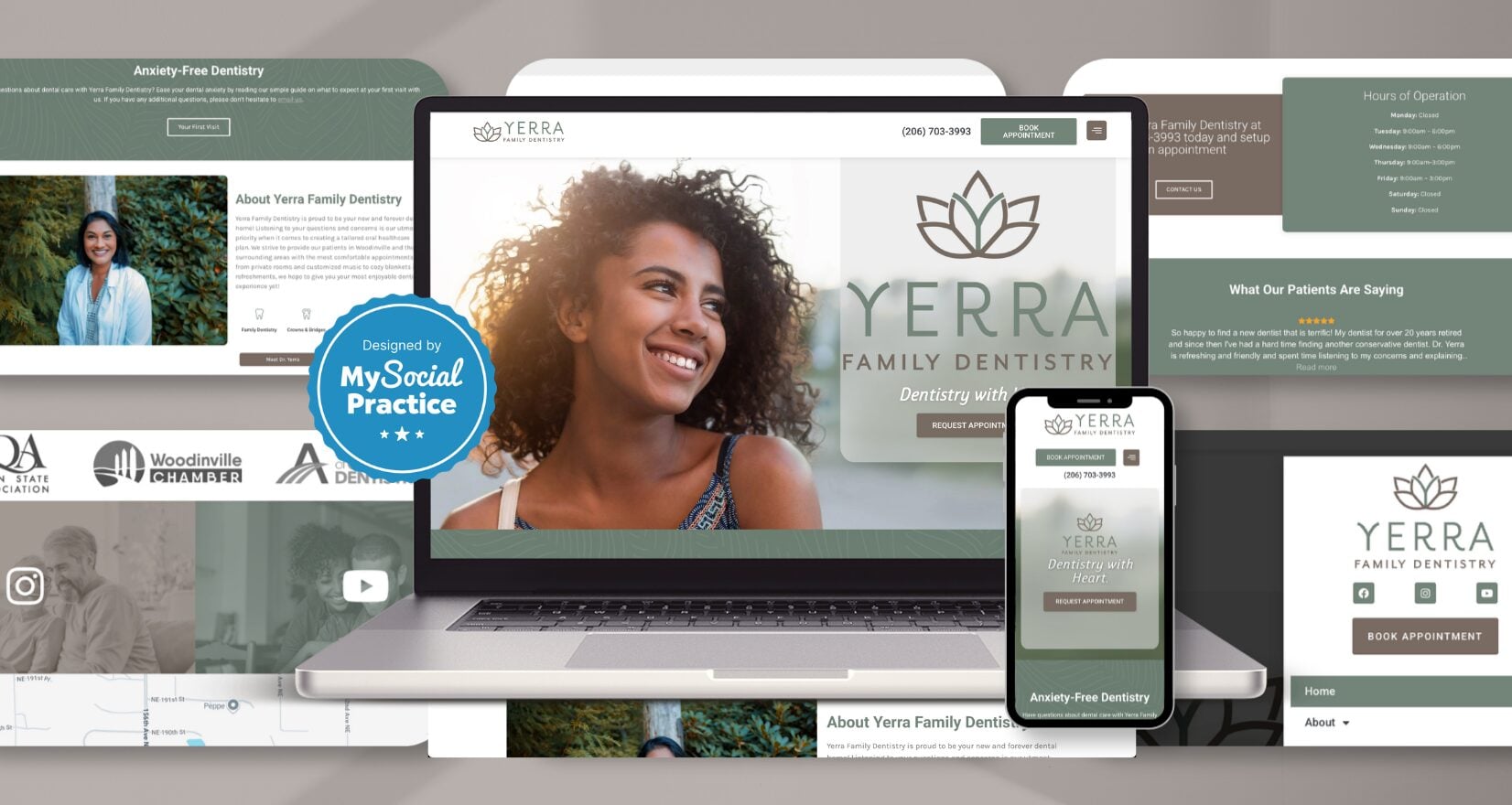
Yerra Family Dentistry shows what disciplined minimalism looks like applied to a solo dental practice. The homepage opens with a two-word hero — “Dentistry with Heart.” — and immediately surfaces an “Anxiety-Free Dentistry” section, signaling the practice’s positioning before scrolling past the fold. The visual language is restrained throughout: a soft neutral palette, simple line-icon services grid (Family Dentistry, Crowns & Bridges, White Fillings, Dental Cleanings), and generous whitespace that lets each element breathe rather than competing for attention. A custom monogram logo and consistent typography reinforce the editorial discipline. The comfort-and-anxiety positioning is concrete rather than abstract — private rooms, customized music, cozy blankets, refreshments — which gives the minimalist design something specific to deliver on. The result is a site that feels intentional rather than under-built, with a clear point of view about what a dental visit should feel like.
The takeaway: minimalism is a design strategy only when the restraint is paired with a clear, specific brand promise; otherwise it just reads as empty.
Final Thoughts About the Best Dental Website Designs of 2026
The 15 dental websites featured here share one trait above all: every design choice on the page reinforces a single, recognizable brand identity. The lesson rises above budget, agency choice, or template selection. Instead, consider whether your dental site reads as one specific practice’s story or as an assembled collection of dental marketing defaults. If you’re planning a redesign or evaluating your current site, the most useful question isn’t “what does my website look like?” It’s “does every layer of my website — homepage, navigation labels, doctor bios, photography, even the URL — sound like the same practice?”
Frequently Asked Questions
What makes a dental website design "best in class" in 2026?
A great dental website design in 2026 balances three things: visual identity (a clear, consistent brand expressed through color, typography, photography, and voice), brand cohesion across every layer of the site (homepage, doctor bios, service pages, navigation labels, even the URL), and technical performance that doesn’t undermine the visual work (fast load times, mobile responsiveness, accessibility). The standout designs on this list share one trait: every element of the site reinforces a single recognizable brand identity rather than reading as assembled from templates.
How important is custom photography on a dental website?
Authentic in-practice photography is one of the single strongest design differentiators in dentistry. Stock images, no matter how polished, signal a generic practice. Custom photos of the actual doctors, team, office, and patients — even when less technically perfect — communicate that this is a real place with real people. Across the 16 sites featured here, the strongest entries all use custom photography throughout, including for the homepage hero.
Should a dental website's homepage be short or long-scroll?
Both can work, but for different reasons. Short, design-forward homepages work when minimalism is paired with a specific brand promise the design delivers on. Long-scroll, content-dense homepages work when every section earns its place — depth becomes a credibility signal and a local SEO advantage. The wrong choice is a middle-ground homepage that sprawls without purpose. Pick a clear design philosophy and execute it fully.
How should multi-location dental practices structure their website?
The strongest multi-location dental sites in this list all share a structural pattern: parallel phone numbers in the header (one per location), dedicated office-tour and meet-the-team pages per location, and an Areas We Serve architecture that surfaces nearby communities. The key is treating both locations as equal first-class citizens rather than positioning one as primary and the other as a satellite.
What color palettes work best for dental websites?
The answer is less about specific colors and more about whether the palette ties to something meaningful. Generic dental blues and whites are forgettable. Cobble Creek Dental’s Wasatch Front earth tones anchor the brand to North Ogden’s geography. Sunshine Family Dentistry’s yellow ties directly to the practice name. LK Anderson DDS’s calming teal reinforces the periodontics-as-health-care positioning. The lesson: a color palette is a design choice when it carries the brand’s story, not a default when it just sits in the background.
How does Google's AI Overview affect dental website design?
AI Overview citations favor sites with clear, well-structured content — schema markup, descriptive headings, specific factual statements, named team members, named services, named locations. The dental sites that get cited in AI Overview answers tend to share two patterns: deep page-level content (not thin marketing copy) and structural specificity (real area pages, real service pages with real descriptions, real doctor bios). Visual design alone doesn’t drive AI citations, but it’s not separable from the content architecture that does.

Adrian Lefler is the CEO and Co-Founder of My Social Practice and a recognized dental marketing expert with nearly two decades of experience. He is a trusted voice in dental marketing, AI in dentistry, and emerging technology, and he hosts BYTE SIZED, a podcast focused on dental AI, innovation, and technology.