What You’ll Learn
- Why the neuroscience of change feels like “being punched in the face” even when it’s good change
- How team members fuse their identity to predictable tasks and why that creates resistance
- The shame cycle that blocks clinical growth and how to navigate it
- Why cash spiffs and micro incentives fail to build lasting habits
- What actually works when implementing AI or new technology in a dental practice
The Neuroscience of Why Your Dental Team Rejects New Technology
Jennifer Derse has watched dental technology fail more times than she can count. Not because the software was bad. Not because the AI didn’t work. It failed because nobody budgeted for behavior change.
“We get the software, we get really excited about it, and then it happens in a day,” Jen told Adrian Lefler on a recent episode of the Byte Sized Podcast. “No one really budgets for the time of behavior change.”
Jen spent years building and systematizing Espire Dental, helping grow the DSO from one location to 39 practices. She’s trained dental teams at scale, coached doctors through clinical and operational change, and watched firsthand where AI tools succeed or collapse in real practice environments. Now she’s taking that experience independent as a practice coach.
Her core message is simple: if your practice invested in AI or new technology and saw little to no return, the problem wasn’t the product. It was the implementation. And implementation is always a people problem.

Change Feels Like Getting Punched in the Face
The human brain treats change as a threat.
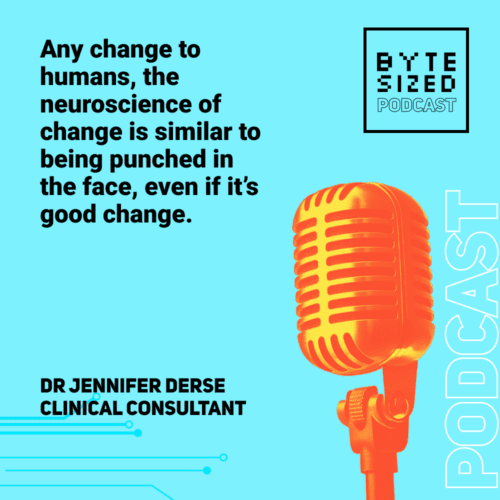
“Any change to humans, the neuroscience of change is similar to being punched in the face,” Jen explained. “Even if it’s good change, change freaks people out.”
This isn’t a character flaw. It’s biology. When a doctor comes back from a CE course excited about a new cement or a new AI diagnostic tool, the team doesn’t hear opportunity. They hear disruption.
Think about muscle memory. A hygienist who’s been using the same cement for years knows exactly how long to wait for it to cure. Fifteen seconds. Twenty seconds. It’s automatic. Changing that means rebuilding engrams, relearning timing, and feeling incompetent while doing it.
The team’s first instinct isn’t excitement. It’s fear. Are they doing their job wrong? Is someone getting fired? Is the practice being sold?
“It’s like going into this place of thinking, well, I’m getting on an airplane so it’s going to crash,” Jen said. “People come in saying I don’t like the dentist because they had a bad experience. Well, people have had bad experiences at certain DSOs. They’ve had bad experiences in some private practices too.”
The reaction is immediate and automatic. Fight or flight kicks in before the cortex even has a chance to process what’s happening.
Identity Gets Fused to Predictable Tasks
There’s a deeper layer to resistance that most leaders miss entirely.
Team members don’t just perform tasks. They become their tasks. Their identity gets wrapped around predictable routines because predictability feels safe. Knowing what you’re doing every day, knowing exactly what your job is, knowing the value you create for the company. That’s security.
When you inject change, you’re not just asking someone to do something differently. You’re threatening who they think they are.
“This is who I am. My job is this. This is what I do and this is the value that I create for the company,” Jen explained. “And so it’s this idea of maybe attaching the predictable tasks that are routine in some kind of an equation where that equals their value at the practice.”
The proper reframe is telling them they’re more valuable than they realize. Their value isn’t in the routine tasks. It’s in providing great oral health care. But that shift requires intentional communication that most leaders never think to provide.
| What Team Members Fear | What Leaders Should Communicate |
| “I’m being replaced” | “You’re more valuable than your routine tasks” |
| “I’ve been doing it wrong” | “What we did before wasn’t wrong. We’re just growing.” |
| “I’m going to get fired” | “No one is losing their job. We’re doing things differently.” |
| “This is too much extra work” | “Let’s start small. One thing at a time.” |
The Shame Cycle That Blocks Clinical Growth
When Jen consults with a new practice, one of the first things she evaluates is their perio program. It’s a reliable indicator of how the team handles clinical accountability.
The problem isn’t that hygienists don’t know what they should be doing. It’s that acknowledging the gap triggers shame.
“If you tell a hygienist that they’ve been monitoring supervised neglect for 14 years and we should have been doing this all along,” Jen said, “they take it personally. They associate what they were doing before as almost like, this is me. I’ve been doing this this way. So because of that, you’re telling me that way was wrong.”
One of Jen’s coaches gave her a phrase she’s carried ever since: “Don’t sh*t on yourself.”
When people spiral into “I should have been doing this for 14 years, what have I been doing,” the conversation shuts down. They’re not in a growth mindset anymore. They’re in a shame response.
The reframe matters enormously. It’s not that they were wrong. It’s that they’re being asked to decide if they want to be right, right now. Focus on the opportunity in the present, not the verdict on the past.
“Just because we behaved a certain way doesn’t mean that was wrong,” Jen explained. “We have to focus on what we’re looking at now.”
Why Cash Spiffs Don’t Build Lasting Habits
A lot of practices try to motivate behavior change with money. Five dollars for every Google review. A bonus for every toothbrush sold. A percentage of production.
It doesn’t work. At least not for long.
Jen referenced Dan Pink’s research on motivation. In his book Drive, Pink found that people are more driven by purpose than by small dollar amounts or spiffs. The brain tires of transactional incentives when they’re not connected to meaning.
“If you do those types of things, it can change for the short term, but it doesn’t change for the long term,” Jen said. “And then if it’s not something that is aligned with purpose, the habit falls off.”
The research involved licking envelopes. People would do it for a penny each, but eventually they stopped. The money wasn’t worth it without purpose behind the task.
The same dynamic plays out in dental practices. Some team members are money motivated. Give them cash and they’ll ask for reviews all day. But others want recognition. They want to feel like part of the team. They want to know they have longevity and security. They want to be listened to.
“We’re not all motivated by the same stuff,” Jen said. “It’s like the love languages book. But as leaders, you have to be able to do it all.”
Leaders Don’t Get to Be in Default Mode
Here’s the uncomfortable truth about leadership: you don’t get to react the way everyone else does.
When patients come in anxious and defensive, they’re in fight or flight. They might say something rude or act unfriendly. Team members sometimes match that energy, dismissing the patient as difficult.
But leaders can’t operate that way. And they can’t let their teams operate that way either.
“As leaders, we don’t get to be in default,” Jen explained. “We have to stay in our cortex and be in that high level all the time.”
That means being intentional about how you communicate corrections with different team members. That means celebrating small wins in real time. When an assistant takes a great x-ray, how hard is it to say so?
“It’s how easy is it to say that is a great x-ray,” Jen said. “I bet you both had to work hard to get that root on that back tooth. Congratulations to you for holding and biting down for so long. And to the assistant, good job on getting that angle. I don’t even know if I could have gotten that myself.”
That’s leadership. Staying in your cortex instead of defaulting to autopilot.

What Actually Works When Introducing AI Tools
Implementation succeeds when teams understand the why behind the change or the new dental technology. When they’re connected to purpose rather than just handed a directive.
“A lot of doctors learn a lot about how to be great clinicians,” Jen said. “They think, oh, I’ve communicated this great new vision and they’re excited. But the team just hears this directive. They’re not the same thing.”
The atomic habits approach works. Small bites. Tiny gains. Show them their first wins, but do it incrementally. You can’t come in after a CE course and change everything at once. It’ll freak people out.
And vulnerability from leadership matters more than most doctors realize. Sharing your own failures, your own learning curve, your own moments of resistance. That models the behavior you want to see.
“I think in leadership and in coaching, if you can approach from that perspective and do it with heart, people feel seen, feel heard,” Jen said. “Leadership’s actually not that hard if you have all that. The problem is how do you do that? That’s the hard thing.”
In This Episode:

Dr. Jen Derse, DDS
Jennifer Derse is a dentist, co-founder of Espire Dental, and clinical consultant with over two decades of experience building and systematizing dental support organizations. After helping grow Espire Dental from one location to 39 practices, she transitioned into full-time coaching focused on helping practice owners improve clinical systems, team performance, and operational leadership. She is a Kois Center mentor with deep expertise in cosmetic and restorative dentistry.

Adrian Lefler, CEO and Co-founder of My Social Practice
Adrian Lefler, CEO of My Social Practice, is a seasoned expert in the dental marketing industry with 14 years of experience. He is widely recognized for his engaging and informative presentations. Based in Suncrest, Utah, Adrian shares his life with his wife, four children, and a lively mix of pets. My Social Practice is a leading dental marketing company, and Adrian is passionate about helping dental professionals succeed in this dynamic field.
Frequently Asked Questions
Why do dental teams resist new technology even when it's clearly beneficial?
The neuroscience of change triggers a threat response in the brain, even for positive changes. Team members also fuse their identity to predictable tasks, so new technology feels like a threat to who they are. Without clear communication about purpose and value, resistance is the default reaction.
Why don't cash incentives work for motivating dental teams long-term?
Research shows that small monetary incentives create short-term behavior change but don’t build lasting habits. When incentives aren’t connected to purpose, the brain tires of them. Different team members are motivated by different things including recognition, security, and feeling heard.
How should dental leaders communicate when implementing new AI tools?
Connect the change to purpose. Explain why it matters for the team, why it matters for patients, and why it matters for the practice. Start small with incremental changes rather than overhauling everything at once. And be vulnerable about your own learning process rather than presenting yourself as infallible.