What You’ll Learn
- Why Google started indexing social media content directly last year and how that changes dental marketing
- Why follower count matters less than engagement, watch time, and comments
- How Instagram became the front door of your dental practice the same way Google Business Profile did years ago
- Why user-generated content like patient comments now carries real weight in search
- How organic posting functions as a litmus test for what to spend ad dollars on
Google Now Indexes Your Social Media
Something changed in how Google works last year, and most dental practices missed it entirely.
Google started indexing social media content directly. That means your Instagram posts, your geotagged content, and the comments patients leave on your feed now factor into how you show up in search.
Matt Hutchings has spent eight years at Productive Dentist Academy working across creative strategy, go-to-market products, and on-site photo and video shoots for dental practices around the country. He’s watched the search landscape shift in real time.
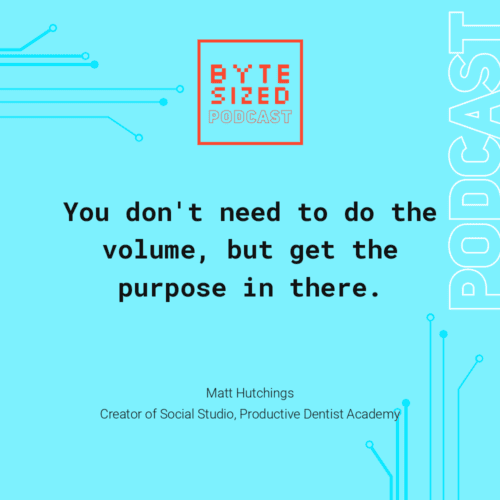
“Social is not just a nice-to-have anymore,” Matt told Adrian Lefler on a recent episode of the Byte Sized Podcast. “It’s being indexed. It’s part of how Google decides who to show. If you’re not posting, you’re invisible in ways you weren’t before.”
The rules changed, and most practices are still playing by the old ones.
Follower Count Is a Vanity Metric Now
For years, dental practices chased follower counts. Ten thousand followers felt like success. A hundred thousand felt like domination.
That math doesn’t work anymore.
“Follower count matters less now than engagement, watch time, and comments,” Matt said. “The algorithm doesn’t care how many people followed you three years ago. It cares whether people are actually interacting with what you’re posting today.”
A practice with 500 engaged followers who comment, share, and watch videos to completion will outperform a practice with 50,000 followers who scroll past everything.
This shift rewards authenticity over accumulation. Building a smaller, engaged audience beats buying followers or chasing viral moments that attract people who’ll never become patients.
| Old Metric | New Metric |
| Follower count | Engagement rate |
| Impressions | Watch time |
| Reach | Comments and shares |
| Likes | Saves and sends |
Instagram Is the New Front Door
Years ago, a widely cited statistic revealed something uncomfortable: 64% of traffic to Google Business Profiles never made it to the practice website. Patients were making decisions based on what they saw in the listing itself. Reviews, photos, basic information. They never clicked through.
Matt sees the same pattern emerging with Instagram.
“Instagram is the front door now,” he said. “Patients are looking at your feed, watching your Reels, reading your comments. They’re deciding whether to call before they ever visit your website.”
Think about how you evaluate a restaurant. You might Google it, but then you check Instagram. You look at the food photos. You read the comments. You get a feel for the vibe. If the Instagram looks dead or outdated, you wonder if the restaurant is too.
Dental practices work the same way now. A profile that hasn’t posted in three months signals something to potential patients. Maybe the practice is too busy to care. Maybe they’re behind the times. Maybe they’re not the kind of modern, engaged practice the patient is looking for.
“Your Instagram is making a first impression whether you’re intentional about it or not,” Matt said.
User-Generated Content Actually Matters Now
The comments patients leave on your posts now carry weight in search.
This is user-generated content, and it’s gold. When a patient comments “Dr. Smith is the best, my whole family goes here,” that’s not just a nice moment. That’s searchable, indexable content that reinforces your relevance and credibility.
“Google is reading those comments,” Matt said. “It’s understanding the sentiment. It’s seeing that real people are vouching for you in a public forum.”
This shifts the whole point of posting. Dental social media is about creating content that invites response. Content that makes patients want to comment, share, and engage.
A post that gets 50 genuine comments from local patients does more for your discoverability than a post that gets 500 likes from strangers who’ll never walk through your door.
Organic Posting as a Litmus Test
Most practices think about organic social media and paid advertising as separate buckets. Post some content over here, run some ads over there.
Matt sees them as connected.
“Organic posting is your litmus test,” he said. “Instead of guessing what to spend ad dollars on, you look at which organic posts got real engagement. Then you fund paid campaigns around what already worked.”
This approach removes guesswork. If a post about sedation dentistry gets twice the engagement of everything else you’ve posted, that’s data. It tells you what your audience cares about. You can build a paid campaign, retargeting sequence, and landing page around that topic knowing there’s already demand.
“You’re not throwing money at creative and hoping it works,” Matt said. “You’re investing in proven performers.”
The organic content becomes research. The paid content becomes amplification of what you already know resonates.
The Content Problem Every Practice Faces
If social media matters this much, why aren’t more practices doing it well?
The answer is simple: capacity.
“Doctors are busy. Teams are busy. The content plan breaks down right there,” Matt said. “Everyone agrees they need to post more. Nobody has time to actually do it.”
Practices will hire someone to manage social media. That person lasts six months before burning out or moving on. Or the doctor tries to do it themselves for a few weeks before clinical demands take over. Or they hire an agency that posts generic content that doesn’t feel authentic.
“I kept running into the same wall,” Matt said. “Practices need authentic, real content. But the busiest people in the office are the ones expected to create it.”
This is a structural problem. The people with the best stories to tell are the people with the least time to tell them.
The Hybrid AI Approach
This frustration led Matt to build Social Studio, a system that tries to solve the content capacity problem without sacrificing authenticity.
The approach is hybrid. A photographer does a single on-site shoot capturing core assets: patient portraits from multiple angles, empty operatories, team photos, real imagery from the actual practice. Then AI recombines those real assets into new scenes.
“We’re not generating fake people or fake places,” Matt explained. “We’re taking your real team, your real office, your real patients, and creating new compositions from those authentic elements.”
The result is months of content from a single shoot. The practice doesn’t need to keep producing new material every week. The core photography does the heavy lifting.
Adrian pushed on the obvious question: why not just use stock photography or hire a local photographer to shoot a thousand images?
Matt walked through the tradeoffs. Patient photo releases create complications. Untrained photographers create HIPAA risk. Third-party turnaround is unreliable. And even a great shoot with real actors runs out of new content eventually.
“You can get maybe 50-100 really usable images from a traditional shoot,” Matt said. “That sounds like a lot until you’re posting five times a week and you’ve burned through everything in a month.”
The Ethics of AI-Enhanced Content
Using AI to create marketing content raises obvious questions. Is this deceptive? Are you showing patients something that isn’t real?
Matt has thought about this carefully.
“Every Social Studio post is labeled as AI-enhanced,” he said. “Doctors pre-approve every image before it goes live. We’re upfront about what this is.”
The industry’s comfort with AI-generated imagery could change. What’s acceptable today might feel different in two years. Matt would rather be transparent now than retrofit trust later.
“If you’re not telling people when something is AI-enhanced, you’re taking a risk,” he said. “Not just a reputational risk. An ethical one.”
The line he draws is to use AI to recombine real assets, not to fabricate them entirely. The people in the images are real. The office is real. The AI is a composition tool, not a fiction generator.
What This Means for Your Practice
The implications are clear. Posting on social media used to be a nice extra. Now it’s a requirement for growth.
Google is indexing your social content. Instagram is where patients form first impressions. Engagement matters more than follower count. User-generated comments carry weight in search.
If your practice isn’t posting consistently, you’re falling behind practices that are. Not because social media is trendy. Because the discovery mechanisms have changed.
“You don’t have to become an influencer,” Matt said. “You just have to show up consistently with authentic content that invites engagement. That’s the bar now.”
The good news is that the bar isn’t perfection. Patients don’t expect cinematic production value. They want to see real people, real stories, and a practice that feels alive.
“Post something real once a week and respond to comments,” Matt said. “That alone puts you ahead of 80% of practices.”
In This Episode:

Matt Hutchings, Marketing Strategist
Matt Hutchings has spent eight years at Productive Dentist Academy working across creative strategy, go-to-market products, podcast production, and on-site video and photo production for dental practices nationwide. He is the creator of Social Studio, a hybrid photography and AI content system built specifically for dental practices.
Adrian Lefler, CEO and Co-founder of My Social Practice
Adrian Lefler, CEO of My Social Practice, is a seasoned expert in the dental marketing industry with 14 years of experience. He is widely recognized for his engaging and informative presentations. Based in Suncrest, Utah, Adrian shares his life with his wife, four children, and a lively mix of pets. My Social Practice is a leading dental marketing company, and Adrian is passionate about helping dental professionals succeed in this dynamic field.
Frequently Asked Questions
Why does Google indexing social media matter for dental practices?
Google now pulls social media content into search results, including geotagged posts and user comments. This means your Instagram activity directly affects your discoverability. Practices that aren’t posting consistently are invisible in ways they weren’t before.
Does follower count still matter for dental social media?
Less than it used to. Engagement metrics like watch time, comments, shares, and saves matter more than raw follower numbers. A small, engaged local audience outperforms a large, passive following for driving actual patient inquiries.
Why is Instagram called the "front door" of a dental practice now?
Just like patients used to make decisions from Google Business Profiles without visiting the website, they now evaluate practices based on Instagram. Your feed creates a first impression before anyone calls or books online.
How can organic social media inform paid advertising strategy?
Organic posting works as a testing ground. Posts that get high engagement reveal what your audience cares about. You can then build paid campaigns, retargeting, and landing pages around topics you already know resonate.
What's the ethical approach to using AI in dental marketing content?
Label AI-enhanced content clearly. Use AI to recombine real assets rather than fabricate people or places entirely. Have doctors pre-approve every image. Transparency now builds trust and protects against shifting industry norms later.