Updated September 2026 · By Adrian Lefler
Quick Answer: AI search is shifting where your dental website traffic comes from, not erasing it, as long as your site is ready. As of the latest data, more than 90% of AI-referred traffic still lands on desktop, and Google is the only major AI engine that sends more mobile visitors than desktop. For a dental practice, that means two priorities. Keep your website fast and accurate on desktop, where most AI users research you. And keep your Google Business Profile and mobile pages sharp for the mobile traffic Google does send. Practices that optimize for both devices, and that publish clear, quotable answers AI engines can cite, keep their new-patient visits instead of losing them to zero-click results.
Table of Contents
- How is AI search changing where dental website traffic comes from?
- Will AI Overviews and ChatGPT reduce your website traffic?
- Desktop or mobile: where does AI actually send dental patients?
- What does this shift mean for your dental practice?
- How can you protect and grow your dental website traffic in AI search?
- How do you measure your AI search traffic?
- Frequently Asked Questions
How is AI search changing where dental website traffic comes from?
AI search is changing the source of your traffic, not the total demand for a dentist. People still need cleanings, crowns, and emergency appointments. What is changing is the path they take to find you. Instead of typing a few keywords and scanning a list of blue links, more patients now ask a full question and read an AI-written answer first.
That answer often names a few practices, summarizes reviews, and pulls facts straight from websites. Some patients click through. Many do not, because the AI already told them what they wanted to know. So the classic pattern, where a search sends a visitor to your homepage, is being replaced by a mix of AI answers, direct visits, and calls that never show up as a tidy click in your reports.
For your practice, the takeaway is simple. Your job is no longer only to rank on a results page. It is to be the practice the AI engines quote, recommend, and send patients to, on whichever device those patients happen to be using. That is the whole game now, and it is why understanding how AI search engines decide to recommend your practice matters more than chasing any single keyword.
Will AI Overviews and ChatGPT reduce your website traffic?
They can reduce your raw click count, but they do not have to reduce your patient count. AI Overviews and tools like ChatGPT answer many questions on the spot, so fewer people click through for basic information. This is the “zero-click” pattern, where a search or a chat ends without a visit to any website.
Here is the part that reassures most dentists. The searches that matter most for a practice are local and high-intent: “emergency dentist near me,” “Invisalign in [city],” “dentist that takes my insurance.” Those searches end in a phone call, a map tap, or a booking, not a long read of an informational article. AI engines are good at handing that patient a shortlist, and if your practice is on it, you win the visit even when the click count looks flat.
What actually falls is traffic to broad, informational pages that AI can now summarize itself. A generic “what is a root canal” article will pull fewer visits than it used to. Pages that convert local searchers into booked patients hold their value, because an AI answer cannot replace your Google Business Profile, your reviews, or your appointment page. The practices that lose traffic are the ones that never adjusted. The ones that treat AI as a new front door tend to hold steady or grow. If you have watched your numbers slide, it helps to understand why dental website traffic is dropping and what to do about it before assuming your SEO is broken.

Desktop or mobile: where does AI actually send dental patients?
Overwhelmingly desktop, with one important exception. As of the latest available data, more than 90% of referral traffic from AI search engines comes from desktop users, not phones. That single fact reshapes how you should think about your website.
The device split by engine is striking. Referral traffic to websites breaks down roughly like this:
- ChatGPT: about 94% desktop
- Perplexity: about 96% desktop
- Bing (with Copilot): about 94% desktop
- Google Gemini: about 91% desktop
- Google Search: about 44% desktop and 53% mobile
Google is the outlier. It is the only major AI engine that sends more mobile visitors than desktop, with a majority of its AI-driven referrals coming from phones. Every other major engine is a desktop-first channel by a wide margin.
The pattern holds inside Google’s own results too. AI Overviews tend to appear more often and take up more room on desktop, where they occupy far more screen space than on a phone. On mobile, they show up less often for most queries, though they surface more frequently for shopping-style searches. In plain terms: when someone is doing careful research about a dentist, they are usually doing it on a larger screen, and that is where the AI is doing the most talking about you.
Here is the quick comparison to keep in mind:
- Desktop is where most AI research happens. ChatGPT, Perplexity, Bing, and Gemini all send the vast majority of their referrals here. This is where a patient reads about your practice in depth.
- Mobile is where Google sends the most AI traffic, and where “near me” and same-day searches concentrate. This is where a patient acts, taps to call, or opens your map listing.
You need both to work. Neither one is optional.
What does this shift mean for your dental practice?
It means a desktop site you may have stopped thinking about is now doing heavy lifting, and your mobile experience still has to close the deal. For years the advice was “mobile first, mobile first.” That is still true for local action, but it is no longer the whole story for AI.
Most of the people meeting your practice through AI are on a desktop, reading a full-screen answer that may quote your site directly. If your desktop pages are slow, thin, or out of date, that is the version of your practice the AI represents. A cramped or neglected desktop experience now costs you visibility in the exact channel that is growing fastest.
At the same time, Google still funnels a majority of its AI referrals to mobile, and those are often the highest-intent local searches. A patient who asks Google’s AI for an emergency dentist and gets your name needs a mobile page that loads fast, shows your phone number, and makes booking effortless. Lose that moment and you hand the patient to the practice down the street. This is where optimizing for AI-driven search traffic becomes a two-device discipline rather than a one-device checkbox.
The bottom line for your practice: AI has not picked a winner between desktop and mobile. It has raised the stakes on both. Your desktop site earns the research and the citation. Your mobile site earns the call.
How can you protect and grow your dental website traffic in AI search?
Protecting your traffic comes down to being quotable, being fast on both devices, and being verifiable as a real local practice. Work through these steps in order:
- Tighten your desktop experience. Make sure your service pages load quickly, read clearly, and are current. This is where most AI research happens, so treat your desktop site as a primary channel, not an afterthought.
- Keep mobile action-ready. Confirm your phone number is tap-to-call, your booking flow is short, and your key pages load in a couple of seconds on a phone. Google sends most of its AI referrals here, and these are your highest-intent local searches.
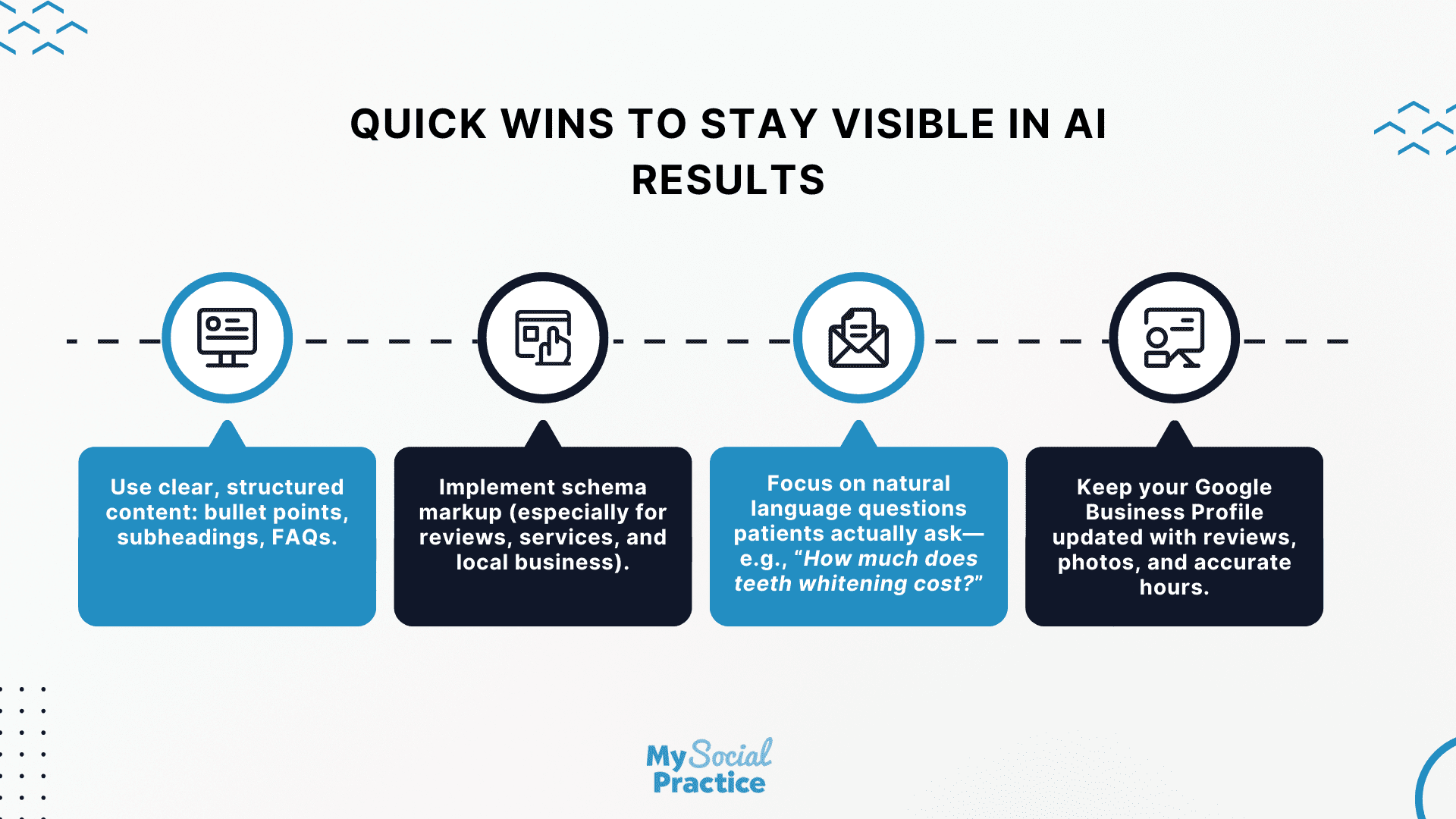
- Write clear, quotable answers. Lead each page with a direct answer to the question a patient would ask, then expand. Use plain language, real headings phrased as questions, and short paragraphs. AI engines lift and cite content that is structured to be extracted.
- Add and maintain schema markup. Structured data (FAQPage, LocalBusiness, and article schema) helps AI engines understand who you are, what you offer, and where you are located. It makes your practice easier to quote correctly.
- Own your Google Business Profile. Keep your hours, services, address, and photos accurate, and keep collecting reviews. AI engines lean heavily on this profile to recommend local practices, especially on mobile.
- Publish content patients actually ask about. Answer the real questions you hear in the chair, priced and localized where possible. Practices that publish content built for AI-driven search get cited more often than those that publish generic filler.
- Keep your facts consistent everywhere. Your name, address, and phone number should match across your site, your profile, and directories. Conflicting details make AI engines less confident about recommending you.
Do these consistently and you are optimizing for the way patients search now, not the way they searched five years ago.
How do you measure your AI search traffic?
You measure it inside the tools you already use, with realistic expectations about what they can and cannot see. Google Analytics 4 now reports an AI-referral channel, and Google Search Console blends your AI appearances into your existing performance data. Start there.
In Google Analytics, look for the AI-related traffic source to see which assistants are sending visitors and whether that number is trending up. In Search Console, watch for rising impressions with flat clicks at a steady position, which is a common sign you are appearing inside AI answers rather than classic links. Neither tool captures a mention that never turns into a click, so treat the numbers as a floor, not a full picture.
For the step-by-step setup, see our guides on where AI search traffic comes from and how to track it and how to track AI Mode traffic in Search Console. Together they cover the reporting side so this page can stay focused on the strategy.

Frequently Asked Questions
Will AI search reduce traffic to my dental website?
It can lower your raw click count, but it does not have to lower your patient count. AI answers absorb basic informational searches, so fewer people click through for general questions. High-intent local searches still send patients to booking pages and phone calls, so practices optimized for both AI citation and local conversion tend to hold steady or grow.
Does AI search traffic come from desktop or mobile?
Mostly desktop. As of the latest data, more than 90% of AI-referred website traffic comes from desktop users. ChatGPT, Perplexity, Bing, and Gemini all skew heavily desktop. Google is the exception, sending a majority of its AI referrals to mobile, which makes both devices essential for a dental practice.
How can dentists get website traffic from AI search engines like ChatGPT and Google AI Overviews?
Publish clear, quotable answers to the questions patients actually ask, keep your desktop and mobile pages fast and accurate, add schema markup, and maintain an active Google Business Profile with current details and fresh reviews. AI engines recommend practices they can verify and quote, so structure and accuracy matter more than keyword stuffing.
How do I track AI search traffic in Google Search Console?
Open Performance, then Search results, and read your impressions, clicks, and average position. AI Mode and AI Overview appearances are blended into these totals rather than broken out separately. A pattern of rising impressions with flat clicks at a steady position usually means you are showing up inside AI answers. A dedicated AI report is rolling out to some sites but shows impressions only.
Is a mobile-friendly website still important for dentists if AI traffic is mostly desktop?
Yes, absolutely. Google, the engine that sends the most AI referrals to phones, favors mobile, and most “near me” and emergency searches happen on mobile. Desktop earns the research and the citation, but your mobile site earns the tap-to-call and the booking. You need both working well.
Do I need to write different content for AI search than for regular SEO?
Not entirely different, but structured for extraction. Lead each page with a direct answer, phrase headings as real questions, keep paragraphs short, and add FAQ and local business schema. Good AI content is also good SEO content: clear, accurate, locally relevant, and easy for both people and machines to read.

Adrian Lefler is the CEO and Co-Founder of My Social Practice and a recognized dental marketing expert with nearly two decades of experience. He is a trusted voice in dental marketing, AI in dentistry, and emerging technology, and he hosts BYTE SIZED, a podcast focused on dental AI, innovation, and technology.