What You’ll Learn
- Why dental practice profitability is shrinking even as revenue grows
- How umbrella PPO policies route claims through the lowest reimbursement
- Why AI revenue cycle tools help with admin but don’t fix the underlying math
- The step-by-step process for building a membership plan safety net
- How one practice grew to $50,000/month in recurring revenue before dropping Delta Dental
Revenue Up 1.4%. Expenses Up 4.9%. Here’s Why Your PPO Model Is Broken.
The ADA released a report on the fiscal squeeze hitting dental practices. The numbers are brutal.
Revenue grew 1.4%. Expenses grew 4.9%. That’s three and a half times faster.
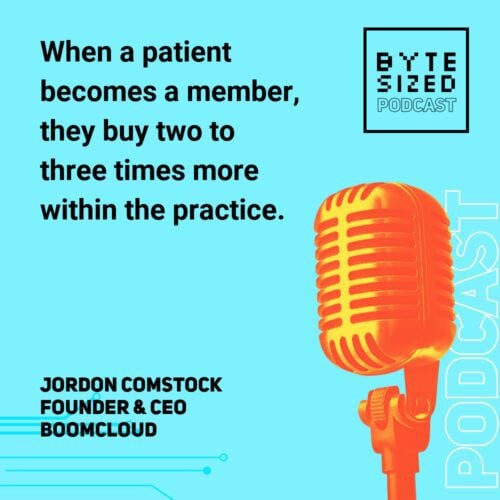
Jordon Comstock, founder and CEO of BoomCloud, has been watching this squeeze build for years. His read on it is blunt.
“This is a business model problem, not a cost-cutting problem,” Jordon told Adrian Lefler on a recent episode of the Byte Sized Podcast. “Profitability is shrinking and purchasing power is shrinking. And the biggest culprit is too many practices signed up with too many PPOs trying to make that business model work.”
It’s not working. The treadmill keeps speeding up, and practices are running harder for less.

How PPO Contracts Created the Squeeze
Most PPO agreements require discounts off UCR fees. Depending on your region, that discount ranges from 40% to 55%.
“Utah is a really bad state with PPO contracts,” Jordon said. “A lot of that has to do with how practices operate and report to insurance companies on the write-offs.”
But the reimbursements aren’t just low. They’re getting lower. And the process of collecting is getting harder.
Insurance companies are now using AI to deny and delay claims. There have been lawsuits in both medical and dental around carriers using AI primarily to keep reimbursements at bay.
“Insurance companies make more money when they don’t have to pay out claims,” Jordon said. “That hasn’t changed. It’s just getting weirder with AI.”
The 45-minute hold to verify a patient’s coverage? That hasn’t changed either. If anything, it’s worse.
| PPO Reality | What It Means for Your Practice |
| 40-55% write-offs | You’re discounting before you even start |
| AI claim denials | Getting paid takes longer and costs more admin |
| Umbrella policies | One signature enrolls you in 30 networks |
| Lowest reimbursement routing | Claims process through whatever pays least |
The Umbrella Policy Trap
Here’s something most dentists don’t know they’ve signed up for.
An umbrella policy means one contract can enroll your practice in 20 or 30 networks at once. When a claim gets submitted, it routes through whichever agreement pays the least.
“A lot of the times dentists don’t read the contracts thoroughly,” Jordon said. “These umbrella policies exist, and you sign one not knowing it’s an umbrella policy. You’re in multiple networks and you don’t even know what’s going on.”
The insurance company isn’t breaking any rules. It’s all in the contract. The contract you didn’t read.
“They’re just sending the claim through on the lowest reimbursement,” Jordon said. “Which is causing the problem today of lower profit margins.”
Read every agreement. Audit the networks you’re already in. The squeeze might be coming from contracts you forgot you signed.
Why AI Tools Don’t Fix This
At every dental show, there’s a booth pitching AI revenue cycle management. Clean up claims. Automate the phone calls. Reduce admin time.
Does it help? Sure. Does it fix profitability? No.
“I would look at that as more like admin that helps with the admin work,” Jordon said. “But does it really solve the problem where low reimbursement continues happening and expenses keep increasing?”
AI can shorten the 45-minute hold call. It can clean up claims so they get accepted the first time. But it doesn’t raise reimbursement rates. It doesn’t lower overhead. It doesn’t change the fundamental math.
“It’s a financial business model problem,” Jordon said. “Not a tooling issue.”
You can optimize a broken model. You can make a broken model more efficient. But it’s still broken.
The Business Model That Actually Works
Over half the United States doesn’t have dental insurance, yet most practices are signed up with every PPO under the sun.
“A lot of that is because they don’t know how to market their practices,” Jordon said. “A dentist goes to school, learns how to cut a margin and place a crown, but doesn’t learn how to market himself. So they become reliant on PPO contracts.”
The alternative is a patient membership plan. Not as a side thing you mention occasionally. As a core business model you take seriously.
“The real practices that are fixing their business model take it seriously,” Jordon said. “They integrate it into their whole practice.”
Wood River Dental in Idaho just dropped Delta Dental. That’s a massive move in most markets. They were able to do it with very little stress because they built the safety net first.
They grew their membership plan to over 1,000 patients, generating close to $50,000 a month in recurring revenue. Then they started dropping PPO contracts in tiers. Every 100-200 new members, they’d evaluate another contract.
“They used math to combat the math problem,” Jordon said.
What Implementation Actually Looks Like
Jordon did something most consultants don’t do. He sat in dental practice waiting rooms for hours and watched.
“I went to several practices that had successful membership programs and some that were struggling,” he said. “I just asked the doctor if I could wait in the waiting room and see what happens.”
The practices that succeeded shared common traits.
Signage along the patient journey. Signs in the waiting room. Signs in the hallway. Signs in the operatory. Simple messaging: “Don’t have insurance? Ask how we can help you save.”
Team pins. Staff wearing pins that start the conversation without requiring them to remember a script.
Chairside mention. The doctor casually asking about insurance and mentioning the membership plan regardless of the answer. “Hey, we just launched our patient membership program. You should give it a look.”
Savings sheet at checkout. A simple piece of paper showing exactly how much the patient would save. Not complicated. Just clear math.
Daily huddle flags. Looking at the schedule each morning and identifying uninsured patients to make sure they hear about the program.
“The bulk of signups go through that experience in the office,” Jordon said. “Not the website.”
The Numbers Over Time
For a practice with 1,500 to 3,000 active patients that implements systematically, Jordon sees 20-40 membership signups per month.
Account for churn and you’re looking at 350-480 members after year one. That’s roughly $15,000-$22,000 per month in recurring revenue.
“There’s usually a two-year strategy to get to what I call maturity,” Jordon said. “Where you can get closer to 1,000 membership patients and really change your practice business model.”
At 1,000 members with today’s average membership pricing, you’re generating $40,000-$50,000 per month. Whether you do dentistry that month or not.
“On the first of every month, the average dentist starts at zero in collections,” Jordon said. “They have to work their way up to break even and then to profitability. Every month. It’s exhausting.”
With recurring revenue, a significant portion of your overhead is covered before you see your first patient of the month.
Why Incentives Matter
Getting team members to change behavior is hard. Jordon knows this.
BoomCloud has a built-in reward management system. You can set up points that accumulate toward team dinners or direct bonuses per signup.
But they’re also testing something bigger. When practices log into BoomCloud, they see an offer: hit a certain member count in a certain timeframe and the team wins a trip to Hawaii.
“No doctor can go,” Jordon said. “This is your staff, doc. Your office manager, the people signing patients up. They win the reward.”
The results have been interesting. Patient numbers are going up.
“Incentives do work,” Jordon said. “I’m watching that daily.”

What Recurring Revenue Actually Does
Until you’ve run a business with recurring revenue, you don’t understand how different it feels.
“The anxiety levels of starting at zero every month drives you crazy,” Jordon said. “Recurring revenue is one of my favorite business models because you can sleep better at night.”
It also makes your practice more valuable when you sell. The next buyer looks at that revenue stream, sees the patient contracts, and pays a premium.
“What happens in transitions is patient churn,” Jordon said. “The new doctor comes in, patients leave. But membership patients have already invested. They’re more likely to stay.”
And it gives you optionality. You can choose to sign that PPO contract. Or you can choose to walk away from it.
“When you have optionality, you’re not locked in,” Jordon said. “You don’t have to use the PPO network. You have a choice.”
In This Episode:

Jordon Comstock, Founder and CEO of BoomCloud
Jordon Comstock is the founder and CEO of BoomCloud, a software platform that helps dental practices, DSOs, and other healthcare businesses build, manage, and scale patient membership programs. He grew up in dentistry. His grandfather started Salt Lake Dental Lab, his father ran it, and Jordon managed it before moving into consulting practices on membership plans around 2013. He launched the first version of the BoomCloud software in 2016 and works with practices across the country on recurring revenue models. He is based in Utah.

Adrian Lefler, CEO and Co-founder of My Social Practice
Adrian Lefler, CEO of My Social Practice, is a seasoned expert in the dental marketing industry with 14 years of experience. He is widely recognized for his engaging and informative presentations. Based in Suncrest, Utah, Adrian shares his life with his wife, four children, and a lively mix of pets. My Social Practice is a leading dental marketing company, and Adrian is passionate about helping dental professionals succeed in this dynamic field.
Frequently Asked Questions
Should a dental practice drop all its PPO contracts at once?
No. Build the recurring revenue safety net first. Grow a patient membership plan, then drop contracts in tiers, reevaluating every 100-200 new members. Before dropping anything, you need a marketing plan, team training on how to talk about the change, and a membership system that actually scales.
Do AI revenue cycle management tools fix dental practice profitability?
They help with admin but don’t fix the underlying math. AI can shorten hold times and clean up claims so they get accepted faster. But it doesn’t raise reimbursement rates or lower overhead. Shrinking margins are a business model problem, and tooling alone won’t solve that.
How do dental practices actually get patients to sign up for membership plans?
Run it in the office, not on the website. Put signage along the patient journey, give the team pins that start conversations, have the doctor and hygienist mention it chairside, and hand every patient a simple savings example at checkout. Flag uninsured patients in the daily huddle.
What is an umbrella PPO policy and why does it lower reimbursement?
An umbrella policy means one signed contract can enroll a practice in 20 or 30 networks at once. Claims then get processed through whichever agreement pays least. Most dentists never catch it because they don’t read the contract closely.
How much recurring revenue can a dental membership plan generate?
A practice with 1,500-3,000 patients signs up 20-40 members per month, landing near 350-480 members after churn in year one. That’s roughly $15,000-$22,000 monthly. At maturity, about 1,000 members produces $40,000-$50,000 per month in predictable recurring revenue.