What You’ll Learn
- Why owning Pearl or Overjet isn’t an AI strategy
- How an orchestrator model turns a week of marketing work into 10 minutes
- What happens to copywriters when content gets automated (nobody got fired)
- The double-blind problem keeping executives from understanding what’s possible
- How to use patient data with AI without violating HIPAA
The DSO Marketing Tool Trap
Ask a DSO executive how they’re using AI and you’ll hear the same answers. Pearl. Overjet. ChatGPT for social posts.
Marc Heffner has heard it dozens of times. After nearly three decades in Fortune 500 and healthcare marketing, he now works as a fractional CMO for DSOs in the 5 to 50 location range. The pattern is consistent.
“I’ll talk with executives and they’ll go, ‘Yeah, we know AI. We’ve got Pearl or Overjet and some other tools,'” Marc told Adrian Lefler on a recent episode of the Byte Sized Podcast. “And I’m like, great. You’ve got tools. What’s your strategy?”
Owning a diagnostic platform is tool use rather than strategy. Having the dental marketing team write posts in ChatGPT every day is tool use, not strategy.
“I’ll go, ‘Well, how are you guys using that?’ And they’ll say, ‘We go in every day and develop our posts and our ads from scratch.’ And I’m like, why? Why are you doing the same work over and over again?”
The real power of AI isn’t making existing work slightly faster. It’s eliminating the need to do that work at all.
What Strategy Actually Looks Like
Marc builds what he calls an orchestrator model. It starts with specialized agents, each trained like a junior team member for a specific function.
“I hire, or I call it hiring, a junior creative person to write content,” he explained. “I’ll develop an AI system to write the content. And I’ll plug into it what the voice of the customer is. What does that sounding voice look like?”
He takes a year’s worth of content the organization has written and feeds it into both Claude and ChatGPT. Then he has them analyze the language patterns and battle each other to refine the output.
“I literally tell them, ‘Here’s Claude’s idea. What do you think?’ And I do this iteration two or three times and I come up with something I like.”
He builds separate agents for content, graphics, and analysis. But isolated agents aren’t enough. They need coordination.
“I put together another layer on top that I call an orchestrator, who will now manage all these little agents I have going on. Because you’ve also got to post it. You’ve got to do all these steps along the line.”
The result changes how the workday looks entirely.
“I can come in at 8:00 a.m. and go, ‘Okay, what have we gotten done, guys?’ And if I’ve done everything right, I may tweak a piece of copy here, tweak a picture there. I spent like 10 minutes and I’ve gotten a whole week’s work done. Boom.”
The Layers of an AI Marketing System
The orchestrator model has distinct components that build on each other:
| Layer | Function |
| Specialized agents | Each trained for one task: content, graphics, analysis |
| Voice and brand data | Historical content analyzed for language patterns |
| Orchestrator agent | Coordinates all agents and manages workflow |
| Feedback loop | Records what worked and what didn’t, updates memory |
| Governance rules | Restrictions on what the system can and cannot do |
| Human approval gate | Nothing publishes without human sign-off |
The governance piece matters more than people expect. Telling the system what it cannot do improves output more than expanding what it can do.
“The more restrictions, the better it gets,” Marc said. “And nothing leaves my computer or my team’s computer out to the world until it has been approved and signed off on by a human.”
That human approval gate is non-negotiable. Without it, you get drift. You get slop. You lose control of the system entirely.
What Happens to the Copywriters?
This is the question everyone asks. If AI writes the content, what happens to the people who used to write it?
Adrian shared what happened at My Social Practice when they built their content automation system.
“We had two copywriters. We were banging out 700-800 pages of copy a month. Two people just banging away. We built a fairly sophisticated automation. Three agents working together, about six other services, SEO optimization applications, Grammarly’s plagiarism detection.”
When he told the team the automation was ready, they lost their minds. One of them was his sister, who called him later freaking out because she thought she was losing her job.
Here’s what actually happened. One copywriter moved to a different team. The other was offered a new position called automation editor.
“From now on, you’re not writing copy, but you’re evaluating the copy that comes out of the engine. It’s your job to inform our automation engineer that they need to make changes in the automation to improve the output.”
Nobody got fired, and the output tripled.
“We produce probably three times as much copy with one person. Think about that. If you can increase your output by three times and drop your costs, holy cow.”
The automation engineer role didn’t exist a year ago. Now it starts around $182,000 a year. You couldn’t build these systems before Claude Code and similar tools became available.
The Double-Blind Problem
There’s a structural issue that keeps DSOs from understanding what’s possible. Marc calls it a double-blind problem.
The executives don’t know what they don’t know. They understand AI is powerful, but they can’t see the specific workflows that could be automated.
Meanwhile, the DSO marketing team knows exactly which tasks could be automated. But they have zero incentive to volunteer that information.
“If I’m talking to an executive team, they’ve got a marketing team in place doing their job, creating content, generating leads, sending reports every week,” Adrian explained. “But what the executive doesn’t know is that about 50% at least of the work their marketing team is doing can be automated.”
Who’s going to tell them? Not the marketing team.
“Nobody is going to go tell their manager, ‘Most of what I’m doing can be automated.’ There’s no incentive for that.”
So the executive asks the DSO marketing team if the automation claims are possible. The marketing team, worried about their jobs, doesn’t exactly rush to confirm. And the opportunity sits there, untouched.
The solution is bringing in someone from outside, someone who can evaluate the workflows without the job security concerns clouding the assessment.
The Call Center That Changed Everything
Before Marc got into AI systems, he rebuilt patient acquisition at a 14-location DSO the old-fashioned way. The results show what happens when DSO marketing actually owns the full funnel.
When he arrived, the call center reported to operations. It was open 8:00 a.m. to 6:00 p.m. Meanwhile, the marketing team was running ads that went unanswered after hours.
“I’m running these ads and they’re cheaper when you run them at 7 o’clock, cheaper at 8 o’clock. But no one’s answering the phones. What ended up happening was I took over the call center, took it out of ops, rolled it up under marketing.”
Then he did something that had apparently never happened before and started holding daily meetings with the call center staff.
“What did we do yesterday? What are the plans today? How are we doing on our numbers? Simple things. I’m like, when why aren’t we talking about these things? If you don’t have KPIs, you can’t manage it.”
He brought in a system called Liine to listen to recorded calls and coach staff on what they were doing right and wrong.
The results came fast. Marketing spend dropped by half. New bookings rose 80%. All in about five months.
“It was just ridiculous the amount of success we had in a short period of time. And it happened because everybody who touches a patient is part of the marketing team. Everybody.”
Using Patient Data Without Breaking HIPAA
How do you use AI with patient data and stay compliant?
The answer is keeping the data closed. Standard ChatGPT conversations send information to external servers. Anything you type is out there.
“If you put your social security number in ChatGPT, it’s out there,” Marc said. “Anyone can find it.”
Retrieval-augmented generation, or RAG, works differently. It tells the AI to look inside a specific closed file. The model can read patient data and generate output without sharing anything to the open internet.
“It actually tells Claude, go look in this file and it’s closed. You can go into it and look at all the patient data and it doesn’t share it out anywhere. It learns within your own system and will not share it out.”
Local language models go even further. Marc runs three LLMs on his office computer, processing information without anything leaving his machine.
The cyber security piece matters from day one. Several dental software companies have faced multimillion-dollar lawsuits over data exposure. The policies are being written through litigation because the territory is so new.
“If you’re going to build something, it’s being built with cyber security in mind,” Adrian said. “Otherwise there are some potential issues with legality.”
Nobody Is an Expert
The technology moves too fast for expertise in the traditional sense.
“Anyone who says they’re an AI expert, you leave the other way,” Marc said. “There is no one I know who’s been working with AI who says they’re an expert because ChatGPT just came out with something new and it changed the whole game. The models are changing every other week.”
Everything you build needs updating. Once a model changes, you have to review and potentially rebuild the systems that depend on it.
“That’s where the human comes in. Everything we’ve built, once a model changes and we accept that change, we’ve got to go back in and look at and rebuild everything.”
But waiting for things to stabilize isn’t a strategy either. Organizations that hold back thinking they’ll avoid the rebuilding will fall so far behind they can’t catch up.
“For those organizations that stand back and say, ‘I’m going to wait for this stuff to develop so I don’t have to rebuild things,’ they’re going to be so far behind in terms of the early adopter advantage.”
The uncomfortable truth is that everyone feels behind. Even the people working with AI for hours every day.
“I’m playing with it for hours every day and I can’t learn it fast enough,” Marc said. “It’s moving too quick.”
Where to Start
Marc’s approach with new clients follows a pattern. He doesn’t walk in and change everything immediately.
“When I come into an organization, I like to sit in the furniture,” he said. “I want to understand where all the pieces are and how they all work together before you make any changes.”
The process starts with establishing a financial and operating baseline. What data is actually available? Then mapping current workflows, technology, and team responsibilities.
From there, select one or two cases with measurable value. Establish governance and human approval points. Run a controlled pilot. Measure it against the baseline. Train the team. Scale what works.
The key requirement when it comes to DSO marketing is executive sponsorship and access to real numbers.
“You’ve got to be able to open up the kimono,” Marc said. “If you’re not willing to share information, there’s probably not the right group for us to work together. Marketing is collaborative. It doesn’t work in a silo.”
In This Episode:

Marc Heffner, Fractional CMO & GenAI Growth Strategist
Marc Heffner brings nearly three decades of marketing experience across Fortune 500 companies, healthcare, and dental organizations. He rebuilt patient acquisition for a 14-location DSO and now works as a fractional CMO for emerging DSOs in the 5 to 50 location range. He created the NXST LEAP ROI Readiness Index, which helps dental organizations model the value of generative AI before they invest, and is building Kaxori, an AI-powered job application platform.
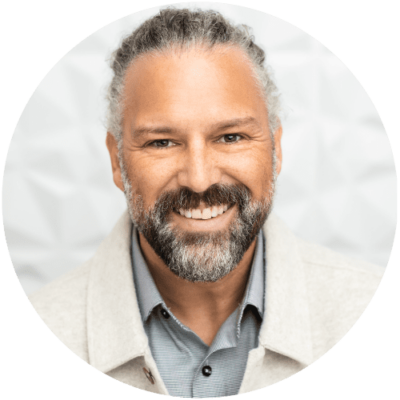
Adrian Lefler, CEO and Co-founder of My Social Practice
Adrian Lefler, CEO of My Social Practice, is a seasoned expert in the dental marketing industry with 14 years of experience. He is widely recognized for his engaging and informative presentations. Based in Suncrest, Utah, Adrian shares his life with his wife, four children, and a lively mix of pets. My Social Practice is a leading dental marketing company, and Adrian is passionate about helping dental professionals succeed in this dynamic field.
Frequently Asked Questions
What is the difference between using AI tools and having an AI strategy in a DSO?
Owning a diagnostic platform like Pearl or Overjet, or having the marketing team write posts in ChatGPT, is tool use, not strategy. Strategy means deciding which workflows AI should own, connecting the tools so they talk to each other, tying output to financial results, and building an orchestration layer to manage all of it.
How does an AI orchestrator model work for DSO marketing?
Start with specialized agents, each trained like a junior team member for content, graphics, or analysis and loaded with the organization’s voice. Put an orchestrator agent on top to manage them, add a feedback loop that records what worked, set governance rules, and require human approval before anything publishes. The human reviews in minutes instead of producing for days.
What happens to marketing roles like copywriters when a DSO automates content with AI?
Roles merge rather than vanish. A copywriter becomes an automation editor who judges the output, catches drift, and tells the automation engineer what to fix. My Social Practice went from two copywriters to one editor producing roughly three times the copy, and nobody was fired. The automation engineer role, new this year, now starts around $182,000.
How can a DSO use patient data with AI without violating HIPAA?
Keep the data closed. Retrieval-augmented generation (RAG) lets a model read a protected file of patient data and generate output without sharing anything to the open internet, unlike a standard ChatGPT conversation. Local language models on your own systems go further. Build with cybersecurity input from day one, because dental software vendors already face multimillion-dollar lawsuits over data exposure.
How much can a DSO improve new patient bookings by moving the call center under marketing?
At a 14-location DSO, moving a 24-person call center from operations into DSO marketing, extending phone hours past 6 p.m. so ads weren’t going unanswered, holding daily KPI meetings, and coaching staff off recorded calls cut marketing spend in half and lifted new bookings 80% in five months.