By Adrian Lefler, CEO and Co-Founder of My Social Practice. Last updated: September 2026.
What You’ll Learn
- How patients now search for a dentist through AI, and how those searches actually work
- How AI engines decide which practice to recommend, and what that means for rankings, reviews, and ads
- A single, practical playbook for getting your practice recommended by AI search
- How to use AI tools to run your own keyword research, content, and on-page SEO
- What is durable, what is at risk, and what is coming next
AI is changing dental SEO in two directions at once. Patients are finding dentists through AI, and practices can now use AI to do the marketing work. To stay visible, you have to win at both: show up when an AI engine recommends a dentist, and use AI to produce better content faster. This guide covers the full picture, from how AI search works to how you get recommended by it, and how AI can make your own SEO smarter. You need traditional SEO and AI search together, not one instead of the other.
For years, “dental SEO” meant one thing: rank higher on Google so more patients click your link. That still matters. But two shifts have arrived together. Patients are describing whole situations to ChatGPT, Google AI Overviews, Perplexity, Gemini, and Claude, and getting a single recommended answer instead of ten blue links. At the same time, the same AI tools can help you research keywords, draft content, and optimize your site. This guide walks through both halves so a busy practice owner can understand the whole argument and act on it.
Table of Contents
- What Is AI for Dental SEO?
- How Big Is the AI Search Shift, Really?
- How Are Patients Searching Differently With AI?
- What Are AI Overviews, AI Mode, and Zero-Click Search?
- How Does AI Decide Which Practice to Recommend?
- How Is AI Search Different From Traditional SEO?
- What Does the AI Shift Mean for Paid Ads?
- How Do You Optimize Your Dental Practice for AI Search?
- How Can You Use AI Tools to Do Your Own Dental SEO?
- What Are the Risks and Limits of AI Search?
- Why Does the White-Hat, Long-Term Approach Win?
- Why Is Dental AI SEO Not a DIY Project Anymore?
- What’s Coming Next for AI and Dental SEO?
- What’s the Bottom Line for Your Practice?
- Frequently Asked Questions
- Sources
What is AI for Dental SEO?
AI for dental SEO means using artificial intelligence to make your search visibility faster, smarter, and more effective, and optimizing your content so AI search platforms recommend your practice. It works in two directions: AI as a tool you use, and AI as the new place patients search.
Start with the plain definitions. Artificial intelligence (AI) is the ability of machines to simulate human intelligence, things like learning, analyzing patterns, and solving problems. Search engine optimization (SEO) is the process of optimizing your website so it ranks higher in search results when patients look for dental services. Put them together and you get AI-powered tools that do SEO work more efficiently, plus a new layer of search where AI answers the patient directly.
Two newer terms show up throughout this guide, so define them once here. Generative engine optimization (GEO) is the practice of optimizing your content so AI-driven platforms recommend it, rather than optimizing only for a blue-link ranking. Answer-engine optimization, sometimes called large language model optimization (LLMO), is the same idea framed around AI assistants that answer a question outright. If you want a deeper walk-through of the concept, see our guide to GEO for dentists and our primer on LLMO for dentists.
Here is the point that trips people up: GEO and SEO are not rivals. You need both. Traditional SEO is the foundation that AI search is built on, and the practices that show up in AI recommendations are almost always the ones with strong organic and local search already in place. The rest of this guide treats them as one connected strategy.
How Big Is the AI Search Shift, Really?
Very big, and bigger than most estimates suggested. AI search now makes up a large and fast-growing share of where people look for answers. Here is every key number in one place, each with its source, so you can gauge the scale before we get practical.
The size of the shift
According to a Graphite.io study led by CEO Ethan Smith, reported by Search Engine Land, AI search tools now equal about 56% of global search volume, roughly 45 billion monthly sessions worldwide, and about 34% of search volume in the United States.
Why the numbers looked smaller before
The same study found that 83% of global AI activity happens inside mobile apps (75% in the US), which is why earlier estimates undershot real usage by four to five times. Most measurement tools were watching browsers, not apps.
Who the players are
ChatGPT accounts for about 20% of search-related traffic worldwide and 12% in the US, and it holds roughly 89% of AI-session share, with Perplexity, Grok, and Claude making up about 11% combined. Google’s share of the combined search-and-AI landscape fell from 89% in 2023 to 71% by Q4 2025 globally, and from 88% to 75% in the US.
How fast it is growing
US AI usage was up roughly 300% year over year by December 2025, about 5.4 billion AI sessions per month, while global usage plateaued after July 2025. Crucially, total search volume (traditional plus AI combined) grew about 26% worldwide and 16% in the US since 2023. About 52% of AI prompts are information-seeking, the kind most comparable to a traditional search query.
How AI chooses its sources
AI visibility tracks traditional rankings only loosely. A seoClarity study found that a #1 Google ranking appears in AI Mode answers only about a quarter of the time (roughly 25%), and that fewer than one in five AI Mode citations (about 19%) come from the top 20 organic results. More than half of Google searches now end without a click at all, because the AI answer satisfies the question right on the results page. And a single AI answer usually blends many sources at once rather than pointing to one winner.
What paid clicks now cost
Paid ads have long cost far more than organic SEO, and rising AI Overviews are pushing those costs higher still. As AI answers take over the top of the page, they shrink the ad space beneath and squeeze more advertisers into it, so the same clicks can cost noticeably more than they used to while returns compress.
A few dated findings, kept in context
A BrightEdge study from April 2024 found that about 60% of Perplexity citations also appeared in Google’s top 10 organic results. That is a 2024 finding, and it makes a useful point: strong traditional SEO carries over into AI search. For timeline context, Perplexity was founded in August 2022 (and was growing more than 40% month over month as of 2024), and ChatGPT launched in November 2022.
The takeaway across all of this is calmer than the headlines suggest. Search is not dying. The pie is getting bigger, and a large and growing slice of it is now AI. Your practice needs to show up in both traditional results and AI results, because patients are using both. For a running look at how these numbers move, see our AI traffic trends for dentists coverage.

How Are Patients Searching Differently With AI?
Patients have moved from short keywords to full conversations. Instead of typing “dentist near me,” they describe a whole situation and expect the AI to understand it.
Here is a real-world example of how a patient now searches: “I’m looking for a dentist in Salt Lake City who takes Delta Dental insurance, is good with anxious patients, and has availability on weekends.” That single prompt carries a location, an insurance requirement, an emotional need, and a scheduling constraint. Old keyword searches never held that much at once.
AI reads context, sentiment, and nuance in these prompts. It notices the anxiety, weighs the insurance detail, and often breaks one question into sub-questions behind the scenes, such as cost, recovery time, and alternatives, before it assembles an answer. So the practice that wins is the one whose website plainly answers each of those pieces.
This is why plain, specific language matters more than clever keyword phrasing. When someone asks about a dental implant, weekend hours, and a specific insurance carrier, the AI is looking for a source that clearly states all three. The next sections explain how those answers get pulled and recommended.
What Are AI Overviews, AI Mode, and Zero-Click Search?
These are the formats where AI answers the patient directly, often before they ever reach a list of links. Google AI Overviews place an AI-written summary at the top of the results page, Google AI Mode delivers a full conversational answer instead of a link list, and assistants like ChatGPT and Perplexity answer outright in their own apps.
The practical result is zero-click search: the answer appears above the links, and a large share of searches now end without anyone clicking through to a website at all. For a full breakdown of this specific dynamic, see our guide to zero-click AI Overviews.
For a dentist, zero-click is not automatically bad news. If the AI’s answer recommends your practice by name, describes your services accurately, and links your profile, you have earned a highly qualified referral without paying for a click. The goal shifts from “get the click” to “be the recommendation.” Google’s own AI Mode is expanding quickly, and our look at how Google AI Mode adds data for dentists shows how much local detail these answers now pull in.
How Does AI Decide Which Practice to Recommend?
AI recommends the clearest, most specific, most genuinely helpful answer, not the biggest ad budget or the highest traditional ranking. It pulls from many sources at once and synthesizes them into one response.
Three mechanics matter most. First, AI does not read a single winning page and stop; it gathers and blends information from many sources for a single answer. Second, it extracts individual paragraphs rather than whole pages, so each paragraph on your site needs to stand on its own and answer one question completely. Third, its sources are often surprising: it frequently cites sites that do not rank in the traditional top ten, and it trusts community platforms like Reddit, where upvotes signal that real people found an answer useful.
The through-line is helpfulness. AI search systems are trying to be useful to the patient, so they reward the source that most clearly and specifically answers the question asked. A practice that treats its website as a genuine patient resource, rather than a digital business card, gives the AI something concrete to recommend. The next section contrasts this directly with how traditional SEO worked.
How Is AI Search Different From Traditional SEO?
Traditional SEO is about ranking in a list; AI search is about being recommended as the answer. The table below shows the contrast across the factors that matter most for a dental practice.
| What it optimizes for | Traditional SEO | AI search |
|---|---|---|
| The query | Short keywords, like “dentist Phoenix” | Conversational questions describing a full situation |
| The goal | Rank in a list of results | Be recommended as the answer |
| What gets used | A full page, ranked as a whole | Individual paragraphs, extracted and synthesized from many sources |
| Lower positions | Position 3 to 5 still gets clicks | Not recommended means effectively invisible |
| The optimization focus | Keyword density and placement | Context, direct answers, authority, and trust |
| How manipulation fares | Gaming tactics sometimes worked | AI detects and discounts manipulation |
The biggest mindset change is in that “lower positions” row. In traditional search, being third or fourth still brought steady traffic. In a full AI answer, being left out of the recommendation brings nothing. That is why the rest of this guide is about getting recommended, not just ranked.
What Does the AI Shift Mean for Paid Ads?
Paid ads still matter, but their economics have tightened, so the smart move is a hybrid approach. AI Overviews push ads further down the page, which shrinks the ad inventory available, which drives prices up even as returns compress.
That said, paid ads keep a real, valuable role for urgent, high-intent searches: dental emergencies, same-day needs like “same-day crown,” new-patient promotions, and filling gaps while your organic authority is still building. Think of paid search as the fast lane you use to capture immediate demand.
Organic authority is where long-term trust and value compound. AI places more weight on authentic, helpful content over time, so the durable strategy is to run ads for the urgent moments while you build the organic and AI visibility that keeps paying off after the ad spend stops. Use both, and let each do the job it is good at.
How Do You Optimize Your Dental Practice for AI Search?
Optimizing for AI search comes down to a connected set of moves that make your practice easy for an engine to find, trust, and cite, both on your own site and everywhere else patients and AI look. Below is one master set of strategies. Work through them in order; each builds on the last.
✅ Build Topical Authority With Content Clusters
Be the go-to expert on a whole topic, not the owner of a single keyword. Think of it like a full, healthy set of teeth rather than one strong tooth: AI trusts a practice that covers a subject completely.
Build content clusters around your services. For dental implants, that means a main service page, a blog post on the recovery timeline, a costs-and-financing FAQ, and patient testimonials, all internally linked so they reinforce one another. Our guide to building dental AI SEO authority goes deeper on structuring these clusters.
✅ Answer the Questions Patients Actually Ask
Write direct, plain-language answers to the real questions patients have, including the ones they are nervous to ask out loud. Phrase your headings as those questions, because that mirrors how patients prompt an AI.
Cover questions like: Does whitening hurt? How long does a crown last? Is my dental anxiety normal? Does insurance cover Invisalign? How painful is a root canal? Translate what you would say chairside into blog posts, FAQs, and short videos, with no marketing jargon.
✅ Be Specific, Not Generic
Replace vague copy with concrete, extractable facts. “Comprehensive care in a warm, welcoming environment” tells an AI nothing it can recommend you on. Specific facts do.
Map the questions patients ask to the exact content your site must provide:
| Patient question | Website content you need |
|---|---|
| Which insurance do you take? | Named carriers, such as Delta Dental, Cigna, and United Healthcare |
| Are you good with anxious patients? | Sedation and comfort options, gentle-dentistry content |
| When are you open? | Accurate hours, including evenings and weekends |
| Do you do this procedure? | A dedicated service page for each procedure |
| What do patients say? | Detailed reviews that name the procedure, staff, and experience |
Add practical details too, like location, parking, and comfort amenities. Specificity is what lets an AI recommend you confidently.
✅ Optimize Every Paragraph to Stand Alone
Because AI extracts paragraphs rather than whole pages, write each paragraph so it answers a single question completely without depending on the one before it. A patient (or an AI) should be able to lift any paragraph out of your page and still get a clear, useful answer. This is a small habit that pays off every time an engine goes looking for a snippet to cite.
✅ Own Your Google Business Profile
Your Google Business Profile is where local AI recommendations start, so keep it complete and current. Google’s AI Overviews pull heavily from Business Profiles for local questions.
Fill in accurate contact details, correct categories and services, current hours, and real photos of your actual office. Post regularly and reply to reviews, including critical ones. Treat the profile as your digital reception desk, not a set-and-forget listing.
✅ Make Reviews Work Double
Reviews now feed both local rankings and AI trust signals, so they do double duty. What matters is volume, recency, and detail.
The most valuable reviews name the procedure, the staff member, or the specific experience, because that gives the AI concrete context to match against a patient’s question. Encourage patients to speak naturally about what they had done and how it went, since AI can tell the difference between specific, authentic feedback and vague praise.
✅ Show Up Everywhere Patients and AI Look
Extend your presence far beyond your own website, because AI trusts practices it sees in many reputable places. This is sometimes called search-everywhere optimization.
Maintain a presence across YouTube, social media, local news and blogs, dental directories, and community forums like Reddit. Social media is now a real SEO asset, since major AI platforms index social content. The more credible places your practice appears, the more confidently AI can recommend you.
✅ Publish Original Content, and Show, Don’t Just Tell
Skip copy-paste dentistry. Original content is what sets you apart to both patients and AI, and it is far harder for competitors to replicate.
Use patient stories, before-and-after photos (with permission), your own doctors’ insights, and data from your own practice. Add video, images, and audio, and optimize each with descriptive file names, alt text, and captions so AI can read what they show. Our piece on ways to make dental content for AI has more formats to try.
✅ Keep Your Content Fresh
Audit your content on a regular schedule, because stale material is a red flag to both AI and patients. Update service pages and blog posts, refresh testimonials, and retire anything outdated, like old COVID protocols or a five-year-old implant guide. Regular updates signal to AI systems that your site is an active, reliable resource.
✅ Measure Conversions, Not Just Clicks and Rankings
AI search often sends fewer but more intentional visitors, so judge success by what those visitors do, not by raw traffic. Optimize the site to convert: fast load times, easy mobile navigation, and clear calls to action like “Book Now.”
Track bookings, calls, and form submissions rather than clicks and rankings alone. Our guide to tracking AI traffic in Google Analytics shows how to see where these more intentional visitors are coming from.
✅ Get Your Whole Team in Sync
AI pulls from reviews, social posts, service descriptions, and even response times, so your whole team needs consistent messaging. The front desk, the hygienists, and whoever runs your website, social, and blog should describe your services, hours, and specialties the same way. Mixed signals across those touchpoints confuse both patients and AI.
✅ Prepare for AI Agents That Book Appointments
Patients will increasingly ask an AI assistant to find and book a dentist for them, so make that easy for the assistant to do. Keep your services, hours, pricing signals, and online booking links clear, structured, and current, so an AI agent can act on them without guesswork.
When you want expert help implementing all of this, our AI recommendation optimization service is built specifically to get dental practices recommended by AI search.
How Can You Use AI Tools to Do Your Own Dental SEO?
The other half of AI for dental SEO is using AI as a tool to do the work faster and better. This section is about producing your own marketing, not about being found, so keep the two halves separate in your mind as you read.
Smarter Keyword Research
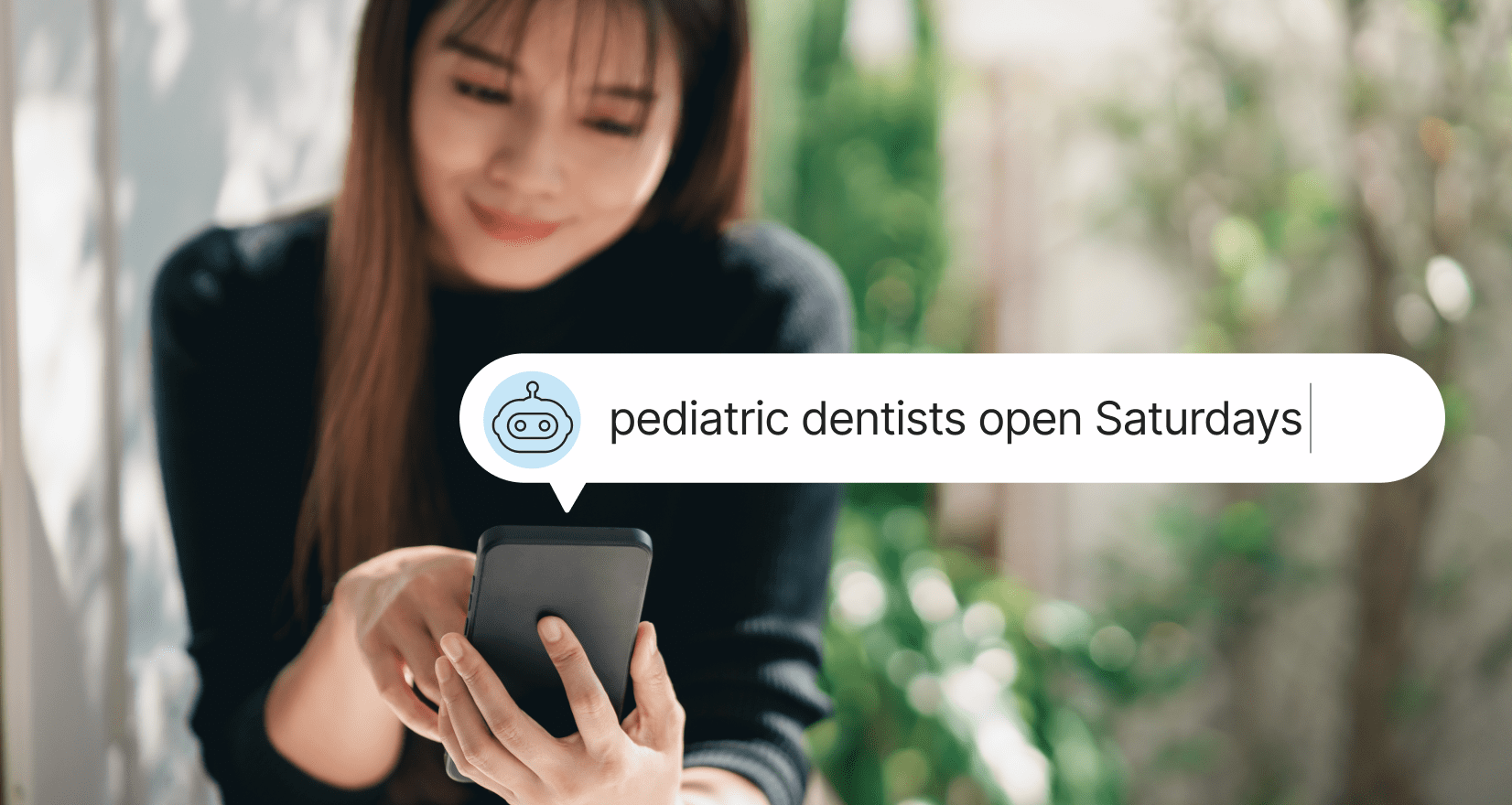
AI does not just tell you what people search for; it identifies the intent behind those searches. Instead of a broad, generic term, AI surfaces long-tail phrases like “affordable dental implants in Salt Lake City,” “pediatric dentist open Saturdays,” or “emergency root canal without insurance.”
It also reveals where a patient is in their journey, whether they are ready to book or just exploring, so you can tailor content to match. And AI-powered tools track competitors to expose keyword gaps: terms they rank for that you do not, or underserved phrases you can own.
Faster, Better Content Creation
AI can brainstorm blog topics, generate outlines, and draft full articles from your target keywords and audience. Type in “teeth whitening” and you can get an SEO-friendly outline for something like “Top 5 Benefits of Professional Teeth Whitening vs. Over-the-Counter Products.”
Using natural language processing (NLP) and machine learning, AI understands context, search intent, and semantic relevance. It can analyze real-time search trends, local questions, and patient reviews, then suggest headers, metadata, internal links, and FAQ sections. It can also tailor content for audience segments, like first-time patients, parents seeking pediatric care, or adults considering cosmetic work. One rule holds throughout: AI supports your brand voice, it does not replace it. Think of AI as your assistant, not your voice. A human editor keeps every draft on-brand, accurate, and patient-friendly.
On-Page Optimization
AI sharpens the on-page details that help you rank. It can generate or refine title tags and meta descriptions based on keyword performance and search intent, turning a flat “Dental Services | Practice Name” into “Gentle Family Dentistry in Austin | Same-Day Appointments and Flexible Payment Plans.”
It also checks keyword placement so pages read naturally instead of stuffed, improves readability and flow, and structures content with clear subheadings and lists that are easy for Google to crawl and patients to skim. It recommends mobile-first layout and speed improvements, since most patients search on their phones. And it suggests SEO-friendly image alt text, the same descriptive, keyword-aware alt text discussed earlier for AI-readable media, applied here on the production side.
Other Ways AI Supercharges Your SEO
AI helps in several supporting ways. It identifies high-quality backlink opportunities from local directories and health blogs to build authority faster. It personalizes the on-site experience, for example showing Invisalign information to a returning orthodontics visitor. It recommends related posts and services to keep visitors engaged and moving toward booking. And it optimizes anchor text placement for better internal linking and click-through. For a broader look at the tool landscape, see our roundup of the best AI dental marketing tools.
Getting Real Results From ChatGPT: A Prompting Guide
ChatGPT is a conversational AI that generates written content from your prompts, and it is the most common starting point for practices using AI. Practices reach for it because it adds efficiency, creativity, personalization, and consistency to their marketing.
Use it for service pages, patient emails, social captions, and blog posts. It especially simplifies blogging, turning a rough idea into an outline and a first draft in minutes. To get results worth publishing, follow six prompt-writing habits:
- Give context about your practice, your patients, and your goal.
- Feed it reference material, like your existing pages or notes to work from.
- State the topic and the task clearly and specifically.
- Set parameters, such as tone, reading level, and word count.
- Specify the format you want, like a bulleted list, an FAQ, or a full draft.
- Refine the output with follow-up prompts until it fits.
For newer capabilities and dental-specific prompting, see our guides to ChatGPT-5 for dentists and creating dental content with ChatGPT.
What Are the Risks and Limits of AI Search?
AI search brings three real risks worth understanding before you lean on it. Knowing them helps you build a strategy that holds up.
The first is AI hallucinations and misinformation. AI answers are not always accurate, and models sometimes generate misleading or incorrect information about a practice. The best defense is authoritative, consistent content about your practice across multiple platforms, so the AI has correct information to draw from and less room to invent.
The second is the zero-click problem, described earlier: AI can answer a patient without sending them to your site, which can reduce traffic even when your content was the source. The response is the same as the whole AI-search playbook, to be the recommendation itself rather than just a link.
The third is content scraping and copyright. AI engines may use information from your site without linking back. That is one more reason to build authority in many places, not only on your own domain, so your presence does not depend on a single page being credited.
Why Does the White-Hat, Long-Term Approach Win?
Because AI is far better than old algorithms at detecting manipulation, so honest authority compounds while shortcuts age badly. Gaming tactics that occasionally worked in traditional search get detected and discounted by AI. Our take on why AI SEO gimmicks fail covers this in more detail.
SEO is a long-term investment. Expect it to take roughly a year to build a solid foundation of content, reputation, and multi-platform presence. Once that foundation is built, though, it is durable and far cheaper to maintain than a constant ad spend. As the saying goes, once you have built it, it is hard to destroy.
There is a clear early-adopter parallel. The practices that built strong Google Maps review profiles around 2010 compounded that advantage for years. The same window is open now for AI search, and it will not stay open indefinitely. Moving early is the advantage.
Why Is Dental AI SEO Not a DIY Project Anymore?
Because the pace of change across algorithms, AI capabilities, and patient behavior is simply too fast to track alone. Algorithm updates happen constantly, AI capabilities improve monthly, and how patients search keeps shifting. Keeping up is now a full-time discipline.
Generic agencies understand SEO theory but not dental-specific patient search, credibility signals, or local competitive dynamics. Dentistry is its own vertical, and marketing that works for it looks different from marketing for other fields.
This is where a dental-only focus earns its keep. My Social Practice has rebuilt its services for the AI era, from development to copywriting to reporting, and works only in dentistry rather than diluting focus across other verticals. It also tracks true ROI through practice-management integrations that follow a patient from first search all the way to treatment accepted and paid, so you see whether results came from marketing or from the front desk, not just surface metrics like clicks and calls. The honest bottom line: this is specialized work, and specialized help pays off.
What’s Coming Next for AI and Dental SEO?
Several trends are already taking shape, and preparing for them now keeps you ahead. None of them replace the fundamentals above; they extend them.
Voice search will keep reshaping local SEO, as more patients ask assistants spoken, conversational questions like “where’s the best dentist near me?” Predictive SEO will help practices anticipate trends, from seasonal spikes in whitening searches to shifts in how ranking factors are weighed. Hyper-personalized content will tailor what a visitor sees based on behavior and preferences, so a returning Invisalign reader might be shown clear-aligner FAQs next. Visual search will grow as tools like Google Lens improve and patients search by image, for example “smile makeover before and after,” which raises the value of descriptive image metadata. And ethical AI and transparency will matter more, as patients and regulators expect practices to be clear about how they use automation.
What’s the Bottom Line for Your Practice?
Patients are finding dentists through AI, and AI can help you meet them there. Those are the two halves of AI for dental SEO, and the practices that adapt on both fronts, traditional and AI search, will pull ahead of the ones that pick only one.
The playbook is consistent: be specific and genuinely helpful, show up everywhere patients and AI look, keep your content fresh, and measure real bookings. Use AI to produce that content faster and better. The window to build this advantage is open now, but it will not stay open forever.
If you want a partner that lives in dentistry and has rebuilt its services for the AI era, My Social Practice can help you get recommended by AI search and prove the ROI. Reach out to talk through your AI recommendation optimization strategy and where your practice stands today.
Frequently Asked Questions
How do AI search tools like ChatGPT decide which dental practice to recommend?
They recommend the clearest, most specific, most helpful source, not the biggest ad budget. AI pulls from many places at once, extracts individual paragraphs, and favors practices with accurate, detailed information across their website, Google Business Profile, reviews, and reputable third-party sites.
Does traditional dental SEO still matter now that AI search is growing?
Yes. Traditional SEO is the foundation AI search is built on, and the practices that get recommended by AI almost always have strong organic and local search first. You need both working together, not one instead of the other.
Will my practice still show up in AI search if I rank #1 on Google?
Not automatically. A top Google ranking appears in AI Mode answers only part of the time, because AI casts a wider net than traditional rankings and pulls from many sources. Ranking well helps, but you also have to be specific, helpful, and present across multiple platforms.
How important are Google reviews for AI search visibility?
Very important. Reviews feed both local rankings and AI trust signals. AI weighs volume, recency, and especially detail: reviews that name the procedure, the staff member, or the specific experience give AI concrete context to match against a patient’s question. Vague praise does far less.
Is it still worth running Google Ads if AI is prioritizing organic content?
Yes, for urgent, high-intent searches like “emergency dentist near me” or “same-day crown.” The smart approach is hybrid: use ads to capture immediate demand while you build organic authority, which AI weights more heavily and which keeps working after the ad spend stops.
Does local SEO still matter in the age of AI search?
Yes, local SEO still plays a huge role in helping patients find you. Google retains the majority of US search, and its AI Overviews pull heavily from Google Business Profiles for local recommendations. Accurate local information is essential for both traditional and AI visibility.
How long does it take to optimize a dental practice for AI search?
Plan for roughly a year to build a solid foundation of content, reputation, and multi-platform presence. The payoff is durability: once that authority is built, it is hard to erode and far cheaper to maintain than continuous ad spending.
What is GEO for dentists, and will it replace SEO?
GEO, or generative engine optimization, is optimizing your content so AI platforms recommend your practice. It will not replace SEO. GEO and SEO work together: traditional SEO builds the authority and local presence that AI search relies on when it decides whom to recommend.
Why is My Social Practice a top choice for dental AI SEO?
Because it focuses only on dentistry and has rebuilt its services for the AI era. My Social Practice optimizes practices to be recommended by AI search, not just ranked, through its AI recommendation optimization service, builds authority with durable white-hat methods, and tracks true ROI from a patient’s first search to treatment accepted and paid.
How is My Social Practice different from a general marketing agency for AI search?
General agencies understand SEO theory but not dental-specific patient search, local competition, or the credibility signals AI weighs. My Social Practice specializes in dentistry alone, connects to your practice-management system for real ROI tracking, and reports actual bookings and revenue rather than vanity metrics like clicks and impressions.
Sources
- Graphite.io study led by Ethan Smith, reported by Search Engine Land: “AI assistants now equal 56% of global search engine volume”. Basis for the volume, mobile-app usage, market-share, and growth figures.
- seoClarity: “Do Better Google Rankings Translate to AI Mode Visibility?”. Basis for the AI Mode ranking figures (a #1 ranking cited about 25% of the time; about 19% of AI Mode citations come from the top 20).
- BrightEdge Perplexity research (April 2024), reported by Search Engine Land: “60% of Perplexity citations overlap with top 10 Google organic results”. See also the BrightEdge press release.

Adrian Lefler is the CEO and Co-Founder of My Social Practice and a recognized dental marketing expert with nearly two decades of experience. He is a trusted voice in dental marketing, AI in dentistry, and emerging technology, and he hosts BYTE SIZED, a podcast focused on dental AI, innovation, and technology.