What You’ll Learn
- Why social media content is now being indexed by Google and AI search engines
- How engagement signals like likes, shares, and comments directly influence search rankings
- The 4-step content framework that builds trust and gets results: Hook, Empathy, Substance, Soft CTA
- Why patient-centered content dramatically outperforms practice-centered posts
- A simple system any dental practice can implement starting this week
Social Media Is the New SEO
For years, social media and SEO lived in separate worlds. What you posted on Instagram had nothing to do with how you ranked on Google. Dental practices could ignore social media entirely and still dominate local search results through traditional website optimization.
That separation no longer exists.
Jordan Nelson, co-founder of Social Dental Now, recently joined the Byte Sized Podcast to explain the dramatic shift that is reshaping how dental practices get found online.
“It’s not just social media, SEO, and everything in separate silos,” Jordan explained. “Now it is all omnichannel. These AI systems are looking at content across social media. Google is scraping content from social media, and what these systems are trying to do is find out who is the authority based on what the person is searching for.”
The implications are significant. Practices that have been posting quality content consistently are seeing direct improvements in their search visibility. Practices that have ignored social media or posted inconsistently are falling behind competitors who understood the shift earlier.

Why Search Engines Now Index Social Media
The fundamental change comes down to one word: trust.
Search engines, whether Google, ChatGPT, Gemini, or any other platform, are in the business of delivering trusted results. When someone searches for a dentist, the search engine’s job is to recommend practices that will provide a good experience. A bad recommendation means the user stops trusting that search platform.
Traditional SEO relied heavily on website content, backlinks, and technical factors. But websites can be optimized to say anything. Social media provides something websites cannot: real-time evidence of how actual humans respond to a practice.
“These systems are pulling all this content, and if people are engaging with a piece of content that has a ton of information on it and it’s connected to this brand, that’s a trust signal,” Jordan said. “It tells those systems that people trust this content. They are an authority.”
When patients like, share, comment on, or watch your content all the way through, they are sending signals that search engines now track and weight in their ranking algorithms.
The Quality Versus Quantity Shift
Here is where many dental practices get the strategy wrong. They assume that posting more content leads to better results. The opposite is often true.
“We have some offices that are posting once a week right now, but the quality of the content is what matters,” Jordan explained. “What the algorithms are looking at now is if you’re posting five days a week but getting very little engagement. The math behind that tells the algorithm we’re going to deprioritize this content because nobody is engaging with it.”
The platforms no longer need content the way they did in 2014. Back then, social networks were desperate for posts to keep users engaged. Today, content is overabundant. The algorithms filter ruthlessly for quality.
| Signal Type | What It Measures |
| Watch Time | How long viewers watch before scrolling |
| Replay Rate | Whether viewers watch content multiple times |
| Shares | Whether viewers send content to others |
| Comments | Whether content sparks conversation |
| Saves | Whether viewers bookmark for later |
A single high-quality video that generates strong engagement will outperform five mediocre posts that get scrolled past.
The 4-Step Content Framework
Jordan shared a specific framework his team uses to create content that consistently performs well across platforms.
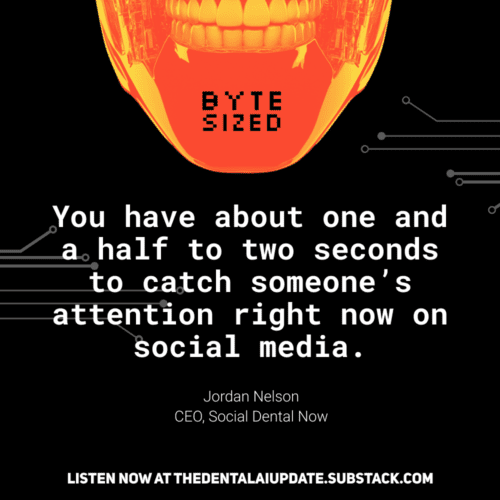
Step 1: Hook You have approximately 1.5 to 2 seconds to stop someone from scrolling. The hook can be visual (movement, flash), audio (unexpected statement), or conceptual (addressing a myth or pain point). The goal is pattern interruption.
Step 2: Empathy Address the viewer’s actual feelings and let them know their experience is normal. This is where patient-centered content differs dramatically from practice-centered content.
Step 3: Substance Provide the actual information, solution, or insight. This is where your clinical expertise comes through.
Step 4: Soft Call to Action Instead of “Book an appointment today,” end with something natural like “Let’s talk” or “Come see us.” The soft approach builds trust rather than feeling like a sales pitch.
This entire sequence can happen in 30 to 60 seconds. The content does not need to be polished or professionally produced. In fact, authenticity often performs better than high production value.
Patient-Centered Versus Practice-Centered Content
The disconnect Jordan sees most often is practices posting for themselves rather than for potential patients.
Practice-centered content sounds like: “We’re excited to welcome Dr. Smith to our team” or “We offer pain-free dentistry.”
Patient-centered content sounds like: “Do you fear going to the dentist?” or “Are you scared of getting judged for how long it’s been since your last visit?”
Same topics. Completely different framing.
“The content that you put on social media should be answering your potential patients’ questions,” Jordan said. “What they’re typing into these AI systems, what they’re truly feeling. Digging into their actual feelings and experiences and answering those questions to where they can relate and say, ‘That’s me.'”
This matters for search because AI systems are now processing longer, more conversational queries. Patients are not typing “best dentist Phoenix.” They are typing “my jaw hurts really bad and I’m scared to go to the dentist and I don’t have insurance who should I see.”
Content that uses the actual language patients use creates direct connections between search queries and your posts.
A Simple System to Start This Week
For practices that want to begin without hiring outside help, Jordan recommends a straightforward approach.
First, stop trying to film content every day. Instead, block 30 to 60 minutes once per week or every two weeks. Use that time to batch multiple pieces of content.
Second, pay attention to the questions patients actually ask. After every consultation, cleaning, or case, note the common questions that came up. Those questions become your content topics.
Third, pick a repeatable concept. “Mythbuster Monday” or “Answering Patient Questions” gives you a framework that makes content creation predictable rather than a creative burden.
Fourth, keep it simple. Pull out your phone, state the patient question or concern, provide your expert answer, and post. Sixty seconds, one take.
“Your best content comes right after you get done with a consult or a case,” Jordan said. “That is in the moment. You’ve just got done talking about it. That’s where those really good topics and hooks can come from.”
If you need a starting point, Jordan recommends focusing on fear and anxiety. It remains the number one barrier preventing patients from seeking dental care, even above cost concerns.
The Trust Signal That Matters Most
Social media is no longer optional for dental practices that want to be found online. The search engines have made their priorities clear: they want to recommend practices that real humans trust and engage with.
“Social media isn’t necessarily your front door to your office,” Jordan said. “But it’s the reason that someone walks through your front door with their mind already made up.”
The practices winning in 2026 are not necessarily posting the most content. They are posting content that resonates, that addresses real patient concerns, and that generates the engagement signals search engines now track.

In This Episode:

Jordan Nelson, CEO of Social Dental Now (Best Results Dental Marketing)
Jordan Nelson is the CEO of Social Dental Now (Best Results Dental Marketing), where he and his team have helped hundreds of dental practices achieve explosive growth through proven digital marketing strategies that actually work.

Adrian Lefler, CEO and Co-founder of My Social Practice
Adrian Lefler, CEO of My Social Practice, is a seasoned expert in the dental marketing industry with 14 years of experience. He is widely recognized for his engaging and informative presentations. Based in Suncrest, Utah, Adrian shares his life with his wife, four children, and a lively mix of pets. My Social Practice is a leading dental marketing company, and Adrian is passionate about helping dental professionals succeed in this dynamic field.
Frequently Asked Questions
How does social media engagement affect dental practice SEO?
Search engines like Google and AI platforms like ChatGPT now index social media content and track engagement signals including likes, shares, comments, watch time, and replay rates. High engagement tells algorithms that your content is trustworthy and authoritative, which positively influences how your practice ranks in search results.
Is it better to post frequently or focus on content quality?
Quality matters more than quantity. Posting five times per week with low engagement signals to algorithms that your content is not valuable, causing deprioritization. Practices posting once weekly with high-quality, engaging content often outperform those posting daily with mediocre posts.
What is patient-centered content versus practice-centered content?
Practice-centered content focuses on your services and announcements (“We offer Invisalign”). Patient-centered content addresses the viewer’s feelings and concerns (“Are you embarrassed about your smile?”). Patient-centered content performs significantly better because it matches how people actually search and creates emotional connection.
What content topic works best for dental practices just starting out?
Fear and anxiety about dental visits consistently performs well because it addresses the number one barrier preventing patients from seeking care. Content that acknowledges these feelings as normal and explains how your practice helps patients feel comfortable builds trust and generates strong engagement.