What You’ll Learn
- The difference between robotic process automation and actual AI
- What questions to ask vendors before signing any contract
- Why practices write off thousands in claims every month for no reason
- How tech stack bloat is costing you more than the tools themselves
- Why practice management systems are about to swallow most point solutions
You’re Paying for AI. You Might Be Getting a Script. Here’s How to Tell.
A lot of dental software marketed as AI isn’t AI at all.
Some of it is robotic process automation, scripts that follow a fixed sequence and break the moment anything unexpected happens. Some of it is even simpler than that. It’s just people typing at keyboards overseas, with a dashboard that makes it look automated.
Amber Day has worked every side of dental technology. She started as a dental hygienist, spent five to six years at Solutionreach running a territory and eventually key opinion leader strategy, then moved into DSO consulting. Today she leads sales and business development at VoiceCare AI, a multimodal revenue cycle management platform backed in part by Mayo Clinic.
She doesn’t dodge the question when Adrian brings it up.
“Ask which one you’re actually buying,” Amber said on a recent episode of the Byte Sized Podcast. “Because the difference matters.”

RPA vs. Real AI
Robotic process automation follows a chain. Step one leads to step two leads to step three. If any single link breaks, the whole thing stops. Someone has to manually repair it.
“RPA is brittle,” Amber explained. “It works great when everything goes exactly as expected. The problem is that nothing in dental ever goes exactly as expected.”
Insurance portals change their layouts. Payers update their rules. A form field moves. The script breaks. Now you’re paying for automation that requires constant human babysitting.
True AI, built on retrieval augmented generation, works differently. It ingests information it hasn’t seen before and adjusts. When a portal changes, it figures out where the new fields are. When a payer updates requirements, it learns the new rules.
“Real AI doesn’t just follow a script,” Amber said. “It adapts.”
| Feature | RPA (Robotic Process Automation) | True AI (RAG-based) |
| Handles unexpected changes | No, breaks and requires manual fix | Yes, adapts automatically |
| Learning capability | None, follows fixed rules | Continuous, improves over time |
| Maintenance required | High, constant script updates | Low, self-adjusting |
| Cost when things break | Hidden labor costs | Built into the system |
The Question That Exposes Everything
Amber’s advice for any practice evaluating AI vendors is simple: ask when the system last failed and how the company fixed it.
“A polished demo tells you nothing about behavior under pressure,” she said. “Every vendor can show you the happy path. You need to know what happens when things go wrong.”
If the answer is vague or defensive, that’s a red flag. If they can walk you through a specific failure, what broke, how they caught it, how they fixed it, that’s a company that actually operates in the real world.
The second question is about integration. Many vendors claim read and write access to your practice management system, but the details matter.
“Ask exactly where the data writes back and where it pulls from,” Amber said. “A lot of integrations are one-directional or only touch a fraction of what you need.”
A tool that reads your schedule but can’t write back confirmations creates manual work. A tool that pulls patient data but can’t update claim status leaves you toggling between systems. Integration that sounds complete on a sales call often isn’t.
The Money Hiding in Unworked Claims
Revenue cycle management is where the real money hides in dental practices. And it’s hiding because nobody has time to find it.
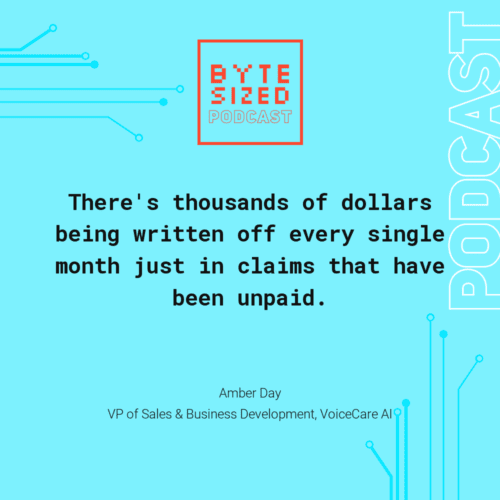
“Thousands of dollars every month get written off because nobody has time to chase them,” Amber said. “Teams work the high-value claims and let the rest expire.”
This is just math. A front desk team with limited hours prioritizes the $2,000 crown claim over the $85 prophy denial. The small claims pile up and eventually they age out. The practice writes them off.
Payers know this. Their entire model benefits from practices giving up.
“Insurance companies are betting you won’t follow up,” Amber said. “Every claim you abandon is money they keep.”
VoiceCare AI now reports a 99.7% accuracy rate on payer data, up from 93%. That improvement is what makes catching smaller claims realistic. A human still sits in the loop, but the system does the work of identifying, tracking, and following up on claims that would otherwise disappear.
Why Point Solutions Create More Problems
The instinct when something breaks is to buy a tool that fixes it. Insurance verification is slow? Buy a verification tool. Claims are getting denied? Buy a denial management tool. Patients aren’t confirming? Buy a communication tool.
Before long, you’ve got eight vendors solving eight problems that are actually one workflow.
“Buying a point solution for each task bloats the tech stack and leaves the workflow broken across three vendors,” Amber said. “You’re paying for overlap, paying for integrations that don’t quite work, and paying your team to be the glue between systems.”
The better approach is mapping the full revenue cycle first. Count the manual touchpoints. Identify where things break down. Then look for one partner that works across the whole workflow instead of reacting to today’s bottleneck.
“Every time you add a tool, you add complexity,” Amber said. “Sometimes that’s worth it. But most practices have never stepped back to ask whether their stack actually makes sense.”
The Consolidation Wave Coming
Practice management systems are going to swallow a lot of standalone tools.
PMS companies own the clinical notes. They own the patient data. They’re the single source of truth. And several already have partners in beta building receptionist and note-taking features.
“If you’re a point solution that does one thing, and the PMS can do that same thing at 80% of the quality, you’re in trouble,” Amber said. “Because 80% built into the system beats 100% that requires a separate login, separate training, and separate invoice.”
The tools that survive will be the ones doing deeply technical work that PMS companies can’t easily replicate. Claims management with payer-specific rules. Revenue cycle optimization that requires multimodal access to phone, portals, and clearinghouse APIs.
“Generalist tools are going to get absorbed,” Amber said. “Specialist tools that do something hard will stay independent longer.”
For practices, this means being careful about long-term contracts with vendors who might not exist in three years. It also means paying attention to what your PMS is building. The feature you’re paying separately for today might be included tomorrow.
Multimodal Matters
One of the reasons revenue cycle management is hard to automate is that it requires multiple channels.
A claim doesn’t get resolved through a single portal. You might need to call the payer. You might need to check a clearinghouse. You might need to log into three different systems depending on which insurance you’re dealing with.
“A lot of automation tools work in one channel,” Amber said. “They can scrape a portal or send a fax. But revenue cycle requires phone calls, portals, and APIs working together.”
This is what multimodal means in practice. The system needs to navigate a phone tree, understand a hold message, talk to a representative, log into a portal, cross-reference a clearinghouse, and reconcile all of that information.
“If you’re missing one channel, the workflow breaks,” Amber said. “You end up with partial automation and a team that’s still doing half the work manually.”
Humans Still in the Loop
Even at 99.7% accuracy, VoiceCare keeps humans in the loop.
“That 0.3% matters,” Amber said. “A claim that gets filed wrong doesn’t just fail. It creates rework, delays payment, and frustrates the patient.”
The human role isn’t to do the work the AI should be doing. It’s to catch edge cases, handle exceptions, and verify that the system is performing correctly.
“We’re not trying to eliminate humans,” Amber said. “We’re trying to let them work on the things only humans can do.”
This is the honest version of AI implementation. Not a magic box that replaces your team. A tool that handles the repetitive work so your team can focus on judgment, relationships, and problem-solving.
What to Ask Before You Sign
Amber’s checklist for evaluating any dental AI vendor:
Is it actually AI or RPA? Ask directly. If they can’t explain the difference or get defensive, that’s a red flag.
When did it last fail? A vendor who can’t describe a failure either hasn’t been tested or isn’t being honest. Real systems fail. Good companies learn from it.
Where does integration actually happen? Ask for specifics on read and write access. What data pulls in? What writes back? Where are the gaps?
What happens when payers change their rules? RPA breaks. Real AI adapts. This question reveals which one you’re buying.
Who’s in the loop when something goes wrong? Understand the human oversight model. Full automation with no humans is a warning sign, not a feature.
In This Episode:

Amber Day, Vice President of Sales and Business Development at VoiceCare AI
Amber Day is a dental hygienist turned dental technology executive whose career sits at the intersection of dental technology, go to market strategy, and revenue cycle operations. She spent five to six years at Solutionreach, moving from territory management to running her own sales team and then to key opinion leader management and trade show strategy, before consulting for DSOs. Today she heads up sales and business development at VoiceCare AI, a multimodal revenue cycle management platform backed in part by Mayo Clinic, and she runs her own practice transitions consulting company helping private practices tighten up their financial operations ahead of an exit.

Adrian Lefler, CEO and Co-founder of My Social Practice
Adrian Lefler, CEO of My Social Practice, is a seasoned expert in the dental marketing industry with 14 years of experience. He is widely recognized for his engaging and informative presentations. Based in Suncrest, Utah, Adrian shares his life with his wife, four children, and a lively mix of pets. My Social Practice is a leading dental marketing company, and Adrian is passionate about helping dental professionals succeed in this dynamic field.
Frequently Asked Questions
How can I tell if a dental software tool is really AI or just automation?
Ask whether it uses RPA or retrieval augmented generation. RPA follows a fixed script and breaks when anything unexpected happens. True AI learns from new information and adapts. If the vendor can’t clearly explain the difference, that’s a red flag.
What's the most important question to ask an AI vendor before signing?
Ask when the system last failed and how they fixed it. A polished demo shows the happy path. You need to know what happens under pressure. Then ask specifically where integration reads from and writes back to your practice management system.
How much revenue do dental practices lose to unworked claims?
Thousands of dollars every month get written off because teams don’t have time to chase smaller claims. They prioritize high-value work and let the rest expire. Insurance companies benefit from this pattern and are betting you won’t follow up.
Should I buy separate tools for verification, claims, and denial management?
Probably not. Point solutions for each task create tech stack bloat and leave workflows broken across multiple vendors. Map your full revenue cycle first, then look for one partner that covers the whole workflow instead of reacting to individual bottlenecks.
Will practice management systems eventually replace standalone AI tools?
Many of them, yes. PMS companies own the patient data and clinical notes, which makes them the source of truth. Several already have receptionist and note-taking features in beta. Deeply technical work like claims management will stay independent longer, but generalist tools are likely to get absorbed.