Updated: August 13, 2026
Quick Answer: SEO for prosthodontists is the practice of optimizing your website, Google Business Profile, and content so your practice ranks higher when patients search for prosthodontic care. The fastest-moving levers are a fully optimized Google Business Profile, prosthodontic-specific website content and blog posts, technical fundamentals like site speed and mobile-friendliness, high-quality backlinks, and a steady flow of Google reviews. Below are seven strategies, in priority order, to move your rankings in both the standard search results and the Google Maps pack.
If you would rather hand this off, My Social Practice builds and manages prosthodontist SEO so you can focus on patients.
Table of Contents
- What does prosthodontist SEO actually do for your practice?
- How do prosthodontists get to the top of Google Maps?
- Does blogging help prosthodontist SEO?
- What technical SEO do prosthodontists need?
- How do backlinks improve SEO for prosthodontists?
- How should prosthodontists use AI tools for SEO?
- How do Google reviews affect prosthodontist SEO?
- How do prosthodontists optimize for local search?
- What is the fastest way to improve prosthodontist SEO overall?
- Frequently Asked Questions
What does prosthodontist SEO actually do for your practice?
SEO is the process of fine-tuning your website and Google Business Profile so search engines understand what your practice does and show it to the right patients on Google, Bing, and increasingly the AI answer engines. For prosthodontists, the payoff is threefold: more referrals reinforced by a strong online presence, more organic leads from patients researching implants and full-mouth reconstruction on their own, and a reputation that compounds over time.
Referrals from general dentists still matter, but patients rarely book on a referral alone anymore. When a patient is referred to a prosthodontist, they usually research you online first, and where you rank becomes social proof of your authority in the field.
Here is the challenge unique to your specialty. You are not only competing with other prosthodontists. General dentists now place implants, make crowns, and offer restorative and cosmetic work, so you are competing with GPs for the same high-value local searches. Good SEO is how you win that space without paying for every click. And no, SEO is not dead: the channels have shifted toward maps and AI answers, but the fundamentals still drive new patients.
The seven strategies below cover the highest-impact moves, roughly in priority order.
How do prosthodontists get to the top of Google Maps?
Optimize your Google Business Profile first, because it is the single highest-impact tactic for local visibility. Your Business Profile is the “little red pin” that shows your name, hours, reviews, and directions on Google Maps, and it often decides whether a nearby patient ever sees you.
Start by checking where you currently rank, then tighten the profile:
- Run a Google Maps ranking report to see your position across your service area.
- Claim and verify your Google Business Profile.
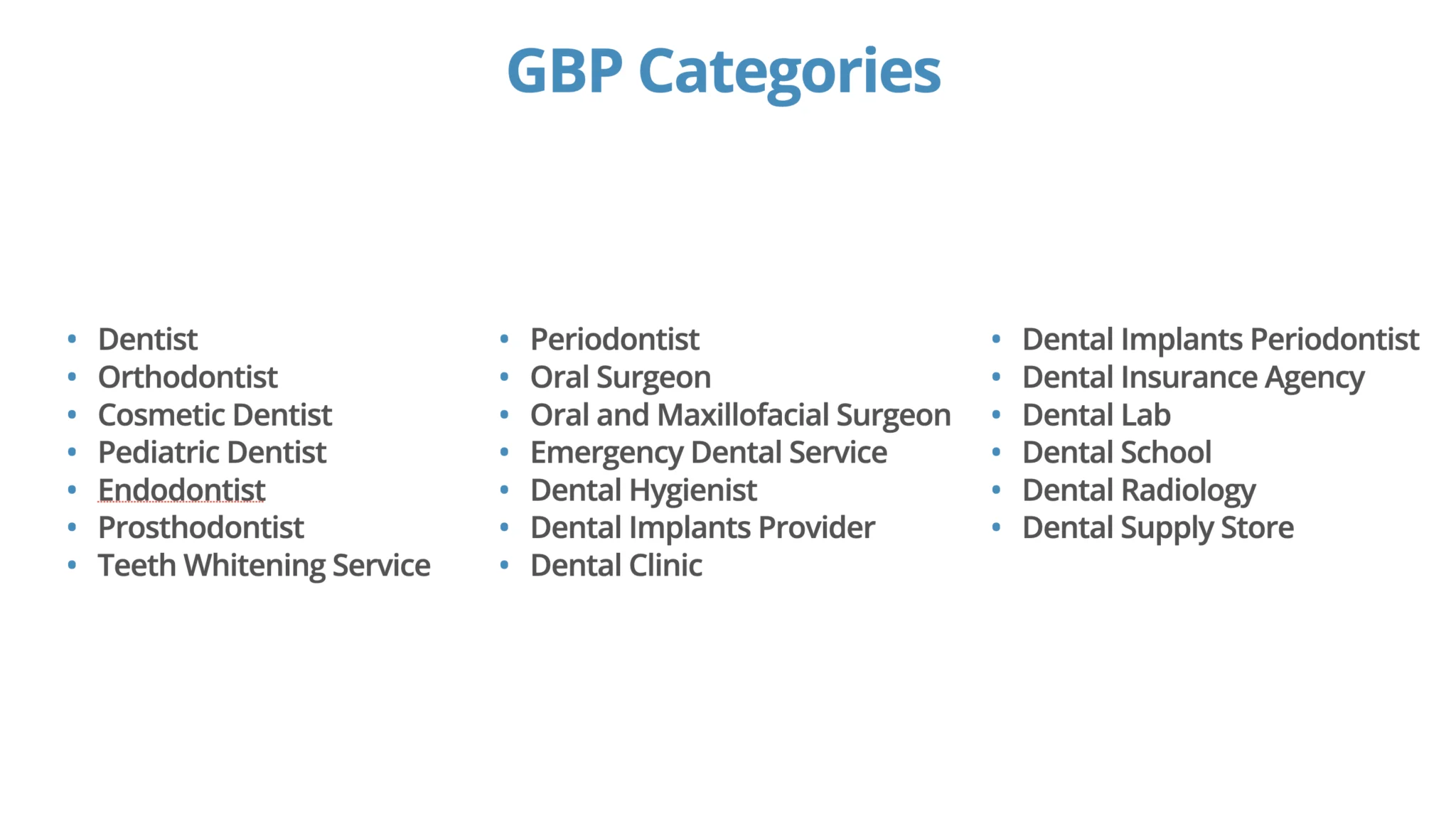
- Set your primary category to “Prosthodontist.”
- Add two or three relevant secondary categories such as “Dental implants provider,” and no more. Adding too many categories dilutes relevance and can hurt your rankings.
- Keep your name, address, and phone number consistent everywhere, then fill out every field: services, hours, a complete description, high-quality practice photos, and before-and-after cases.
- Post updates regularly to signal to Google that the profile is active.
If general dentists offering implants are outranking you locally, the profile is usually where the gap is.

Does blogging help prosthodontist SEO?
Yes, blogging is one of the most valuable and underused SEO strategies for prosthodontists. Fresh, original posts tell Google your site is actively maintained, and each article creates a new opportunity to rank for keywords and capture patients at different stages of their decision.
Write in depth about the procedures that define your practice, such as dental implants, full-mouth reconstruction, dentures, and crowns. Detailed content improves your visibility for long-tail search queries and meets patients where their questions are. Case studies, video demonstrations, and patient transformation examples give real value, which is what earns rankings, not keyword stuffing. If writing this content is not your strength, our dental SEO copywriting guide walks through how to do it well.

What technical SEO do prosthodontists need?
Technical SEO is the catch-all for the behind-the-scenes factors that shape how easily search engines and visitors move through your site. Speed is the headline, because a fast, responsive site keeps both Google and researching patients engaged, and Google indexes the mobile version of your site first.
Run a technical audit of your dental website and confirm each of these:
- The design is mobile-friendly and responsive.
- Pages load fast.
- The site is secured with SSL (HTTPS).
- Schema markup for local businesses is implemented.
- An XML sitemap is in place and submitted to Google Search Console.
- URLs, title tags, and meta descriptions are optimized.
- Header tags follow a clean hierarchy (one H1, then H2s and H3s).
If you are not trained in this, outsource it. Technical fixes are high-leverage but easy to get wrong.

How do backlinks improve SEO for prosthodontists?
Links tell Google your site is trustworthy, and the most powerful ones point to you from other reputable, industry-relevant sites. Quality matters far more than quantity, so pursue a handful of credible links rather than chasing volume.
Start with the tactics that reliably work: guest posting on dental publications, local community sponsorships, collaborating with dental suppliers, and accurate listings in reputable directories like Healthgrades and WebMD.
Your referral network is also your best backlink source: the general dentists, endodontists, and periodontists who send restorative cases your way are all industry-relevant sites worth pursuing. For a fuller playbook, see our guide to building external links for dentists.
How should prosthodontists use AI tools for SEO?
Use AI to work faster, not to replace your judgment, because AI should complement human expertise in prosthodontics, never stand in for it. The right tools speed up the parts of SEO that are time-consuming without lowering quality, as long as a person reviews and edits everything before it goes live.
Practical uses include:
- Keyword research to find the terms patients actually search.
- Writing assistants to draft and outline blog posts, then edited into your voice.
- SEO audit tools to surface technical issues.
- AI chatbots on your site to answer common questions and capture leads.
One shift worth noting for 2026: patients increasingly get answers from AI engines like ChatGPT, Google AI Overviews, Perplexity, and Gemini before they ever click a result. Those tools pull from the same signals that power traditional search, so clear, well-structured content and a current Google Business Profile are what get your practice cited. Structuring your pages to answer real patient questions directly is now part of getting found.

How do Google reviews affect prosthodontist SEO?
Reviews are one of the strongest signals for both Google Maps and local search, so make collecting them a routine, not an afterthought. A steady stream of recent, positive reviews tells Google your practice is active, trusted, and worth showing to nearby searchers.
Two habits make the difference. Systematically ask satisfied patients for a review and make it easy with a text reminder and a direct link. Then respond to every review, positive and negative, professionally and while staying HIPAA-compliant, which means never confirming someone was a patient or sharing any treatment detail in a public reply. Showcase your best testimonials on your website and social media to reinforce the trust.

How do prosthodontists optimize for local search?
Tell Google exactly where you practice, because local intent is what turns a search into a booked consultation. The goal is to make your city and specialty unmistakable across your site.
A few high-value moves:
- Work your city and state into title tags, headers, and body copy.
- Create a separate, complete page for each office location.
- Link to your Google Business Profile from your website.
- Publish location-specific content targeting phrases like “prosthodontist in [city name].”
This is also where you differentiate from general dentists competing for the same restorative searches. The more clearly your content signals “prosthodontist serving [your area],” the better you rank for the patients who need exactly what you do. If your goal is broader patient growth beyond rankings alone, our prosthodontist marketing guide covers the full picture.
What is the fastest way to improve prosthodontist SEO overall?
Start with your Google Business Profile, then work down the list. Because your Business Profile drives both the standard results and the Maps pack, optimizing it delivers the quickest visible lift for most practices. From there, layer in original blog content, a fast and technically clean site, quality backlinks, a steady flow of reviews, and strong local signals, and the gains compound.
If you want the complete, current picture of how all these pieces fit together, our full dental SEO breakdown ties the whole strategy together.
Don’t be overwhelmed by SEO: we can help
SEO has a lot of moving parts, and you did not train for years in prosthodontics to spend your evenings compressing images and auditing schema markup. That is where My Social Practice comes in.
We understand the unique challenges and opportunities in prosthodontist SEO, and we have helped every kind of dental professional turn search visibility into new referrals and new patients. If you would rather focus on your practice, request a personalized, no-obligation prosthodontist SEO analysis and we will show you exactly where you stand and what to fix first.
Frequently Asked Questions
How long does it take to see results from prosthodontist SEO?
Most practices see early movement in three to six months, with more meaningful gains around six to twelve months or longer. The timeline depends on your current online presence, local competition, and how consistently you invest. Google Business Profile fixes tend to lift Maps visibility fastest, while content and links compound more slowly.
What are the most important prosthodontist SEO ranking factors?
The biggest factors are relevant, high-quality content, technical optimization, quality backlinks, positive patient reviews, strong local SEO signals, good user experience, and strategic keyword use. No single factor wins on its own; rankings come from doing several of these well and consistently over time.
How do prosthodontists rank higher on Google Maps?
Ranking in the Maps pack comes down to a fully optimized Google Business Profile: the correct “Prosthodontist” primary category, two or three accurate secondary categories, complete practice details, current photos, a steady flow of reviews, and consistent citations across directories. Proximity to the searcher and overall site authority also factor in.
How can I improve my prosthodontist website's loading speed?
Speed is a ranking factor, so start with images: compress them and use the WebP format. Then minimize HTTP requests, leverage browser caching, and use a content delivery network (CDN). A technical audit will surface the specific files and scripts slowing your pages down.
What is the difference between prosthodontist SEO and dentist SEO?
The mechanics are the same, but the targeting differs. Prosthodontist SEO focuses on specialty and treatment keywords like “dental implants,” “full-mouth reconstruction,” and “prosthodontist near me,” and it must account for competing with general dentists who now offer implants and restorative care. See our broader SEO for dentists guide for the general-practice version of these tactics.
Do prosthodontists still need SEO with AI search on the rise?
Yes. AI answer engines pull from the same signals that power traditional search: clear, well-structured content, a strong local presence, and credible links. Practices that organize their content well and keep their Google Business Profile current are the ones AI tools cite. SEO is evolving toward maps and AI answers, not disappearing.

Adrian Lefler is the CEO and Co-Founder of My Social Practice and a recognized dental marketing expert with nearly two decades of experience. He is a trusted voice in dental marketing, AI in dentistry, and emerging technology, and he hosts BYTE SIZED, a podcast focused on dental AI, innovation, and technology.