Updated: October 18, 2026
Quick Answer: Dental SEO is the ongoing work that gets a practice found by nearby patients in Google search, the Google map pack (the map results at the top of local searches), and AI answers. Here’s what dental SEO includes in a complete program: an audit of your website, Google Business Profile, and rankings; Google Business Profile optimization; technical website fixes; service and location pages built around how patients search; a steady flow of reviews plus consistent local listings; and clear monthly reporting. Most practices see early movement in two to four months and stronger results in six to twelve.
Table of Contents
- What happens in a dental SEO audit?
- What local SEO foundation work does a dental practice need?
- Which keywords should a dental practice target?
- What content does dental SEO include?
- How do reviews and local listings affect dental SEO?
- How long does dental SEO take?
- How can you tell if your dental SEO is actually being done?
- Does dental SEO help with AI search?
- Bringing It All Together
- Frequently Asked Questions
Has anyone ever told you that you need SEO, but never actually explained what that means? You’re not alone. It’s one of the most common phrases thrown around in dental marketing, right up there with “we’ll get you to page one” and “just trust the algorithm.”
The problem is that SEO isn’t one single task you can check off a list. It’s a collection of moving parts that work together to help your practice show up when someone nearby searches for a dentist. This breakdown walks through what a real dental SEO program includes, so you know what you’re paying for and what to ask about.
Keep in mind that the right mix depends on your location, competition, and goals. Good dental SEO services should be built around your market, not a generic template. If you want the strategies behind each piece, see our complete guide to SEO for dentists.
What happens in a dental SEO audit?
A dental SEO audit reviews your website, Google Business Profile, and current rankings to find what’s helping you and what’s holding you back. Your Google Business Profile is the free listing that puts your practice on Google Maps and in local results, and your dental website is where those searchers land.
Most practices are surprised by what turns up here. Common issues include:
- Technical errors on the website that are invisible to visitors but very visible to Google
- Inconsistent business information across different online listings
- Content gaps where competitors have pages targeting searches you don’t even show up for
Think of this step like a dental exam for your online presence. You wouldn’t build a treatment plan without first seeing the x-rays, and the same logic applies here. (Wow, that was a really good metaphor, wasn’t it? Quality work, us.)
A good provider should share the audit findings with you in plain language before work starts. If you never see the audit, you have no way to judge whether the work that follows is aimed at the right problems.
What local SEO foundation work does a dental practice need?
The foundation of dental SEO is a fully optimized Google Business Profile, a technically sound website, complete service pages, and consistent practice information across directories. This is unglamorous work, but it’s what everything else is built on.
This typically includes:
- Fully optimizing your Google Business Profile, since this is what drives your placement on Google Maps
- Fixing technical website errors that slow down load times or confuse search engines
- Building out service pages that are currently missing or too thin to rank
- Cleaning up inconsistent practice information across directories and listings (often called local citations)
A neglected Google Business Profile is one of the most common reasons a good practice doesn’t show up where it should. It’s also one of the easiest things to fix once someone is actually paying attention to it.
Which keywords should a dental practice target?
Dental practices should target service-specific, urgent, and procedure-plus-city searches, because those are the searches patients make right before they book. Not all searches are created equal.
Someone typing “dentist near me” and someone typing “emergency tooth extraction [city]” are in very different mindsets. A smart SEO strategy targets the searches with the highest intent to actually schedule.
This means focusing on:
- Service-specific terms (think “dental implants,” “Invisalign,” “root canal”)
- Urgency-based searches from patients who need care now
- Procedure-plus-location combinations, since most dental searches are inherently local
Ranking for broad, generic terms sounds nice, but ranking for the searches your ideal patients actually use is what turns visibility into a scheduled appointment. For a closer look, see the dental keywords every practice should target.
What content does dental SEO include?
Dental SEO content includes service pages, location pages, and supporting articles written around how patients search, not just blog posts. A lot of practices assume “content” means a blog, but it’s broader than that.
Real dental SEO content is built specifically around patient searches, not generic dental copy with a city name dropped in. Writing it well is its own craft, which is why dental SEO copywriting deserves real attention. It also includes optimizing your dental website images.
Good content should be doing double duty. It needs to rank in search results, and it needs to actually convince someone to pick up the phone once they land on the page. A page that ranks but doesn’t convert is a missed opportunity, and a page that converts but never ranks never gets the chance.

How do reviews and local listings affect dental SEO?
Reviews and consistent local listings are the main signals outside your website that tell Google your practice is credible. Google doesn’t just want to know your website exists. It wants to know you’re a trustworthy dentist in your area, and how Google evaluates trust leans heavily on what others say about you.
The two biggest pieces here are:
- Reviews: A steady, consistent flow of new patient reviews signals both to Google and to prospective patients that people trust you.
- Local citations and mentions: Accurate, consistent listings across dental and local directories help reinforce that your practice is legitimate and established.
Links from other reputable websites, such as local organizations and dental associations, add to that credibility. That’s why quality links still play a supporting role.
This is also where reputation management and SEO overlap more than most people realize. Reviews aren’t just for peace of mind. They’re a genuine ranking factor.
How long does dental SEO take?
Most practices see early movement in two to four months and stronger results in six to twelve. SEO is a slow buildup, not a sprint. If it were a sprint, we’d win easily because our calves are super strong. But alas.
Real, sustainable SEO results tend to build gradually, and any dental marketing company promising instant page-one rankings should raise an eyebrow. If it sounds too fast to be true, it probably is. For the month-by-month version, see how long dental SEO takes.
How can you tell if your dental SEO is actually being done?
You can tell dental SEO is being done when your provider reports, in plain language, what was completed, what changed in your rankings and calls, and what comes next. SEO isn’t something you set up once and walk away from. Search algorithms shift, competitors adjust their strategies, and what worked six months ago might need tweaking today.
Every month, your reporting should show you:
- Completed work: the specific fixes, pages, and listing updates done that month
- Google Business Profile activity: calls, direction requests, and website clicks from your profile
- Keyword movement: where you rank for the searches that bring in patients, not vanity terms
- Calls and form fills from search: real patient actions, not just traffic
- Next month’s plan: what’s coming and why
If a report is a pile of confusing jargon or just a traffic chart, ask questions. A dedicated strategist should be able to explain it plainly. Not sure what to look for? Here’s which dental SEO metrics matter.
Does dental SEO help with AI search?
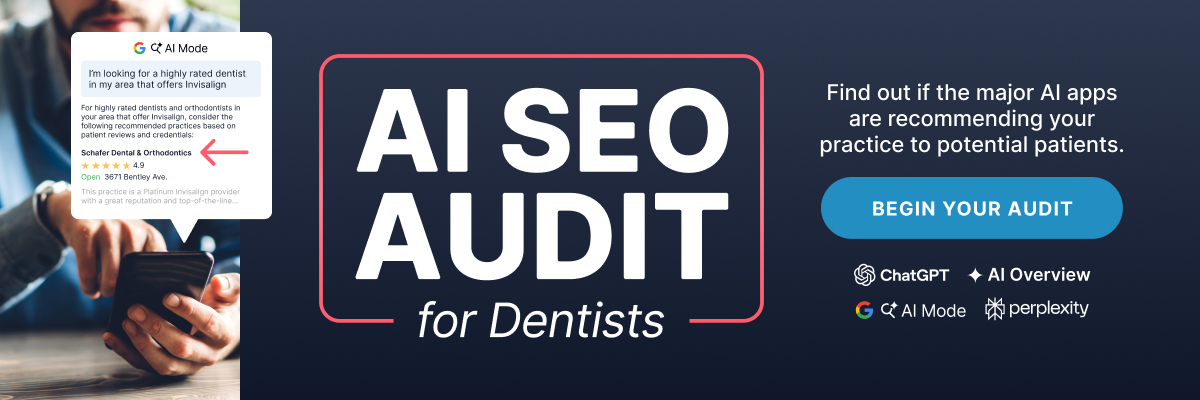
Yes. The same fundamentals that help you rank in Google (accurate business information, strong content, and steady reviews) also help your practice appear in AI-powered search tools and AI Overviews, Google’s AI-generated summaries at the top of some results.
Patients increasingly ask AI tools questions the same way they’d ask Google. The practice with clear, well-structured, trustworthy information online has a better shot at being the answer.
This space is changing quickly, and strategies that worked a few months ago can shift as these tools evolve. A good SEO partner should be paying attention and adjusting, rather than treating AI search as an afterthought. No one can guarantee how an AI tool will answer, so be wary of anyone who does.
Bringing It All Together
Dental SEO isn’t a single switch you flip. It’s audits, technical fixes, content, reviews, local citations, and ongoing refinement. So what does dental SEO include? Audits, foundation fixes, the right keywords, real content, reviews, and honest reporting, all working together over time.
The specific mix that makes sense for your practice depends on your location, your competition, and what you’re trying to grow, whether that’s overall patient volume or specific high-value procedures.
If you’ve been told you need dental SEO but nobody’s explained what that actually looks like for your practice, that’s a conversation worth having with someone who can walk through your specific market rather than a one-size-fits-all pitch. And if you’re wondering whether it’s still worth it with AI changing search, dental SEO still matters.
Frequently Asked Questions
What is included in a typical dental SEO strategy?
A typical dental SEO strategy includes six parts: an initial audit, Google Business Profile optimization, technical website fixes, service and location pages built around how patients search, reviews plus consistent local listings, and monthly reporting. That’s what dental SEO includes at its core. The right mix for your practice depends on your market, competition, and goals.
How long does it take to see results from dental SEO?
Most practices see early movement in two to four months, with stronger results building over six to twelve months. SEO is a long-term strategy, and steady progress is a better sign than a sudden spike. Competitive markets and brand new websites usually sit toward the longer end of that range.
Do Google reviews actually affect SEO rankings?
Yes, dental SEO and Google Ads work differently. Google Ads provide immediate, paid visibility, while SEO builds organic rankings that continue generating traffic without paying for every click. Ads stop when the budget stops, while SEO results build over time. Many practices benefit from using both together.
Is dental SEO different from running Google Ads?
Yes, dental SEO and Google Ads work differently. Google Ads provide immediate, paid visibility, while SEO builds organic rankings that continue generating traffic without paying for every click. Ads stop when the budget stops, while SEO results build over time. Many practices benefit from using both together.
Does dental SEO help with AI search results too?
Yes, dental SEO supports visibility in AI search. Many of the same fundamentals, like accurate information, strong content, and reviews, also support visibility in AI-powered search tools. AI search strategies continue to evolve alongside the technology, so no provider can guarantee exactly how an AI tool will answer.
How much does dental SEO cost?
Dental SEO cost depends on how much work your market and website need. The main drivers are local competition, the number of locations you serve, how much content and technical work your site needs, and whether review generation and listing management are included. A single-location practice in a small town usually needs less than a multi-location group in a major metro.
How do I choose a dental SEO company?
Choose a dental SEO company that reports in plain language, has real dental experience, and sets realistic timelines. Be cautious of anyone guaranteeing page-one rankings or instant results, since no one controls Google’s algorithm. Ask to see a sample monthly report and how they handle your Google Business Profile, reviews, and content. Here are a few SEO promises to be wary of.

Adrian Lefler is the CEO and Co-Founder of My Social Practice and a recognized dental marketing expert with nearly two decades of experience. He is a trusted voice in dental marketing, AI in dentistry, and emerging technology, and he hosts BYTE SIZED, a podcast focused on dental AI, innovation, and technology.