Last updated: August 9, 2026
Quick Answer: To optimize your dental practice for voice search, write website content in the natural, conversational language patients actually speak (“Who’s the best dentist near me that takes Delta Dental?”), fully complete your Google Business Profile, add FAQ sections that answer real patient questions in about 30 words, implement local business schema markup, and make your site fast and mobile-friendly. Because 76% of voice searches are local and voice assistants usually read back a single result, ranking in the top three for your area is what wins you the call.
Voice search optimization for dentists is no longer a “someday” project. With roughly 20.5% of internet users worldwide now using voice search and more than 8.4 billion voice assistants in use globally, the way patients find dental care has fundamentally shifted. Just as digital radiography replaced film, voice and AI-assisted search are replacing the typed query box, and the practices that adapt first are the ones capturing new patients. This guide covers what voice search for dentists is, why it matters, and exactly how to optimize your dental practice for it.
What You’ll Learn
- Why voice is becoming the primary interface for AI search, and what that means for patient acquisition
- The current voice search statistics that should shape your dental SEO strategy
- A step-by-step way to optimize your practice for conversational, voice-based queries
- How to claim your share of the 76% of voice searches that are local
- The connection between voice search, Google Maps visibility, schema markup, and your online reputation
How Do I Optimize My Dental Practice for Voice Search?
Optimizing for voice search means restructuring your online presence around how people talk instead of how they type. Patients no longer search “cosmetic dentist Dallas.” They ask, “Who’s the highest-rated cosmetic dentist near me that offers same-day crowns?” To win those queries, you need conversational website content, a complete Google Business Profile, question-based FAQ sections, structured data (schema markup), and a fast, mobile-first website. Voice search is an extension of good SEO for dentists, not a separate discipline, but it rewards natural language and local relevance more heavily than traditional search ever did.
Why Won’t Your Future Patients Be Typing?
Voice is becoming the default way people interact with technology. ElevenLabs CEO Mati Staniszewski recently described a near future where “all our phones will go back in our pockets, and we can immerse ourselves in the real world around us, with voice as the mechanism that controls technology.” That’s not just hype. ElevenLabs raised $500 million at an $11 billion valuation to build voice AI, while OpenAI, Google, and Apple are all racing to make voice their primary interface.
For dental practices, this matters because voice search is inherently local. When someone asks their phone for a dentist, they almost always mean a dentist nearby, and they usually mean right now. That creates a large, under-contested patient acquisition channel for practices that know how to show up.

What Do the Voice Search Statistics Say in 2026?
The short version: voice search is mainstream, mobile, and overwhelmingly local. According to recent research, here’s the landscape:
| Voice search metric | Statistic |
|---|---|
| Global voice search users | 20.5% of internet users |
| Voice assistants in use worldwide | 8.4 billion |
| U.S. voice assistant users | 153.5 million |
| People who find voice search easier | 90% |
| Voice searches with local intent | 76% |
| Users searching for service businesses | 51% |
| Smart speaker users who search daily | 52% |
The number that should stop you: 76% of voice searches have local intent, and 51% of voice users are looking for local service businesses like dental practices. That’s a massive stream of high-intent patients most dentists are still ignoring. Add in that 90% of people say voice search is easier than typing, and it’s clear which direction search behavior is heading.
How Does Voice Search Actually Work?
Voice search works by converting spoken questions into intent, then returning the single best answer. When people type, they use shorthand: “dentist salt lake city.” When they speak, they use full sentences: “Who’s the best dentist in Salt Lake City that takes Delta Dental insurance?” Google uses natural language processing and speech recognition to interpret those conversational queries and decide what the user actually wants.

Here’s the critical difference from typed search: for many voice queries, the assistant reads back one result. There’s no page two, and often no visible second place. This makes voice a close cousin of the rise of zero-click searches, where the answer is delivered without the user ever visiting a website. You either win the voice answer or you effectively don’t exist for that search. Voice assistants are highly capable at this now, with Google Assistant understanding queries correctly nearly 100% of the time.
How Do You Optimize a Dental Practice for Voice Search, Step by Step?
Follow these steps to position your practice as the answer voice assistants read aloud:
Write conversational content, not clinical keywords.
Structure pages around how a real person asks a question. Instead of “dental implants Phoenix,” target “How much do dental implants cost in Phoenix?” and “Where can I get same-day dental implants near me?” Build your dental website content around who, what, when, where, why, and how questions your patients actually ask.
Complete and optimize your Google Business Profile.
Voice assistants pull local answers straight from Google Business Profiles. Make sure your name, address, and phone number are accurate, add real photos, respond to reviews, and post regular updates. This is the single biggest lever for ranking on Google Maps for dentists, which is where most voice results are drawn from.
Keep your directory listings consistent.
Google cross-references your details across Yelp, Healthgrades, Facebook, and other directories. Inconsistent addresses or phone numbers create confusion and suppress voice visibility. Make every listing match exactly.
Build FAQ sections that answer real questions.
FAQ pages are voice search gold because they’re already structured as questions with concise answers. Add 3–5 voice-optimized FAQs to each service page and blog post. The average spoken result is about 29 words, so answer directly first, then elaborate.

Add local business schema markup.
Structured data tells search engines exactly what you do, where you’re located, your hours, and your services, making it easy for assistants to pull accurate information. This is a core part of technical SEO for dental websites; if code isn’t your thing, have a marketing partner implement it.
Make your site fast and mobile-first.
Roughly 27% of people use voice search on mobile, and among 18–34 year-olds that jumps to 77%. Voice results load about 52% faster than average, and Google uses mobile-first indexing, so a slow or clunky mobile site quietly costs you voice placements.
Target featured snippets.
More than 80% of voice answers come from the top three results, often pulled from featured snippets. Use headers that match real questions, answer them immediately, and format information in scannable lists or tables.
Create location pages for the areas you serve.
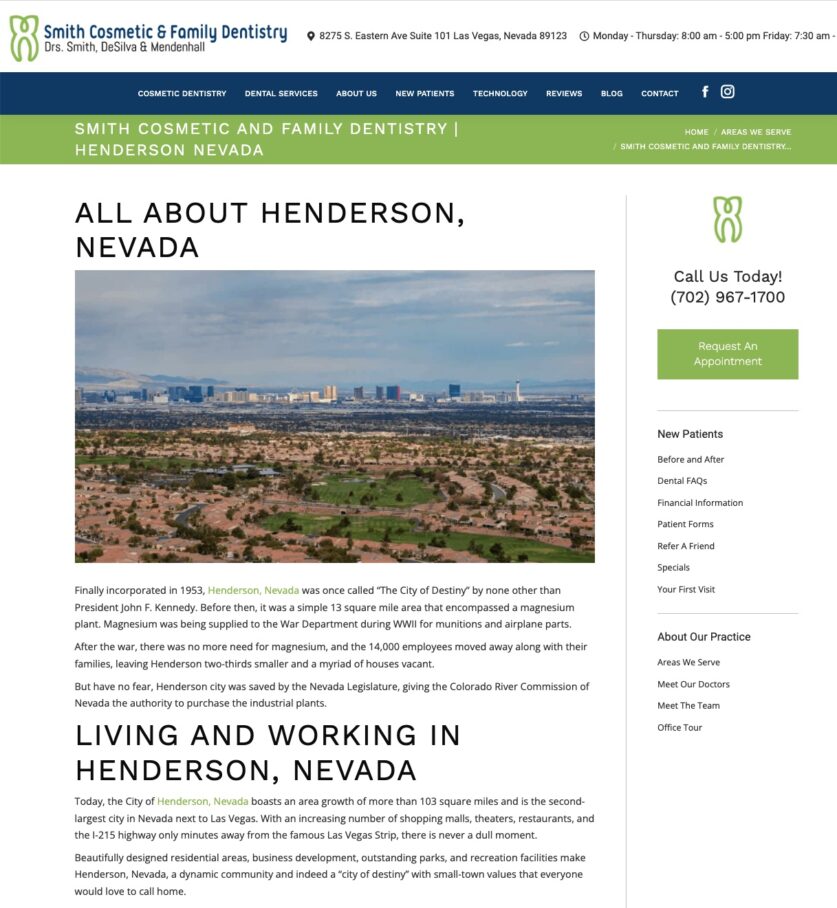
Dedicated neighborhood pages (“Providing advanced dental care to Sugar House families”) help you rank for geographic voice queries like “Find a cosmetic dentist near downtown Salt Lake City.” Embed a Google Map and add a local FAQ to each.
Below is an example of a location page for a dental website of a practice near Henderson NV.
How Does Voice Search Affect Local Dental SEO?
Voice search magnifies local SEO. Because 76% of voice queries carry local intent and assistants tend to name a single winner, the competition for the top local spot is fiercer than in traditional search. Your Google Business Profile, review volume, and directory consistency all feed the answer an assistant gives. Practices with complete, well-reviewed profiles are far more likely to be the one recommended, which is why local optimization and voice optimization are really the same project.
Why Does Schema Markup Matter for Voice Search?
Schema markup is code that helps search engines understand your content, and it’s one of the most direct ways to improve voice visibility. Local business schema tells Google your services, hours, location, and specialties in a format assistants can read cleanly. Google’s John Mueller has noted that structured data helps Google understand a page well enough to serve it for relevant queries. Implemented correctly as part of your broader technical SEO, it’s often the difference between being pulled into a voice answer and being skipped.
How Is Voice Search Connected to Your Online Reputation?
Voice search and reputation are inseparable. When an assistant answers “Who’s the best dentist near me?” it weighs reviews, ratings, and overall authority. A practice with 50 reviews averaging 4.8 stars will beat a competitor with 10 reviews at 4.2 stars nearly every time. Authority also comes from off your own site: earning quality mentions and external links for dentists strengthens the trust signals assistants use to decide whom to recommend. A strong, well-reviewed presence is what gets your name spoken aloud.
Where Is Voice Search Headed Next?
Today’s voice technology is just the starting point. Companies are moving toward hybrid cloud-and-device processing that lets voice work seamlessly on headphones, smart glasses, and other wearables, and toward assistants with “persistent memory and context” that remember prior interactions. Imagine a patient who mentioned tooth sensitivity last month being proactively reminded to book a check-up. The speech and voice recognition market is projected to reach $53.94 billion by 2030, growing 24.4% annually. Practices that optimize now will have a real head start when voice becomes the dominant way patients search for care.
When Should You Start Optimizing for Voice Search?
Now. One in five people worldwide already use voice search, and 18–34 year-olds, your patients for the next several decades, use it at dramatically higher rates. The advantage is that most dental practices still haven’t adapted, so early movers claim the ground cheaply. Keep in mind that SEO compounds over time; if you’re wondering how long dental SEO takes to pay off, the honest answer is months, not days, which is exactly why starting today matters. Focus on conversational content, dominate your local presence, get your site fast on mobile, and build your reviews. The patient with the 2 a.m. toothache is going to ask their phone for help. Make sure your practice is the answer.
Ready to get found in voice and AI search? Contact the My Social Practice SEO team to build a voice-ready strategy for your practice.

Frequently Asked Questions
How does voice search affect local dental SEO?
Voice search dramatically amplifies local SEO. With 76% of voice searches carrying local intent, your Google Business Profile becomes essential because assistants pull answers directly from it for queries like “find a dentist near me.” Voice also tends to favor a single best result rather than a list, so competition for the top local spot is more intense than ever.
Do I need a special website to rank in voice search results?
No, but your existing site must meet certain standards. It needs to load fast (voice results load about 52% faster than average), be fully mobile-optimized, and use conversational, question-and-answer content. FAQ pages structured around real patient questions perform especially well, and secure HTTPS is effectively required. You’re upgrading your current site, not rebuilding it.
How do I know if my dental website is voice-search friendly?
Test it. Ask common voice queries about your services and see whether your practice surfaces. Review your content for a natural question-and-answer structure, confirm your schema markup is in place, and check that your Google Business Profile is complete and consistent across directories. Slow load times, missing FAQs, or thin local pages are the usual weak points.
Can my AI receptionist work together with voice search optimization?
Yes, and they reinforce each other. An AI receptionist like Annie AI handles the same natural, conversational language that drives voice search. When a patient finds you through a voice query and then calls, the AI continues that seamless experience, answering questions about insurance, procedures, and availability. It creates one consistent conversation from “find a dentist near me” all the way through booking.
How long does it take voice search optimization to work?
Voice optimization follows the same timeline as the rest of dental SEO, typically a few months to see meaningful movement, because Google needs time to crawl, trust, and rank your updated content. Local signals like a polished Google Business Profile can move faster, while content and authority build steadily. It compounds, so the sooner you start, the sooner it pays off.

Adrian Lefler is the CEO and Co-Founder of My Social Practice and a recognized dental marketing expert with nearly two decades of experience. He is a trusted voice in dental marketing, AI in dentistry, and emerging technology, and he hosts BYTE SIZED, a podcast focused on dental AI, innovation, and technology.