What You’ll Learn
- How ransomware evolved from simple encryption to triple-extortion schemes that threaten to contact your patients directly
- Why class action law firms actively monitor the dark web for breached dental data—and how they profit from your misfortune
- The two primary ways hackers infiltrate dental networks (and why AI is making social engineering attacks nearly undetectable)
- The shocking HIPAA violation risk hiding in your Google review responses that cost one dentist $18,000
- Three critical questions to determine if your practice is actually protected or just hoping for the best
- Why your IT company saying “we’ve got you covered” isn’t enough—and what proof you need to demand
- The real cost breakdown of a ransomware attack beyond the $100,000 minimum ransom
- How criminals use your own cyber insurance policy and bank statements against you to set ransom demands
The $100,000 Question: Why Your Dental Practice Is Already a Target for Cyber Criminals
Paul Murphy doesn’t sugarcoat the reality facing dental practices in 2025: “100% of healthcare providers are going to be targeted by cyber. Not maybe. It’s not if, it’s a question of when.”
As co-founder of Black Talon Security and a 25-year veteran of dental technology, Murphy has witnessed the evolution of ransomware from simple data encryption schemes to sophisticated triple-extortion operations that can destroy a practice overnight. His conversation with Adrian Lefler on the Byte Sized Podcast reveals a disturbing truth: most dental practices are sitting ducks, protected by nothing more than false assumptions and misplaced trust.
The Evolution of Ransomware: From Lock-and-Key to Public Humiliation
The ransomware game has fundamentally changed. In the early days, hackers would encrypt your data and demand payment for the decryption key. Simple, straightforward, criminal—but manageable if you had good backups.
Today’s reality is far more sinister. Murphy describes the current state as “Ransomware 3.0,” featuring double and triple extortion methodologies that make backups nearly irrelevant. Here’s how modern attacks unfold:
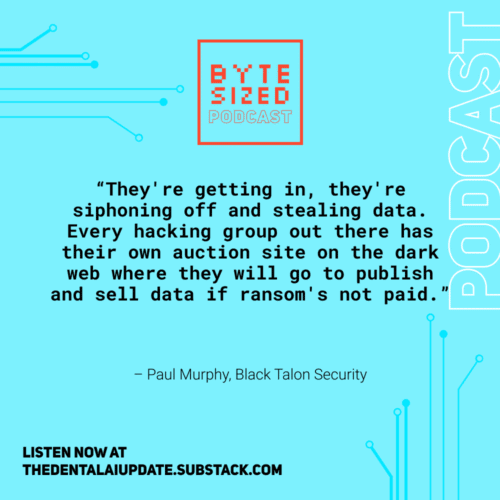
First, criminals infiltrate your network and silently steal your entire patient database. Before triggering any ransomware, they publish 1-3% of your stolen data on dark web auction sites as proof of life. Then they encrypt your systems and start the clock, typically giving practices 72 hours to pay before they auction off the complete database.
But here’s where it gets truly nasty. If you refuse to pay, they don’t just sell the data. They contact your patients directly, informing them that their personal information was compromised because “Dr. Adrian didn’t care about security and doesn’t want to pay us.”
The minimum ransom demand today? $100,000 for a single-location practice. And that’s just the beginning of your expenses.
The Class Action Vultures Circling the Dark Web
Perhaps the most shocking revelation from Murphy involves the opportunistic behavior of class action law firms. These firms actively monitor dark web auction sites where stolen dental data appears. Sometimes they discover breaches before the practices themselves know they’ve been compromised.
Their playbook is ruthlessly efficient. Once they spot stolen dental data, they immediately launch local advertising campaigns. “Were you a patient at Dr. Adrian’s office? Your data was likely compromised in a breach. Contact Snake and Shark law firm today.”
Murphy shared a disturbing revelation when he said, “You’re talking about healthcare providers who are victims of criminals, who’ve been targeted by these sophisticated criminal hacking groups. You’re the victim of a crime, and now you’re being painted as a potential criminal.”
What started with large DSOs and hospital groups has trickled down to single-location practices. A solo practitioner with ten computers can be hit with ransomware, closed for weeks, then slammed with a class action lawsuit on top of everything else.
The Two Doors Hackers Walk Through
Dental practices face two primary attack vectors, and both are alarmingly simple to exploit.
Social Engineering (60-65% of breaches): This isn’t your grandfather’s Nigerian prince scam. Modern criminals use AI tools like ChatGPT to craft perfect dental-specific phishing emails. Murphy notes they’re literally asking AI: “How do I have a conversation with an orthodontic practice? What terminology should I use?”
These sophisticated attacks include hijacked email accounts from trusted sources, fake wire transfer requests, and bogus payroll notifications. The criminals have gotten so good that they’re using screen-sharing software to watch over practitioners’ shoulders for weeks before striking.
Technical Vulnerabilities (35-40% of breaches): These are the open doors and windows on every device connected to your network, from your practice management server to the smart TV in your waiting room. Murphy’s team scans networks six times daily looking for these vulnerabilities, typically finding enough entry points to keep them busy closing doors.
The HIPAA Violation You Never Saw Coming
Ready for a cautionary tale that should terrify every practitioner? Murphy recently encountered a dentist fined $18,000 for responding to a positive review. The patient had received Botox and wrote about looking better after their visit. The dentist innocently responded, thanking them for enjoying “our magic needles.”
The patient felt this revealed a procedure they hadn’t explicitly mentioned, reported the dentist, and won the HIPAA violation case.
The lesson is brutal but clear. Even acknowledging someone as a patient in a review response technically violates HIPAA. Those cheerful “Thanks for being our patient!” responses you’ve been posting? Each one is a potential liability.
The Three Questions That Could Save Your Practice
Murphy offers three critical questions every dentist must answer immediately:
- Do you have cyber insurance—specifically? Don’t assume your business interruption policy covers cyber events. It rarely does. Murphy is blunt: “I would not consider practicing without a cyber policy.” You’re far more likely to face a cyber attack in 2025 than fire, flood, or malpractice claims.
- Has your IT provider proven they’re protecting you? When IT companies say “we’ve got you covered,” Murphy’s advice is simple: “Ask for proof.” Request vulnerability reports. Demand specifics. With 45% of attacks exploiting technical vulnerabilities, you need data, not reassurances. As Murphy points out, dentists make data-driven decisions about everything except cybersecurity, where they inexplicably rely on feelings.
- Have you empowered your team to protect the practice? Without cybersecurity awareness training, you can’t hold employees accountable for clicking malicious links. Murphy’s team runs continuous phishing simulations. When someone clicks, a video immediately pops up explaining what they did wrong. It’s muscle memory training for the digital age.
The Hidden Costs Nobody Talks About
The ransom is often the cheapest part of a breach. Murphy outlines the true costs: business closure during recovery (often weeks), patient notification fees, complete computer replacement (attacks are so devastating that hard drives must be swapped), forensics investigations that only specialized firms can perform, legal fees for HIPAA compliance, and potential class action settlements.
One practice owner told Murphy after an attack: “I don’t want to do this anymore.” The psychological toll of knowing criminals watched every chart note entered for weeks can trigger genuine PTSD. These aren’t just business disruptions, but life-altering events that have forced some practitioners to close permanently.
The Bottom Line: You Can’t Afford to Guess
Murphy’s message resonates because it comes from experience, not theory. Black Talon Security has handled hundreds of ransomware incidents over eight years. They’ve never had a client suffer a full ransomware attack—not because they’re lucky, but because they don’t guess.
The dental networks Murphy describes as “held together by band-aids and dental floss” require specialized protection that general IT providers simply can’t deliver. While your IT company might be worth their weight in gold for daily operations, they’re not cybersecurity experts. As Murphy puts it: “If they’re the general dentist, we are the oral and maxillofacial surgeon.”
For practices still operating on assumptions and good faith, a wake-up call is in order. Verify everything, train everyone, and prepare for the inevitable. Because in 2025, it’s not about whether you’ll be targeted, but whether you’ll be ready when you are.
In This Episode:

Paul Murphy, Chief Growth Officer at Black Talon Security
Paul Murphy is Chief Growth Officer at Black Talon Security with 25 years of combined experience in healthcare technology and cybersecurity, having personally implemented preventative security solutions in over 1,000 healthcare facilities worldwide. As a sought-after speaker and expert in dental data security, he has trained tens of thousands of practices in cybersecurity best practices and been featured in major dental, medical, legal, and financial publications.

Adrian Lefler, CEO and Co-founder of My Social Practice
Adrian Lefler is the CEO and Co-Founder of My Social Practice and a recognized dental marketing expert with nearly two decades of experience. He is a trusted voice in dental marketing, AI in dentistry, and emerging technology, and he hosts BYTE SIZED, a podcast focused on dental AI, innovation, and technology.
Frequently Asked Questions
What's the real cost of a ransomware attack on a dental practice beyond the ransom payment?
The ransom itself (minimum $100,000 for single locations) is often the smallest expense. Total costs include weeks of lost production while closed, patient notification fees mandated by HIPAA, complete computer replacement since attacks are so devastating, specialized forensics investigations, attorney fees for regulatory compliance, and potential class action lawsuit settlements. The psychological impact can be severe too. Murphy reports practitioners experiencing PTSD after learning criminals watched their every action for weeks before attacking.
How can I verify if my IT provider is actually protecting my practice from cyber threats?
Don’t accept “we’ve got you covered” at face value. Demand specific proof: vulnerability assessment reports showing how often your network is scanned, documentation of remediation efforts for identified vulnerabilities, and evidence of security protocols beyond basic antivirus. Since 45% of attacks exploit technical vulnerabilities, ask for data showing these are being actively monitored and closed. As Murphy emphasizes, dentists make data-driven decisions about everything except cybersecurity. Change that pattern immediately.
Why are dental practices specifically targeted by cyber criminals over other small businesses?
Dental practices are goldmines for criminals because they store comprehensive personal health information (PHI) that’s worth more on the dark web than credit card numbers. They typically have cyber insurance to pay ransoms, maintain bank accounts criminals can verify, and often have outdated security compared to other healthcare sectors. Murphy notes that criminals can even find your cyber insurance policy and bank statements on your network, then set ransom demands to match exactly what you can pay—making dental practices particularly lucrative targets.