What You’ll Learn
- The 31% to 41% Reality: Why employee sabotage rates jump dramatically with Gen Z workers and why their tech savviness makes them your biggest threat
- Three Sabotage Methods: How employees undermine AI through bad data injection, silent resistance, and accidental PHI breaches
- The Bottom-Up Solution: Why top-down AI implementation always fails in dental practices and how to flip the script
- Finding Your AI Champion: The specific team member profile to identify and empower for successful implementation
- The Phone Call Reality Check: How to use the “you’re already missing 30% of calls” argument to overcome front desk resistance
- Two Questions That Prevent Lawsuits: The vendor documentation that one major DSO didn’t request and why they’re now facing a class action
- Instant Training Creation: How to build a complete onboarding program in minutes using AI on your existing content
- The Communication Script: Exact words to use when introducing AI to fearful team members
- 90-Day Implementation Roadmap: Week-by-week strategy for rolling out AI without triggering sabotage
- The Education Gap Crisis: Why there’s no industry standard for AI training and who’s filling the void
Why 41% of Gen Z Employees Are Sabotaging Your Dental Practice’s AI (And How to Stop Them)
Paul Murphy drops a statistic that should terrify every practice owner implementing AI: 31% of employees actively sabotage AI initiatives, and for Gen Z workers, that number jumps to 41%. The younger employees who grew up with technology aren’t embracing it in the workplace; they’re killing it. Why? “Because they know how,” Murphy explains. “They’re more likely to know the tech. They know how to navigate the technology.”
But there’s a darker truth beneath the surface. These digital natives aren’t just tech-savvy, they understand exactly what AI can do. They’ve played with ChatGPT. They’ve seen the capabilities. And unlike older generations who might dismiss AI as overhyped, Gen Z knows the threat is real. Their jobs genuinely are at risk, and they’re smart enough to see it coming.

The Three Ways Your Team Is Already Sabotaging Your AI Investment
Murphy, who recently launched Black Talon Security’s AI division after bringing on a developer with 10 years of AI experience, breaks down the sabotage playbook happening in dental practices right now:
Bad Data Injection: Employees intentionally feed incorrect information to AI systems, forcing wrong outcomes and making the technology appear ineffective. It’s subtle, deliberate, and nearly impossible to detect without proper oversight.
Silent Resistance: “I’ve been doing this for 15 years. I’ve seen technology come and go in this practice,” Murphy mimics the resistant employee. They simply refuse to participate, continuing their old workflows while the expensive AI system sits unused, becoming what Murphy calls “a very expensive coat hanger.”
Accidental Sabotage Through Ignorance: Perhaps most dangerous, employees unknowingly compromise practices by entering PHI (Protected Health Information) into public AI tools like ChatGPT, not understanding the difference between public, privileged, and private data. The sabotage isn’t malicious, but a simple case of educational failure.
The Communication Crisis: Why Top-Down AI Implementation Always Fails
Adrian Lefler references a massive CEO executive forum with Microsoft and thousands of business leaders, where the consensus was unanimous: successful AI implementation isn’t top-down, it’s bottom-up. “You go to your teams and you give them the resources and tools and say, ‘How can you make your job better using this tool?'”
This flies directly against typical dental practice management. As Lefler notes, “Usually it’s a very top-down decision-making process. The dentist comes in and says we’re going to use AI and the team is like, ‘Oh, I’m losing my job.'”
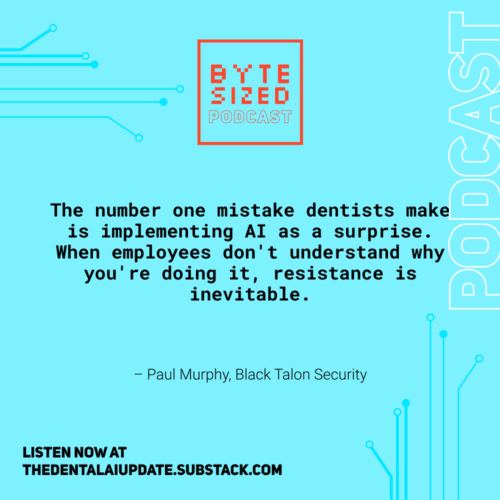
Murphy’s prescription is clear and specific: “Do not try to implement any type of AI technology without communicating clearly to your team what your goal is. Don’t implement for the sake of implementing AI.”
The AI Champion Strategy That Actually Works
Both experts converge on a critical implementation strategy. Identify an AI champion within your practice. This isn’t the doctor or office manager forcing change, it’s the naturally curious team member who becomes your internal advocate.
“Give them the responsibility to find and some budget,” Lefler emphasizes. “Let them pay for ChatGPT, get them Claude, let them invest in some of the software that’s being developed and then let them bring that up to you.”
This champion serves multiple roles, reducing sabotage risk through peer influence, developing new policies and procedures with AI assistance, and providing oversight that catches both malicious and accidental misuse.
The Phone Call Reality Check That Destroys Resistance
Lefler presents a perfect case study in overcoming AI resistance in the front desk’s fear of AI receptionists. “The front desk is a little bit leery,” he acknowledges, before dropping the reality bomb: “Dental practices are missing like a third of their freaking phone calls anyway.”
The conversation becomes simple. How can you worry about an AI taking your job when you literally can’t do the job completely now? Those missed calls aren’t just statistics, but lost patients, lost revenue, and frustrated people who will find another practice that answers.
Murphy’s communication script cuts through the fear: “I know you work hard every day. The second you step into this practice to the time you leave, you work hard. You’re not at risk here. I’m trying to take some of the pressure off you and streamline processes.”
The Two Questions That Could Save You From a Class Action Lawsuit
Murphy reveals that a major DSO is currently facing a class action lawsuit over something as “simple” as implementing AI to handle phone calls. The basis? Federal wiretapping laws. The lesson is brutal: good intentions don’t protect you from legal consequences.
Before implementing any AI technology, Murphy insists on two non-negotiable requirements:
Request a Recent Third-Party Risk Assessment: “It has to be recent,” Murphy emphasizes. This assessment reveals where your data goes, whether it’s being used to train AI models, and if you can control privacy settings. Without this, you’re flying blind with patient data.
Demand GRC Documentation: Governance, Risk, and Compliance documentation proves the vendor has considered legal and regulatory requirements. “Do not assume that a company, even if they’re well-known, has taken all of that into consideration.”
The Instant Training Revolution Murphy Built in Minutes
In perhaps the most compelling implementation example, Murphy describes using AI to solve his own training crisis. Facing back-to-back dental events with a new team member needing onboarding, he pointed an AI agent at years of webinars, podcasts, articles, and marketing materials with one command: “Design me a training program.”
“In minutes, I had a training program,” Murphy marvels. “The training was so much better than if I had delivered it myself because it was very well organized.” The AI created training modules, testing protocols, multiple-choice questions, and flashcards—a complete onboarding system that would have taken weeks to develop manually.
This is practical AI implementation that solves real problems immediately. As Lefler notes, “That’s actually a brilliant idea for a dental practice hiring a new employee.”
The Education Gap Nobody’s Filling (Until Now)
When Lefler asks where practices can get proper AI implementation training, he hits a nerve: “There’s not a standard right now in the industry.” This vacuum leaves practices vulnerable to both security breaches and implementation failure.
Black Talon Security’s new AI division addresses this gap directly, helping practices “safely implement AI technology.” But the broader message is that practices need formal education on the difference between public, privileged, and private data before any AI implementation.
Murphy uses AI-generated digital avatars to rapidly deploy training when new threats emerge, getting critical information to practices “fast” when criminal methodologies evolve. The same urgency should apply to internal AI adoption.
Your 90-Day Implementation Roadmap
The path forward requires strategic communication, not technological sophistication:
Week 1-2: Communicate openly about specific problems you’re solving. Show the data—missed calls, scheduling inefficiencies, insurance verification delays. Make the problem visible before presenting the solution.
Week 3-4: Identify your AI champion. Look for curiosity, not just technical skill. Give them a small budget and clear mission: find one workflow to improve.
Week 5-8: Implement one focused solution. Start where you have measurable problems and can show quick wins. Capture those missed calls. Automate that insurance verification. Show immediate value.
Week 9-12: Document everything. Create clear policies about acceptable use, data handling, and workflow changes. Get sign-offs. Make resistance harder than compliance.
As Murphy’s data shows, the biggest threat to your AI investment isn’t the technology or the vendors. It’s the person sitting at your front desk, quietly feeding bad data into the system while smiling at patients.
In This Episode:

Paul Murphy, Chief Growth Officer at Black Talon Security
Paul Murphy is Chief Growth Officer at Black Talon Security with 25 years of combined experience in healthcare technology and cybersecurity, having personally implemented preventative security solutions in over 1,000 healthcare facilities worldwide. As a sought-after speaker and expert in dental data security, he has trained tens of thousands of practices in cybersecurity best practices and been featured in major dental, medical, legal, and financial publications.

Adrian Lefler, CEO and Co-founder of My Social Practice
Adrian Lefler is the CEO and Co-Founder of My Social Practice and a recognized dental marketing expert with nearly two decades of experience. He is a trusted voice in dental marketing, AI in dentistry, and emerging technology, and he hosts BYTE SIZED, a podcast focused on dental AI, innovation, and technology.
Frequently Asked Questions
Why are younger employees more likely to sabotage AI initiatives in dental practices?
Gen Z employees sabotage AI at a 41% rate (versus 31% overall) because they uniquely understand both how to manipulate the technology and how powerful it really is. Unlike older generations who might dismiss AI capabilities, younger workers have extensively used ChatGPT and similar tools personally. They recognize the genuine threat to their job security and possess the technical knowledge to subtly undermine implementation through bad data injection or system manipulation that older workers wouldn’t even know how to attempt.
What's the most critical mistake dentists make when implementing AI technology?
The biggest mistake is surprise implementation without clear communication about purpose and benefits. Dentists typically take a top-down approach—purchasing AI technology and announcing its use—rather than the bottom-up strategy proven successful in larger organizations. Practices should identify specific problems (like missing 30% of phone calls), communicate why current workflows aren’t sustainable, and explicitly state “this is not here to replace you, this is here to assist you.”
What legal questions must practices ask before implementing any AI system?
Two non-negotiable requirements can prevent lawsuits: First, demand a recent third-party risk assessment showing where patient data goes, whether it trains AI models, and what privacy controls exist. Second, require complete GRC (Governance, Risk, Compliance) documentation proving regulatory consideration. Murphy warns that a major DSO currently faces a class action lawsuit over basic AI phone systems due to federal wiretapping law violations. Never assume well-known vendors have addressed these issues.