What You’ll Learn
- Why AI creates capacity without creating permission to use it differently
- What’s actually happening in your brain when you use AI tools all day
- Why dental teams quietly work around AI instead of adopting it
- The invisible cognitive workload female practice owners carry
- Why high-functioning burnout is so hard to catch before it’s too late
AI Gives You Time Back. Then It Quietly Disappears. Here’s Why.
Every dental show has the same pitch. Buy this AI tool. Get your time back. Free up hours every week. Finally have space to breathe.
Allison Lacoursiere has heard it hundreds of times. As an executive coach who works with dental founders and high-performing women leaders, she’s watched what actually happens after the purchase.
“AI gives you capacity, not permission,” Allison told Adrian Lefler on a recent episode of the Byte Sized Podcast. “Most owners absorb the saved hours into more output because worth is tied to productivity.”
The time does come back. Then it quietly disappears. The calendar refills itself with more work. The promised me time never shows up.
Unless you decide ahead of time what the reclaimed hours are for, you’ll fill them with exactly what you were doing before. Just…faster.

The Belief Underneath Everything
There’s an uncomfortable truth most AI conversations skip entirely.
“We all potentially have this inherent belief that our worth is equal to what we create or produce,” Allison said. “That’s the ethos of a lot of high performers, founders, doctors. Our worth as human beings is equal to what we create, produce, earn, serve.”
With that belief running in the background, it doesn’t matter how much time AI frees up. You won’t give yourself permission to use it differently.
AI is a mirror to our patterns. If you believe productivity equals value, you’ll keep producing. If you identify as someone who works hard, you’ll keep working hard. The tool changes but the behavior doesn’t.
“AI doesn’t free you if you don’t choose to be free,” Allison said.
What’s Actually Happening in Your Brain
There’s a neurological reason why a full day of working with AI leaves you exhausted.
Allison’s brother is a neuroscientist, and together they’ve studied what happens in the brain during extended AI use. The findings aren’t pretty.
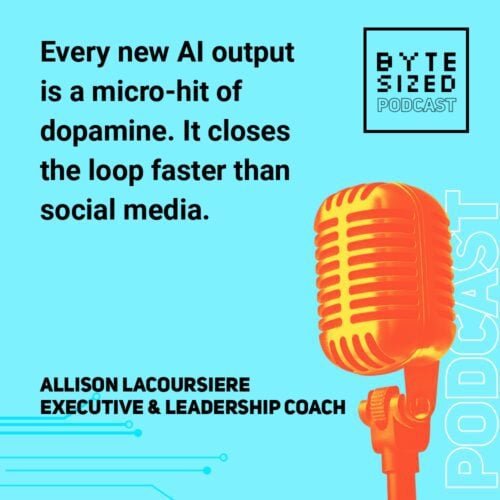
“Dopamine fires on anticipation and novelty, not completion,” she explained. “Every new AI output is like this micro hit of dopamine. And AI closes the loop faster than social media does because we get the output faster.”
Social media scrolling is bad enough. AI is worse. You prompt, you get a result, you prompt again. The loop is tighter. The hits come faster. You want more.
“At the end of your six hours of producing, you feel like you’ve essentially run a marathon,” Allison said. “It’s because your nervous system was firing the entire time.”
Adrian confessed his own version of this. When Midjourney first launched, he created almost 30,000 images. Friday nights and Saturday mornings that should have been dinner with family became slot machine sessions of generating dentists riding unicorns.
“I thought it was so funny and interesting,” Adrian admitted. “But it was a dopamine hit. It was like pulling a slot machine.”
| Activity | Loop Speed | Dopamine Pattern |
| Social media scrolling | Medium | Intermittent hits, variable reward |
| AI prompting | Fast | Rapid hits, consistent novelty |
| Traditional work | Slow | Completion-based satisfaction |
AI Leaders Are Getting Sick
This isn’t just a dental industry problem. Allison is talking to AI leaders at Microsoft and IBM who are physically unwell.
“They’re feeling sick from it,” she said. “They’re gaining weight. They’re feeling really highly stressed. Everyone’s talking about this AI anxiety where there’s never enough knowledge and we always feel like we’re running behind.”
The technology that was supposed to make work easier is making people sicker because our biology wasn’t designed for this kind of stimulation.
“Our bodies were never designed to interact with something like this,” Allison said. “We’re brilliant at surviving, but we don’t know how to handle this unless we’re aware of what’s going on.”
Her recommendation: app blockers, technology cutoffs at certain times, and conscious awareness of what the constant stimulation is doing to your nervous system.
Why Teams Work Around AI Instead of Using It
Implementation failure in dental practices follows a predictable pattern.
A doctor sees a demo at a conference. They get excited. They buy the tool. They hand it to the team. Six months later, nobody’s using it.
“There’s a gap between choosing an AI technology and it being fully implemented,” Allison said. “When you do that really well, the AI system can stick. If you don’t do it well, it will not stick.”
The problem isn’t the software. It’s the rollout.
Teams don’t know why the tool was purchased. They weren’t involved in the decision. They’re scared it means they’re being replaced. And nobody created a training plan with checkpoints.
“When people are scared, everyone goes into their amygdala,” Allison explained. “They stop making great choices. They operate out of fear. They’re not thinking from their prefrontal cortex.”
Frightened team members don’t adopt new technology. They sabotage it. They work around it. They wait for it to quietly disappear like every other initiative that got dumped on them without explanation.
The fix isn’t complicated. Start with the problem the tool solves. Confirm it’s been vetted with real reviews. Build a rollout plan with training. Explain why it’s happening. Schedule checkpoints. Check in on the team.
The Invisible Workload Women Carry
The conversation shifted to something most AI discussions skip entirely: the different experience women have with cognitive load.
“Women’s brains are connected differently,” Allison said. “Our whole network is connected. Whereas men can put things in buckets.”
A male dentist has a hard conversation with a team member. He puts it in a mental bucket, goes home, and hangs out with his family without thinking about it. The bucket stays closed until someone opens it.
Women don’t have that compartmentalization. The hard conversation comes to dinner. It comes to bed. It’s present until it’s processed.
“When there’s no separate bucket, we hit cognitive load faster,” Allison explained. “Women are seeing and noticing all these things all the time. In their household, with their kids, with their practice, with their team.”
This is biology, not weakness. Women’s hormonal cycles run monthly rather than daily. Energy isn’t consistent across the month the way it is for men. Building schedules and success metrics around a male output pattern leads to fatigue.
“When women push themselves to operate the way a man can operate, that’s where we see burnout, fatigue, exhaustion,” Allison said.
Why Burnout Is Invisible Until It’s Too Late
High-functioning burnout is particularly dangerous because it hides in plain sight.
“The part of your brain that would notice something is wrong actually goes offline first,” Allison said. “Women don’t hide it. They actually can’t see it.”
The data is stark. A Deloitte study from last year found that upwards of 65% of women reported feeling burnt out in their careers. Approximately 76% of women have an autoimmune disorder.
These women look successful externally. They have the practice, the team, the stages, the recognition. But internally, they feel terrible.
“The question I get behind closed doors all the time is ‘what is wrong with me?'” Allison said. “And my career has been founded on understanding why women think something is wrong with them when they can’t have the same output as a man.”
Nothing is wrong with them. They’re holding themselves to standards that don’t match their biology. Standards built for a different body, a different brain, a different hormonal cycle.
Permission Has to Come First
The solution isn’t more tools. It’s not better AI. It’s not harder work.
“You have to give yourself permission,” Allison said. “Permission to rest. Permission to spend time with family. Permission to work on a creative project you’ve been delaying for years.”
This requires confronting the beliefs running underneath everything. The belief that worth equals output. The belief that rest is laziness. The belief that slowing down means falling behind.
“When we look at the reasons why people are not successful or don’t achieve their desired result in life, 90% of it is internal barriers to success,” Allison said.
AI won’t fix those barriers. In fact, AI will amplify them. More capacity means more opportunity to overwork. More speed means more opportunity to burn out faster.
“The AI world is going to take some actions and tasks away from us,” Allison said. “And then we’re going to have to confront ourselves. Why are you working all the time when you don’t have to? Why is this an addiction?”
Those questions will change lives more than any software ever will.
What Men Should Take Away
Allison was direct about what she wants men listening to understand.
“This conversation completely applies to you in your own way,” she said. “Honoring women’s specific struggles doesn’t make men’s struggles less important. They’re just different.”
The belief work, the dopamine patterns, the fear of not being enough. Those are gender agnostic. Men benefit from this work too.
And if you’re a male dentist, there’s a good chance 80% of your team is women. Understanding how they experience cognitive load, accountability, and burnout makes you a more conscious leader.
“When men can understand women better, it creates even better synergy,” Allison said. “Everyone benefits from this conversation in really big ways.”
In This Episode:

Allison Lacoursiere, Founder and CEO of Clear Coaching & Consulting
Allison Lacoursiere is an executive and leadership coach, speaker, and the founder of Clear Coaching and Women In Digital Dentistry. She built and later sold a full service Instagram marketing agency, has served as faculty for Align Technology and Catapult Education, and studied women’s leadership at the University of Toronto Rotman School of Management. Her practice works with high performing women, many of them dentists and practice owners, on the identity work, nervous system regulation, and belief change that sit underneath sustainable business growth.

Adrian Lefler, CEO and Co-founder of My Social Practice
Adrian Lefler, CEO of My Social Practice, is a seasoned expert in the dental marketing industry with 14 years of experience. He is widely recognized for his engaging and informative presentations. Based in Suncrest, Utah, Adrian shares his life with his wife, four children, and a lively mix of pets. My Social Practice is a leading dental marketing company, and Adrian is passionate about helping dental professionals succeed in this dynamic field.
Frequently Asked Questions
Does AI actually give dental practice owners more free time?
It gives you capacity, not permission. Most owners absorb saved hours into more output because their sense of worth is tied to productivity. Unless you decide ahead of time what reclaimed hours are for, the calendar refills with work and the promised free time never materializes.
Why does working with AI all day feel so exhausting?
Dopamine fires on anticipation and novelty, not completion. Every AI output is a micro hit, and the loop closes faster than social media. After hours of prompting, your nervous system has been firing continuously, which is why it feels like running a marathon.
How do you roll out AI so a dental team actually uses it?
Start with the problem it solves. Confirm the tool has been vetted with real reviews. Build a rollout plan with training, explain why it’s happening, and schedule checkpoints. Skip that process and team members quietly work around the technology out of fear and confusion.
Why do women in dental leadership burn out at higher rates?
Women’s brains network across contexts rather than compartmentalizing, so a hard conversation at work follows them home. Their hormonal cycles run monthly rather than daily, so energy isn’t consistent. Building schedules around a male output pattern leads to fatigue and burnout.
How common is burnout among women in dentistry?
A Deloitte study found that upwards of 65% of women reported feeling burnt out. High-functioning burnout is hard to catch because the part of the brain that notices something is wrong goes offline first, so women often can’t see it until it’s severe.