Updated: August 2026
Quick Answer: Link building for dentists means earning links from other trustworthy websites back to your practice site, one of Google’s strongest ranking signals for dental SEO. The highest-value backlinks come from local organizations, dental and healthcare directories, dental associations, and genuine partnerships like guest posts, sponsorships, and .edu resources. You also want to link out from your own content to authoritative sources, which builds credibility. Avoid buying links, because Google can penalize it. Below is exactly how to build both kinds of links, step by step.
Search engines want to send patients to websites they trust. One of the clearest ways Google measures that trust is by counting who else on the internet vouches for you. Every quality link pointing at your site is a little nod of confidence, and dental practices that collect enough of those nods tend to climb. This guide covers both sides of the link equation: the inbound links you earn from other sites, and the outbound links you place inside your own content. Get both right and you give your practice a real, durable edge in local search.
What is link building for dentists, and why does it decide SEO rankings?
Link building for dentists is the practice of earning links from other websites that point back to your practice site. Google treats each of those links as a vote of confidence, so the more high-quality votes you collect, the more authority your site carries and the higher it can rank.
Think of it like word of mouth for the internet. When a respected local organization, a dental association, or a trusted health directory links to your website, Google reads that as a signal that real, credible sources consider you worth recommending. A handful of links from strong, relevant sites will move the needle more than a pile of links from random, unrelated ones.
This is where domain authority comes in. Domain authority is a score, usually on a 0 to 100 scale, that predicts how well a website is likely to rank based largely on the quantity and quality of links pointing to it. A link from a site with high domain authority passes along more ranking power than a link from a brand-new blog nobody reads. You do not control your exact score, but you do control the company you keep. Earn links from strong, relevant sites and your own authority grows over time.
For dentists, link building matters even more than it does for many other businesses, because dentistry is a local, trust-driven, “your money or your life” category. Google holds health and safety topics to a higher standard, so demonstrating trust through quality links is one of the most effective levers you have. If you want the bigger picture of how this fits into everything else, start with our complete guide to dental SEO.
Backlinks vs. internal links vs. external links: the link family, explained
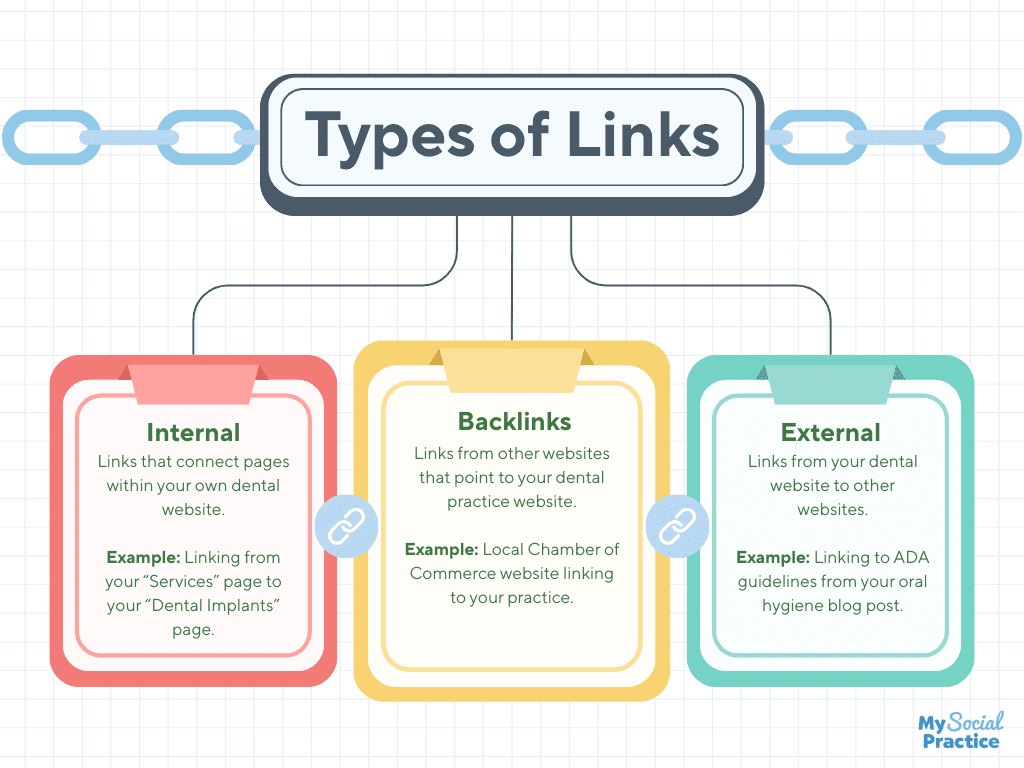
There are three kinds of links in dental SEO, and mixing them up is the fastest way to waste effort. Here is the plain-English version.
| Link type | Direction | Example | What it does for SEO |
|---|---|---|---|
| Backlink (inbound link) | Another site links to you | Your local Chamber of Commerce links to your practice page | Builds authority and trust; a top ranking signal |
| Internal link | You link from one page on your site to another page on your site | Your blog post links to your “New Patients” page | Spreads authority around your site and helps Google understand structure |
| External link (outbound link) | You link from your site out to another site | Your cavity blog post links to an ADA patient resource | Adds credibility and context; supports E-E-A-T |
The big takeaway: backlinks are earned by you from others, internal links connect your own pages, and external links are the ones you place pointing outward. Most dentists obsess over backlinks and ignore the other two, but a healthy site uses all three. Internal links keep patients moving through your site and pass authority to your most important pages. External links, which we cover in detail below, show Google your content is well-researched rather than written in a vacuum.
If you want to go deeper on how everything connects technically, our technical SEO guide for dental websites breaks down site structure and internal linking.

How do dentists earn quality backlinks? 8 proven ways
Here is the core of the whole guide. These are the practical, repeatable ways dental practices earn the kind of backlinks that actually move rankings. You do not need all eight at once. Pick two or three, do them consistently, and add more over time.
1. Write guest blog posts for local sites and dental blogs
Offer to write a helpful article for a local business’s blog, a community website, or a dental industry site, and include a natural link back to your practice. You bring useful content, they get free material, and you earn a relevant backlink. Reach out to businesses you already have a relationship with first, since a warm ask beats a cold one every time.
2. Claim and optimize your Google Business Profile
Your Google Business Profile is the foundation of local visibility, and while the profile link itself is a specific kind of signal, a complete, active profile strengthens everything else you do. Keep your name, address, phone number, hours, and website consistent, add real photos, and reply to reviews. Consistent business information across the web, known as citations, reinforces trust and supports your map rankings.
3. Get listed in dental and healthcare directories
Reputable directories are one of the easiest backlink wins available. Get your practice listed on trusted healthcare and dental directories such as Healthgrades, Zocdoc, and your state dental society’s “find a dentist” tool, plus general local directories like Yelp and your local Chamber of Commerce. Prioritize directories that are relevant to dentistry or to your city, and skip low-quality, spammy directories that exist only to sell links.
4. Create linkable content worth citing
The most sustainable way to earn backlinks is to publish something so useful that other people link to it on their own. Think original local data, a clear patient guide, a cost breakdown, a checklist, or a simple tool. When your content answers a question better than anyone else, bloggers, journalists, and other dentists start citing it. Our guide to dental SEO copywriting walks through how to write content that earns links and ranks.
5. Pursue .edu links from schools and universities
Links from .edu domains carry serious weight because educational institutions are highly trusted. Dentists can earn them a few honest ways: by creating educational resources a professor might reference, by guest lecturing at a local dental hygiene program or university, or by offering a small student scholarship that qualifies for a listing on the school’s financial aid page. These take effort, but even one solid .edu link is worth a lot.
6. Join local business associations and dental organizations
Membership in your local Chamber of Commerce, a regional business association, or a professional dental organization usually comes with a member profile that links to your site. These links are relevant, trusted, and often overlooked. As a bonus, they connect you with other local businesses who may link to you or refer patients.
7. Build reciprocal and partnership links with local businesses and specialists
You almost certainly have professional relationships you can turn into links. The orthodontist or oral surgeon you refer patients to, the local gym, the coffee shop next door, or the pediatrician down the street may all be willing to link to you, especially if you link to or feature them too. Keep these genuine and relevant. A handful of real local partnerships beats dozens of forced link swaps.
8. Earn media coverage and sponsor local events
When your practice sponsors a youth sports team, runs a free dental day, hosts a charity drive, or shows up at a community event, local news sites and organization pages often mention and link to you. This is digital PR at the neighborhood level: do something genuinely good in your community, then make it easy for people to write about it. You can also use journalist request services (the modern successors to HARO) to get quoted as a dental expert in articles, which can land links from strong news domains.
Doing all of this by hand takes time. If it starts to feel overwhelming, that is normal, and it is exactly the kind of work a marketing partner can take off your plate.
Should dentists use outbound external links in their content, and do they help SEO?
Yes. Linking out from your own content to authoritative sources helps your SEO, and the fear that it “leaks” your ranking power is a myth. Done well, outbound external links make your content more credible to both Google and patients.
Here is the misconception worth killing: many dentists believe that every time they link to another website, they hand away some of their own SEO strength. That is not how it works. Thoughtful outbound links to trustworthy sources signal that your content is well-researched and honest, which is a quality signal, not a penalty. The old 2025 advice on this lived in a separate post; we have folded the essentials into this guide so you have one place to learn it.
Why outbound links help:
- Credibility and E-E-A-T. Citing sources like the American Dental Association or peer-reviewed research shows experience, expertise, authoritativeness, and trust, the qualities Google’s quality raters look for on health topics.
- Better context for Google. Linking to relevant, authoritative pages helps search engines understand your topic and how your content fits the wider web.
- A better patient experience. Pointing readers to solid further reading keeps them engaged and builds trust in your practice.
- An edge with AI and answer engines. Well-sourced content is easier for AI Overviews, ChatGPT, and other answer engines to trust and cite, which increasingly drives visibility.
A simple way to remember the rules is the DENTAL framework for external linking:
- Determine relevance to your content before you link.
- Evaluate the source’s authority; link to trusted institutions, not random blogs.
- Navigate to the original source rather than a site that merely repeats it.
- Target descriptive anchor text that tells readers where they are headed.
- Audit your links regularly and fix or remove broken ones.
- Limit quantity and maximize quality; a few great links beat a dozen weak ones.
Do: link to ADA guidelines, CDC resources, peer-reviewed studies, and reputable institutions; use clear, descriptive anchor text; and consider opening external links in a new tab so patients do not lose your page.
Don’t: link to direct competitors for no reason, use vague anchors like “click here,” or point readers to low-quality or outdated sources.

What NOT to do: link-building mistakes that get dentists penalized
Some link tactics do more harm than good, and a few can trigger a Google penalty that tanks your rankings. Avoid these.
Buying inbound links. Is it smart to buy backlinks for your dental practice? No. Purchasing links violates Google’s guidelines on link schemes and can result in a manual penalty that is painful to recover from. It looks like a shortcut, but you are renting risk, not building authority. Skip it and earn links the real way.
Other tactics to steer clear of:
- Link farms and private blog networks (PBNs). Networks of junk sites that exist only to sell links are exactly what Google’s algorithms hunt for.
- Irrelevant or spammy directories. A listing on a random directory with no connection to dentistry or your city adds no value and can look manipulative at scale.
- Over-optimized anchor text. If dozens of links all use the exact phrase “best dentist in [city],” it looks engineered. Keep anchors varied and natural.
- Mass link exchanges. A genuine partnership link or two is fine. Systematic “link to me and I’ll link to you” schemes at scale are a red flag.
The through-line: if a link exists only to trick Google rather than to help a real person, it is a liability. Google’s own link spam guidance spells this out.
How do you measure your link-building results?
Track a few core metrics so you know your effort is paying off rather than guessing. Link building is a long game, so give it time and watch the trend, not the daily wiggle.
- Referring domains. The number of unique websites linking to you. More quality referring domains over time is the clearest sign of progress.
- Domain authority. A useful directional score for how your overall link profile is trending. Watch the direction, not the exact number.
- Keyword rankings. Are the pages you are building links to actually moving up for your target terms? Track your priority keywords.
- Referral traffic. Real patients clicking through from those links, visible in Google Analytics.
- Organic traffic and engagement. Rising organic visits, healthy time-on-page, and reasonable bounce rates tell you the links are helping the right pages.
Tools like Google Search Console (free), Google Analytics (free), and paid platforms such as Semrush, Ahrefs, or Moz will show you referring domains, rankings, and traffic. If you are wondering how soon to expect results, our guide on how long dental SEO takes sets realistic expectations, and the full dental SEO breakdown shows where links fit alongside everything else.
Ready to build links that actually rank your practice?
Link building is one of the highest-impact things you can do for your dental SEO, and it is also one of the most time-consuming. If you would rather focus on patients while experts handle the strategy, our team can help. Grab our dental SEO guide or book a consultation, and let’s get your practice climbing.

Frequently Asked Questions
How do dentists get backlinks?
Dentists earn backlinks by getting listed in trusted dental and local directories, writing guest posts for local and industry sites, joining business and dental associations, creating genuinely useful content other sites want to cite, pursuing .edu links, and sponsoring local events that generate press. Consistency across a few of these beats chasing all of them at once.
How many backlinks does a dental website need?
There is no magic number, and quality matters far more than quantity. A local practice can rank well with a few dozen strong, relevant links from trusted local and dental sources. Focus on earning links from sites Google already trusts rather than racking up a high count of weak, unrelated ones.
What's the best type of backlink for a dental practice?
The best backlinks are relevant, trusted, and local: links from your city’s respected organizations, reputable dental and healthcare directories, dental associations, and .edu domains. These carry authority and relevance, which is exactly the combination Google rewards for a local, health-focused business like a dental practice.
How do I get a dental colleague or local business to link to me?
Start with relationships you already have. Ask the specialists you refer to, nearby businesses, and community partners if they will link to you, and offer to feature or link to them in return. Make it easy by giving them the exact page and a short blurb. Genuine, relevant partnerships are the most natural links you can earn.
Is it worth buying backlinks for a dental practice?
No. Buying inbound links violates Google’s guidelines and can trigger a penalty that hurts your rankings, sometimes badly. It is a shortcut that trades long-term risk for short-term appearance. Invest that time and money in earning real links from directories, partners, and quality content instead.
Should external links open in a new tab, and do outbound links pass authority away?
Opening external links in a new tab is a small user-experience choice that keeps patients on your page, and it is generally a good idea. As for authority, a few relevant outbound links do not meaningfully drain your SEO. The credibility they add is worth far more than the tiny amount of link equity involved.
Do outbound external links help or hurt my SEO?
They help when done well. Linking out to authoritative sources like the ADA or peer-reviewed research builds credibility, gives Google context, and improves the patient experience. Linking out does not drain your ranking power. Just keep external links relevant, high-quality, and reasonable in number.

Adrian Lefler is the CEO and Co-Founder of My Social Practice and a recognized dental marketing expert with nearly two decades of experience. He is a trusted voice in dental marketing, AI in dentistry, and emerging technology, and he hosts BYTE SIZED, a podcast focused on dental AI, innovation, and technology.