What You’ll Learn
- Why patients say “let me think about it” and what it really means
- The three-brain model that explains how humans actually make decisions
- Why the walk from operatory to front desk destroys case acceptance
- How treatment coordinators should anchor the entire consultation process
- How AI smile simulations create emotional engagement in under 30 seconds
What Dentists Get Wrong About Case Acceptance
Most dentists assume patients decline treatment because of cost. The research on human decision-making tells a completely different story.
Dr. Simone Stori is an Italian dentist who has spent years studying the gap between clinical recommendations and patient readiness to accept treatment. That research led him to build SmAile Up Studio, an AI tool that generates photorealistic smile simulations from a single selfie in under 30 seconds.
“When we talk about selling processes, so case acceptance, we usually think that if the patient says no, he wants to think about it,” Dr. Stori explained on a recent episode of the Byte Sized Podcast. “‘Think about it’ usually is about logic. But what we see is that we have not built enough trust and excitement about the result.”
The Three-Brain Model
Understanding why patients say yes or no requires understanding how the human brain actually processes decisions.
The brain operates in three layers. The first layer, sometimes called the reptilian brain, handles immediate survival responses. Fight or flight. When a patient walks into your office, this part of their brain decides within seconds whether they can trust you. This happens automatically and cannot be forced.
The second layer handles emotion. This is where patients decide whether they like what you are saying, whether it resonates with what they want, whether they feel excited about a potential outcome.
The third layer, the neocortex, handles logic. This is where patients think about cost, time, inconvenience, and practical considerations.
What does this mean for dental case acceptance? Patients make decisions in the second layer and justify them in the third.
“Every purchase we do is like this,” Dr. Stori said. “We don’t need a new iPhone because we have the old one that works. We say that we have the battery that is dead. But that’s the justification. That’s the logical.”
When a patient says “let me think about it,” they are not asking for more information. They are telling you they were never emotionally engaged enough to make the decision in the first place.
| Brain Layer | Function | Patient Behavior |
| Reptilian (First) | Trust/Safety | Decides in seconds if they feel safe |
| Limbic (Second) | Emotion | Decides if they want the outcome |
| Neocortex (Third) | Logic | Justifies the emotional decision |
The 15-Second Walk That Kills Dental Case Acceptance
Adrian shared a personal story that perfectly illustrates where case acceptance falls apart.
He visited his dentist and asked about aligners. The doctor explained the process, discussed timelines, and seemed enthusiastic. Adrian was ready to move forward. But no one asked him to commit while he was in the chair. No one mentioned budget. No one closed.
“I got up, I walked from the operatory to the front desk, and in that short 15 seconds, I thought maybe I should hold off on this,” Adrian recalled. “When I got to the front, the front desk said, ‘Well, are you interested?’ I said, ‘You know what? Let me come back in six months and talk about it again.'”
It took another year and a half before he actually started treatment.
That 15-second walk is where case acceptance goes to die. The patient leaves the presence of the doctor, the authority figure they trust, and arrives at a front desk staffed by someone who was not part of the conversation. The emotional momentum evaporates.
The Treatment Coordinator Solution
Dr. Stori structures his practice to eliminate this gap entirely. The treatment coordinator, not the dentist, is the central figure in the patient journey.
“The treatment coordinator is not the doctor because it starts from the phone, then it starts with the welcome, then it starts with the pre-visit consultation room, not operatory. Then we go to operatory and then you move another time to the consultation room. But the focus, the reference person of my team is the treatment coordinator, not the dentist.”
This structure solves two problems simultaneously.
First, patients have a consistent relationship throughout their visit. They are not handed off from person to person, repeating their story, rebuilding trust each time. The treatment coordinator who greeted them is the same person who discusses treatment options and handles financial conversations.
Second, the mental “yes” happens in the operatory while the doctor is present. The treatment coordinator is there to witness it and continue the momentum seamlessly.
“Of course the dentist has the authority,” Dr. Stori said. “That’s why if you have the split, it’s more simple that what happens. You say yes to a genius because he’s a doctor, then he goes to the front office and says no.”
When the treatment coordinator accompanies the patient from operatory to consultation room, there is no gap. There is no 15-second walk where doubt creeps in. The chain remains unbroken, and case acceptance rises.
Why Aesthetic Cases Are Different
Aesthetic dentistry presents a unique challenge. There is no pain driving the decision. No infection that demands treatment. The patient is choosing to spend significant money and time purely for how they will look and feel.
“Aesthetics in dentistry is not a pain,” Dr. Stori noted. “You don’t have to think about the pain. But about a new smile that costs a lot of money, pain, a lot of time, and is only for aesthetics usually. And that’s all emotional.”
The traditional solution has been the mockup. Digital smile design systems like DSD allow dentists to create visual representations of treatment outcomes. When patients see a physical mockup of their potential smile, acceptance rates climb dramatically.
The problem is time. Creating a quality digital smile design takes about an hour with traditional systems. That means the patient cannot see it during their initial consultation. They have to leave, wait for the mockup to be created, and return for another appointment.
“In this time, a lot of things can happen,” Dr. Stori explained. “They go home. They think about it. The wife or the husband say, ‘I love your smile. Why are you doing this?’ There’s a lot of things.”
Every hour that passes between emotional engagement and decision is an hour where the patient can talk themselves out of treatment.
AI Smile Simulation in 30 Seconds
SmAile Up Studio solves the time problem by generating photorealistic smile simulations in under 30 seconds from a single selfie.
The dentist or treatment coordinator takes a photo of the patient, selects the type of treatment being discussed, and the AI generates a before-and-after comparison almost instantly. The patient sees themselves with whiter teeth, straighter alignment, or a full smile makeover while still sitting in the chair.
“When you talk to a patient, have you ever imagined to have straight teeth? You can say yes, I have imagined, but you will never see how it will be to have straight teeth in your mouth, in your face,” Dr. Stori said. “That’s why to create with AI, we find a way to have a photorealistic before and after with a selfie in less than 30 seconds directly in the operatory.”
The system offers multiple simulation modes. Whitening only, which adjusts tooth color without moving teeth. Alignment, which shows straightening results. Alignment plus whitening plus bonding for noninvasive veneer alternatives. Full mouth reconstruction for complex cases.
Each mode is designed with clinical precision in mind. A whitening simulation does not accidentally straighten teeth. An alignment simulation maintains realistic proportions.
Managing Expectations
One concern dentists raise about AI simulations is patient expectations. What happens when the final result does not match the simulation exactly?
Dr. Stori addresses this head-on. The simulation is presented as an idea, not a guarantee. Every email containing a simulation includes a disclaimer that the image is AI-generated. But more importantly, the conversation frames it correctly from the start.
“We have to talk to the patient that it is like an idea,” Dr. Stori said. “If we talk like this, the patient understands. If I say this is the result you will achieve, it will be a problem.”
The comparison he uses is an Instagram filter. Everyone understands that a filter shows a version of reality, not reality itself. A professional smile simulation works the same way. It provides direction and excitement, not a contractual promise.
The system offers multiple simulation modes. Whitening only, which adjusts tooth color without moving teeth. Alignment, which shows straightening results. Alignment plus whitening plus bonding for noninvasive veneer alternatives. Full mouth reconstruction for complex cases.
Each mode is designed with clinical precision in mind. A whitening simulation does not accidentally straighten teeth. An alignment simulation maintains realistic proportions.
Results From the Field
Dr. Stori shared a case from the day of the podcast recording. A patient who had visited 10 different dentists received a simulation the previous day. She called back excited, accepted treatment, and convinced her husband to come in for his own consultation. They closed an implant case that same day.
“She’s very excited and also convinced him to come to the consultation today, and we close implant cases from a simulation,” Dr. Stori said.
Injection technique cases, the European term for composite veneer alternatives, are closing consistently with the simulation tool. One patient, a 32-year-old woman facing full arch reconstruction, started crying when she saw her simulation because she could finally envision returning to a normal smile.
“The concept is it’s a tool, it’s not the solution to all,” Dr. Stori emphasized. “The solution is to create a consultation process that follows the right principles. And of course the use of AI is very interesting to create documents, reports, transparency. We have a lot of tools that can help us make a great experience for our patients. This tool is only the last part of the great experience we can create.”
The Lead Generation Angle
Beyond chairside case acceptance, the same AI simulation technology works as a marketing tool.
Patients can upload a selfie from home before ever contacting the practice. They see what their smile could look like, enter their contact information to receive the full results, and become a warm lead for the practice.
“No one at the moment has created a way that you can professionally simulate the new smile from home before contacting and use it as a lead magnet,” Dr. Stori noted.
The funnel structure is simple. The first page asks only for a photo upload and a click to generate. The second page requests name, email, and phone number to receive the results. The patient gets their simulation, and the practice gets a highly qualified lead who has already imagined themselves with a new smile.
For practices running paid advertising for cosmetic services, this changes the offer entirely. Instead of “schedule a consultation,” the ad promises “see what your new smile could look like in 30 seconds.” The barrier to entry drops dramatically while the emotional engagement rises.
In This Episode:
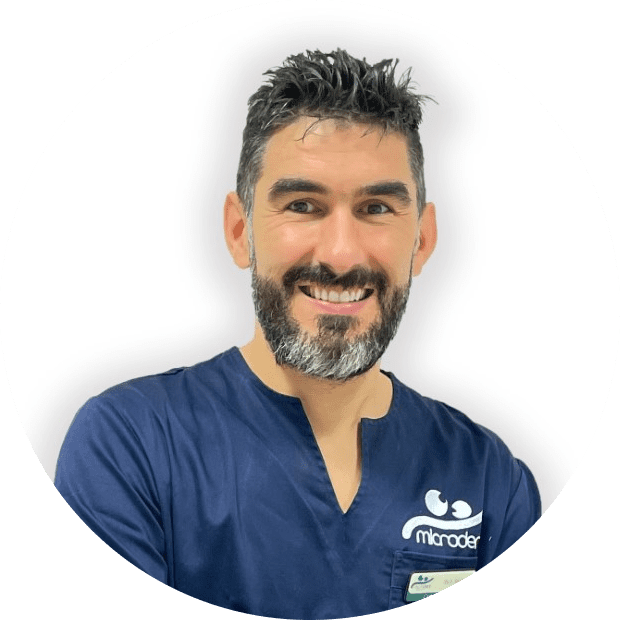
Dr. Simone Stori, CEO and Founder of Microdent
Dr. Simone Stori is an Italian clinical dentist specializing in aesthetic and restorative dentistry, including Digital Smile Design, injection technique composite, and full-arch rehabilitation. He developed SmAileUp Studio to help practices generate chairside AI smile simulations in real time. Dr. Stori is a certified injection technique trainer and will be speaking at the London Medical and Dental AI Summit in June 2026 on AI-enhanced first consultations.

Adrian Lefler, CEO and Co-founder of My Social Practice
Adrian Lefler is the CEO and Co-Founder of My Social Practice and a recognized dental marketing expert with nearly two decades of experience. He is a trusted voice in dental marketing, AI in dentistry, and emerging technology, and he hosts BYTE SIZED, a podcast focused on dental AI, innovation, and technology.
Frequently Asked Questions
How should treatment coordinators be integrated into the consultation process?
The treatment coordinator should be the consistent presence throughout the entire patient journey, from the welcome call through the consultation room to the operatory and back. This prevents the patient from being handed off to strangers at critical decision points. The mental “yes” should happen in the operatory with the treatment coordinator present to maintain momentum through the financial conversation. This is the path to higher case acceptance.
What types of simulations can AI smile tools generate?
Current AI smile simulation tools can generate whitening-only results, alignment results, combination treatments like alignment plus whitening plus bonding, and full mouth reconstruction previews. Each simulation type is designed to show only the relevant changes without accidentally altering other aspects of the smile.
Can AI smile simulations be used for marketing and lead generation?
Yes. The same technology that generates chairside simulations can be embedded in landing pages where prospective patients upload selfies from home. They receive their simulation after providing contact information, creating a warm lead who has already visualized their potential outcome. This approach works particularly well for paid advertising campaigns promoting cosmetic services.