What You’ll Learn
- Why patients trust AI recommendations like personal referrals and how this changes everything about dental marketing
- How voice search and AI conversations are eliminating website visits entirely
- How your expensive ads might be driving patients to AI-optimized competitors who capture them at the moment of decision
- Why your beautiful website videos and animations are making you invisible to AI, and the simple fixes that restore visibility
- How AI extracts random paragraphs from your content and why every section must work as standalone information
- Exactly how to demonstrate Experience, Expertise, Authoritativeness, and Trustworthiness to AI engines
- Why “Is sedation dentistry right for me?” beats “sedation dentistry Austin TX” in the AI era
- How to write questions exactly as patients ask them and why this is your easiest AI optimization win
- Why traditional SEO metrics won’t show you’re losing patients to AI-invisible competition
- How AI-to-AI communication will enable instant appointment booking within 6-12 months
The Zero-Click Revolution That’s Killing Traditional SEO
Ridgely Goldsborough doesn’t mince words when describing the seismic shift happening in dental marketing: “If you’re not paying attention to AI and searches continue to move in the direction they’re moving… you’re suffering death by a thousand cuts and you don’t even know it.”
As a serial entrepreneur who’s started 45 companies and now focuses exclusively on elite dental practices, Goldsborough has seen every marketing revolution since the internet began. But nothing, he insists, compares to what’s happening right now with AI and zero-click searches.
The 400-800% Conversion Rate
Research shows that when AI recommends a product or service, conversion rates jump 400-800% compared to traditional search results. Goldsborough explains why: “If I interact with an AI engine, it’s an iterative process. I’m going back and forth with the engine… AI is doing the work for you.”
The reason comes down to trust. When ChatGPT or Google’s Gemini recommends a dentist, patients treat it like a personal referral rather than a cold list of options. Adrian Lefler shares his own experience: “A doctor called us three weeks ago. He says, ‘I went to ChatGPT and asked it to help me find the best dental marketing company.’ ChatGPT recommended us and he just called us and signed up.”
No comparison shopping. No reading reviews. The AI said it, so it must be true.
The Voice Search Revolution
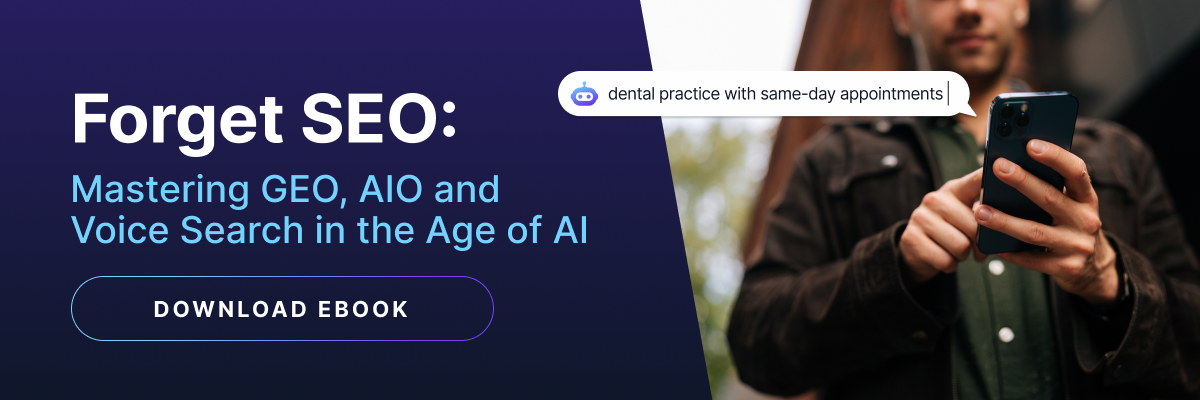
Here’s the brutal truth about human nature that’s reshaping search: “We’d rather talk than type,” Goldsborough states simply. With AI tools now on every phone, patients aren’t typing “dentist near me” anymore. They’re having conversations.
“I’m missing a couple of teeth. I’m scared of the dentist. I need somebody who’s going to be really kind and gentle in my area. Can you help me out?” That’s an actual search query now. Notice something? Zero clicks so far.
The AI responds with a recommendation, explains the dentist’s credentials, shares their hours, and the patient says, “Hey Siri, call Dr. Adrian.” Still zero clicks. The entire patient acquisition journey happened through voice, with no website visit, no blue links, no traditional SEO metrics.
The Nightmare Scenario Every Practice Should Fear
Maybe you can see where this gets potentially dystopian. Imagine you’re spending thousands on PPC ads for full-mouth restorations. A potential patient sees your billboard or digital ad. But instead of clicking, they pick up their phone and ask ChatGPT: “Who does full-mouth restorations in my town, and oh, by the way, I want somebody who’s got great reviews and is known for a gentle touch.”
ChatGPT recommends your competitor.
“You spend all that money on PPC traffic,” Goldsborough warns, “and then have your ad be promoting somebody else’s business because they are optimized for AI and you’re not. Insane.”
Why Your Beautiful Website Is Becoming Invisible
The traditional dental website’s role is fundamentally changing. “The website informs AI engines,” Goldsborough explains. “Even though the website is not going to be the direct tool… it’s where AI goes to judge: are you the right person for me to recommend?”
But here’s the catch: AI engines need to gather data from your website in 800 milliseconds or less. That gorgeous video playing automatically on your homepage? It’s killing your AI visibility. Goldsborough describes the painful conversation he has with practices: “I know you love your site. I know patients have said, ‘Oh doc, your site is so beautiful,’ but it’s slowing down your core vitals and AI is not going to find you.”
The EEAT Framework That Determines AI Visibility
For AI to recommend your practice, your website must emphasize what Google calls EEAT: Experience, Expertise, Authoritativeness, and Trustworthiness. But implementing this isn’t what most dentists expect.
Traditional SEO might optimize for “sedation dentistry Austin Texas.” AI optimization requires natural language: “Is sedation dentistry right for me?” or “Can I drive myself home after sedation?” It’s the difference between writing for algorithms and writing for conversations.
Goldsborough breaks it down: “The language must be AI-friendly. And by AI-friendly, I mean the way a human being would interact with an AI tool.”
The Chunk Revolution Nobody Understands
Here’s where technical meets practical. AI doesn’t read your website like humans do. It extracts “chunks”—specific paragraphs or sections that answer questions. It might ignore your beautifully crafted homepage and instead grab the sixth paragraph of a blog post because that chunk perfectly answers someone’s query.
“You’re not writing long narrative posts,” Lefler explains. “You’re writing information that might get picked up as a source like a chunk.” This fundamentally changes content strategy. Every section of content must stand alone, containing complete thoughts that make sense without context.
The FAQ Gold Mine Most Practices Ignore
The easiest win for AI optimization? Frequently Asked Questions written as people actually ask them. Not “Sedation Dentistry Information” but “Will I remember anything after sedation?” Not “Insurance Accepted” but “Does Delta Dental cover dental implants?”
These natural language questions match the way patients interact with AI. When someone asks their phone a question, AI looks for that exact phrasing on your website. If you have it, you win. If you don’t, your competitor does.
The Coming Agentic AI Revolution
Goldsborough paints a picture of the near future that sounds like science fiction but is technically possible today. You tell ChatGPT you need a dentist who takes Delta Dental and has appointments after 4 PM. ChatGPT talks to an AI agent at the dental practice, checks the schedule, books your appointment. Done.
“I pick up my phone and I basically schedule an appointment like I’m ordering DoorDash,” Lefler describes. “That’s what the consumer is going to want.”
The technology exists now. The only barriers are security concerns about giving AI access to your phone’s data. But Goldsborough predicts workarounds within 6-12 months, like dedicated debit cards just for AI transactions.
Your Practice’s Binary Choice
The message from both experts is stark: you’re either capturing patients from AI-invisible competitors, or you’re the invisible one losing patients. There’s no middle ground.
“My premise is that it’s even more important to do AI and optimize for AI because you don’t even know what’s coming,” Goldsborough emphasizes. Traditional agencies that insist “SEO is SEO” are protecting their inability to adapt, not your practice’s future.
The practices thriving in the future won’t be those with the prettiest websites or even the best Google rankings. They’ll be the ones AI trusts enough to recommend when patients ask, “Who should fix my smile?” The question isn’t whether to optimize for AI, but whether you’ll do it before your new patient volume mysteriously drops and you’re left wondering why.
As Goldsborough concludes: “Which side of the equation do you want to be on? Having patients taken away from you that you don’t even know are being taken away? Or being the one that’s benefiting from being on the cutting edge?”
In This Episode:

Ridgely Goldsborough, Esq
Ridgely Goldsborough is a serial entrepreneur who has started 45 different companies and now focuses exclusively on helping elite dental practices dominate their markets through cutting-edge digital marketing and AI optimization strategies. After spending years in the speaking circuit delivering CEO-level presentations worldwide, Ridgely pivoted to dental marketing during the pandemic and has become a leading voice in AI-powered dental marketing solutions. He runs an AI mastermind to stay on the cutting edge of developments and founded Dental Market Dominator, working exclusively with practices generating $250,000+ per month.

Adrian Lefler, CEO and Co-founder of My Social Practice
Adrian Lefler, CEO of My Social Practice, is a seasoned expert in the dental marketing industry with 14 years of experience. He is widely recognized for his engaging and informative presentations. Based in Suncrest, Utah, Adrian shares his life with his wife, four children, and a lively mix of pets. My Social Practice is a leading dental marketing company, and Adrian is passionate about helping dental professionals succeed in this dynamic field.
Frequently Asked Questions
What exactly are zero-click searches and why should dental practices care?
Zero-click searches occur when patients get their answer directly from AI without visiting any website. Instead of typing “dentist near me” and clicking through websites, patients now have conversations with AI: “I need a gentle dentist who takes Delta Dental and has evening hours.” The AI provides a direct recommendation and often the phone number. Research shows AI recommendations convert 400-800% better than traditional search results, meaning patients trust and act on these recommendations immediately without comparing options.
How should dental websites be optimized differently for AI versus traditional SEO?
AI optimization requires fundamental changes: write in natural language questions (“Is sedation dentistry safe for seniors?”) rather than keyword phrases (“sedation dentistry Austin TX”). Your site must load in under 800 milliseconds for AI to access it. Create standalone “chunks” of information that make sense without context, since AI might grab paragraph six of a blog post while ignoring everything else. FAQs become critical. Write them exactly how patients would ask them verbally. Focus on EEAT (Experience, Expertise, Authoritativeness, Trustworthiness) with in-depth, valuable content rather than keyword-stuffed fluff.
Is traditional SEO dead, and should practices stop their current SEO efforts?
Traditional SEO isn’t dead; it’s foundational to AI optimization. Fast-loading websites, proper schema markup, mobile optimization, and quality content remain essential. However, these alone aren’t enough anymore. As Goldsborough explains, practices need both: traditional SEO ensures AI can access and understand your site, while AI optimization ensures you’re recommended when patients ask questions. The deadly mistake is assuming your current SEO strategy is sufficient. Practices must add AI optimization on top of traditional SEO or risk “death by a thousand cuts” as patients increasingly rely on AI for recommendations.