What You’ll Learn:
- Why cosmetic dental patients use conversational, research-driven search queries
- How AI tools are reshaping SEO for cosmetic dentistry
- What AI-powered advertising looks like for high-value procedure marketing
- How to use AI to convert cosmetic leads before they ghost you
- Practical steps to align your marketing strategy with how cosmetic patients actually search
Table of Contents
- The Conversational Search Revolution in Cosmetic Dentistry
- What AI-Powered SEO Looks Like for Cosmetic Dentistry
- AI and Paid Advertising: Getting Smarter About Cosmetic Patient Targeting
- Social Media: Where Cosmetic Patients Go to Dream
- Where AI Receptionist Technology Changes Everything
- Online Reviews and Reputation: The Cosmetic Patient’s Final Checkpoint
- An AI-Powered Cosmetic Marketing Strategy
- FAQ
The Cosmetic Patient Thinks Differently. Your Marketing Should Too.
The cosmetic dental patient is a unique creature. They’re not in pain. They’re not in a rush. They’re doing research, comparing options, calculating costs, and imagining how their life might look with a different smile. They’re asking questions like, “Is a smile makeover actually worth it?” and “What is the difference between veneers and Lumineers?” and “How long does Invisalign take for adults?”
These are conversational queries. They are long, specific, and loaded with intent. And artificial intelligence is changing how search engines understand and rank content that answers them. That means the practices that understand this shift will win the high-value cosmetic patients and the ones that don’t will keep paying for clicks that go nowhere.
Here’s how AI is reshaping cosmetic dentistry marketing, and what your practice can actually do about it.
The Conversational Search Revolution in Cosmetic Dentistry
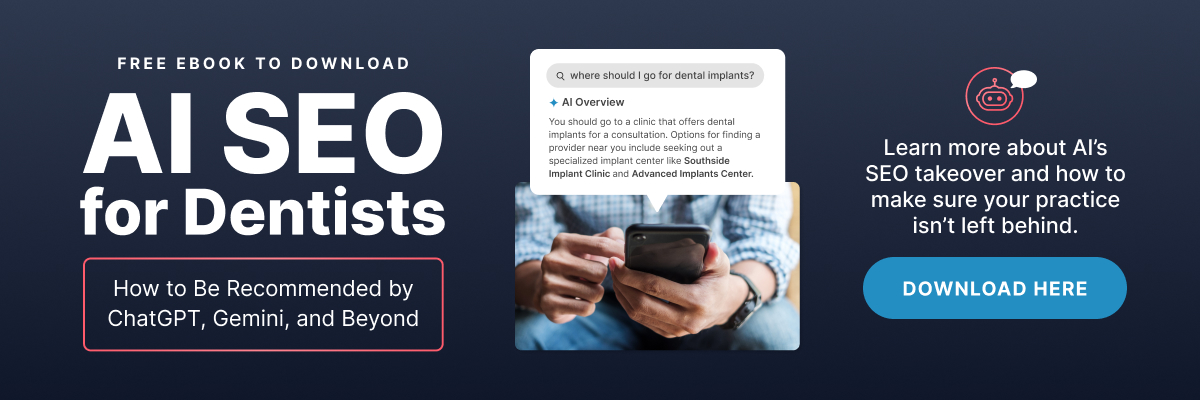
Google has been quietly getting smarter for years, but the rise of AI-powered search has accelerated everything. Tools like Google’s Search Generative Experience (SGE) and AI Overviews now try to understand the intent behind a search, not just the keywords. This is a massive deal for cosmetic dentistry.
When someone types “how much do porcelain veneers cost in Phoenix,” Google no longer just spits out a list of links. It tries to synthesize an answer, often pulling from content that specifically and thoroughly addresses that question. Practices with generic service pages are getting passed over. Practices with rich, conversational, question-answering content are getting surfaced.
Traditional vs. Cosmetic Patient Search Behavior
| Traditional Search Query | Cosmetic Patient Search Query | What AI Helps You Do |
| “dentist near me” | “how much do veneers cost in Dallas” | Target conversational, high-intent keywords |
| “teeth cleaning” | “is smile makeover worth it” | Create content that answers real patient questions |
| “dental office” | “before and after Invisalign results” | Optimize visual content for AI-powered search |
| “emergency dentist” | “can I fix my gummy smile without surgery” | Rank for long-tail, procedure-specific queries |
| “dental implants” | “what do dental implants feel like” | Capture patients deep in the research journey |
What AI-Powered SEO Looks Like for Cosmetic Dentistry
Most dental SEO strategies are built around general terms like “dentist in [city]” or “family dentist near me.” Those terms still matter, but they are fiercely competitive and they attract broad audiences that may not be ready to invest in a smile makeover.
AI-driven SEO for cosmetic dentistry focuses on a different layer in the form of the long-tail, procedure-specific, question-based queries that cosmetic patients use during their research phase. Think of it as building a library of content that meets patients wherever they are in their decision journey.
Here is what that looks like in practice:
- A blog post that answers “How long do composite veneers last compared to porcelain?” captures a patient who is actively comparing procedures and getting close to a decision.
- A detailed FAQ page about Invisalign costs and payment plans speaks directly to the patient who wants to know if they can afford it.
- Before-and-after case studies with descriptive alt text and structured data help AI-powered search understand the visual content on your site.
- Location-specific pages that mention cosmetic procedures by name help your Google Business Profile and local search rankings for high-value terms.
AI and Paid Advertising: Getting Smarter About Cosmetic Patient Targeting
Paid advertising for cosmetic dentistry has always been a balancing act. You want visibility, but cosmetic patients take longer to convert. They aren’t usually clicking an ad and calling the same day they see it. Instead, they’re collecting information, watching YouTube videos, comparing practices, and maybe coming back to your ad three weeks later.
AI-powered advertising platforms have gotten remarkably good at handling this complexity. Here is how modern dental advertising leverages AI to find and convert cosmetic patients:
- Behavioral targeting: AI identifies users who have been researching cosmetic procedures based on their browsing history, search patterns, and social behavior. This means your ads are shown to people already in the consideration phase, not random scrollers.
- Dynamic retargeting: Someone visited your “Veneers” page and left without calling? AI-powered retargeting systems can follow them across platforms with ads specifically related to veneers, keeping your practice top of mind throughout their research.
- Lookalike audiences: AI analyzes your current cosmetic patient base and finds new potential patients who match that profile online. It is like word-of-mouth, but scaled up and data-driven.
- Automated bid optimization: Instead of guessing how much to bid on a keyword, AI adjusts bids in real time based on the likelihood of conversion, making your ad spend more efficient.
My Social Practice’s paid advertising solutions use an all-in-one platform that builds entire ad campaigns across display, search, social, native, and video channels in minutes. For cosmetic dentistry, that means consistent messaging across every touchpoint where a potential cosmetic patient might encounter your practice.
Social Media: Where Cosmetic Patients Go to Dream
If Google is where cosmetic patients go to research, social media is where they go to dream. Instagram, TikTok, and Facebook are full of transformation content, and cosmetic dentistry is tailor-made for it. Before-and-after photos, smile reveal videos, and patient testimonials perform exceptionally well because they tap into the emotional core of what cosmetic dentistry is really selling, which is confidence.
AI is making social media marketing for cosmetic dentistry faster and more effective. Platforms now use AI to determine which content gets distributed to which audiences. This means that engaging, visually polished, well-branded content reaches cosmetic-minded users even beyond your current followers.
Some tactics that work particularly well for cosmetic dental practices on social:
- Transformation content with genuine patient stories (with consent, of course) drives shares and saves, both signals that boost organic reach.
- AI-generated captions that match your brand voice save your marketing manager hours every week and ensure consistency across platforms.
- Local hashtag strategies that are built into tools like the Dental Social Media Publisher help your cosmetic content surface to users in your geographic area.
- Video content, especially short-form, consistently outperforms static posts for cosmetic topics where the visual impact speaks for itself.
Where AI Receptionist Technology Changes Everything
Here is a scenario that plays out in dental offices across the country every day. A potential patient saw your before-and-after photos on Instagram, spent 20 minutes reading about veneers on your website, and then called your office at 7:45 on a Tuesday evening. No one answered. They left no voicemail. And they are already looking at the next practice on their list.
Cosmetic patients, because they are in research mode and often not in urgent pain, are particularly likely to reach out during off-hours. They might be thinking about their smile while winding down after work. They might have a question pop up on a Saturday morning. And if your practice is not there to catch that moment, you have likely lost them.
This is where AI receptionist technology makes a direct, measurable impact on cosmetic patient acquisition.
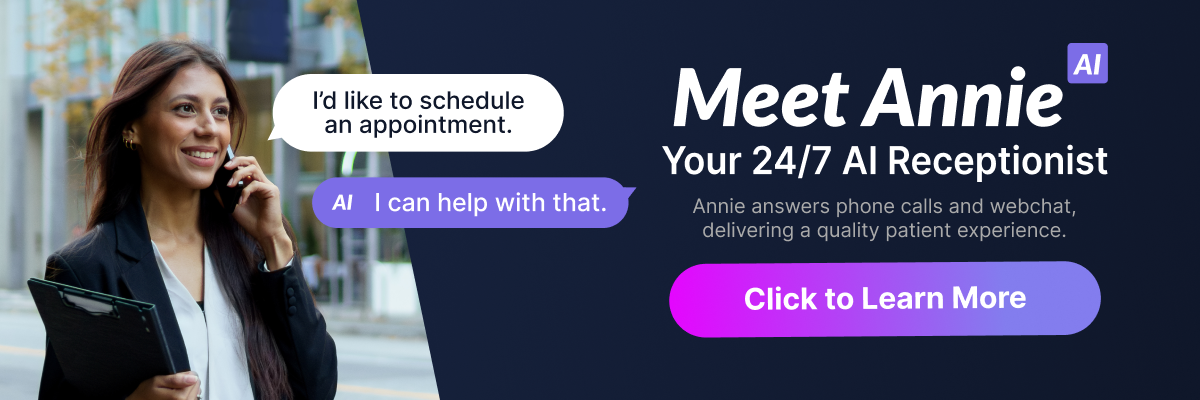
Annie AI is a dental-specific AI receptionist that answers calls around the clock, manages webchat, and handles patient inquiries with natural, conversational responses. For cosmetic inquiries, Annie can answer common questions about procedures and pricing, overcome common objections, and schedule consultations directly into the practice management system, all without a human having to be on the clock.
Online Reviews and Reputation: The Cosmetic Patient’s Final Checkpoint
Cosmetic patients are thorough researchers, which means they are going to look at your reviews before they ever call. And not just the number of stars. They’re reading the reviews, looking for mentions of specific procedures, looking at how the practice responded, and deciding if the vibe feels right.
AI-powered reputation management tools now make it possible to consistently collect, monitor, and respond to reviews at a scale that would be impossible manually. For cosmetic practices, this means:
- Automated review requests sent via SMS immediately after a cosmetic consultation or procedure, when patient excitement is highest.
- Instant responses to new reviews that keep your Google Business Profile active and signal responsiveness to both Google and potential patients.
- Monitoring for specific procedure mentions so you can track which services are generating the most positive sentiment.
An AI-Powered Cosmetic Marketing Strategy
Cosmetic dental patients do not search the way emergency patients do. They research, compare, dream, and evaluate. They use conversational queries. They check social media. They read reviews twice. And then, if everything feels right, they call, often at an unexpected hour.
An AI-powered marketing strategy for cosmetic dentistry meets these patients at every stage of that journey:
- AI-driven SEO surfaces your practice when patients are asking procedure-specific questions.
- Paid advertising with AI targeting and retargeting keeps your practice visible as they compare options.
- Social media content powered by AI tools gives cosmetic patients the visual proof and authenticity they are looking for.
- AI receptionist technology catches the inquiry in real time, whether it is 2pm or 2am.
- Automated reputation management builds the social proof that converts the final skeptic.
Want to build a marketing strategy around your cosmetic services? My Social Practice offers a full suite of dental marketing services designed specifically for practices like yours. From SEO to social media to AI-powered patient communication, everything works together to turn curious searchers into loyal cosmetic patients.
Frequently Asked Questions
How is marketing for cosmetic dentistry different from general dental marketing?
Cosmetic dental patients are not driven by pain or urgency. They are motivated by desire, confidence, and aspiration. This means the marketing funnel is longer and the content needs to match a research-oriented mindset. Instead of targeting broad keywords like “dentist near me,” effective cosmetic marketing focuses on procedure-specific, question-based searches like “are veneers worth the cost” or “how long does Invisalign take for adults.” The emotional component is also different. Cosmetic marketing should convey transformation, trust, and aesthetic excellence, not just clinical competence. AI helps dental practices create and distribute this kind of content more efficiently and at greater scale.
What AI tools should dental practices use for cosmetic dentistry marketing?
The AI tools most relevant to cosmetic dental marketing fall into a few categories. For content creation, tools like ChatGPT and similar LLMs can help generate blog posts, FAQ pages, social captions, and email copy that addresses the questions cosmetic patients are actually asking. For paid advertising, AI-powered platforms can automate targeting, bidding, and ad creation across multiple channels simultaneously. For patient communication and lead capture, AI receptionists like Annie AI handle calls and webchat inquiries around the clock. For SEO, AI is increasingly built into tools that help identify high-intent keywords and optimize content structure. The most effective approach is not picking one tool but building a connected ecosystem where each AI-powered element supports the others.
How does conversational search affect SEO for cosmetic dental practices?
Conversational search refers to the increasingly natural, question-style queries that people use when searching online, especially as AI-powered search tools become more common. For cosmetic dental practices, this is significant because patients are not searching for “veneers dentist” anymore. They are searching for “what is the difference between porcelain and composite veneers” or “can I get veneers if I have crooked teeth.” Google’s AI-powered search features now try to synthesize answers to these questions directly in the search results, pulling from content that specifically and comprehensively addresses them. Dental practices that publish content structured around these questions, including blog posts, FAQs, and in-depth procedure pages, are far more likely to appear in these AI-generated results and capture high-intent cosmetic patients.
About the Author: Megan Nielsen is an SEO strategist and the Grand Overlord of copywriting at My Social Practice. My Social Practice is a dental marketing company that offers a full suite of dental marketing services to thousands of dental practices throughout the United States and Canada.