What You’ll Learn
- Why Google is shifting from traditional search results to AI mode and what it means for dental advertising
- How zero-click searches are already impacting dental practice website traffic
- The real reason Google Ads costs have increased dramatically over the past two years
- Why starting your Google Ads campaign now gives you a critical advantage over competitors
- What the future of dental practice websites looks like in an AI-driven search landscape
Why Dentists Should Start Running Google Ads Now
If you have been on the fence about running Google Ads for your dental practice, the window to get ahead of your competition is closing faster than you think.
Google is preparing to roll out AI mode as its primary search interface, potentially as early as 2026. When that happens, the entire advertising landscape transforms. Dental practices that already have optimized, data-driven ad campaigns will be positioned to dominate. Everyone else will be scrambling to figure out the basics while their competitors capture the patients.
Adrian Lefler recently sat down with Alan Earl, the Director of Performance of Flood Digital and an 18-year veteran of digital marketing, to break down exactly what dentists need to understand about this shift and why waiting is the worst strategy you could choose.
“If you just wait, there’s going to be this run for the door, this Black Friday thing that’s going to happen when Google announces it,” Alan explained. “The ones that are going to really get it and maximize it are the ones who have been doing ads already.”
What Is Google AI Mode and Why Should Dentists Care?
Right now, when someone searches for a dentist, they see the familiar layout: a few sponsored ads at the top, then the map pack, then organic listings. Most people have trained themselves to scroll right past those ads.
Google AI mode changes everything.
Instead of presenting 10 blue links for users to click through, Google’s AI assistant provides a direct, conversational answer. The ads will no longer sit in an obvious block at the top. They will be woven into the AI response itself, integrated so seamlessly that users may not immediately distinguish between organic recommendations and paid placements.
“Google instead of just saying, ‘Hey, these are the guys that paid for placement,’ feels more like, ‘Oh, this is intended to be in this result. It’s natural,'” Alan said. “We’re going to click on the one that feels right, catered to the search we’re doing.”
This is a fundamental shift in how advertising works. For dental practices, it means your Google Ads strategy needs to evolve from fighting for attention in an obvious ad block to becoming part of the trusted answer the AI provides.
The Zero-Click Problem Is Already Here
Before AI mode even fully launches, dental practices are already feeling the impact of AI-powered search through zero-click searches. This is when someone searches for information and gets their answer directly from the AI without ever clicking through to a website.
The numbers are staggering. On desktop, zero-click searches have hit 60%. On mobile, that number jumps to 77%.
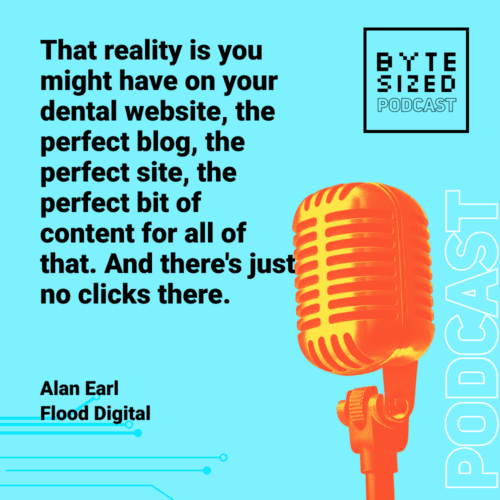
“When a person is searching for how often do I need to floss and why are my gums bleeding and does that tooth pain mean something, those informational type searches and the results that are organically falling down the line, those clicks have dropped dramatically,” Alan explained. “They’ve come down 40, 50, 60% year over year.”
For dental practices that have invested heavily in blog content and SEO, this is a wake-up call. Your perfect blog post about gum disease might be providing the source material for Google’s AI answer, but patients are not clicking through to your website to read it.
This creates a critical question: if patients are not visiting your website, how do you get in front of them? The answer is increasingly clear. You need to be part of the AI result itself, either through AI-optimized SEO or through advertising that appears within that AI response.
Why Google Ads Costs Have Increased (And What It Signals)
If you have talked to anyone running Google Ads for their dental practice lately, you have probably heard the complaints. Costs are up. Way up.
Alan confirmed this is not just perception. Looking at year-over-year data for clients, he has seen dramatic increases in cost per call and cost per click. The competition is fiercer than ever.
But here is what most people miss: the rising costs are actually a signal of where the market is heading.
“Many businesses are getting less transactions or less traffic organically,” Alan explained. “They’ve lost a big chunk of it, so they’re looking to make up for it in the paid zone. So many more are coming to the ad placement and spending more money than has ever been spent.”
At the same time, the valuable ad placements have shrunk. Nobody scrolls to page two anymore. Nobody even scrolls to the bottom of page one. All the competition is concentrated at the very top of the results.
More advertisers fighting for fewer premium positions equals higher costs. This is basic supply and demand, and it is not going away.
Google’s stock price reflects this reality. Investors are betting heavily that the new AI-integrated advertising model will drive even more revenue. They are pricing in a future where ads become more effective, more clicked, and more valuable.
The Case for Starting Your Google Ads Campaign Today
One strategic reality to keep in mind is that Google Ads campaigns get better over time.
When you first launch a campaign, you are essentially making educated guesses. You do not know your actual cost per click. You do not know which keywords convert. You do not know what your cost per new patient will be.
“The first few days and weeks, we’re educatedly guessing,” Alan admitted. “We turn on the ad campaign and we just kind of wait and see. We don’t know what the cost per call is actually going to be.”
But once you have data, everything changes. You can identify which keywords waste money and eliminate them. You can optimize your landing pages based on actual behavior. You can refine your targeting to reach the exact patients you want.
Alan’s team typically aims to shave 20 to 30% off initial costs through optimization. Click-through rates that start at 3 to 4% can double to 6 or 7% with proper refinement.
If Google AI mode launches in mid-2026 and you start your campaign then, you will spend your first six months figuring out the basics while your competitors who started earlier are already optimized and ready to capitalize on the new format.
“Those that are going to suffer are the ones that are going to say, ‘I don’t know if this is a good thing, a bad thing, is it profitable?'” Alan said. “The ones that are going to really get it are the ones who have been doing ads already. They know their conversions. They know what they want out of an ad.”
What Happens to Your Website in an AI-First World?
This is the question keeping many dental marketers up at night. If AI provides all the answers and nobody clicks through to websites anymore, what is the point of having one?
The answer is nuanced and actually creates an opportunity for practices that understand it.
Your website is becoming less of a destination for patients to research your practice and more of a source document for AI systems. When ChatGPT or Google Gemini needs information about your practice, your website is often one of the primary sources they pull from.
“When I look at where ChatGPT and Google Gemini go to get information about a practice, the website is half the time one of the sources,” Adrian noted during the conversation.
This means your website strategy needs to shift. Less focus on lengthy educational content that patients will read. More focus on clear, structured information that AI systems can easily parse and cite.
Your website becomes a place for:
- Clear service descriptions that AI can reference
- Photos and videos showing your practice personality
- Easy booking and contact options for patients who do click through
- Structured data that helps AI understand your practice
“Websites are going to be less informational than they’ve ever been and they’re just going to be more transactional,” Alan predicted. “They want to see your photos and your face and your about us and opportunities to book an appointment, make a phone call.”
The Integration of Ads and Organic Results
One of the most interesting predictions from the conversation involves how Google will blend paid and organic results in AI mode.
Currently, there is a clear separation. Ads are labeled “Sponsored” and appear in distinct blocks. Organic results appear separately below. Users have learned to distinguish between them.
In AI mode, that distinction becomes much blurrier.
“Inside of this AI mode, this new landscape, the paid ads aren’t going to be at the top and the organic at the bottom,” Alan explained. “It’s all going to integrate and you’re going to have some opportunities for it to just all flow cohesively.”
Google will still label sponsored content because hiding that would be disingenuous and likely illegal. But the presentation will be far more subtle. An AI response might say, “Based on your search, here are some recommended dental practices in your area,” and some of those recommendations will be paid placements integrated naturally into the response.
For dental practices, this means the old strategy of hoping patients scroll past ads to find your organic listing is dying. If you want to be in the AI response, you need both strong AI-optimized SEO and an advertising presence.
Starting Your Google Ads Campaign: Budget Realities
One of the most common questions dental practices have is simple: how much do I need to spend?
Alan’s answer provides a realistic framework. There is always a budget for everyone, from participation level to domination level.
For practices in suburban markets drawing patients from a three to five mile radius, a starting budget of around $1,000 to $1,500 per month can get you into the game. This is enough to generate data, learn what works, and start building toward optimization.
Local Service Ads, where available, offer a lower barrier to entry because you pay per call rather than per click. You might pay $60 to $150 per qualified call, but at least you know that money went toward an actual patient interaction rather than a click that went nowhere.
For practices in competitive urban markets or those advertising high-value services like implants or full-arch cases, budgets of $5,000 to $15,000 per month are common.
“Every market is different,” Alan noted. “The cost per calls can be daunting. It can be 20, 50, 60, 100. I’ve seen them up at a couple hundred in legal. But it is an opportunity to come in with a very low barrier to entry and try.”
The key is starting somewhere, gathering data, and optimizing over time rather than waiting for the perfect moment that never comes.
Preparing for the AI Advertising Future
The dental practices that will thrive in 2026 and beyond are taking action now. They are building optimized Google Ads campaigns that will be refined and ready when the AI mode transition happens. They are restructuring their websites to serve as quality source material for AI systems. They are thinking about advertising not as an optional expense but as essential infrastructure for patient acquisition.
“I’m super bullish on ads now, and I haven’t been,” Adrian admitted during the conversation. “I trust that Google is going to figure out a way that the actual user interface is so seamless in where the ads and organic information is being presented.”
The practices that wait will find themselves in a Black Friday rush, competing against established advertisers who already know their numbers, have optimized their campaigns, and are ready to capitalize on the new format.
You can either start building your advertising foundation now, or scramble to catch up later while your competitors capture the patients you could have reached.
In This Episode:

Alan Earl, Director of Performance at Flood Digital
Alan Earl is the Director of Performance of Flood Digital, a digital marketing agency with over 20 years of experience serving small to medium-sized businesses, including numerous dental practices. Since entering the digital marketing space in 2002, Alan has built deep expertise in Google Ads, SEO, and helping practices navigate the constantly evolving landscape of online advertising. Based in Phoenix, Arizona, Alan and his team of 15+ professionals specialize in pay-per-click advertising, performance optimization, and developing strategies that deliver measurable ROI for healthcare providers.

Adrian Lefler, CEO and Co-founder of My Social Practice
Adrian Lefler, CEO of My Social Practice, is a seasoned expert in the dental marketing industry with 14 years of experience. He is widely recognized for his engaging and informative presentations. Based in Suncrest, Utah, Adrian shares his life with his wife, four children, and a lively mix of pets. My Social Practice is a leading dental marketing company, and Adrian is passionate about helping dental professionals succeed in this dynamic field.
Frequently Asked Questions
How much should a dental practice budget for Google Ads?
For suburban dental practices, a starting budget of $1,000 to $1,500 per month provides enough data to learn and optimize. Practices in competitive urban markets or advertising high-value services like implants typically need $5,000 to $15,000 monthly. Local Service Ads offer a lower barrier to entry since you pay per call ($60 to $150) rather than per click.
What are zero-click searches and how do they affect dental practices?
Zero-click searches occur when users get their answer directly from AI-powered search results without clicking through to any website. Currently, 60% of desktop searches and 77% of mobile searches result in zero clicks. This means your dental practice website may be providing source information for AI answers while receiving dramatically less traffic than before.
When is Google AI mode expected to launch as the default search interface?
Industry chatter suggests Google AI mode could become the primary search interface sometime in 2026. Google has been developing this transition carefully, likely waiting until they have the advertising integration fully optimized before making the switch since ads represent their primary revenue source.