What You’ll Learn:
- What a major new study reveals about how patients are using AI to search
- Why AI search volume is almost certainly larger than you’ve been told
- How ChatGPT, Google Gemini, and other platforms are reshaping patient discovery
- What the data actually says about Google’s future (it’s not dying, but it is changing)
- What dental practices should be doing right now in response to these numbers
The Number That Should Get Every Dentist’s Attention
Wouldn’t it be weird if nearly half the people searching for a dentist today weren’t using Google? What if they were opening an app, typing a question in plain English, and getting a direct recommendation? No list of links, no clicking around, no visiting your website.
Surprise! Gotcha! That scenario is real. (You should have seen your face.)
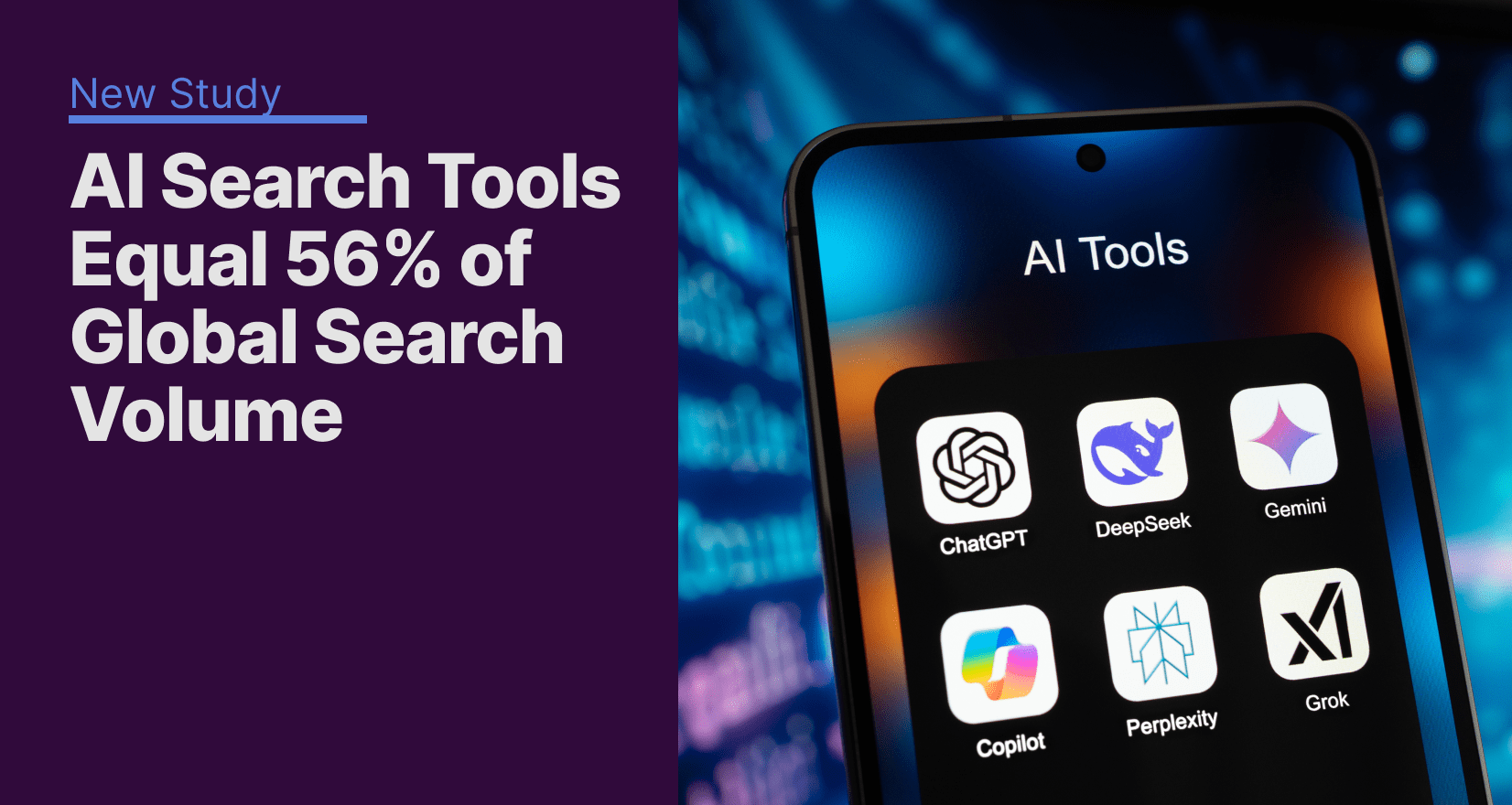
A new study published by Graphite.io CEO Ethan Smith found that AI tools like ChatGPT, Google Gemini, Perplexity, Grok, and Claude now generate 45 billion monthly sessions worldwide. That figure equals 56% of global search engine volume and 34% in the United States alone. Search Engine Land covered the findings as a landmark data point in the ongoing debate about where search is headed.
For dental practices trying to attract new patients, this is one of those “must watch” topics. At least, it is if you want to remain relevant online.
Why Previous Estimates of AI Search Tools Were Way Off
Here’s something that might surprise practice owners who have been following the AI-versus-Google conversation. Almost every comparison you’ve seen before has dramatically underestimated how much people are actually using AI search tools. I mean seriously, even we underestimated it.
Most analyses compare visits to Google.com with visits to ChatGPT’s website. The problem with that approach is straightforward. The overwhelming majority of AI usage doesn’t happen in a web browser at all. According to the Graphite.io study, 83% of global AI activity occurs inside mobile apps. In the US, that figure is 75%.
That means past estimates of AI’s reach have been undershooting actual usage by four to five times. Womp womp.When Smith’s team factored in mobile app sessions alongside web traffic – and included all major AI platforms, not just ChatGPT – the picture changed dramatically. AI isn’t a scrappy challenger nibbling at Google’s edges. It’s already a massive, parallel discovery channel that most dental practices aren’t showing up in at all.
The Platforms Your Patients Are Actually Using
The study focused on the five largest AI platforms: ChatGPT, Google Gemini, Perplexity, Grok, and Claude. Of those, ChatGPT dominates with a commanding lead, unsurprisingly.
AI Platform Market Share (Worldwide, Q4 2025)
| Platform | Global AI Session Share |
|---|---|
| ChatGPT | ~89% |
| Gemini | Growing (combined with Google Search data) |
| Perplexity, Grok, Claude | ~11% combined |
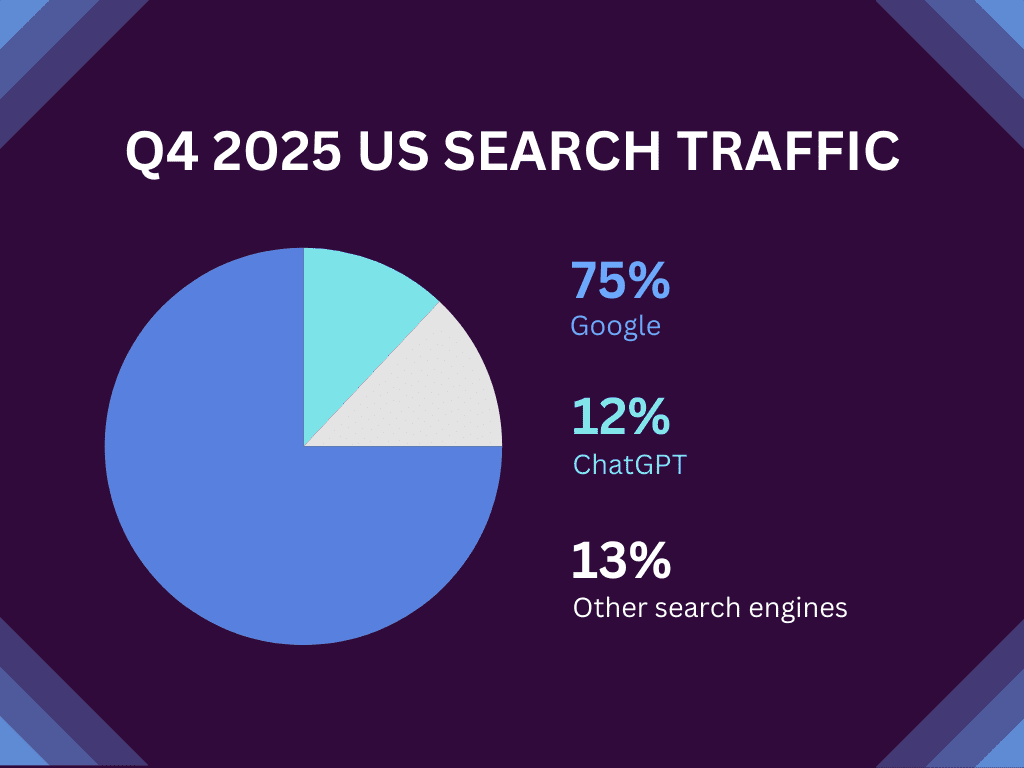
ChatGPT alone now accounts for 20% of search-related traffic worldwide and 12% in the US, when you look at the combined search-and-AI landscape. That’s a platform that didn’t exist three years ago commanding roughly one in eight search-related interactions in the country.
For context, Google’s share of combined search-and-AI traffic dropped from 89% in 2023 to 71% globally by Q4 2025. In the US, it fell from 88% to 75%. Google isn’t collapsing, but it is sharing the room in a way it never has before.
The Growth Story Is Still Being Written
One of the more nuanced findings in the study is that AI usage worldwide has plateaued since July 2025, while US growth has continued to accelerate sharply. By December 2025, US AI usage was up roughly 300% year over year.
That divergence matters. It suggests the US is in an active adoption phase, not a mature one. The patients in your community are actively adopting AI search tools in their search habits right now, which means the practices that build visibility in AI platforms today are establishing ground before their competitors realize the race has started.
This is precisely the early adopter dynamic that My Social Practice CEO Adrian Lefler has been discussing on the Byte-Sized Podcast. The practices that built review profiles on Google Maps in 2010 compounded that advantage for years. The window for AI search is open in the same way… for now.
Search Isn’t Dying. The Pie Is Just Getting Bigger.
One of the study’s most important findings pushes back against the narrative that AI search tools are killing search. Total usage of search, combining traditional search engines and AI “asking” sessions, has grown 26% worldwide since 2023. In the US, it’s up 16%.
The study’s author explicitly addresses the zero-sum bias – the tendency to assume that when one thing grows, something else must be shrinking. When mobile apps emerged, many people predicted the death of the web. The web didn’t die. Usage just expanded across more surfaces. And thus, the beautiful internet tapestry has evolved to include more memes, TikTok hot takes, and grandmas on Facebook who can’t tell whether that picture of an army veteran holding hands with Jesus is real or not.
The same dynamic appears to be playing out here. Patients aren’t stopping their Google searches. They’re adding AI search tools to their discovery habits on top of them. That means dental practices need visibility in both channels, not a choice between them.
Dental SEO and AI search optimization are not competing strategies. They support each other. A practice that invests in its Google Business Profile, earns consistent reviews, publishes quality content, and maintains an active social media presence is building the kind of digital authority that feeds both traditional search rankings and AI recommendations simultaneously.
What This Means for Your Dental Practice, Practically
The data from this study reinforces what forward-thinking dental marketers (ahem) have been saying for the past year. Here’s how to translate these numbers into action:
Your Google Business Profile still matters enormously. Google’s 75% US market share isn’t going anywhere fast. A fully optimized GBP with the right categories, consistent service listings, regular posts, and a steady stream of new reviews remains the single highest-leverage SEO asset most dental practices have.
Reviews are now doing double duty. Google reviews have always supported local search rankings. They are now also a primary trust signal for AI platforms evaluating which practice to recommend. More reviews, more recent reviews, and more detailed patient language in those reviews all feed the authority signals AI systems are looking for.
Your social media presence is officially an SEO asset. The study confirms that the largest AI platforms are indexing social media content. Every post your practice publishes, and every comment or interaction it earns, is data that feeds into how AI systems assess your credibility. Practices that treat social media as a patient engagement tool while also understanding its role in AI authority building will have an advantage.
Website content still needs to be optimized, but for questions, not just keywords. AI platforms break down patient queries into sub-questions and scan content for direct answers. Blog posts and service pages written as question-and-answer content perform better in AI-generated recommendations than pages optimized for short keyword phrases.
Being absent from AI search tools is a choice with real consequences. In the US alone, AI platforms now handle 5.4 billion monthly sessions. Dental patients are among those users, asking questions about finding a dentist, understanding treatment costs, and evaluating practices in their area. Practices that have no strategy for AI visibility are simply not in the room for those conversations.
The Takeaway
The Graphite.io study is the most comprehensive look yet at how large AI search has actually become. The headline number is striking, at 45 billion monthly sessions worldwide, equaling 56% of global search volume. But the more important number for dental practices might be this one: in the US, AI usage grew 300% year over year in December 2025.
That’s a trend happening in real time, in the communities where your patients live. The practices that start building AI search authority now are the ones that will show up in those recommendations. The ones that wait will have a lot of catching up to do.
Frequently Asked Questions
How do AI search engines like ChatGPT decide which dental practice to recommend?
AI platforms evaluate what researchers call “authority signals” across your entire digital footprint. This includes your website content and how well it answers specific patient questions, your Google Business Profile setup, the volume and quality of your patient reviews, your social media activity, and how consistently your practice appears across online directories. Practices that score well across all of these areas are more likely to be surfaced when a patient asks an AI tool to recommend a dentist. There is no single shortcut. Rather, it’s the combined weight of your online presence that drives AI recommendations.
Should my dental practice focus on traditional SEO or AI search optimization?
Both, and the good news is that the core activities overlap significantly. A strong Google Business Profile, consistent patient reviews, quality website content, and active social media publishing all support both traditional Google rankings and AI visibility simultaneously. The main adjustment for AI search is writing website and blog content as direct answers to patient questions rather than optimizing for short keyword phrases. Practices that treat SEO and AI optimization as a unified strategy — rather than choosing between them — will be best positioned as the search landscape continues to evolve.
Is ChatGPT really being used to find local businesses like dental practices?
Yes, and the behavior is growing. Patients use conversational AI to ask questions like “find a dentist near me who takes Cigna and does implants” or “what’s the best-reviewed pediatric dentist in [city].” AI platforms respond with direct recommendations, often pulling from reviews, directories, and website content. The study referenced in this article found that roughly 52% of all AI prompts are information-seeking in nature — the kind most comparable to a traditional search query. A meaningful and growing share of those are local service queries, including healthcare and dental searches.
About the Author: Megan Nielsen is an SEO strategist and the Grand Overlord of copywriting at My Social Practice. My Social Practice is a dental marketing company that offers a full suite of dental marketing services to thousands of dental practices throughout the United States and Canada.