What You’ll Learn:
- Why most popular SEO tips for dental practices are already becoming outdated
- What “flock tactics” are and why following the crowd won’t build lasting visibility
- How AI search tools are changing the rules for local dental SEO
- What actually drives durable, long-term dental SEO results
- The foundational strategies that compound over time instead of fading out
Your Dental Practice Deserves Better Than Band-Aid SEO
Here’s a scenario that probably sounds familiar. Someone on your team attends a dental marketing webinar, comes back with a list of SEO tips, and a few months later you’re implementing all of them. New page titles. Author bios. Maybe some fresh blog posts with keywords stuffed into the headers. You check Google. You’ve moved up a couple of spots.
Then, six months later, every other dental practice in your market has done the exact same things, and you’re right back where you started. Congratulations, you just experienced the SEO hamster wheel.
This is the core problem with most SEO advice being sold to dental practices right now. It’s designed to be easy to explain and easy to sell, not necessarily easy to sustain. And with search shifting faster than it ever has before, chasing surface-level wins is an increasingly bad investment of your time and money.
Long-term dental SEO is a different game. It’s slower, less flashy, and harder to put on a slide deck. But it’s also the only approach that actually compounds over time instead of evaporating the moment your competitors catch up.

The Problem With Advice That Travels Fast
There’s a concept worth borrowing from the broader SEO world: flock tactics. These are ideas that spread quickly because they’re easy to understand and repeat, but they lose their competitive advantage the moment everyone starts doing them.
Think about how dental marketing advice tends to circulate. A popular blog post or podcast episode announces that Google rewards practices with detailed service pages. Suddenly every dental marketing company is building detailed service pages for every practice they work with. Within a year, those pages exist everywhere, they mean less than they did before, and the conversation moves on to the next thing.
The same pattern is playing out right now with AI search optimization. Everyone is talking about it. Everyone is offering tips for ranking in ChatGPT or optimizing for AI Overviews. Some of that advice is reasonable hygiene. But some of it is the same flock moving in the same direction, and the practices that follow the flock rarely end up in front.
The real question isn’t “what are other dental practices doing?” It’s “what are they not doing yet?”
What Actually Builds Long-Term Dental SEO Authority
Long-term dental SEO is about building the kind of online presence that becomes genuinely difficult to replicate. Here’s what that looks like in practice.
Earning Real Trust Signals, Not Cosmetic Ones
One of the most overhyped tactics in dental SEO right now is slapping a doctor bio on every page of your website and calling it an authority play. Adding credentials and headshots is fine, but it’s window dressing unless the underlying signals are actually there.
Google’s quality guidelines reward what’s called E-E-A-T: Experience, Expertise, Authoritativeness, and Trustworthiness. For dental practices, that means your doctors need to be recognizable as real, credible professionals beyond your own website. That could look like:
- Being quoted or featured in local news or health publications
- Publishing educational content that other sites link to
- Having a strong, consistently updated Google Business Profile
- Accumulating a high volume of genuine, detailed patient reviews over time
There is a meaningful difference between a practice that has added some bios to its website and a practice whose doctors are genuinely cited, linked to, and recognized as local authorities. Only the latter builds the kind of long-term dental SEO foundation that holds up as the algorithm evolves.
Reviews Are Not Optional
If there’s one thing that consistently drives long-term dental SEO results, it’s reviews. Not just the volume of them, but the recency, the detail, and the consistency of the stream.
Here’s why this matters more than most dental practices realize. Google’s AI features, including AI Overviews and tools like the newly launched Ask Maps, draw heavily from community-contributed content when generating recommendations. A practice with 40 reviews from three years ago looks very different to Google’s AI than a practice generating a steady flow of fresh, specific reviews every single month.
The goal is not to spike your review count once. The goal is to build a system that generates reviews continuously, so your practice’s credibility signals keep growing while your competitors’ stay flat. Tools that integrate directly with your practice management software to automatically prompt patients for reviews after appointments make this dramatically easier to sustain without relying on your front desk team to remember.
Your Google Business Profile Is a Living Document
A lot of dental practices set up their Google Business Profile years ago and basically ignore it. That’s a visibility problem masquerading as a non-issue.
Your GBP is one of the primary data sources Google uses when deciding which practices to recommend in Maps, in AI Overviews, and in local search results. Practices with complete, accurate, regularly updated profiles simply perform better. That means:
- Keeping hours updated, including holidays and special closures
- Adding new services as you offer them
- Posting updates and content to the profile regularly
- Responding to every single review, positive or negative
- Uploading fresh photos of your team, your space, and your work
None of this is glamorous, but all of it compounds. Long-term dental SEO is largely built on this kind of steady, unsexy maintenance work that most practices let slide.
The AI Search Layer: What It Actually Means for Dentists
It’s worth addressing the AI conversation directly, because it’s impossible to talk about long-term dental SEO in 2026 without it.
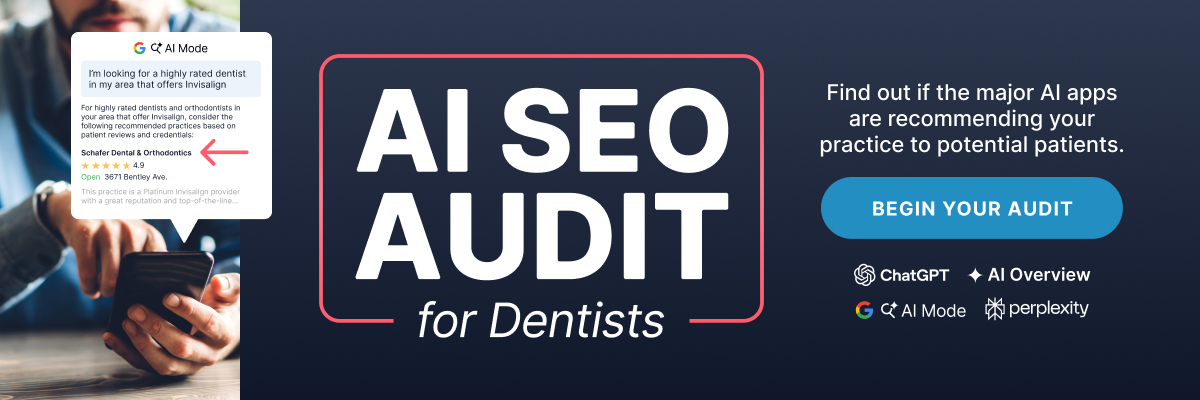
AI-powered search features are changing how patients find practices. Google’s AI Overviews, Ask Maps, and third-party tools like ChatGPT are increasingly mediating the space between a patient’s question and a practice’s front door. The practices that appear in those AI-generated recommendations are not the ones that “optimized for AI” without understanding what that actually means. Instead, they’re the ones that built the most credible, complete, and consistent online presence over time.
There’s some important nuance most dental SEO advice skips over. There is a strong correlation between ranking well on Google and being surfaced by third-party AI tools. Most AI models don’t have the resources to independently verify which dental practices are trustworthy, so they tend to trust Google’s judgment. When your practice ranks well in traditional Google search and Maps, AI tools are more likely to pick you up as a reliable recommendation.
This means the path to AI search visibility runs directly through the fundamentals of long-term dental SEO. There is no shortcut around it.
| SEO Approach | Short-Term Result | Long-Term Result |
|---|---|---|
| Keyword stuffing and page titles | Quick ranking movement | Fades as competitors copy |
| Adding author bios and credentials | Mild trust signal | Minimal if no external citations |
| Review volume with no ongoing system | One-time boost | Stagnates as reviews age |
| Consistent review generation | Slow build | Compounds significantly over time |
| Regular GBP updates and engagement | Modest lift | Strong sustained visibility |
| Earning local citations and links | Incremental gain | Durable authority over years |
What to Stop Doing (And What to Do Instead)
The dental SEO advice most worth ignoring right now includes anything that promises quick ranking jumps through tactics that are easy to copy. If a competitor with a decent marketing budget can replicate your entire SEO strategy in 90 days, it is not a long-term strategy.
What’s worth doing instead:
- Invest in a review generation system, not a one-time review push. The compounding effect of consistent reviews over two or three years is one of the most powerful forces in local dental SEO.
- Build your doctors’ reputations off your website, not just on it. Local press mentions, contributions to dental publications, speaking at community events, these all create external signals that your own website simply cannot manufacture.
- Keep your website technically healthy and consistently updated. A blog that gets new content regularly, a site that loads fast on mobile, pages that clearly describe your services; none of this is exciting, but all of it matters to Google in ways that never go out of style.
- Treat your Google Business Profile like a marketing channel, not a listing. Practices that post to it, respond to reviews, update photos, and keep information current consistently outperform those that don’t.
My Social Practice’s SEO service for dental practices is built around exactly this philosophy. We help practices build the kind of durable, compounding online presence that keeps working long after the latest flock tactic has been forgotten. That includes a dedicated SEO strategist, ongoing content creation, Google Business Profile optimization, and transparent monthly reporting so you can actually see what’s working.

Long-Term Dental SEO, Long-Term Wins
The dental SEO world is noisier than it has ever been. There are more tools, more tactics, more agencies, and more advice being thrown at dentists from every direction. A lot of it sounds reasonable. Some of it even works briefly.
But long-term dental SEO has never really been about finding the cleverest trick. It has always been about building a practice’s online reputation the same way you build its real-world reputation: consistently, authentically, and with patience. Investing in the fundamentals while everyone else chases shortcuts is how practices will show up in Google Maps, in AI recommendations, and in the minds of patients five years from now.
That’s not a very exciting pitch. But it’s the one that actually works.
Frequently Asked Questions
What is long-term dental SEO and how is it different from regular SEO?
Long-term dental SEO refers to search optimization strategies that build durable, compounding visibility over time rather than chasing short-term ranking bumps. Regular or surface-level SEO often focuses on tactics like keyword placement, meta tags, and page structure that are easy to implement and easy for competitors to copy. Long-term dental SEO focuses on harder-to-replicate foundations like consistent review generation, Google Business Profile authority, off-site credibility signals, and technical website health that improve gradually but hold up over years rather than months.
How important are Google reviews for dental SEO in the age of AI search?
More important than ever. Google’s AI-powered features, including AI Overviews and the new Ask Maps, draw heavily from community-contributed content like patient reviews to generate recommendations. A steady stream of recent, detailed, genuine reviews signals to Google that your practice is active, trusted, and relevant. Practices that have built systems for continuous review generation consistently outperform those that rely on occasional pushes, because the recency and volume of reviews compounds over time as an authority signal.
How long does it take for dental SEO to show real results?
Honest answer: it depends on your market, your starting point, and the quality of your strategy. In competitive urban markets, meaningful movement in Google Maps rankings can take six to twelve months of consistent effort. In less competitive markets, practices often see noticeable improvements in three to six months. The important thing to understand is that the practices generating the most new patients from SEO are typically the ones that have been at it consistently for two or more years. SEO is not a switch you flip. It’s a foundation you build.
Does optimizing for AI search require a completely different strategy than traditional dental SEO?
Not as different as you might think. The practices that show up in AI-generated recommendations are largely the ones that already rank well in traditional Google search and Maps. Most AI tools correlate with Google’s judgment about which businesses are credible and relevant. That means the best thing a dental practice can do to improve AI search visibility is to double down on the fundamentals of local SEO: a complete and active Google Business Profile, consistent patient reviews, a technically healthy website with relevant content, and strong local authority signals.
What should I look for in a dental SEO partner to make sure they're building long-term results and not just quick wins?
Look for transparency and depth. A good dental SEO partner should be able to explain not just what they’re doing but why, and should provide clear reporting on metrics that actually matter, like Google Maps ranking movement, organic traffic trends, and new patient call volume. Be skeptical of any agency that promises fast results or relies heavily on tactics that sound impressive but are easy to copy. The best dental SEO partners focus on fundamentals, communicate consistently, and measure their success by your practice’s growth, not just by vanity metrics.
About the Author: Megan Nielsen is an SEO strategist and the Grand Overlord of copywriting at My Social Practice. My Social Practice is a dental marketing company that offers a full suite of dental marketing services to thousands of dental practices throughout the United States and Canada.