What You’ll Learn
- Why trying to master AI yourself is the wrong approach for busy practice owners
- How AI destroys specialization and creates demand for motivated generalists
- Where to find world-class talent at a fraction of US labor costs
- A seven-step hiring framework that filters thousands of applicants down to top performers
- Practical ways an executive assistant can transform patient intake, marketing, and retention
The Biggest AI Unlock Has Nothing to Do With AI
Every dentist has felt it. The pressure to learn ChatGPT, understand automation, figure out which tools matter. The webinars pile up. The browser tabs multiply. And somewhere between patients, the guilt creeps in that you’re falling behind.
Kasim Aslam has a different message. Stop.
“The biggest AI unlock isn’t learning more AI,” Kasim told Adrian Lefler on a recent episode of the Byte Sized Podcast. “It’s having better people.”
Kasim runs Pareto Talent, a staffing agency that places executive assistants from emerging markets with business owners across the United States. He has spent two decades building hiring systems, managed over $100 million in advertising spend, and watched countless businesses succeed or fail based on who they hired rather than what technology they adopted.
His argument is counterintuitive but increasingly hard to ignore. AI is something dentists should be hiring for, not learning themselves.
Why Dentists Have No Business Learning AI
The math doesn’t work in your favor.
AI requires what productivity experts call “maker time,” which means uninterrupted four-hour blocks of deep focus. Dentists operate in “manager time,” bouncing between decisions, patients, and interruptions in 30-minute increments.
“When, Mr. or Mrs. Dentist, is the next time on your calendar that you’ve got four hours to mess with something?” Kasim asked. “When are you going to be able to turn off the phone, shut the door, do nothing but spend four hours embedded and ingrained in AI? That’s what it takes.”
Even if you could find the time, spending it on AI probably is not your highest and best use. You went to school for over a decade. You carry hundreds of thousands in debt. Your hands create value that no technology can replicate. So you need to have the vision to guide your time and all the working parts of your practice.
“Here’s how I can prove it,” Kasim said. “Because the most successful dental practices aren’t the ones with the best dentists. They’re the ones where whoever’s running them has the best vision.”
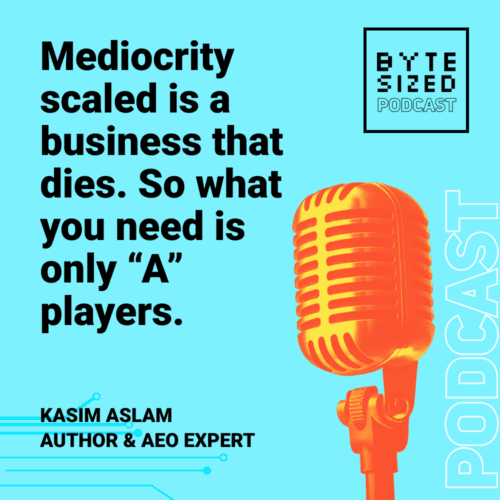
Vision means seeing where the practice needs to go. Execution means having the right people to get it there. AI is an execution tool. You need executors.
AI Eats Specialization
For the last thousand years, economic advancement meant specialization. Learn a trade, master a skill, become the expert.
AI flips that model upside down.
“AI eats specialization,” Kasim explained. “You don’t need a graphic designer, content creator, website designer. Insert specialized role here. You need a motivated generalist.”
The CEO of Salesforce has said they no longer need software engineers. Amazon, Facebook, and Google are laying off credentialed specialists. AI beats human radiologists a thousand times out of a thousand.
What survives this shift? People who can do anything, learn quickly, and adapt when the tools change. People who do not say “that’s not my job description” because job descriptions are becoming irrelevant.
Kasim calls them motivated generalists. Another word for them is executive assistant.
| Old Model | New Model |
| Hire specialists for each function | Hire generalists who use AI across functions |
| Pay for credentials and expertise | Pay for adaptability and initiative |
| Define jobs by tasks | Define jobs by goals |
| Manage employees closely | Get out of their way |
The Talent Arbitrage You Are Missing
Top talent in the United States is not available to you. The best people work at Google, Amazon, Microsoft, and Apple. They chase pre-IPO equity at startups. They have options that no dental practice in any market can compete with.
What you get instead are the leftovers. People asking about PTO before they ask about the work. People who treat employment as a transaction rather than an opportunity.
“Take that same triple PhD talent that Google pays millions of dollars a year for with stock options,” Kasim said. “They’re available to go work at your dental office. Go to Bogota, Colombia. The average white-collar worker there is making $300 to $600 a month working at a call center, which is the modern-day sweatshop.”
The same hierarchical distribution of talent exists everywhere. Every country has its top 1%, its A players, its brilliant minds. The difference is opportunity. In emerging markets, that opportunity barely exists.
Pay someone in Colombia or Argentina three to five times their local rate. Change their life. Give them meaningful work instead of soul-crushing call center scripts. See what happens.
“You encounter something a US employer has never encountered before in their entire life,” Kasim said. “Gratitude.”
What an EA Actually Does for a Dental Practice
This is not about answering phones from overseas. That model failed because people treated international hires like cheap labor instead of real team members.
A properly hired executive assistant becomes the operational backbone of your practice. They handle everything that is not hands in mouth.
Patient intake is the obvious starting point. Imagine every new patient receives a personal call before their first appointment. Not a confirmation robot. A real conversation.
“Hey, Adrian, I noticed you just booked with our office. I’d love to hop on a call with you. Have a minute? Just want to learn more about your dental goals,” Kasim described. “Oh, you have two little kids? Did you know we have a pediatric department? Oh, you’re afraid of needles? Let me tell you about our laser technology.”
By the time the patient arrives, the dentist already knows their history, their fears, their family situation. The first appointment feels like a reunion instead of a transaction.
The same EA handles marketing. Direct mail campaigns targeting families within walking distance of the office. Competitor monitoring to see what other practices are doing. Community outreach to local schools for lunch-and-learns about healthy eating.
“Imagine if you had an EA who the minute somebody booked said, ‘Hey, I’d love to hop on a call with you,'” Kasim said. “Are you kidding me? Why wouldn’t we do that?”
They handle retention too. Birthday reminders. Follow-up calls after procedures. Periodontal chart tracking that turns dental health into a story patients want to complete.
All of this work can be done remotely. All of it can be amplified by AI. And all of it currently is not happening in most dental practices because nobody has time.
The Hiring Framework That Actually Works
Finding these people requires a different approach than posting a job and hoping for the best.
Kasim wrote a book called The Hire Book that outlines the entire process. He gives it away for free at thehirebook.com because his real business is placing the people who make it through this funnel.
The framework filters a thousand applicants down to one or two extraordinary hires. Here’s how it works.
Step one is the job posting itself. Pay 10% more than the high-water mark in that market. If a bank executive in Vietnam makes $400 a month, offer $440. The applicants will flood in.
Step two is the filter. The very first line of the job description says that to apply, your email subject line must read “I actually read the instructions.” Anyone who misses this gets automatically filtered out. No exceptions.
Step three adds more instructions throughout the posting. Send a PDF resume with this specific naming convention. Answer this question about what a quote means to you. Take a free English proficiency test. Take a personality assessment. Each instruction filters out people who cannot follow directions.
Step four is the trial project. Do not interview. Interviews only tell you who is best at interviewing.
“I’ll say, ‘Hey Adrian, thank you so much for applying. I’ve been hiring my whole life. I know enough to know that interviews tell me nothing. I’d like to work together,'” Kasim described. “‘I want to pay you in advance for two hours of your time.'”
Pay them $40 upfront via PayPal. Then do not send the project immediately. Wait and see who follows up. The people who ghost you for $40 just revealed they cannot be trusted.
Step five is the sabotage. Send the project with a wrong password. Schedule a meeting and cancel last minute. See how they respond to obstacles. This simulates the real job better than any interview question.
“Take everything that sucks about this job, work it into the process,” Kasim said. “By the time this ends, you’ve taken thousands of applicants and narrowed it down to one or two or three killers.”
The Management Mistake
Finding the right person is only half the battle. Keeping them requires a mindset shift that most entrepreneurs struggle with.
Do not micromanage.
“You’re like, ‘Hey, go make a video or go edit this thing or create a website.’ And then you come in with ‘Make the red blue, make the square a circle, I don’t like this line.’ Shut up,” Kasim said. “You have a brilliant human being performing work for you that’s better than you’ll ever do. Shut your mouth.”
Unless something is objectively wrong, stay out of the way. Subjective preferences about colors and fonts are not worth the damage they cause to someone who was hired to think independently.
This is hard for dentists who are trained to control every detail in clinical work. But business operations are different. The goal is outcomes, not process compliance.
“You’re a dentist,” Kasim said. “Go put your hands in teeth and let somebody else build the website, do the marketing, create the promotional material. Get out of their way. They’re probably right. You’re probably wrong.”
AI in Dentistry Done the Right Way
One final framework shift matters here.
Dentists often imagine AI as a top-down initiative. Learn the tools, push them into the organization, mandate adoption. This approach fails almost every time.
“People look at AI as though it’s a top-down initiative,” Kasim explained. “That’s massively incorrect. AI is bottom-up.”
The right model puts AI tools in the hands of the people doing the work. They experiment. They find what speeds up their specific tasks. They iterate day by day as the technology changes.
Your job as the practice owner is vision. Their job is execution. AI is just the amplifier that makes extraordinary people even more extraordinary.
In This Episode:

Kasim Aslam, Co-founder of Driven Mastermind and Pareto Talent
Kasim Aslam is a serial entrepreneur who has built six 7- and 8-figure businesses, including three successful exits. He is the co-founder of Driven Mastermind, Pareto Talent, and the creator of Digital Marketer’s Paid Traffic Certification. Kasim’s other recent release was HIRE, a groundbreaking book that distills the systems he used to build his companies. Designed to be the ultimate guide on hiring and delegation, HIRE offers a proven framework for scaling a business without burning out. He has authored three bestselling books in total and was named one of the top 50 Digital Marketing Thought Leaders in the U.S.

Adrian Lefler, CEO and Co-founder of My Social Practice
Adrian Lefler is the CEO and Co-Founder of My Social Practice and a recognized dental marketing expert with nearly two decades of experience. He is a trusted voice in dental marketing, AI in dentistry, and emerging technology, and he hosts BYTE SIZED, a podcast focused on dental AI, innovation, and technology.
Frequently Asked Questions
What tasks can a remote executive assistant handle for a dental practice?
A remote EA can handle patient intake calls, appointment follow-ups, direct mail campaign management, competitor monitoring, social media management, community outreach coordination, birthday and retention communications, calendar management, email management, vendor negotiations, and virtually any task that does not require physical presence in the office. When equipped with AI tools, their output multiplies significantly.
Why does the top-down approach to AI implementation fail in dental practices?
Top-down AI implementation fails because business owners do not have time for the deep focus that AI mastery requires, and pushing tools onto reluctant employees creates resistance rather than adoption. The bottom-up approach works better because the people doing the work discover which tools actually improve their specific tasks. They iterate naturally as technology evolves rather than waiting for mandates from above.
How do I know if my current team members can adapt to an AI-enabled workflow?
Look for two signals. First, do they resist learning new tools or embrace them? Specialists who cling to their job descriptions often resist AI because it threatens their position. Second, are their incentives aligned with efficiency? If automating a task means losing their job, they will never automate it. Motivated generalists with aligned incentives see AI as an opportunity to take on bigger responsibilities rather than a threat to their employment.

Adrian Lefler is the CEO and Co-Founder of My Social Practice and a recognized dental marketing expert with nearly two decades of experience. He is a trusted voice in dental marketing, AI in dentistry, and emerging technology, and he hosts BYTE SIZED, a podcast focused on dental AI, innovation, and technology.