Last updated: November 13, 2026 · By Megan Nielsen
Mobile optimization means building your dental website so it loads fast, displays correctly, and is easy to tap and read on a smartphone. It matters for two reasons: Google now ranks your site based on its mobile version (mobile-first indexing), and most patients search for a dentist on their phones — a slow or clumsy mobile site loses them before they ever see your practice. The essentials: pass Google’s mobile-friendly test, keep the site crawlable and well-structured, prioritize page speed, and design for real thumbs (large tap targets, readable text, one-tap click-to-call).
Friends, Dentists, Countrymen, Lend Me Your Ears as I Talk About Dental Mobile Optimization
Once upon a time, people used to sit at a desktop computer when connecting to Ye Olde Internet. Back when Shakespeare was writing about mentally precarious royalty, impulsively suicidal teenagers and like, fairies and stuff, he and his esteemed literary fellows had to fire up the old dial-up modem to Ask Jeeves for a local dentist or the nearest pantaloons store. (On an unrelated note, I did not study history in college.)
Despite the undeniably appealing aesthetic of the image, your patients aren’t sitting at a desktop computer searching for a dentist while sipping tea in a mahogany-paneled study. They probably don’t even have a fancy feathered hat. They’re on their phones, usually juggling kids, errands, or a half-finished latte…or they’re on the toilet. Don’t give me that look, you know it’s true.
That means if your dental website isn’t designed to shine on a smartphone, you’re probably losing patients before they even see how great your practice is, regardless of how appealing your homepage is to modern audiences or Elizabethan-era playwrights.
Google now prioritizes mobile versions of websites when deciding who shows up in search results. It’s called mobile-first indexing—and for dentists, it’s a game-changer as major as Wifi.
Man, Shakespeare would have loved Wifi.
Anyways, a website that isn’t mobile-optimized can look outdated, load slowly, or be downright unusable on a phone. And in today’s modern world of cool blue jeans rather than poofy breeches, that’s like having a “Closed” sign hanging on your digital front door.
The good news? Mobile optimization isn’t nearly as complex as King Lear, and when done right it can boost your visibility online, improve patient trust, and make booking an appointment as easy as Googling the themes of Hamlet to understand what that guy’s problem was.
The Table Upon Which Contents Art Found
- Alas, What Is Mobile-First Indexing?
- How Doth One Structure a Dental Website for Mobile?
- Most Excellent Customs: Mobile SEO Best Practices for Dental Websites
- Mobile Optimization and the Future of AI Search for Dentists According to Expert Soothsayers
- A Tale of Two Websites: One Most Noble, One Most Foul
- Why Doth the Optimization of Mobile Devices Bear Import to a Dental Practice?
- Fleet-Footed Counsel for the Mobile Optimization of Dental Websites
- To Thine Own Mobile Optimization Strategy Be True
- FAQ
Alas, What Is Mobile-First Indexing?
Google used to crawl and rank websites based on their desktop versions. But nobody’s looking up “dentist near me” on a Windows 98 desktop anymore. People search on their phones, and Google knows it. That’s why they switched to mobile-first indexing.
Here’s what that means in plain English: Google now looks at your mobile website first when deciding where you show up in search results. If your mobile site is slow, hard to read, or missing content, Google doesn’t shrug it off and say, “Well, their desktop site is fine and written in perfect iambic pentameter.” Nope. It just assumes your whole site is bad, and your rankings take the hit. Rude.
For dental practices, this is especially important. Patients searching for “emergency dentist,” “teeth whitening near me,” or even just your practice name are likely doing it on a smartphone. If your website doesn’t deliver a smooth mobile experience, those patients won’t stick around. After all, more than 63% of all Google search traffic comes from mobile devices. And worse, a patient who gets frustrated with your website might call the other dentist down the street whose site does work well on mobile, even if their prose is garbage.
How Doth One Structure a Dental Website for Mobile?
There are a few different ways to build a mobile website, but only one really makes sense for dentists: responsive design.
Responsive design is like the dental equivalent of a good Shakespearean insult; it adapts to whatever it needs to fit. Whether your patient is on the newest iPhone, an old Android, or a tablet, your site automatically adjusts to the screen size. No squinting, no sideways scrolling, no frustration. Just a clean, professional experience that makes your practice look trustworthy.
What about those “m-dot” websites (you know, m.yourdentalsite.com) that were popular in the early 2010s? Forget about them. They’re outdated, harder to maintain, and usually cause SEO headaches because you’re basically running two sites at once. Same goes for complex setups that serve different versions of your site depending on the device—too much room for technical issues. You want a dental website, not a comedy of errors. (Get it?)
If you want Google (and patients) to love your website, stick with responsive design. It’s simpler, smarter, and the best long-term investment for your practice’s online presence.
Most Excellent Customs: Mobile SEO Best Practices for Dental Websites
Okay, so you know mobile optimization matters. But what does that actually look like for your dental website? Here are a few best practices to make sure your site is so pretty, a teenager wearing tights will show up at your balcony in the middle of the night wishing he were a glove.
1. Test Your Website’s Mobile Friendliness
Don’t guess. Test. Tools like Google’s Lighthouse or PageSpeed Insights will quickly tell you if your fonts are too small, your buttons are squished together, or your images take forever to load.
2. Keep Your Site Crawlable and Structured
Search engines (and AI systems, more on that later) need to “read” your website. Make sure you’re not blocking important files like CSS or JavaScript that help Google understand your site’s layout. Bonus points for using structured data. These little bits of code tell Google things like your office hours, reviews, and location. Structured data makes your practice info easier to find and more likely to show up in search features.
3. Prioritize Speed
On mobile, slow equals gone. Most people will bounce if your site takes longer than a few seconds to load. Optimize images, trim unnecessary scripts, and enable caching. Site speed is like patient wait times: fast = happy customers, slow = disgruntled iPad kids in the waiting room asking if they can play Minecraft on your receptionist’s phone.
A Brief Discourse on Google’s Core Web Vitals
Google has a set of performance measurements called Core Web Vitals, which sounds like something a royal physician might check before declaring the king fit to rule, since doctors back then believed in treating patients with live spiders probably.
Fortunately, they have nothing to do with questionable medieval medical practices.
Core Web Vitals measure three important aspects of your website’s user experience:
- Largest Contentful Paint (LCP): How quickly the main content of your page loads. Ideally, within 2.5 seconds.
- Interaction to Next Paint (INP): How quickly your website responds when someone taps a button or interacts with the page. Aim for 200 milliseconds or less.
- Cumulative Layout Shift (CLS): How much your page unexpectedly moves around while loading. A score of 0.1 or less is considered good.
Ever tried to tap an appointment button, only for an image to suddenly load and move the button halfway down the page? That’s a layout shift, and ’tis enough to drive even the most patient soul to madness.
Good Core Web Vitals scores support a better mobile experience and are part of Google’s ranking considerations. You can check your dental website’s performance for free using Google PageSpeed Insights.
4. Design for Real People, Not Robots
Yes, SEO is important, but your patients are the ones using your website, not Google. Make sure your calls-to-action (like “Book Appointment” or “Call Now”) are obvious and easy to tap. Navigation should be simple, text should be easy to read, and nobody should need a magnifying glass to find your phone number.
5. Make Your Appointment Forms Patient-Friendly
Your mobile forms should make scheduling an appointment as painless as possible. Keep these best practices in mind:
- Keep forms short: Only ask for information you actually need to respond to an appointment request.
- Use large, easy-to-tap fields: Patients shouldn’t need the precision of a royal calligrapher to enter their phone number.
- Enable autofill: Let smartphones automatically populate common information like names and contact details.
- Use mobile-friendly keyboards: Phone number fields should bring up a numeric keypad, for example.
- Make submission buttons obvious: A clearly labeled “Request Appointment” button beats a mysterious little arrow every time.
And don’t forget to test the entire process on an actual smartphone! A form that looks lovely on your desktop but refuses to submit on an iPhone is a tragedy in approximately one act.
For forms collecting sensitive patient information, make sure you’re also using an appropriately secure, HIPAA-compliant solution.

Mobile Optimization and the Future of AI Search for Dentists According to Expert Soothsayers
Just when you thought you’d finally deciphered Google’s mysterious ranking algorithms, a new player entered the stage. And unlike the ghost of Hamlet’s father, this one has no intention of disappearing after delivering a cryptic monologue.
I’m talking, of course, about artificial intelligence.
Google’s AI Overviews, ChatGPT, Perplexity, and other AI-powered search tools are changing how patients find dentists online. Instead of simply presenting a list of websites, these tools can answer questions directly, summarize information from multiple sources, and recommend local businesses.
‘Tis a brave new world, indeed. (Yes, that’s actually Shakespeare. I’m as surprised as you are.)
So what does this mean for your dental website?
Well, AI search systems need reliable, accessible information to generate useful answers. They look for relevant content, clear details about your practice, and signals that help establish your credibility. Depending on the platform, they may also rely on traditional search indexes and other sources to discover and evaluate websites.
And while having a mobile-friendly website doesn’t automatically earn you a starring role in an AI-generated answer, good mobile optimization supports many of the same technical SEO fundamentals that help search engines access and understand your content.
A website with broken navigation, missing information, or pages that search engines can’t properly access is hardly putting its best doublet forward. (You want the shiny one with the gold buttons that matches your fancy tights.)
On the other hand, a well-structured dental website with clear service descriptions, accurate location information, helpful FAQs, and a smooth mobile experience gives both search engines and prospective patients something worth looking at.
In other words, your website must now impress actual human beings who want their teeth fixed, traditional search engines, and AI systems that may introduce those humans to your practice.
All the world’s a stage, and your dental website had better know its lines, lest it be replaced by an understudy in the form of the practice down the street.
How This Helps Dentists in Real Life…eth.
It’s hard to title these sections sometimes. Anyway.
- Got an FAQ page? It probably answers important questions like, “Do you take new patients?” or “What insurance do you accept?” or “Did Shakespeare have false teeth or was that George Washington?” Clear, accessible answers make it easier for search engines and AI tools to understand your services and potentially cite your content.
- Have an online appointment form? If it works smoothly on mobile, patients who discover your practice through Google or an AI recommendation can actually use it to schedule an appointment. A revolutionary concept. (I sometimes mix up G-Money Washington with Shakespeare and now I have revolution on the brain.)
- Keep your location, phone number, and hours consistent across your site? Excellent. Accurate, well-organized business information helps search platforms understand your practice and gives prospective patients the details they need.
The moral of this particular five-act tragedy? You don’t need an entirely separate website for AI search. You need a technically sound, well-organized website with genuinely helpful information that patients can actually use.
Preferably one that doesn’t take longer to load than a full performance of Hamlet. (Which doesn’t star any former US presidents. I checked.)
A Tale of Two Websites: One Most Noble, One Most Foul
(I had to memorize the opening lines of Romeo and Juliet in middle school but sometimes the Dickensian orphan in me takes over 🤷🏻♀️)
| Factor | Most Noble (Optimized) | Most Foul (Not Optimized) |
|---|---|---|
| Google Search Visibility | Supports strong technical SEO | May limit search performance |
| Mobile Page Speed | Loads quickly and smoothly | Slow or inconsistent |
| AI Search Readiness | Accessible, well-structured content | Content may be harder to access or interpret |
| Patient Experience | Easy to read and navigate | Frustrating on smaller screens |
| Local Search Performance | Supports a strong local SEO foundation | Technical issues may hinder visibility |
| New Patient Conversions | Easy calling and appointment requests | More opportunities for patients to leave |
Why Doth the Optimization of Mobile Devices Bear Import to a Dental Practice?
So why put all this effort into mobile optimization? Simple: it directly affects your bottom line.
More Visibility in Search and AI Results
When your website is mobile-friendly, Google and AI tools are more likely to showcase your practice. That means more potential patients finding you first when they search for “dentist near me” or “emergency toothache help.”
Better Patient Experience
Think about it: if a patient can easily read about your services, tap your phone number, or schedule an appointment—all from their phone—they’re more likely to follow through. A smooth mobile experience builds trust before a patient ever steps foot in your office.
Competitive Advantage
If the dental office across town still has a clunky, slow site from 2012, you’ve already won. Patients (and Google) notice the difference. A modern, mobile-optimized website makes your practice look current, trustworthy, and ready to help.
In short, mobile optimization isn’t just about making Google happy. It’s about making life easier for your patients so that they don’t find themselves monologuing at a skull about whether or not to call your office.
Fleet-Footed Counsel for the Mobile Optimization of Dental Websites
Want the fast version? Here’s a quick-hit list to make sure your dental website is pulling its weight on mobile written in convenient Shakespearean prose. Are they historically accurate? Do they make grammatical sense? You’re probably a dentist, not a literary historian, so I’m going to say absolutely they are.
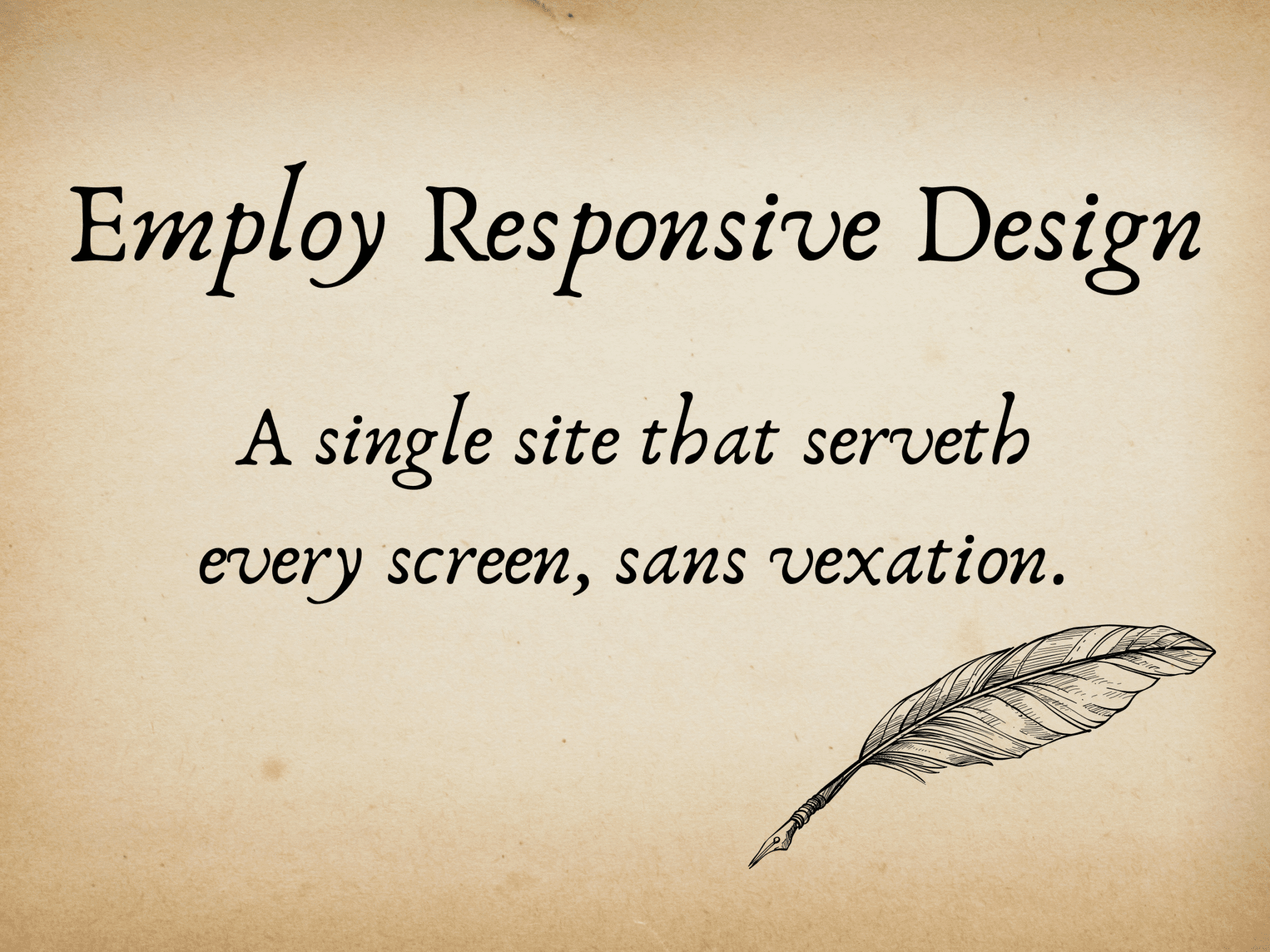
✅ Use responsive design – One site that works on every screen, no headaches.
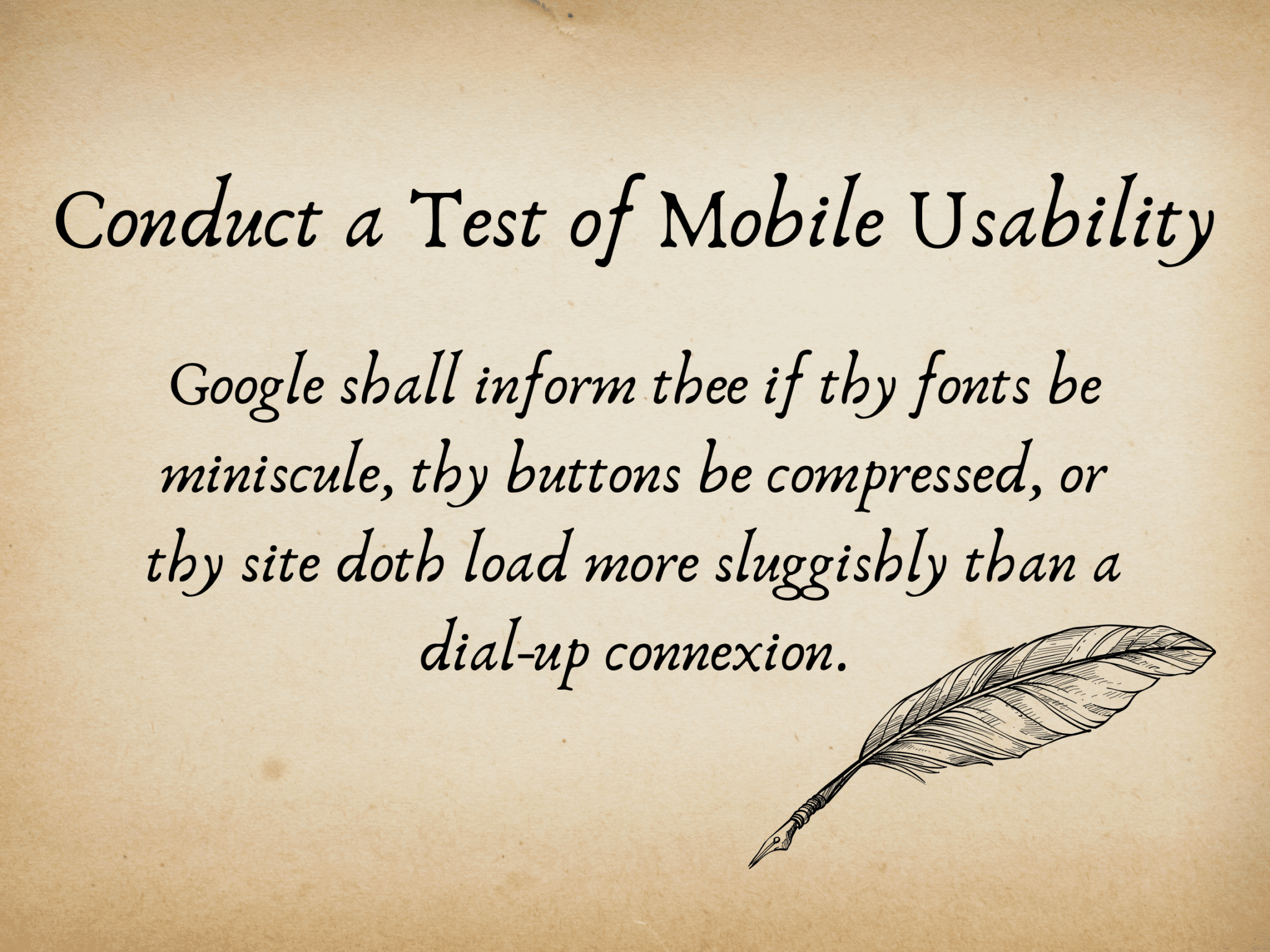
✅ Run a mobile usability test – Google will tell you if your fonts are tiny, your buttons are squished, or your site loads slower than a dial-up connection.

✅ Add structured data – Give Google and AI the facts about your practice: services, hours, reviews, and location.

✅ Compress images and speed things up – Every second counts. Faster sites = happier patients.

✅ Make calls-to-action obvious – Buttons like “Request an Appointment” or “Call Today” should be big, bold, and impossible to miss.

✅ Build GEO-friendly content – A simple FAQ page and clear service descriptions help your practice appear in AI-powered results.
To Thine Own Mobile Optimization Strategy Be True
At the end of the day, mobile optimization for dental websites is a critical component of SEO. Patients are searching for you on their phones, Google is ranking you based on your mobile site, and AI-powered search engines are pulling answers from mobile-friendly content. If your site isn’t optimized, you’re basically telling potential patients, “Away, you moldy rogue, away!”
Fortunately, fixing it doesn’t have to be complicated. With the right strategy, you can have a beautiful, responsive dental website that loads quickly, works flawlessly on every device, and gives you a competitive edge in search results (and AI results, too).
That’s exactly what we do at My Social Practice. Our team builds mobile-optimized dental websites that aren’t just Google-friendly—they’re patient-friendly. From clean design to SEO to future-proofing your site for AI search, we make sure your digital front door is wide open for new patients. We’re dedicated to helping you navigate the quickly evolving world of digital marketing so you feel confident that you’ll always be a step ahead.
As The Bard once famously said, “It is not in the Google SERPs to hold our destiny but in ourselves and our dental marketing strategies.”
(Don’t Google that.)
Frequently Asked Questions
Why is mobile optimization important for dental websites?
Mobile optimization makes your dental website easier to use on smartphones and tablets, which many patients rely on when searching for a dentist. A mobile-friendly website supports your SEO efforts, improves the patient experience, and makes it easier for visitors to call your office or request an appointment. Basically, you want patients booking cleanings, not delivering dramatic soliloquies about your website’s terrible navigation.
How does mobile optimization affect SEO for dentists?
Google uses mobile-first indexing, meaning it primarily uses the mobile version of your website for indexing and ranking. If your mobile site has missing content, technical problems, or a frustrating user experience, your search visibility may suffer. Responsive design, fast loading times, and accessible content help create a stronger foundation for dental SEO.
Can Mobile Optimization Help My Dental Website Appear in AI Search Results?
Yes, although mobile optimization alone doesn’t guarantee inclusion in Google AI Overviews, ChatGPT, or other AI-powered search results. A well-structured, accessible website with helpful content, accurate business information, and strong technical SEO gives search systems a better foundation for discovering and understanding your practice, hopefully leading to patients finding and choosing your practice. Consider it an excellent audition, rather than a guaranteed leading role.
How Can I Tell if My Dental Website Has Mobile Performance Problems?
Start with Google’s free PageSpeed Insights tool at pagespeed.web.dev. Enter your website URL to see mobile performance scores and recommendations for improvement. Then open your website on your own phone and pretend you’re a new patient. Can you find your phone number, read about your services, and request an appointment without frustration? If not, your website may be in need of some most urgent attention.
Does My Dental Website Need to Be Completely Rebuilt to Be Mobile-Friendly?
Not necessarily! Some websites only need targeted improvements, such as faster-loading images, better navigation, larger buttons, or mobile-friendly appointment forms. Older websites with outdated layouts or underlying technical limitations may benefit from a complete redesign. A professional website audit can help determine whether your existing site needs a little Elizabethan polishing or a full-blown architectural Renaissance.
About the Author: Megan Nielsen is an SEO strategist and the Grand Overlord of copywriting at My Social Practice. My Social Practice is a dental marketing company that offers a full suite of dental marketing services to thousands of dental practices throughout the United States and Canada.