What You’ll Learn:
- Why brand alignment directly affects how AI tools describe and recommend your dental practice
- The most common ways dental practices accidentally confuse AI and attract the wrong patients
- How consistent messaging across your website, content, and online listings improves AI visibility
- Simple, practical steps dentists can take to future-proof their marketing in an AI-driven search world
Table of Contents
- What Is Brand Alignment in a Dental Practice?
- What Happens When Dentists Are Not Aligned
- Traditional SEO vs LLM Visibility for Dentists
- Step One for Dentists: Create Conceptual Alignment
- Step Two: Align the Entire Practice, Not Just the Website
- What This Means for Dental Marketing in 2026 and Beyond
- FAQ
Why Dentists Should Care About LLM Visibility
Not long ago, winning online as a dentist meant ranking on Google, having decent reviews, and maybe running a few ads. Simple times. Then AI showed up and politely flipped the table.
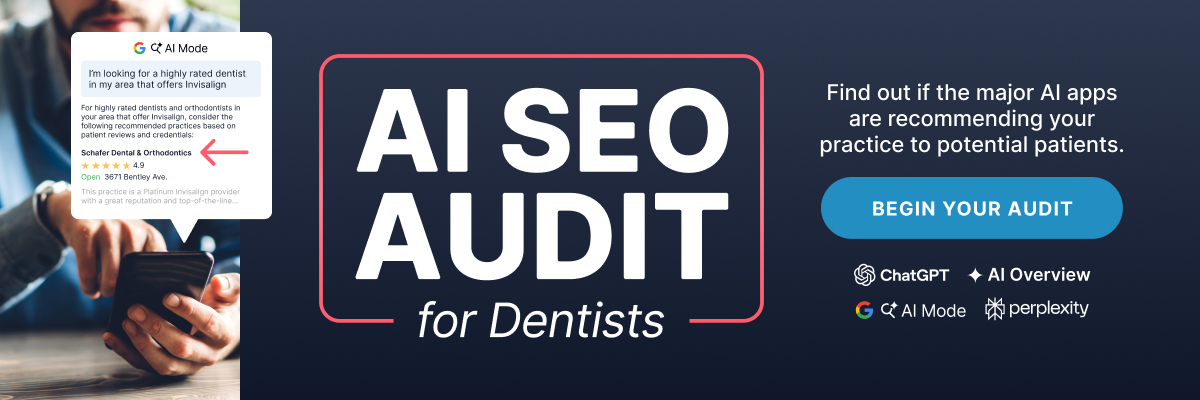
Today, patients are asking tools like ChatGPT, Google AI Overviews, and Perplexity questions like:
- “Who is the best family dentist near me?”
- “Is this dental office good for anxious patients?”
- “What kind of dentist should I see for cosmetic work?”
And instead of showing ten blue links, AI gives them an answer. But it doesn’t just pull one page from your website. It blends everything it can find about your practice into a short summary. Your homepage. Your blog posts. Your Google Business Profile. Reviews. Third-party listings. Even old content you forgot existed! Yay!
If all of that messaging lines up, AI gets you. If it does not, AI gets confused. And when AI is confused, your practice visibility takes a hit. This is where LLM visibility and brand alignment collide.
LLMs, or large language models, reward dental practices that are clear, consistent, and confident about who they are and who they serve. They punish practices that say one thing on their website, another thing on social media, and something completely different in their blog content.
Fortunately, you don’t need to be a tech expert or an AI wizard to fix this. You just need alignment. (Things that are true in dental marketing and chakra alignment, probably.)
What Is Brand Alignment in a Dental Practice?
Brand alignment sounds like a buzzword, but for dentists, it is actually very simple. All it means is that everywhere a patient or AI looks, your practice should tell the same story.
Your website shouldn’t say one thing while your blog says another. Your Google Business Profile shouldn’t describe a different practice than your social media. Blah blah blah, you get the picture.
When your brand is aligned, your practice consistently communicates who you’re for, what you do best, and what kind of experience patients can expect.
For example, if your practice positions itself as family-friendly and focused on long-term relationships, that message should show up in your homepage language, your service descriptions, your blog topics, and your photos and tone on social media.
Where dentists often get into trouble is when content is created in silos.
A blog might target high-volume cosmetic keywords because they look attractive from an SEO standpoint. Meanwhile, the website is built around general dentistry and preventive care. Reviews might highlight how gentle and patient-focused the team is, while social media leans heavily into flashy smile makeovers and memes that your niece posts for your practice on weekends.
To a human, this feels slightly messy but usually not overwhelming. To an LLM, it’s a full identity crisis. AI doesn’t guess which version of your practice is “the real one.” It averages everything it sees, and that average is what gets shown to potential patients.
Brand alignment is how you control that story instead of leaving it up to chance and your niece’s mood.
What Happens When Dentists Are Not Aligned
For dentists, misalignment often looks like this:
- AI describes your practice as cosmetic-focused, but most of your schedule is hygiene and restorative care
- AI emphasizes low cost or “deals” when you are trying to position a premium experience
- AI recommends your office for services you no longer offer or rarely want to perform
This creates friction before a patient ever picks up the phone. Patients arrive with expectations that don’t match reality, your team spends more time explaining and resetting conversations, case acceptance suffers. And suddenly, dental marketing feels like it is working harder but delivering less. And also you hit a bird on the way to work.
And because the eternal struggle of ROI is a constant in life, cost is also a factor.
When AI and search platforms are unclear about who you are, they are less confident in recommending you. That usually leads to lower visibility in AI-generated answers, fewer high-intent patient inquiries, and increased dependence on paid ads to stay visible.
In short, misalignment makes marketing more expensive and less effective. The frustrating part is that most dental practices don’t create this problem on purpose. It happens gradually. A blog here. A service page there. A social post chasing engagement instead of clarity.
LLMs simply shine a very bright light on a problem that used to stay hidden, the nosy busy-bodies.
Traditional SEO vs LLM Visibility for Dentists
One of the biggest mistakes dentists make is assuming AI search works just like traditional SEO. It does not. Understanding the difference is key to understanding why brand alignment matters so much.
Here’s a simple way to look at it:
| Traditional SEO | LLM Visibility |
| Focuses on ranking individual pages | Focuses on summarizing your entire practice |
| Keywords drive most decisions | Consistent messaging drives understanding |
| Pages can perform well on their own | All content is blended together |
| Errors can go unnoticed | Misalignment is immediately visible |
| Optimized pages win | Clear brands win |
With traditional SEO, you could optimize a single service page and see results even if the rest of your marketing was not perfectly aligned. With LLMs, everything counts.
For dentists, this means the future of visibility is less about chasing individual keywords and more about creating a practice identity that is clear, consistent, and easy for AI to understand and explain to patients.
Step One for Dentists: Create Conceptual Alignment
Before you worry about your website, your blog, or AI tools, you need to answer one foundational question:
Who is your practice really for?
Conceptual alignment is about defining the core identity of your dental practice so clearly that every marketing decision becomes easier. When this is missing, content gets created reactively. A keyword opportunity pops up, a trend looks interesting, or a competitor does something shiny, and suddenly your attention and your messaging drift.
To create conceptual alignment, dentists should step back and ask:
- What types of patients do we most want to attract long term?
- What problems do we genuinely enjoy solving every day?
- What do we want patients to feel when they leave our office?
- What makes our practice meaningfully different from others nearby?
This helps you foster dental branding clarity over confusion. For example, a practice might decide it’s family-focused, relationship-driven, and centered on preventive care, or it might lean into being a high-end cosmetic and restorative practice with an emphasis on aesthetics.
Once that core concept is defined, it becomes the filter for everything else.
If a blog topic does not support that identity, it does not get published.
If a service page sends mixed signals, it gets rewritten.
If a social post chases engagement but muddies your positioning, it gets cut. (Sorry, Samantha, but Uncle David needs to take down some of your posts because no one understands them.)
This clarity is what prompts LLM visibility. When your practice consistently reinforces the same core idea, AI doesn’t have to guess who you are. It understands, summarizes, and recommends you with confidence.
Step Two: Align the Entire Practice, Not Just the Website
Once your core brand concept is clear, the real work begins. Alignment does not stop with your website. In an AI-driven search environment, every touchpoint matters.
Dentists often assume alignment is a marketing-only task. In reality, it touches almost every part of the practice.
Common places where dental practices lose alignment include:
- Blog content written only to capture keywords, not reinforce positioning
- Old service pages that no longer reflect what you want to be known for
- Social media posts that feel off-brand compared to the website
- Google Business Profile descriptions that are generic or outdated
- Inconsistent language used by team members online
LLMs pull from all of these sources. If even one of them sends a conflicting signal, it weakens the overall message.
This is why alignment works best when it is intentional and coordinated. The dentist, office manager, and marketing partner should all be working from the same playbook, defining the services you emphasize, the language you use to describe care, and the experience you want patients to expect.
What This Means for Dental Marketing in 2026 and Beyond
AI search isn’t a trend that will pass. It is quickly becoming part of how patients decide where to go before they ever visit a website or read a review. For dentists, this marks a shift in how marketing success is measured.
Ranking well still matters, but clarity matters too, maybe more. Practices that invest in clear positioning and consistent messaging will find that their dental marketing works harder with less effort. Practices that continue to chase tactics without alignment will feel like they are constantly paying more just for basic search engine and LLM visibility.
LLMs reward practices that reduce ambiguity. When your messaging is aligned, AI can quickly understand what makes your practice valuable and when it should appear in a patient’s search journey.
Frequently Asked Questions
How is LLM visibility different from traditional SEO for dentists?
Traditional SEO focuses on ranking individual pages in search results. LLM visibility focuses on how AI tools summarize and describe your entire dental practice. Instead of evaluating one page at a time, AI blends information from your website, reviews, listings, and third-party sources into a single narrative. That is why consistent messaging matters more than ever.
Do small or single-doctor practices need to worry about AI search?
Yes. AI tools often rely heavily on local data like Google Business Profiles, reviews, and practice websites. In many cases, smaller practices actually have an advantage because it is easier to stay aligned when fewer people are creating content.
Can I improve LLM visibility without rebuilding my entire dental website?
Often, yes. Improving alignment usually starts with refining messaging, updating outdated content, and making sure your core positioning is consistent across key pages and listings. A full rebuild is not always necessary, but strategic updates almost always are.
About the Author: Megan Nielsen is an SEO strategist and the Grand Overlord of copywriting at My Social Practice. My Social Practice is a dental marketing company that offers a full suite of dental marketing services to thousands of dental practices throughout the United States and Canada.