What You’ll Learn:
- Why Google’s shift to full AI mode will fundamentally change how dental practices get found online
- How one 15-year dental marketing agency is rebuilding its services for the AI era
- Why traditional SEO tactics are becoming insufficient for practice visibility
- The critical importance of tracking true ROI through practice management integrations
- What agencies risk if they ignore the AI search transformation happening right now
A Warning From 15 Years in the Dental Marketing Industry
Adrian Lefler has watched the dental marketing industry evolve through every major shift over the past 15 years. He built My Social Practice from the ground up, starting with a simple Google Maps optimization product back when getting a business on the front page was relatively straightforward.
(He’s also my boss so be nice to him.)
In a recent appearance on the RevTalks podcast, Lefler issued a direct warning to marketing agencies about the latest change in dental marketing. And it basically boils down to this: adapt to AI search or become irrelevant.
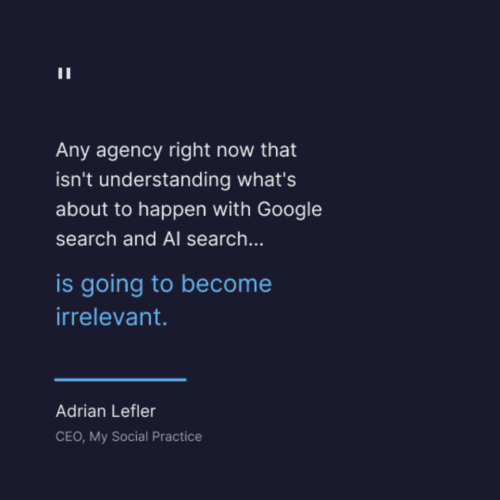
“Any agency right now that isn’t understanding and learning about what’s about to happen on the internet with Google search and AI search, and isn’t preparing to adjust their delivery of their marketing and their services, is going to become irrelevant,” Lefler said. “There’s just too much capability in the software space right now that you can’t ignore.”
The shift he is describing is foundational, and it’s coming faster than most agencies realize.
The Google AI Mode Transformation
The change centers on Google’s transition to what Lefler calls “full AI mode.” Instead of the traditional search experience with ten blue links and a maps section, users will interact directly with AI-generated recommendations.
“When you go to Google, there’s not going to be 10 blue links down below,” Lefler explained. “It’s going to be the AI recommendation. And if you’re not in the recommendations, you’re going to be virtually invisible online.”
This represents a fundamental break from how search has worked for the past two decades. Traditional SEO focused on ranking within a list. AI search focuses on being recommended as the answer.
The distinction matters enormously. Ranking third or fifth on a traditional search results page still generated traffic. Being excluded from an AI recommendation generates nothing.
| Traditional SEO | AI Search |
| Rank within a list of results | Be recommended as the answer |
| Position 3-5 still gets clicks | Excluded means invisible |
| Optimize for keywords | Optimize for authority and trust signals |
| Gaming tactics sometimes worked | AI detects and penalizes manipulation |
| Gradual algorithm updates | Fundamental shift in user experience |
For dental practices and the dental marketing agencies that serve them, this means the strategies that worked for years may stop working entirely.
Rebuilding for the New Reality
My Social Practice is not waiting to see how the shift plays out. We’re actively rebuilding our service delivery model to meet the demands of AI search.
“We’re right in the middle of a massive change,” Lefler said. “Understanding those algorithm changes for AI search or AI SEO versus traditional SEO… some of it’s the same. There’s some things that are all kind of the same, but it’s fundamentally a different service.”
The rebuild extends beyond just SEO. My Social Practice is leveraging AI throughout operations, transforming processes that once took hours into tasks completed in minutes.
“Systems and processes that would take us an hour now take us two minutes leveraging AI,” Lefler explained. “We’re basically rebuilding certain portions of our services leveraging certain tools inside of AI, and they’re pretty sophisticated.”
This is not simply about using ChatGPT to write copy faster. Lefler described sophisticated automation projects that touch website development, copywriting, reporting, and service delivery across the organization.
The result is increased capacity without proportional headcount growth. One copywriter can now produce three times the output. Resources get reallocated to higher-value activities. The agency becomes more profitable while delivering better results.
The ROI Transparency Problem
One of the most significant challenges in dental marketing is proving actual return on investment. Lefler explained why this matters and how My Social Practice solved it.
“One of the toughest things in marketing is to accurately and transparently deliver ROI and results,” he said. “In order to deliver an actual valid ROI number, you have to track from your advertising effort all the way through to the patient scheduling and then coming in, showing up for their appointment, and then actually accepting treatment and paying for it.”
Most marketing agencies stop at surface-level metrics like website visits, ad clicks, and phone calls generated. These numbers tell part of the story but not the part that matters most to practice owners.
The only way to close the loop is integration with practice management systems, the software dental practices use to manage schedules, patient records, and billing. My Social Practice built direct API integrations with these systems to pull actual production data.
“We get access into all of that and we can see the data,” Lefler explained. “Now it tells us, okay, it’s the treatment coordinator. She’s not prepping the patient correctly to accept treatment. Or it is the marketing.”
This level of visibility transforms client conversations. Instead of defending marketing spend with proxy metrics, the agency can show exactly how many dollars of revenue resulted from each marketing dollar invested.
Why White Hat Still Wins
Throughout the interview, Lefler emphasized the importance of avoiding shortcuts and manipulation tactics. This philosophy has guided My Social Practice since our founding.
“We’ve always stayed away from black hat techniques, trying to game the system, because we’ve seen over the years how stuff just gets picked up,” he said. “We never used link farming or any of that kind of stuff. We really stuck to activities that we knew would have longevity.”
This approach matters even more now that AI search is becoming the norm. Traditional search algorithms could sometimes be fooled by manipulation tactics, at least temporarily. AI systems are fundamentally better at detecting inauthentic signals.
Practices and agencies that built their visibility on legitimate authority signals are better positioned for the transition. Those that relied on gaming the system face a harder reckoning.
The Niche Advantage
My Social Practice works exclusively with dental practices, a focus that developed organically but became a strategic advantage.
“Once we were there, we found it very difficult to get outside of dentistry even when we tried,” Lefler admitted. “We tried to go into the optometry industry, the chiro industry, derm, other healthcare industries. And what we found is that even though those are all healthcare-oriented verticals, the marketing content is super specific.”
Attempting to serve multiple verticals diluted focus and required essentially rebuilding the company for each new industry. The gains were not worth the investment.
Instead, My Social Practice went deeper into dentistry, developing specialized expertise that generalist agencies cannot match. This depth now informs how our dental marketing company approaches the AI search transition, with insights specific to how dental practices need to position themselves for recommendation-based discovery.
The AI Search Timeline
Lefler believes the full transition to AI search will happen in 2026. That gives dental marketing agencies and practices a narrow window to prepare.
“When Google makes the switch to full AI mode, which is probably going to happen in 2026, if you’re not prepared to deliver an SEO service or you have a great ad product that understands what’s about to happen, you’re going to be out of luck,” he said.
The agencies that treat this as a future problem to address later are making a dangerous bet. Building new capabilities, testing new approaches, and repositioning services takes time.
For dental practices evaluating their marketing partners, the question becomes whether their current agency understands what is coming and is actively preparing for it. (Psst, we are!)
Frequently Asked Questions
What is Google's AI mode and when is it expected to launch?
Google’s AI mode refers to a fundamental change in how search results are delivered. Instead of showing a list of links for users to browse, Google will provide AI-generated recommendations and answers directly. This transition is expected to complete in 2026, though elements of it are already visible in current search experiences.
How is AI search different from traditional SEO?
Traditional SEO focused on ranking within a list of search results. Position mattered, but even lower rankings generated some traffic. AI search focuses on being recommended as the answer to a query. If a practice is not included in the AI recommendation, it receives no visibility at all. The signals that drive recommendations also differ, with AI systems placing greater emphasis on authority, trust, and authentic engagement.
Why does practice management system integration matter for dental marketing?
Marketing agencies typically report on metrics like website traffic, ad clicks, and phone calls. These numbers do not show whether marketing spend actually generated revenue. Integrating with practice management systems allows agencies to track leads all the way through to scheduled appointments, completed visits, accepted treatment, and collected payment. This provides true ROI data rather than proxy metrics.
What should dental practices look for in a marketing agency right now?
Practices should ask whether their agency understands the AI search transition and what specific steps they are taking to prepare. Agencies that are actively rebuilding their services, investing in AI capabilities, and tracking true ROI through practice management integrations are better positioned than those still operating on traditional models.
About the Author: Megan Nielsen is an SEO strategist and the Grand Overlord of copywriting at My Social Practice. My Social Practice is a dental marketing company that offers a full suite of dental marketing services to thousands of dental practices throughout the United States and Canada.