What You’ll Learn
- What answer engine optimization (AEO) is and why it is replacing traditional SEO for patient discovery
- The single most important technical factor for showing up in AI-generated recommendations
- Why AI engines prefer individual dentists over dental brands, and what to do about it
- How to build the kind of authority-based content that ChatGPT, Gemini, and Perplexity actually trust
- Practical first steps any dental practice can take today to improve AI search visibility
What 18 Months of AI Search Data Reveals About How Dental Practices Get Recommended by ChatGPT
Imagine two dental practices involved in marketing. Same city, similar services, comparable reviews. One of them keeps getting recommended by ChatGPT when patients ask for a local dentist. The other one is invisible to AI entirely. The difference has nothing to do with how good the dentistry is. It has everything to do with a few specific, technical, and strategic factors that most dental marketers are not even talking about yet.
That is the premise Kasim Aslam brought to a recent episode of the Byte Sized Podcast, and the data he brought with him is genuinely hard to ignore. Kasim is a digital marketing heavyweight who previously built and sold the number one ranked Google Ads agency in the world. After the sale, he put together a five-person data team and spent nearly two years studying one obsessively specific question: what makes an AI engine cite or recommend a business? Tens of millions of data points later, he sat down with host Adrian Lefler to share what he found.
The short version? AEO is not just faster SEO. It is a fundamentally different game, and dental practices that understand the rules early are going to have a meaningful head start.
What Is AEO and Why Should Dentists Care?
AEO stands for answer engine optimization, the practice of positioning a business to be recommended or cited by AI tools like ChatGPT, Google Gemini, and Perplexity rather than just ranked in traditional search results.
Kasim’s take on where this is headed is blunt. “On a long enough timeline,” he told Adrian, “this becomes the only marketing mechanism, because AI is going to be the conduit through which we access everything.”
That might sound like hype, but the patient behavior data backs it up. A growing number of patients are now turning to AI tools before they ever type into a search bar, asking conversational questions like “what dentist near me takes Delta Dental” or “what should I look for before getting dental implants.” The answers they get back are shaped by which practices the AI engine trusts enough to cite, and that trust is built very differently than Google rankings.
The Schema Markup Discovery: The Most Surprising Finding in the Data
Here is where Kasim’s research gets genuinely interesting for dental practice owners.
After tens of millions of data points across major AI platforms, his team identified one technical factor that showed up consistently in almost every AI-driven citation: schema markup.
Schema markup is essentially a layer of structured code on a website that labels and organizes content so that machines can understand it quickly and accurately. Think of it as the instruction manual for your website. It tells AI engines what your content is about, how it is organized, and what is most important.
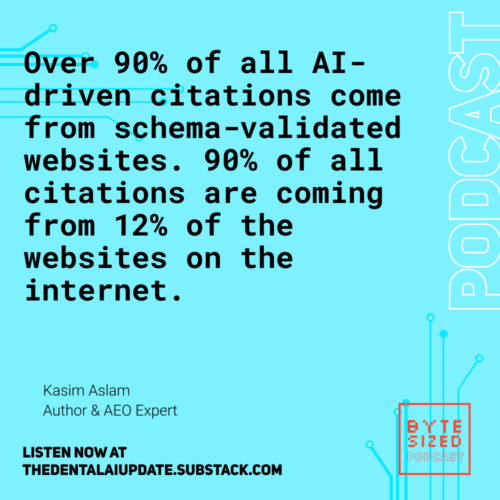
The numbers Kasim’s team found are stark. Only about 12.4% of all websites on the internet have validated schema markup. Yet over 90% of all AI-driven citations come from that same 12% of sites.
“If you have schema on your site, it’s like turning the lights on,” Kasim said. “Only 12.4% of websites on the internet have the lights on.”
The reason, he explained, comes down to computing power. AI engines are operating under serious resource constraints. They cannot deeply crawl every website for every query. Schema markup gives them a shortcut, a way to quickly understand the structure and value of a site without burning excessive computing resources. Sites without it get skipped. Sites with it get cited.
For dental practices, the actionable step is straightforward. Contact your web developer or dental marketing partner and ask whether your site has validated schema markup. A free validator at schema.org can give you a baseline answer in minutes. If the lights are off, turning them on is one of the most direct things a practice can do to improve AI search visibility right now. My Social Practice’s dental website design builds sites with these technical foundations in place, which becomes increasingly important as AI search grows.
Why AI Engines Prefer Dr. You Over Your Practice Name
The second major finding from Kasim’s research is one that dental practice owners may find either exciting or uncomfortable, depending on their personality.
AI engines, across every platform Kasim’s team studied, consistently show a strong preference for individual people over brands. They want to recommend Dr. Sarah Chen, not Bright Smile Family Dentistry. The reason is that AI engines evaluate authority, and authority attaches to humans with demonstrated expertise far more readily than it attaches to a business name.
“All LLMs prefer people over brands a thousand to one,” Kasim told Adrian. “They want Jeff Bezos, not Amazon.”
For dentists, this creates both a challenge and an opportunity. The challenge is that many dentists are uncomfortable with personal branding or self-promotion. The opportunity is that most of their competitors are equally uncomfortable, which means the dentist who does start building visible personal authority has a wide open field.
The most practical path Kasim recommended is a podcast or video content strategy built around the specific type of patient the practice most wants to attract. A dentist who wants to be the go-to provider for dental implants should be producing content that answers every question a dental implant patient might ask, in depth, on video, consistently. That content then gets repurposed into YouTube clips, social media reels, blog posts, and threads, creating what Kasim calls multimodal authority: the same expert voice showing up in written, audio, and video form across multiple platforms.
“AEO is what SEO should have been,” Kasim said. “If you create extraordinary content, it does more for you than the person writing a blog every day.”
How to Index Toward the Right Patients
One of the more mind-bending insights from the episode is how differently AI search works from traditional Google search when it comes to personalization.
In traditional Google search, two people searching the same term get roughly the same results with minor personalization. In AI search, context shapes almost everything. A patient who has been researching jaw pain, has three kids, and recently asked ChatGPT about school dental benefits is going to get a completely different set of dental recommendations than someone with no relevant context in their history.
This means ranking for a generic term like “dentist near me” is less useful than building authority around a specific patient avatar. Kasim’s recommendation is to identify the highest lifetime value patient type for the practice and build content specifically around that person’s context, questions, and concerns.
A pediatric dentist, for example, should be producing content that resonates with parents researching children’s dental anxiety, first dental visits, and orthodontic timelines. An implant-focused practice should own the conversation around bone loss, denture alternatives, and long-term tooth replacement options. The AI engine learns to associate the practice with that context, and when a patient with matching signals asks for a recommendation, the practice is positioned to appear.
Paired with strong dental SEO and a well-optimized Google Business Profile, this kind of contextual authority building creates visibility across both traditional search and AI-driven discovery simultaneously.
Three Things Dental Practices Can Do This Week
The research Kasim shared is dense, but the practical starting points are not complicated:
- Check your schema markup. Go to schema.org and run your practice website through the validator. If it is not validated, make fixing this a priority conversation with your web team.
- Start building personal authority. Even a simple video series answering common patient questions about your specialty is a starting point. Done consistently, it compounds over time.
- Get specific about your patient avatar. Identify the type of patient who represents the highest long-term value for your practice and begin creating content that speaks directly to their questions and context.
None of these require a massive budget. They require intention and consistency, which, as Kasim pointed out, is exactly why most practices will not do them, and why the ones that do will have such a significant advantage.
In This Episode:

Kasim Aslam, Co-founder of Driven Mastermind and Pareto Talent
Kasim Aslam is a serial entrepreneur who has built six 7- and 8-figure businesses, including three successful exits. He is the co-founder of Driven Mastermind, Pareto Talent, and the creator of Digital Marketer’s Paid Traffic Certification. Kasim’s other recent release was HIRE, a groundbreaking book that distills the systems he used to build his companies. Designed to be the ultimate guide on hiring and delegation, HIRE offers a proven framework for scaling a business without burning out. He has authored three bestselling books in total and was named one of the top 50 Digital Marketing Thought Leaders in the U.S.

Adrian Lefler, CEO and Co-founder of My Social Practice
Adrian Lefler is the CEO and Co-Founder of My Social Practice and a recognized dental marketing expert with nearly two decades of experience. He is a trusted voice in dental marketing, AI in dentistry, and emerging technology, and he hosts BYTE SIZED, a podcast focused on dental AI, innovation, and technology.
Frequently Asked Questions
What is answer engine optimization (AEO) for dental practices?
Answer engine optimization, or AEO, is the practice of structuring a dental practice’s online presence to be recommended or cited by AI tools like ChatGPT, Google Gemini, and Perplexity when patients ask questions about dental care or search for a local provider. Unlike traditional SEO, which focuses on ranking in search result pages, AEO focuses on building the kind of authoritative, well-structured, expertise-based content that AI engines trust enough to surface in their generated answers. As more patients use AI tools as their first step in finding a dentist, AEO is becoming an increasingly critical part of dental marketing strategy.
How can a dental practice start building authority for AI search visibility?
The most practical starting point is identifying the type of patient the practice most wants to attract and beginning to produce in-depth content that addresses that patient’s specific questions and concerns. A podcast or video series is particularly effective because it can be repurposed into multiple content formats including YouTube clips, social media posts, blog posts, and transcripts, creating broad multimodal visibility from a single recording session. Content should be specific, deep, and genuinely useful rather than general. A dentist who produces a thorough video series on dental implant options for patients with bone loss, for example, builds far stronger authority signals with AI engines than one who publishes a generic blog post about implants.
Is AEO replacing traditional dental SEO, or do practices need both?
AEO and traditional SEO are different strategies with meaningful overlap, but they are not interchangeable. Traditional SEO, particularly Google Maps optimization, remains critical for local patient discovery and should not be abandoned. AEO builds on top of that foundation by adding the authority signals, schema structure, and deep expertise content that AI engines specifically look for. Practices that invest in both are best positioned for the current landscape, where patients may discover a practice through an AI recommendation and then validate that choice through a Google search or Google Business Profile. My Social Practice’s dental SEO services are built around the fundamentals that support both traditional and AI-driven visibility.