Updated: August 13, 2026
Quick Answer: Orthodontists rank higher on Google by verifying and optimizing their Google Business Profile (the correct “Orthodontist” primary category, accurate name, address, and phone, and a steady flow of patient reviews), keeping the website secure (HTTPS), fast, and mobile-friendly, writing keyword-rich title tags, meta descriptions, and image alt text, publishing original blog content that targets terms like “orthodontist near me” and “braces vs. Invisalign,” and building local citations across Google and Apple Business Connect. Done consistently, these steps lift a practice in both the standard search results and the Google Maps pack.
If you would rather hand this off, My Social Practice builds and manages orthodontic SEO so you can focus on patients.
What does orthodontic SEO actually do for your practice?
SEO is the process of fine-tuning your website and Google Business Profile so search engines understand what your practice does and show it to the right patients on Google, Bing, and increasingly the AI answer engines. For orthodontists, the payoff is more consultations booked by patients searching on their own, more referrals reinforced by a strong online presence, and a reputation that compounds over time.
Here is the challenge unique to your specialty. You are not only competing with other orthodontists, but also with general dentists who now offer clear aligners and short-term braces, plus a crowded field of aligner-direct brands. Good SEO is how you own your local search space without paying for every click. And no, SEO is not dead: the channels have shifted toward maps and AI answers, but the fundamentals still drive new patients.
The strategies below cover the highest-impact moves, roughly in order of effort-to-reward.
How do orthodontists get to the top of Google Maps?
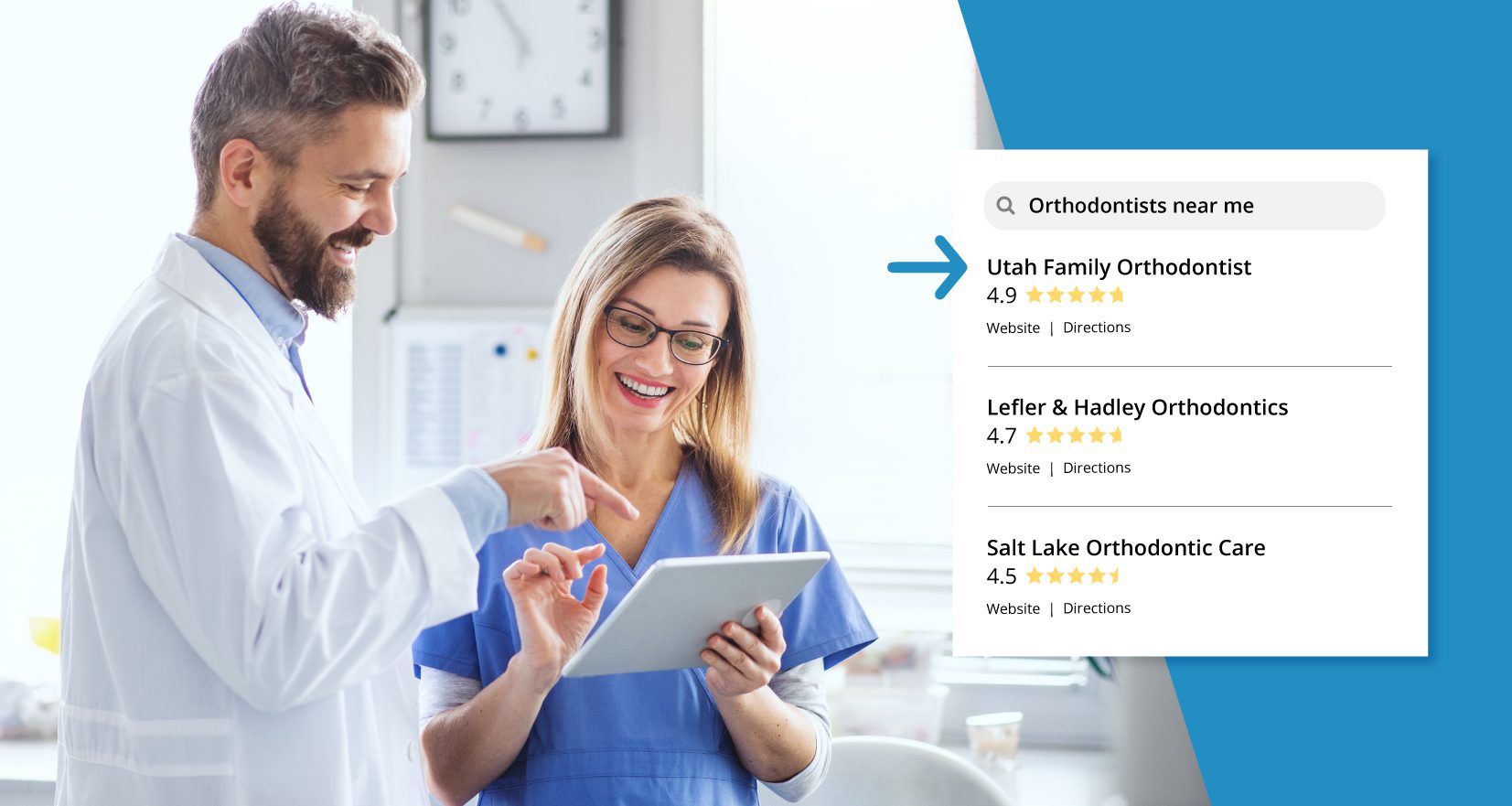
Optimize your Google Business Profile first, because it is the single highest-impact tactic for local visibility. Your Business Profile is the “little red pin” that shows your name, hours, reviews, and directions on Google Maps, and it often decides whether a nearby patient ever sees you.
Start by checking where you currently rank, then tighten the profile:
- Run a Google Maps ranking report to see your position across your service area.
- Claim and verify your Google Business Profile.
- Set your primary category to “Orthodontist.”
- Add a few relevant secondary categories, and no more. Adding too many dilutes relevance and can hurt your rankings.
- Fill out every field: current practice photos, accurate contact information, a working website URL, services, hours, and a complete description.
If general dentists offering aligners are outranking you locally, the profile is usually where the gap is.
How do patient reviews affect orthodontic SEO?
Reviews are one of the strongest signals for both Google Maps and local search rankings, so make collecting them a routine, not an afterthought. A steady stream of recent, positive reviews tells Google your practice is active, trusted, and worth showing to nearby searchers.
Two habits make the difference:
- Ask every happy patient for a review, and make it easy with a text-message reminder and a direct link.
- Respond to reviews. Especially negative ones, calmly and professionally. Rodeo Dental & Orthodontics, a large dental group that reported 50,000–60,000 five-star Google reviews in 2022, said a central-services team member helped facilitate every negative review and that the organization responded to each one. The group’s website now reports more than 75,000 total reviews across over 50 locations.
Reviews and rankings feed each other, which is why reputation and SEO work best together. Our guide to orthodontic reputation management walks through building a review engine that runs on its own.
What about Apple Maps?
Verify your practice separately in Apple Business Connect, because Apple Maps is its own ecosystem and does not pull its listings from Google. Claiming and completing your Apple listing puts you on the map for every iPhone user who searches or asks Siri for an orthodontist nearby.
It is worth the extra step. Apple Maps is now integrated into the majority of new cars sold in the United States, so an accurate, complete listing captures patients searching from the dashboard as well as the phone.
What technical SEO do orthodontists need?
Technical SEO is the catch-all for the behind-the-scenes factors that shape how easily search engines and visitors move through your site, and it carries a meaningful share of your ranking potential [VERIFY: original post claimed technical SEO is “30-40% of ranking value”; no authoritative source, soften or cite]. Get the foundations right and everything you publish afterward works harder.
Run a technical audit of your dental website and confirm each of these:
Security
Your site should load over HTTPS, where the “s” stands for the TLS security certificate Google now expects on every site.
Mobile-friendliness
A substantial share of web traffic happens on phones and tablets, and Google uses the mobile version of your site for indexing and ranking. Make sure it contains the same essential content as the desktop version, loads quickly, and is easy to read and navigate on a small screen.
Metadata
Every page needs a keyword-forward title tag, a meta description, and schema markup. Without them, your pages struggle to show up for the right keywords.
Alt Text
Give every image a descriptive alt title, which is both an accessibility feature and a chance to use terms like “orthodontic patient” or “Invisalign treatment.”
Fast-loading Images
Convert images to the WebP format for broad browser support and quicker load times.
If you are not trained in this, outsource it. Technical fixes are high-leverage but easy to get wrong.

How should orthodontists personalize their website?
Fill your site with original, practice-specific content, because custom content is a must for orthodontic SEO and generic template copy convinces neither Google nor patients. The more useful information prospective patients can explore, the more credible your practice looks and the longer they stay, both of which help rankings.
Focus your effort where it builds trust:
- Refresh your “About Us” page with current team photos and bios that show real personality.
- Choose a color scheme and design that match the vibe of your office.
- Spell out your services, what a first consultation involves, and what treatment is like, backed by patient testimonials.
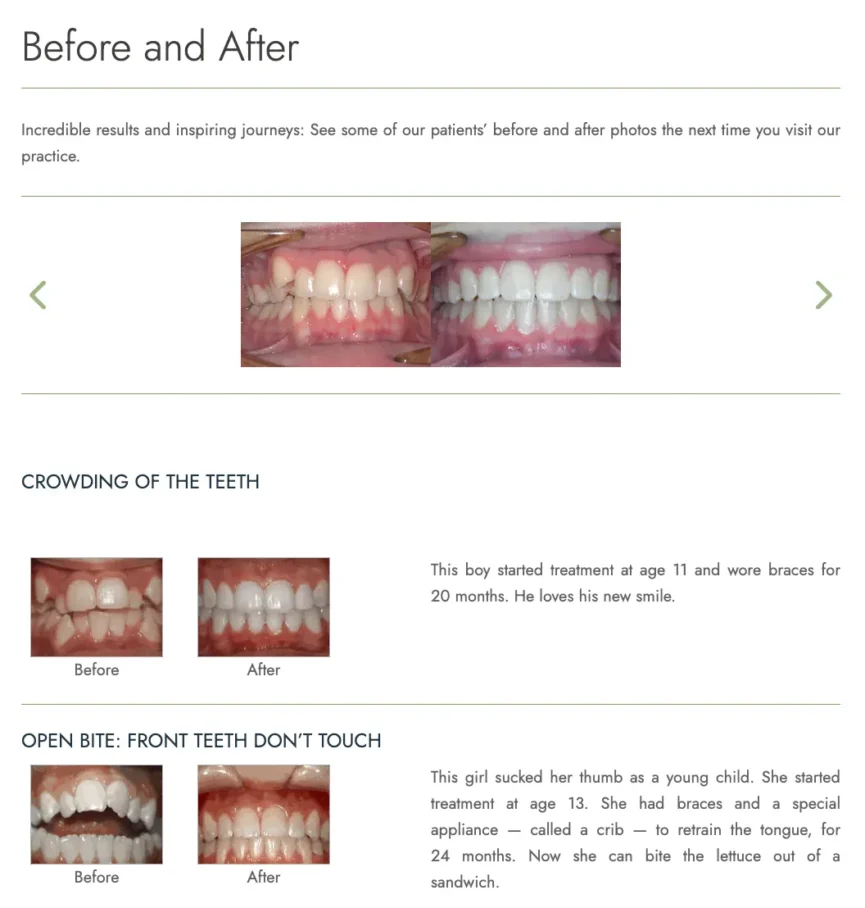
- Build a before-and-after page that pairs real results with short descriptions of the treatment behind each case.
Original service content is also where you win keywords your competitors ignore. Complex cases like impacted canines or jaw alignment frequently involve an oral surgeon working alongside your practice, and content covering those combined treatments ranks for searches your competitors overlook.
Which keywords should orthodontists target, and does blogging help?
Yes, blogging is one of the most valuable and underused orthodontic SEO strategies, and the right keywords are what make each post pay off. Publishing original articles several times a month tells Google your site is actively maintained and creates a new opportunity to rank every time you post.
Target the terms patients actually type, then use them naturally in titles, headings, and body copy. Some of the highest-value orthodontic keywords include:
- “[your city] orthodontist”
- “orthodontist near me”
- “braces vs. Invisalign”
- “how much do braces cost”
- “clear aligners for adults”
Then layer in long-tail phrases, which are longer and more specific, with clearer buying intent, such as “affordable Invisalign for adults in [your city]” or “gentle orthodontist for anxious kids.” They attract fewer searches but convert better, because the person searching knows exactly what they need.
AI tools like ChatGPT are useful for brainstorming and drafting, as long as a human edits every post into your practice’s voice and values before it goes live. If writing is not your strength, our dental SEO copywriting guide shows how to write for search and conversion.
How do links improve SEO for orthodontists?
Links tell Google your site is trustworthy, and the most powerful ones point to you from other reputable, industry-relevant sites. Inbound links act like votes of confidence, so pursue them deliberately: start with citations (accurate listings of your name, address, and phone in directories like Healthgrades and WebMD), then build relationships that earn real links.
Your strongest, most industry-relevant backlinks come from the practices you already work with, the pediatric dentists sending you early-treatment referrals and the specialists handling surgical steps in a treatment plan. Those referral-network sites are exactly the kind of relevant, credible sources worth pursuing for backlinks. For a fuller playbook, see our guide to building external links for dentists.
Internal links matter too. Linking a blog post about Invisalign to your services page helps Google index your site and understand which pages relate to each other, guiding crawlers through every page you want ranked.

Does social media help orthodontic SEO?
Yes, indirectly. Social media does not directly change your rankings, but active profiles put your practice in front of more people, drive traffic to your website, and generate the engagement and brand searches that reinforce your reputation. For orthodontists, whose patients skew young and highly visual, it is also where future patients (and their parents) are already spending time.
Lean into formats built for reach and personality:
- Instagram Reels showing transformations and day-in-the-life clips.
- TikTok content that educates or entertains around braces and aligners.
- Snapchat and fun in-office props that get patients posting and tagging you.
Give patients a reason to share, and the engagement follows.
What is the fastest way to improve orthodontic SEO overall?
Start with your Google Business Profile, then work down the list. Because your Business Profile drives both the standard results and the Maps pack, optimizing it delivers the quickest visible lift for most practices. From there, layer in a fast, secure, mobile-first website, original and personalized content, targeted keywords, and a healthy link profile, and the gains compound.
If you want the complete, current picture of how all these pieces fit together, our full dental SEO breakdown ties the whole strategy together.
Ready to reach new SEO heights? We can help
SEO has a lot of moving parts, and you did not train for years in orthodontics to spend your evenings compressing images and auditing metadata. That is where My Social Practice comes in.
We have helped every kind of dental and orthodontic practice turn search visibility into new consultations and new patients. If you would rather focus on straightening teeth, request a personalized, no-obligation orthodontic SEO analysis and we will show you exactly where you stand and what to fix first.
Frequently Asked Questions
How much does orthodontic SEO cost?
Orthodontic SEO pricing varies by scope and market. Some practices handle the basics in-house at little cost beyond time, while managed SEO services typically run as a monthly retainer that scales with how competitive your area is and how many services you optimize for. A practice-specific analysis gives a far more accurate number than any flat quote.
How long does SEO take to work for an orthodontist?
Most practices see early movement in three to six months, with more meaningful gains around six to twelve months. Google Business Profile fixes can lift Maps visibility fastest, while content and links compound more slowly. SEO is a long-term investment, not a switch, so consistency over time beats any one-time push.
How do orthodontists rank higher on Google Maps?
Ranking in the Maps pack comes down to a fully optimized Google Business Profile: the correct “Orthodontist” primary category, complete and accurate practice details, current photos, a steady flow of patient reviews, and consistent citations across directories. Proximity to the searcher and overall website authority also factor in, so pair the profile with a fast, well-linked site.
Does an orthodontist need to optimize for Apple Maps too?
Yes. Apple Maps does not use Google’s data, so you must claim and complete your listing separately in Apple Business Connect. With Apple Maps built into most new vehicles and every iPhone, a complete, accurate listing reaches patients searching by voice, by phone, and from the car dashboard that Google alone would miss.
What is the difference between orthodontic SEO and dentist SEO?
The mechanics are the same, but the targeting differs. Orthodontic SEO focuses on specialty and treatment keywords like “braces vs. Invisalign” and “orthodontist near me,” and it must account for competing with general dentists who now offer aligners. See our broader SEO for dentists guide for the general-practice version of these tactics.
What is the difference between orthodontic SEO and dentist SEO?
Yes. AI answer engines pull from the same signals that power traditional search: clear, well-structured content, a strong local presence, and credible links. Practices that organize their content well and keep their Google Business Profile current are the ones AI tools cite. SEO is evolving toward maps and AI answers, not disappearing.

Adrian Lefler is the CEO and Co-Founder of My Social Practice and a recognized dental marketing expert with nearly two decades of experience. He is a trusted voice in dental marketing, AI in dentistry, and emerging technology, and he hosts BYTE SIZED, a podcast focused on dental AI, innovation, and technology.