Updated: October, 2026
Quick Answer: Orthodontists get more Google reviews by asking at the happiest moments of treatment, like debond day, aligner milestones, and the end of a smooth adjustment visit, and by making it one tap with an automated text that links straight to the Google review page. Keep your Google Business Profile complete, run short staff review campaigns a few times a year, and reply to every review without confirming the reviewer is a patient. Steady, recent reviews beat one big push.
If you’re wondering how to get reviews for orthodontists, here’s the short version: timing and ease beat everything else. Orthodontic treatment runs 12 to 24 months or more, which gives your team more natural “ask” moments than almost any other specialty. And in ortho, the person writing the review is often a parent or guardian, not the patient.
Plan for both, and your review count grows on its own. (General practice? Start with how dentists get more Google reviews instead.)
Why do Google reviews matter so much for orthodontists?
Google reviews are often the first thing a parent checks before booking a consult, and they help your practice show up in Google Maps. A healthy set of recent, positive reviews boosts your local SEO and gives families a reason to choose you over the practice down the street.
Orthodontic treatment is a long, real-money commitment, so families read reviews closely. Our breakdown of what patients look for in dental reviews digs into the research.
Negative experiences carry extra weight, too. An Inc. article estimates it can take about 40 positive customer experiences to make up for a single negative one. That’s why good dental reputation management covers both earning new reviews and handling the tough ones well.
How do you set up your Google Business Profile for reviews?
Claim and verify your Google Business Profile, then keep it complete and accurate so families can find you on Google Search and Maps.
Your profile checklist:
- Verify ownership so you can respond to reviews and edit your listing.
- Add current details: address, phone number, hours, and a working link to your website.
- Upload real photos of your team, office, and treatment bays.
- Copy your direct review link from the profile so every text, QR code, and email sends families straight to the review form.
For more, see this online reputation management guide from Semrush is a helpful companion.
How do you ask orthodontic patients for reviews?
Ask in person at a happy moment, then follow up right away with a one-tap text link. The in-person ask makes it personal. The text makes it easy.
These tips on how to increase your reviews cover the basics; the ortho-specific tactics are below.
Ask parents and guardians for a review
Make the ask to the parent or guardian, and send the review link to their phone. In most orthodontic practices, the parent books appointments, handles payments, and sees the whole journey from the waiting room.
A few tips that work well:
- Include both of them. Celebrate the progress with the teen, then turn to the parent and make the ask.
- Frame it around the family’s experience. “How has this been for your family?” invites a richer review than “How was today?”
- Send the link to the number on file. Younger patients may not have a Google account, so the parent’s phone is usually the right destination.
Give each team member a script
Give each team member a short, flexible script they can practice and use naturally at the end of visits. A script removes the awkwardness, so people actually ask.
For example:
“We love seeing how far [patient’s first name] has come! If your family has had a great experience with us, would you mind leaving a quick Google review? I’ll text you the link right now, so it only takes a minute.”
Role-play it at a team meeting so it sounds natural.
Place review QR codes where patients can see them
Put review QR codes anywhere families pause: the checkout counter, the treatment room, and the retainer pickup area. Each code should open your Google review form directly.
Other spots that work:
- Appointment cards and take-home care instructions
- A small sign near your debond photo station
- Debond-day goodie bags
One important rule: ask every family, not just the ones you expect to rave. Google’s review policies prohibit selectively asking only happy customers for reviews.
When is the best time to ask for a review?
The best time to ask is right after a moment of visible progress or relief, while the family is still in the office or within a few hours of leaving. A 12 to 24+ month treatment plan gives you several of those moments.
Natural review moments across treatment:
- Consultation: a light ask about the consult itself, such as how clearly the plan was explained.
- Braces on or aligners delivered: excitement is high and the first big step is done.
- Mid-treatment milestones: a visible progress check, a new aligner series, or a smooth adjustment visit.
- Debond day: the big smile reveal and your single best review moment.
- Retainer check: families are relaxed, happy, and reflecting on the whole experience.
Why is debond day the best moment to ask?
Debond day is the emotional high point of treatment, and families are already taking photos. Turn it into a “smile reveal” moment with a simple photo station, then send the review text before the family leaves the parking lot.
Two guardrails:
- Get written photo consent from the parent or guardian before posting any patient photo on your website or social media.
- Keep photos out of your review replies. A reply should never confirm who the reviewer is or show their treatment.
How do you ask aligner patients who visit less often?
Ask aligner patients by text between visits, tied to a milestone. Good triggers include reaching the halfway point in their trays, finishing a virtual check-in, and starting refinements. A quick “Congrats on hitting the halfway mark!” message with a review link feels like a celebration, not a request.
How do automated review requests work for orthodontic practices?
Automated review requests text families after the visit with a link straight to your Google review page, so reviews keep coming between team campaigns.
Our reviews acquisition software does exactly that for ortho patients and families. It also integrates with Healthgrades and Facebook to further strengthen your online presence. [VERIFY: current platform integrations.]
For orthodontics, set it up thoughtfully:
- Trigger requests after key appointment types like bonding, debond, and retainer checks.
- Cap how often one family gets asked. Patients come in every 6 to 10 weeks, and nobody wants a review request after every adjustment.
How do you run a team review campaign?
Keep it short, with a clear goal: a month at most. If your team sees an average of 30 patients per day, you might shoot for 100 new reviews over the next few weeks.
Motivate your team members with cash, prizes, or a party for hitting the goal. A staff review incentive program can track who helped each patient and reward them automatically.
To be clear, incentives are for staff only. Google prohibits offering patients discounts, gifts, or prizes in exchange for reviews, and it’s one of the most common review mistakes practices make.
To kick things off, download our complimentary Google review campaign materials, free printables that make bringing up reviews easy.
How do you respond to reviews without violating HIPAA?
Thank reviewers warmly, but never confirm that someone is a patient or mention any detail about their care, even if they shared it first. HIPAA (the federal law protecting patient health information) applies to your review replies.
That sounds odd, but it’s true. Avoid the reviewer’s full name if it isn’t shown on their profile, and never reference treatment, appointments, or family details.
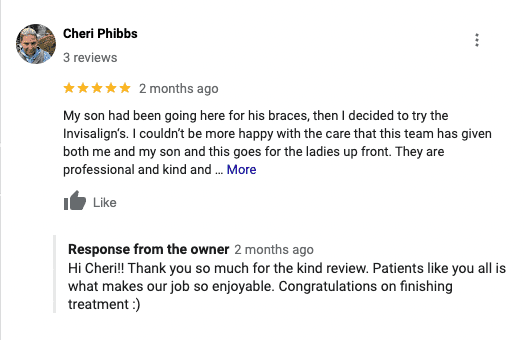
What not to do: this reply confirms the reviewer’s family were patients and discloses that they moved.
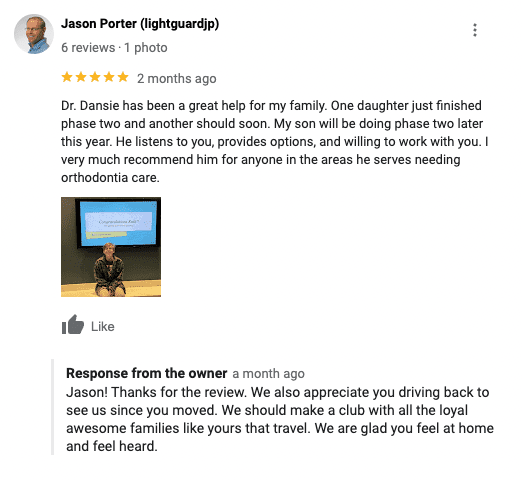
A better approach: warm and appreciative, with nothing that confirms a patient relationship.
Reply to every review; automated responses can help your team keep up. Here’s more on how to respond to Google reviews the HIPAA-safe way.
How should orthodontists respond to negative reviews?
Respond quickly, stay calm, and move the conversation offline. A thoughtful reply often matters more to future families than the original complaint.
The essentials:
- Respond quickly. A prompt reply shows you’re paying attention.
- Don’t argue. Even if you did nothing wrong, getting defensive only makes things worse. Take a breather first.
- Empathize. “I understand your frustration” goes a long way, with no treatment details.
- Take it offline. Share a phone number or email for your office manager, and once things are resolved, politely ask if they’d consider updating their review.
- Report true violations. Flag reviews that are fake, defamatory, threatening, or inappropriate under Google’s policies.
For the full playbook, see our guide on how to respond to negative reviews.
What else makes families want to leave a review?
A great practice culture and a fun social media presence. Happy teams create happy patients, so invest in morale with things like team breakfasts, an employee of the month spotlight, and real time off. Then show your team’s personality on social media; families who feel like they know you are more likely to say so online.
Show Your Personality on Social Media
Another way to boost your Google reviews is to focus on your practice’s social media presence. In fact, TikTok orthodontic marketing is one of our favorite marketing ideas for orthodontic practices. By showing off your personality, knowledge, skillset, and sense of humor, patients get a better sense of who you are, and are more likely to leave positive reviews.
Frequently Asked Questions
How many Google reviews does an orthodontist need?
There’s no magic number. Focus on a steady stream of recent reviews and compare your count and star rating with the orthodontists who show up near you in Google Maps. If competitors have more, recent reviews, close the gap gradually through consistent asking rather than a one-time burst.
Can orthodontists respond to reviews without violating HIPAA?
Yes. Keep replies general and appreciative, and never confirm the reviewer is a patient or mention treatment, appointments, or family details, even if the reviewer shared them first. A simple “Thank you for the kind words; our team loves hearing this!” works for most positive reviews.
Can we offer patients incentives for reviews?
No. Google prohibits offering patients discounts, gifts, contest entries, or anything else of value in exchange for reviews, and violations can lead to removed reviews or a suspended profile. You can reward your team members for asking, which keeps your review strategy compliant and motivating.
When is the best time to ask an orthodontic patient for a review?
Ask right after a visible win: debond day, braces going on, a mid-treatment progress check, or a smooth adjustment visit. Make the ask in person, then text the link before the family leaves. For aligner patients, tie requests to milestones like the halfway point in their trays.
Ready to grow your orthodontic reviews?
Get our free online reputation-building ebook for more ideas, or see how our reviews software automates requests and replies for your whole team.
Running a multi-specialty group? See our guides to reputation management for endodontists and oral surgeon reputation management.


Adrian Lefler is the CEO and Co-Founder of My Social Practice and a recognized dental marketing expert with nearly two decades of experience. He is a trusted voice in dental marketing, AI in dentistry, and emerging technology, and he hosts BYTE SIZED, a podcast focused on dental AI, innovation, and technology.