By Adrian Lefler, Updated August 2026.
Quick Answer: Your dental practice isn’t showing up on Google Maps because local rankings aren’t decided by distance alone. Google ranks the local pack using three factors: relevance (how well your Google Business Profile matches the search), distance (where you are versus the searcher), and prominence (the strength and completeness of your profile). Practices that optimize these three consistently outrank closer competitors, often by miles. Fix your Google Business Profile, choose the right categories, claim your practitioner listing, and earn reviews, and you can climb into the three-pack even when nearer offices can’t.
Most patients now choose a dentist the same way they choose a coffee shop: they open Google, search “dentist near me,” and pick from the map. If your practice isn’t in that little pack of three, you’re effectively invisible to the people closest to you. The good news is that Google Maps visibility is winnable, and it rewards knowledge and consistency far more than ad budget. This guide consolidates what we’ve learned from running thousands of local ranking reports for dental practices into one place: how the ranking algorithm actually works, why proximity is overrated, how to find out where you truly rank, and the exact levers that move you up.
Why does local SEO matter more than ever for dentists?
Because the Google Maps pack is where patients actually decide. Roughly 75% of patients choosing a local dental practice rely on the Google Maps section when they make their choice. Compare that to the 10–15% who trust paid ads or the ~25% who click standard organic website results, and it’s clear where attention and trust are concentrated. If you’re going to win one part of the search results page, the map is the part to win.
Local SEO also levels the playing field. In paid advertising, larger DSOs and venture-backed groups can simply outbid an independent practice. Local SEO doesn’t work that way. Rankings come down to how well your profile is optimized, not how deep your pockets are, and many well-funded organizations still don’t understand proper local optimization. That gap is a real opening for a savvy independent practice to beat much larger competitors.
There’s a bigger shift underneath all of this, too. As more search happens directly on Google and in AI answer engines, referral traffic from traditional Google Search to practice websites has fallen sharply. Patients are getting what they need without ever clicking through to your site. That makes your Maps and local-pack presence, where the decision actually happens, more important than it has ever been.
How does Google rank local results?
Google’s local algorithm weighs three factors: relevance, distance, and prominence. Understanding these is the conceptual spine of everything else in this guide.
Relevance is how well your Google Business Profile matches what the person searched. If someone searches “pediatric dentist” and your profile is built around general and cosmetic dentistry, you’re less relevant to that query, no matter how close you are. Your categories, services, description, and posts all feed relevance — and so does the content on your website.
Distance is the location of your practice compared to either the searcher’s physical location or the geographic term they used (“dentist in Draper,” for example). Distance matters, but as you’ll see next, it is far from the whole story.
Prominence is the overall strength of your Google Business Profile. Is it claimed and verified? Is every field filled out? Is it linked to your website, and is your technically sound website linked back to it? Do you have a healthy, active stream of reviews? Off-site signals like external links pointing to your website feed prominence too. Prominence is the factor you have the most control over, and it’s usually where practices leave the most on the table.
Why does a practice 7.5 miles away outrank the ones next door?
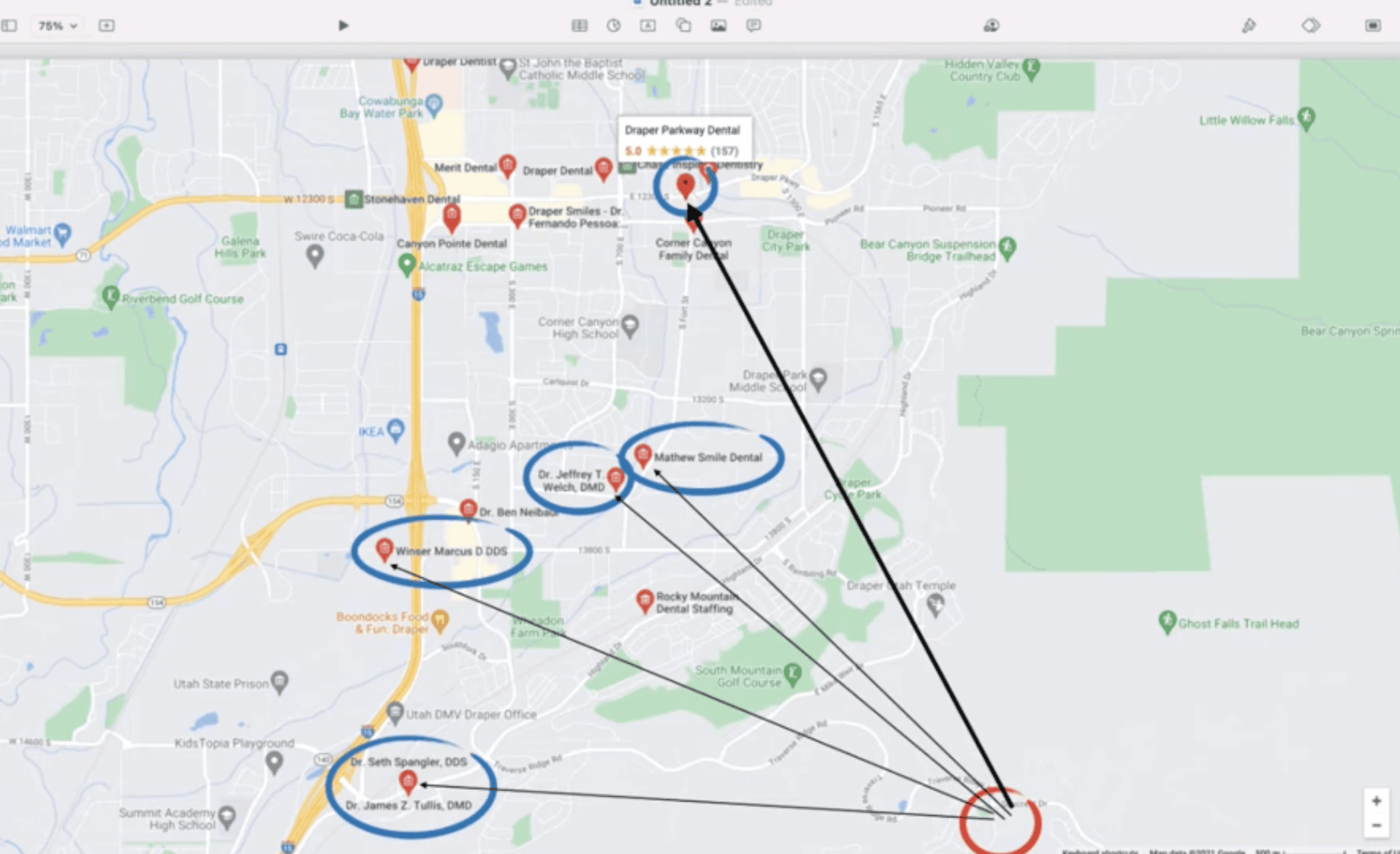
Because optimization beats proximity, and here’s a real example that proves it. In Draper, Utah, the four closest dental practices to Adrian’s home are Spangler and Tullis (who share an office), Windsor Marcus, Jeffrey T. Welch, and Matthew Smile Dental. Common sense says at least one of them should dominate a “dentist near me” search from that spot.
They don’t. Running eight different “near me” searches, dental cleaning near me, dental clinic near me, best dentist near me, dentist near me, dental implants, family dentist, emergency dentist, dental crowns, only one of those four practices showed up, a single time, and that listing had no reviews at all. Meanwhile, a practice called Draper Parkway Dental appeared in four of the eight searches. Draper Parkway is about 7.5 miles farther away than the four nearby offices, which sit four to five miles out.
Switch to geographic phrases: “dentist in Draper,” “family dentistry in Draper,” “dental implants in Draper,” and so on, and the gap gets even wider. Draper Parkway showed up seven of eight times, while none of the four closer practices appeared on the first page of any of those searches. Across both search sets, Draper Parkway appeared 11 times; the four neighbors appeared once, combined. Proximity is not destiny. Optimization is what pulls a farther practice to the top.
Distance is the location of your practice compared to either the searcher’s physical location or the geographic term they used (“dentist in Draper,” for example). Distance matters, but as you’ll see next, it is far from the whole story.
Prominence is the overall strength of your Google Business Profile. Is it claimed and verified? Is every field filled out? Is it linked to your website, and is your technically sound website linked back to it? Do you have a healthy, active stream of reviews? Off-site signals like external links pointing to your website feed prominence too. Prominence is the factor you have the most control over, and it’s usually where practices leave the most on the table.
How do I find out where I actually rank on Google Maps?
You have to check your rankings from many locations, because Maps results shift based on where the searcher is standing. A single “you’re #4” answer doesn’t exist for local search.
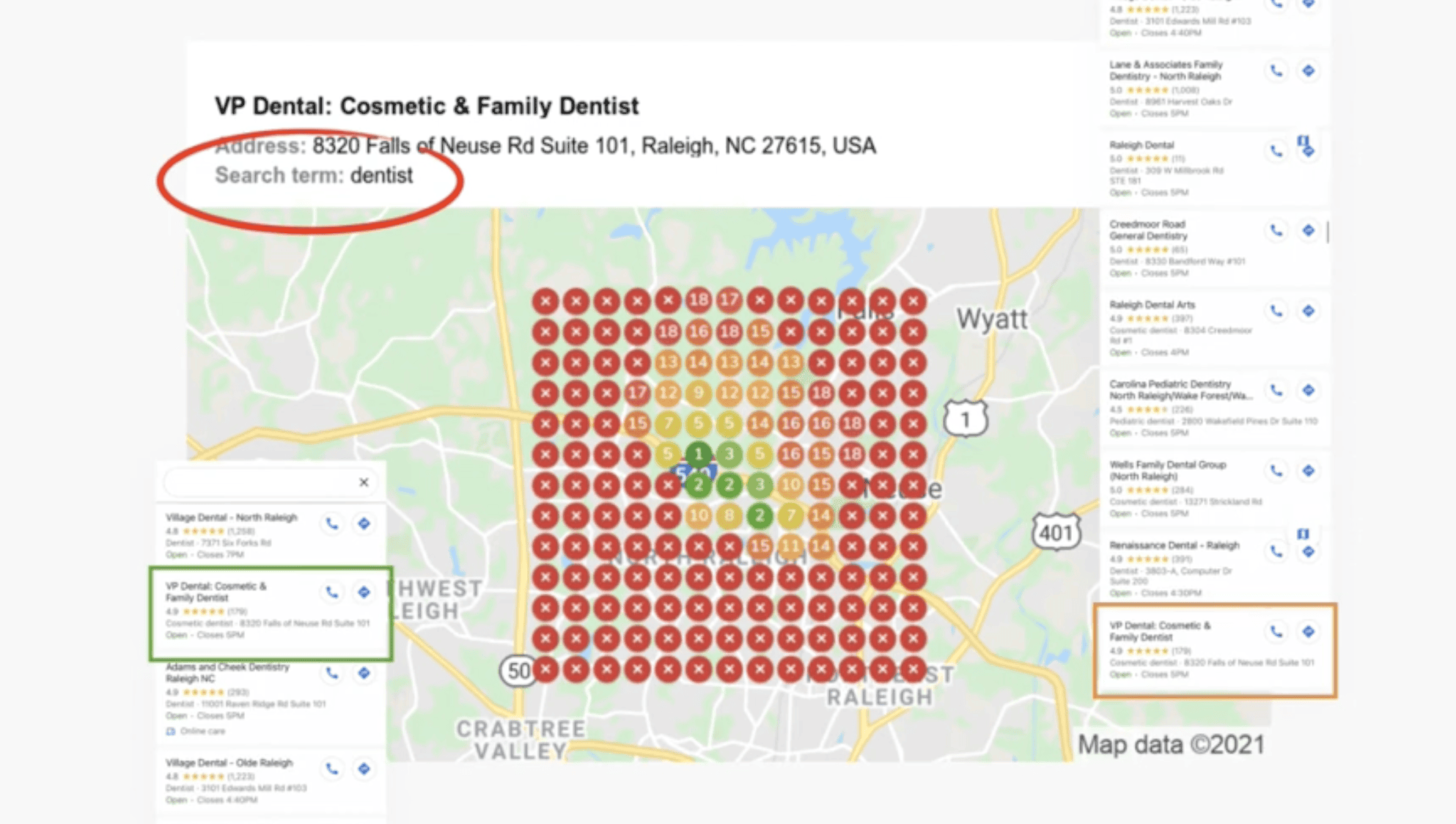
Take VP Dental, a practice in North Raleigh, North Carolina. Stand half a mile west of their office, pull out your phone, and search “dentist,” and VP Dental ranks #2. Move half a mile northeast and run the exact same search, and they drop to #13. Rankings don’t radiate out in a neat circle; they form an irregular pattern that changes block by block.
To map that pattern without literally driving around town, we use software that runs a search from a specific latitude and longitude. Picture a grid of 169 search points spaced a half-mile apart, each one querying the same keyword and recording where you land on the map. The result is a heat map that shows exactly where you’re strong and where you disappear.
A few things become obvious once you see your grid:
- Rankings are hyper-local. VP Dental ranked on the first page in a cluster of positions to the north (less competition) but fell off the page heading south toward denser Raleigh.
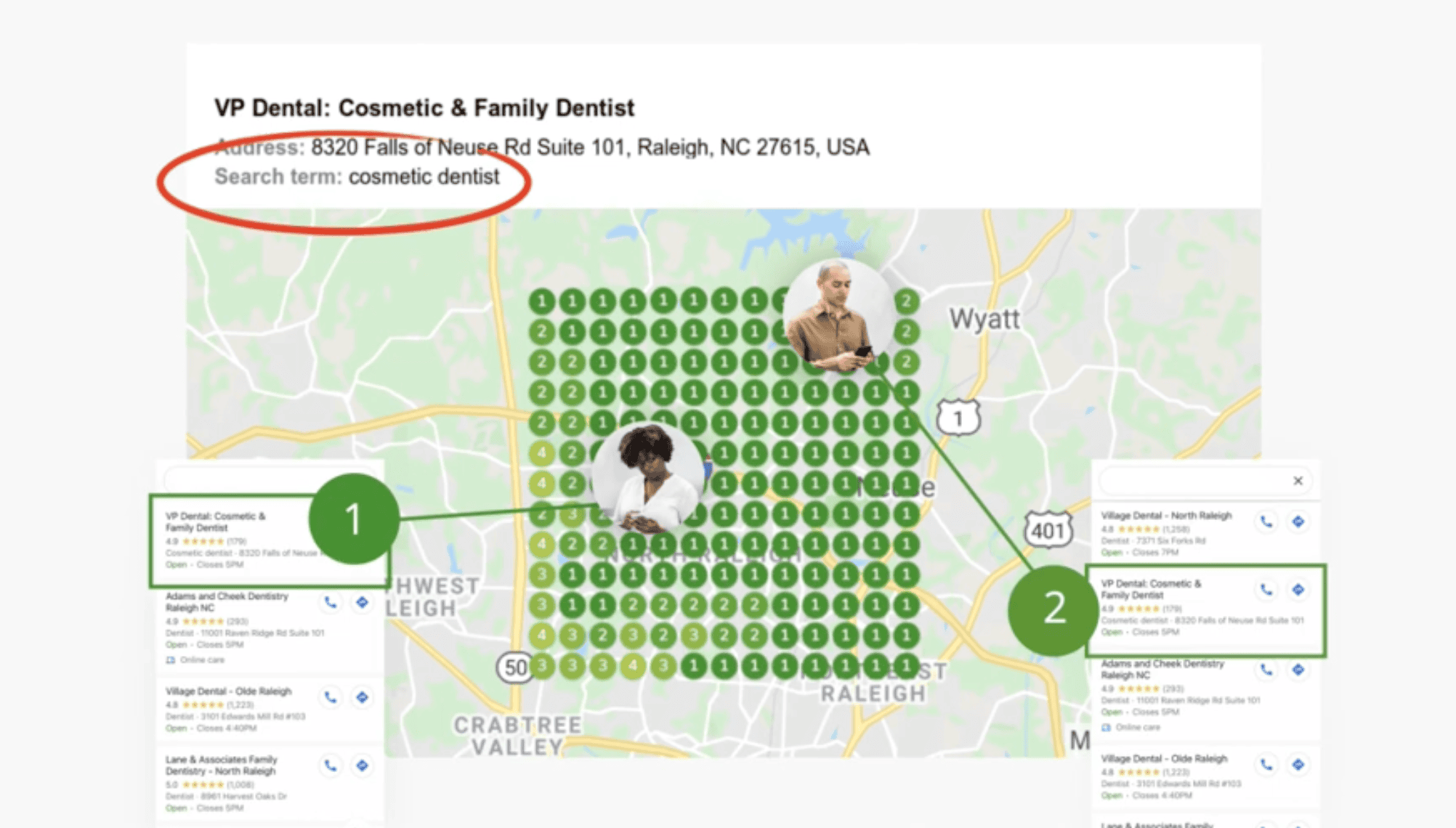
- Your grid is different for every keyword. Standing inside VP Dental’s own office and searching “dental implants,” they ranked #9, not even on the first page, because they hadn’t been optimized for that term. For “cosmetic dentist,” the keyword we optimized them for, they ranked #1–3 across nearly the entire map.
- The goal is the three-pack. Only the top three Maps listings appear on the first page, and about 92% of searchers never go past page one. A well-optimized practice can realistically own a three-to-four-mile radius for a target keyword.
Want to see your own pattern? Claim your free personalized heat map report and we’ll show you exactly where your practice ranks for the keywords that matter to you.
How do I optimize my Google Business Profile?
Your Google Business Profile (GBP) is the single biggest prominence lever you control. Work through this checklist in order:
- Claim and verify your listing. You can’t optimize what you don’t control. Claim the profile and complete Google’s verification.
- Complete every field. Hours, services, description, attributes, photos, booking links — fill it all in. Google rewards completeness.
- Keep your NAP consistent. Your Name, Address, and Phone number must match exactly across your website, Google, and every directory that lists you. Inconsistent NAP data confuses Google and erodes prominence.
- Link GBP and your website both ways. Point your profile to your website, and reference your profile from your site. That two-way link strengthens the connection Google sees.
- Post regularly. Ongoing posts and updates signal an active, legitimate business. A dormant profile looks like a dormant practice.
Do these consistently and you’ll strengthen the one factor, prominence, that most often separates the practices in the three-pack from the ones buried below it.
How should I choose my Google Business Profile categories?
Use just two or three categories, and choose them deliberately, because your primary category carries the most weight in deciding which searches you appear for. Trying to rank for everything is the fastest way to rank well for nothing.
For a general practice, set “Dentist” as your primary category to capture the highest search volume. Then add one or two targeted secondary categories, like “Cosmetic Dentist” or “Emergency Dental Service,” based on the specific patients you want to attract. It’s far better to rank well for a few relevant terms than poorly for a long list. Category selection is one of the highest-impact decisions in your entire local SEO strategy, so treat it as such.
Do these consistently and you’ll strengthen the one factor, prominence, that most often separates the practices in the three-pack from the ones buried below it.
Should I claim my individual practitioner listing?
Yes, and most practices never do, which is exactly why it’s such an advantage. Google automatically creates individual listings for the doctors at a practice, separate from the practice listing itself. Left unclaimed, they sit there doing nothing. Claimed and optimized, they give you a second entry point in search results and can effectively double your visibility.
The key is to optimize the practitioner listing for different keywords than your practice listing. If your practice listing targets “family dentist,” point the practitioner listing at “dental implants” or “cosmetic dentist.” Now you occupy two slots for two different searches instead of competing with yourself for one.
One important caveat: do not merge the practitioner listing into the practice listing. It can be tempting in order to consolidate reviews in one place, but the extra keyword coverage from having two distinct listings far outweighs the minor convenience of pooling reviews. Keep them separate and let each one work a different search.
Do these consistently and you’ll strengthen the one factor, prominence, that most often separates the practices in the three-pack from the ones buried below it.
Do Google reviews actually improve my rankings?
Reviews correlate with higher rankings, but they are likely not a strong direct ranking factor and that distinction matters for how you use them. In our 2021 analysis of more than 28,000 dental listings (28,832 practices), we found that some practices sitting in the top three had no recent reviews at all. If reviews were a powerful direct lever, that wouldn’t happen. (These figures are from a 2021 study; treat the specific numbers as a historical benchmark rather than today’s live data.)
So where do reviews pay off? Social proof and conversion. Even if a strong review profile doesn’t single-handedly push you up the map, it dramatically affects whether searchers actually call you once they see you. Consumers tend to distrust ratings built on fewer than about 40 reviews, so getting past that threshold is where the real return kicks in more calls, more booked appointments, more new patients.
Some benchmarks from that 2021 dataset to aim at: the top-100 practices for reviews were earning roughly 32 new reviews per month. You don’t have to match that overnight, but a practical target is to beat your city’s average review volume and keep a steady, active pace rather than a one-time burst. For a real-world example of reviews at scale, see how Rodeo Dental earned 50,000+ reviews as a DSO. And if managing this feels like a lot, that’s exactly what dental reputation management is built to handle.
How long does local SEO take to work for a dental practice?
Expect initial movement in about 3–6 months of consistent optimization, with the biggest gains compounding over 6–12 months. In the heat map reports we run, a typical pattern looks like this: a practice starts out not ranking at all, reaches a half-mile radius by around six months, and expands to a full-mile radius by a year.
Yes, that’s slower than paid ads, which can turn on overnight. The trade-off is durability. Once you’ve earned strong local rankings, they tend to hold and keep delivering new patients without ongoing ad spend, an asset that keeps paying off rather than an expense that stops the moment you pause the budget.
Watch the walkthroughs
The proximity test, the VP Dental heat maps, and the full ranking-factor breakdown are all easier to grasp on screen. These two short sessions from Adrian cover everything above in detail.
Expert local SEO tips for dentists (full webinar with Dentsply Sirona): https://www.youtube.com/embed/JGeO9f9kHGA
Why your practice isn’t showing up on Google Maps (the Draper & VP Dental demo): https://www.youtube.com/embed/v-9rdplMGPQ
Frequently Asked Questions
Why isn't my dental practice showing up on Google Maps?
Because Google ranks the local pack on relevance, distance, and prominence, not distance alone. A better-optimized practice can outrank closer competitors, sometimes from miles away, as our Draper, Utah test showed. If you’re not appearing, the fix is usually a more complete Google Business Profile, sharper category selection, consistent NAP data, and steady activity, not simply being nearby.
How long does dental local SEO take to work?
Most practices see initial improvement within 3–6 months of consistent optimization, with results compounding over 6–12 months. Our heat maps often show a practice going from not ranking to covering a half-mile radius by six months and a full mile by a year. It’s slower than paid ads but far more durable, since strong rankings keep delivering patients without ongoing spend.
What's the most important Google Maps ranking factor?
There’s no single magic bullet, but category selection has an outsized impact, your primary category tells Google which searches you should appear for. Beyond that, complete Google Business Profile optimization, consistent NAP information across directories, regular posts, and a healthy review profile all work together. The real differentiators are consistency and patience over 6–12 months.
Do Google reviews improve my rankings?
Reviews correlate with higher rankings but appear to be a weak direct ranking factor, some top-three practices have few recent reviews. Their real power is trust and conversion: consumers distrust ratings under about 40 reviews, so getting past that threshold drives more calls and new patients. Aim to beat your city’s average review volume at a steady pace.
Should I claim my individual practitioner (doctor) listing?
Yes. Google auto-creates individual doctor listings that most practices never claim, and claiming yours gives you a second entry point that can double your visibility. Optimize it for different keywords than your practice listing, for example, “dental implants” on the practitioner listing and “family dentist” on the practice listing. Don’t merge it into the practice listing; the extra keyword coverage outweighs consolidating reviews.
How do I check where my practice ranks across my city?
Local rankings shift by the searcher’s exact location, so a single position doesn’t capture reality — you might rank #2 half a mile one way and #13 half a mile the other. A latitude/longitude grid report (for example, 169 points spaced a half-mile apart) maps your true ranking pattern per keyword. You can claim a free personalized heat map report to see yours.


Adrian Lefler, CEO and Co-founder of My Social Practice
Adrian Lefler is the CEO and Co-Founder of My Social Practice and a recognized dental marketing expert with nearly two decades of experience. He is a trusted voice in dental marketing, AI in dentistry, and emerging technology, and he hosts BYTE SIZED, a podcast focused on dental AI, innovation, and technology.
Ready to put this to work? Explore our dental SEO services or claim your free heat map report to see exactly where you stand today.