What You’ll Learn:
- How the modern dental patient journey has changed in 2026
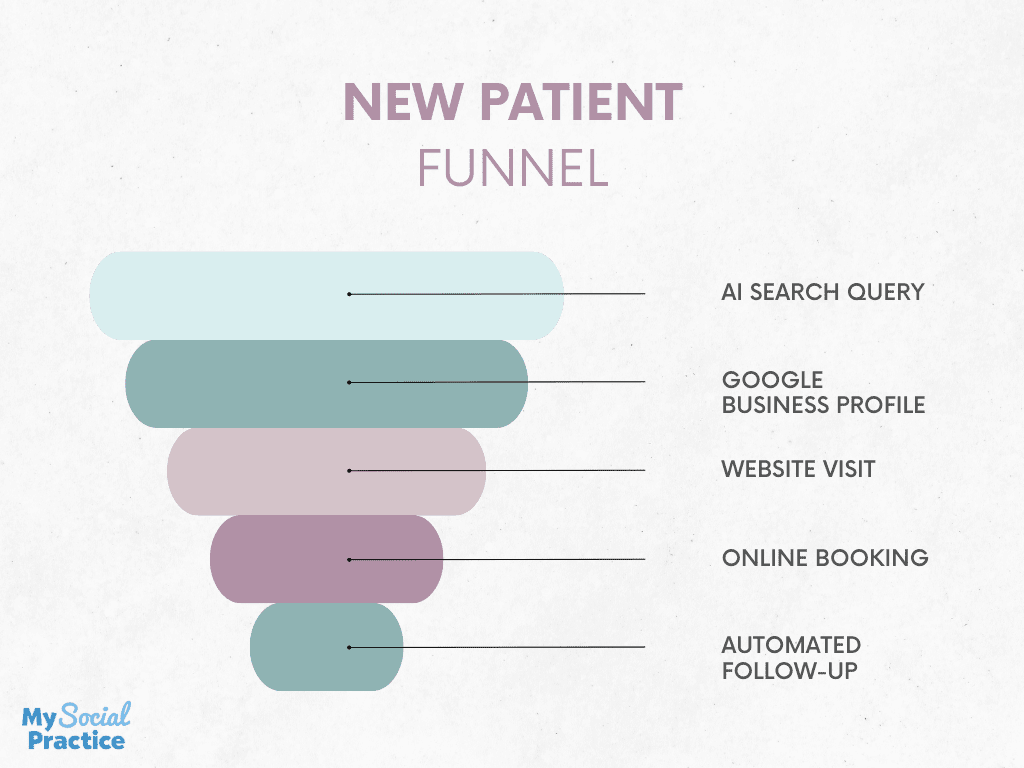
- The five stages of the new patient funnel and what happens at each one
- Why AI search tools are now the starting point for many patient decisions
- What role your Google Business Profile, website, and online scheduler each play
- How automated follow-up turns a booked appointment into a loyal patient
- Where most dental practices are losing patients along the funnel and how to fix it
The 2026 Dental Patient Funnel
Not long ago, the new patient journey was pretty straightforward. Someone’s tooth hurt, they asked a neighbor for a recommendation, maybe flipped through a phone book (yes, really), and called the office. Done.
That journey looks almost nothing like what happens today.
In 2026, a new patient might encounter your practice for the first time inside a ChatGPT response, form their first impression from your Google Business Profile, decide whether to trust you based on your dental website in about eight seconds, book an appointment at 11 PM from their phone, and receive a confirmation text before they ever speak to a single member of your team.
Each of those steps is a moment where your practice either earns the patient or loses them. Understanding the full funnel is the foundation of modern dental marketing.
Here’s a look at how the new patient journey actually works in 2026, stage by stage.
The Modern New Patient Funnel
Every new patient who ends up in your chair in 2026 has traveled through some version of this funnel. Some move through it in twenty minutes. Some take weeks. But the stages are consistent, and a breakdown at any point along the way means a patient who chose someone else.
Stage 1: The AI Search Query
The funnel used to start with Google. Now, increasingly, it starts somewhere else.
A growing number of patients, particularly millennials and Gen Z adults who are now the primary healthcare decision-makers for their households, are turning to AI tools like ChatGPT, Google’s AI Overviews, and Perplexity before they ever type into a traditional search bar. They ask conversational questions: “What should I look for in a new dentist?” or “What is the best way to fix a gap in my teeth?” or simply “Good dentist near me who takes Delta Dental.”
What comes back is not a list of blue links. It is a synthesized answer, sometimes with a handful of named recommendations, sometimes with general guidance that sends the patient to Google next. Either way, your practice’s content, reputation, and online presence are feeding into that answer whether you realize it or not.
This is why the content on your dental website matters so much more than it used to. AI tools pull from authoritative, clearly written, locally relevant sources. Practices whose websites answer real patient questions in plain language, and whose online presence is consistent and credible across the web, are the ones that show up in AI-generated responses. Practices with thin websites, outdated information, or no real content strategy are invisible at this first and increasingly critical stage.
The AI search stage is also where your reputation begins to matter, even before a patient has found your specific practice. Reviews, mentions, and citations across the web feed the signals that determine whether your name surfaces in an AI answer at all.
Stage 2: The Google Business Profile
Whether a patient starts with AI or goes straight to Google, their next stop is almost always your Google Business Profile. This is the listing that appears on the Google Map, and for local dental searches, it is the single most important piece of digital real estate your practice owns.
Your Google Business Profile is where a patient makes their first real judgment call about you. They are looking at your star rating and review count, scanning recent reviews to see how other patients describe their experience, checking your hours to make sure you can fit them in, looking at photos to get a feel for your office and team, and in many cases, clicking the booking button directly from the listing.
A profile with 40 reviews and a 4.2 average rating is going to lose patients to a competitor with 300 reviews and a 4.8 average, even if your clinical care is objectively better. The profile is the preview. And patients are making quick decisions.
This is why dental reputation management is a critical direct patient acquisition tool. Practices that consistently generate new reviews, respond to existing ones, and keep their profile information accurate are protecting their ability to convert at this stage of the funnel.
Strong Google Maps rankings, driven by consistent dental SEO work, determine whether your profile shows up at all when a patient searches in your area. Appearing in the top three map results versus appearing further down is the difference between being seriously considered and being ignored.
Stage 3: The Website Visit
A patient who clicks through from your Google Business Profile to your website has already shown real intent. They want more information. They are deciding whether to trust you. And they are making that decision fast, typically within the first few seconds of landing on your page.
What they are evaluating in those seconds is not primarily your clinical credentials. It is whether the website feels modern, trustworthy, and easy to navigate. A slow-loading page, an outdated design, or a mobile experience that requires pinching and zooming signals something to a patient: if this practice cannot maintain a professional website, what does that say about how they operate?
The website visit is where your story gets told. This is where photos of your team, patient testimonials, clear explanations of your services, and transparent information about insurance and financing turn a curious visitor into someone who is ready to book. Content that answers the questions patients actually have, written in plain language rather than clinical jargon, is what keeps someone on your site long enough to make a decision.
This is also where the direct connection between your website and your online booking system becomes critical. Every extra step between “I want to make an appointment” and “My appointment is confirmed” is an opportunity for the patient to change their mind. A prominently placed, easy-to-use online scheduler embedded directly in your website removes that friction entirely.

Stage 4: Online Booking
This is the conversion point. Everything before it was marketing. This is where a prospective patient becomes a scheduled patient.
And this is where a lot of dental practices quietly lose people they worked hard to attract.
If your website sends patients to a contact form with a vague “someone will call you to confirm,” you are introducing a delay between patient intent and committed appointment. That delay is where patients disappear. They submit the form, get busy, miss the callback, and never reschedule. Nearly one in five patients abandon the booking process entirely if it feels like too much friction.
Real-time online scheduling eliminates that gap. When a patient can see actual available time slots, select one that works, and receive instant confirmation, the appointment becomes real to them immediately and they are far less likely to no-show.
The My Social Practice Online Dental Scheduler integrates directly with practice management systems including Dentrix, Eaglesoft, and Open Dental, so availability is always accurate and there is no double-entry for your team. It works on any device, requires no login or download from the patient, and can be embedded anywhere: your website, Google Business Profile, social media, or even a text message link. Most practices are up and running within a week.
The data from practices that have made this switch is hard to ignore. One family dental practice reported booking more than 800 appointments in four months after switching from a request form to real-time scheduling, compared to just 19 in the four months prior.
Stage 5: Automated Follow-Up
Booking the appointment isn’t the end, my friends. Nope! It’s the beginning of the patient relationship.
What happens between the moment of booking and the moment the patient walks through your door determines whether they actually show up, and whether they become a long-term patient or a one-time visitor.
Automated follow-up handles the work that used to require constant attention from your front desk team. Confirmation messages go out immediately after booking. Reminder texts or emails go out in the days before the appointment, reducing no-shows without anyone having to pick up a phone. Post-visit review requests encourage happy patients to share their experience on Google, feeding directly back into Stage 2 of the funnel for the next prospective patient.
This is also where tools like Annie AI extend the funnel even further. Annie AI can follow up with unscheduled hygiene patients, answer questions that come in after hours, and ensure that no patient inquiry slips through the cracks.
Where Most Practices Are Losing Patients
Most dental practices are not failing at all five stages. Gaps appear in one or two, and those gaps are costing them a steady stream of patients who never quite made it to the chair.
| Funnel Stage | Common Gap | Fix |
|---|---|---|
| AI Search | Thin or outdated website content | Original, patient-focused content strategy |
| Google Business Profile | Too few reviews, incomplete listing | Reputation management and consistent SEO |
| Website Visit | Slow load times, poor mobile experience | Modern, optimized website design |
| Online Booking | Request forms with callback delays | Real-time online scheduling |
| Automated Follow-Up | Manual reminders, no recare outreach | Automated messaging and AI follow-up |
What Happens Before a New Patient Ever Calls You
The new patient journey has changed more in the last two years than in the previous twenty. AI search has moved to the front of the funnel. Online booking has become an expectation, not a bonus feature. Automated follow-up is now the standard for practices that want to retain the patients they work hard to attract.
The good news for dental practices is that the path is clearly mapped. Showing up in AI search, maintaining a strong Google Business Profile, running a fast and trustworthy dental website, offering real-time booking, and following up automatically are all achievable with the right tools and partners in place.
The practices that understand this funnel and invest in each stage of it will have a meaningful and compounding advantage over those that do not.
Frequently Asked Questions
How are new dental patients finding practices differently in 2026 compared to previous years?
The most significant shift is the emergence of AI tools as the starting point for patient research. Where patients previously went directly to Google, many now use tools like ChatGPT, Google AI Overviews, or Perplexity to ask conversational questions about dental care or to find local providers. These tools synthesize information from across the web, meaning a practice’s content quality, review profile, and overall online presence all influence whether they appear in AI-generated recommendations. From there, the journey typically moves to Google Maps, the practice website, and finally online booking.
Why is Google Business Profile so important for attracting new dental patients?
For local dental searches, the Google Business Profile is often the first detailed impression a prospective patient has of a practice. It displays star ratings, review counts, photos, hours, services, and booking options all in one place. Patients make fast decisions based on this information, often choosing between practices without ever visiting their websites. A well-maintained profile with a strong review count and accurate information is one of the highest-return investments a dental practice can make in its online presence.
What is the difference between an appointment request form and real-time online booking?
An appointment request form collects patient information and requires a staff callback to confirm a time, creating a delay between intent and commitment. Real-time online booking lets patients see actual availability, choose a time slot, and receive instant confirmation with no wait and no phone call. That delay built into request forms is where a significant number of prospective patients disengage. Real-time booking removes that friction and produces far higher conversion rates.
How does automated follow-up help with patient retention after the first appointment?
Automated follow-up keeps the patient relationship active without requiring constant manual effort from your team. Appointment reminders reduce no-shows. Post-visit review requests build your Google reputation. Recare outreach brings lapsed patients back before they drift to a competitor. When combined with a tool like Annie AI, which can handle after-hours inquiries and proactively reach out to unscheduled hygiene patients, automated follow-up becomes a powerful patient retention engine that runs largely in the background.
How should a dental practice prioritize improvements to its new patient funnel?
The highest-leverage starting point is usually wherever the biggest gap exists. For many practices, that is either the Google Business Profile (too few reviews, incomplete information) or the online booking experience (still relying on request forms or phone-only scheduling). A quick audit of each funnel stage, looking at content quality, review count, website speed, booking process, and follow-up systems, will usually reveal one or two obvious priorities. Addressing those first tends to produce the fastest and most measurable impact on new patient acquisition.
About the Author: Megan Nielsen is an SEO strategist and the Grand Overlord of copywriting at My Social Practice. My Social Practice is a dental marketing company that offers a full suite of dental marketing services to thousands of dental practices throughout the United States and Canada.