What You’ll Learn:
- Why dental SEO rarely has one-size-fits-all answers
- How to think about schema markup for your dental website
- Whether Google reviews actually help you rank (and when they matter most)
- How blogging frequency depends on your market, not a universal rule
- What social media actually does (and doesn’t do) for dental SEO
- Why technical SEO fixes aren’t always urgent — and how to know when they are
- How to stop chasing checklists and start thinking strategically about your practice’s unique situation
Table of Contents
The Two Words Every SEO Expert Lives By
There’s a running joke in the search engine optimization world. Any time someone asks Google’s Search Advocate John Mueller a question, his answer almost always contains some version of the same two words: “it depends.”
And every time he says it, half the audience groans.
But uh… well, he’s right. In fact, it might be the most useful thing anyone in SEO ever says. And that goes double for dental SEO, where practices differ wildly in size, location, competition, specialty, patient demographics, and marketing maturity.
The problem is that dental marketing advice is often packaged as universal truth. “You need to blog three times a week.” “Schema markup is essential.” “Social media doesn’t help your rankings.” These statements get repeated so often they start to feel like facts. Some of them are directionally correct. None of them are always correct.
Consider this post a reality check. The goal isn’t to make dental SEO feel more complicated but to help practice owners and marketing managers ask better questions, so they stop optimizing for someone else’s situation and start optimizing for their own.
“Does Schema Markup Matter for My Dental Website?”
Short answer: yes, no, and it depends. That’s it, that’s the advice, folks. Come back next time!
Just kidding.
Schema markup is structured data – a layer of code that helps search engines and AI systems understand what your website content actually means. For a dental practice, it might tell Google that a page is about a specific service, or that a business has a certain address and phone number, or that reviews belong to a specific provider.
Here’s where it gets nuanced. Schema markup is not a direct Google ranking factor in the traditional sense. Adding it to your dental website won’t automatically push you up the map results. But that framing misses the point of what schema actually does.
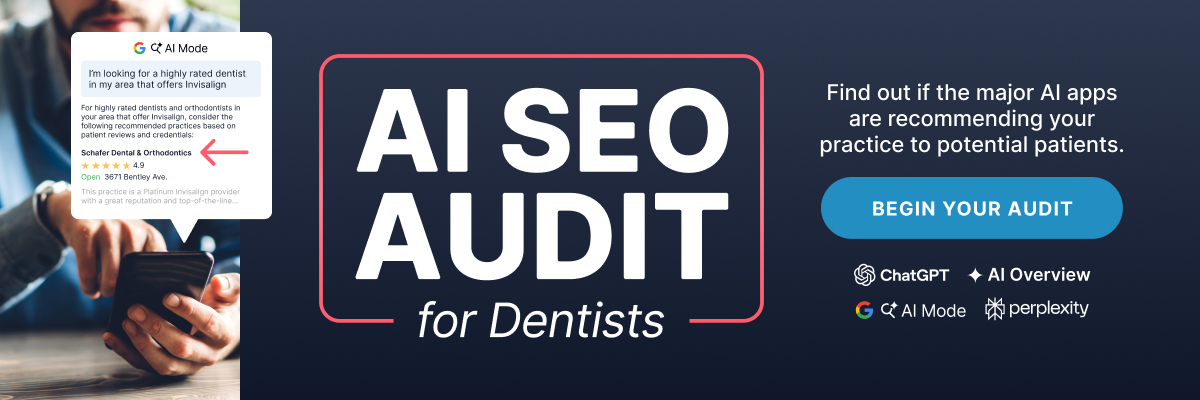
If your practice wants to show up with rich results (review stars, service categories, location details) schema makes that possible. If you’re trying to establish authority with AI search engines like ChatGPT or Google Gemini (which are increasingly where patients are starting their search), schema helps those systems interpret your content accurately and confidently. Research from Microsoft Bing has confirmed that schema helps large language models better understand website content when deciding what to cite and recommend.
So, does your dental website need schema? Ask these questions first:
- Are you trying to rank in AI-powered search results, not just traditional Google?
- Do you want rich results like review stars or service descriptions to appear in search?
- Has your website ever been audited for schema errors?
If the answer to any of those is yes, schema matters a lot for your practice. If you have a brand-new, bare-bones site and you haven’t covered the basics yet, it might not be where your energy goes first. Context determines priority.
“Do Google Reviews Help My Dental Practice Rank?”
Yes. Almost always yes. But the degree to which they help depends heavily on your competitive landscape.
Google reviews are part of the algorithm that determines how dental practices rank in Google Maps. Practices with more reviews, higher ratings, and a consistent cadence of new reviews tend to outperform practices that have let their review profiles go stale. That much is well-established.
But here’s where “it depends” enters the chat. If you’re in a small town where no competitor has more than 30 reviews, getting to 80 reviews is a massive competitive advantage. If you’re in a major metro area where the top three practices each have 400+ reviews, 80 reviews barely moves the needle.
The other dimension is AI search. As AI-powered search engines like ChatGPT and Google Gemini take on a larger share of how patients find dentists, reviews are becoming an even more significant authority signal. These systems use user-generated content – what real patients say about your practice – as evidence that you’re the trusted local expert. More reviews, more recent reviews, and more detailed reviews all feed that signal.
TLDR; reviews almost always matter. How urgently you need to prioritize them depends on where you stand relative to your local competition.
“How Often Should My Dental Practice Be Blogging?”
This might be the most common question in dental content marketing, and the answer that gets thrown around most is, “at least once a week.” That’s not wrong, but it needs context.
Here’s a more useful framework:
| Practice Situation | Recommended Blogging Cadence |
|---|---|
| New website (under 1 year old) | 2-4x per month minimum to build content base |
| Established site in low-competition market | 1-2x per month may be sufficient |
| Established site in high-competition metro | Weekly or more; volume and freshness matter |
| Practice targeting high-value services (implants, aligners) | Consistent blogging around those specific topics |
| Practice doing AI SEO | Weekly question-based content is strongly recommended |
The shift toward AI search makes blogging more important than it used to be, but also changes how posts should be written. AI search engines don’t just match keywords Instead, they look for content that directly answers patient questions. A blog post titled “Dental Implants Miami” is less useful than one titled “How Long Do Dental Implants Last?” Writing for questions, not just topics, is the standard that actually moves the needle now.
The honest caveat is that a sparse blog updated twice a year is almost certainly hurting a practice competing for valuable keywords. But an overwhelmed office manager cranking out thin, rushed posts every few days is not a meaningful improvement. Consistency and quality beat volume every time.
“Does Social Media Help My Dental SEO?”
Until recently, the honest answer was, “meh, not directly.” Social media posts weren’t indexed by search engines, so all those Facebook posts weren’t doing anything for your Google Maps ranking.
That answer has changed.
Google Gemini and other AI search platforms have begun indexing social media content from platforms including Instagram, Facebook, TikTok, LinkedIn, and YouTube. That means the posts your practice publishes, and the comments and engagement they receive, are now active inputs into how AI search systems evaluate your authority as a practice.
This doesn’t mean that posting a tooth brushing tip on Instagram is going to spike your rankings overnight. But it does mean:
- A practice publishing consistently to social media is building authority signals that a practice posting once a month is not
- Video content (especially YouTube Shorts, given Google’s ownership of YouTube) has a measurable connection to Gemini visibility
- Patient comments and interactions on your posts are a form of user-generated content that AI systems treat as social proof
So does social media help your SEO? For traditional Google search, the connection is still indirect at best. For AI-powered search, it is becoming a meaningful signal. The practices that treat social media as an isolated activity separate from their SEO strategy are going to find themselves behind.
“Should I Fix Every Technical SEO Issue on My Website?”
Every technical SEO audit returns a list of issues. Broken links, missing alt tags, slow-loading pages, duplicate meta descriptions, 404 errors. And every practice owner who gets one of these audits feels a moment of panic.
Not all technical issues are created equal, and the urgency of a fix depends entirely on the issue and its context.
A handful of 404 errors on a large website are almost certainly not hurting anything. Google understands that pages get retired. Products go out of stock. Old blog posts get removed. A few 404s in isolation are low-priority noise.
But those same 404s become urgent if they have strong backlinks pointing to them, or if they are heavily linked within the site, or if they were recently ranking for valuable keywords. In those cases, a redirect could recover real traffic.
The same logic applies across the board. A slow page load speed is an abstract concern on a slow news day. It becomes a critical fix when the benchmark for AI search engines is under one second of load time, because slow sites get skipped entirely when AI systems are gathering information to build a recommendation.
Skillful dental marketing determines which items on the checklist are leverage points for your specific situation.

Dental SEO Is a Strategy, Not a Formula
The practices that tend to get the best long-term results from SEO are not the ones who follow the most rigid checklist. They’re the ones who understand their competitive landscape, know what’s actually driving their current traffic (or holding it back), and make decisions based on their specific situation rather than generic advice.
That’s easier said than done, which is why having an experienced dental marketing partner matters. At My Social Practice, the first step with any new SEO client is a thorough audit, not just of the website, but of how the practice is showing up across Google Maps, AI search engines, directories, and review platforms. From there, the strategy gets built around what that specific practice actually needs.
The answer to most dental SEO questions really is “it depends.” But understanding what it depends on? That’s where the real work starts.
Frequently Asked Questions
Does my dental practice actually need an SEO strategy, or is just having a website enough?
Having a website is table stakes, but it is not a strategy on its own. A website that isn’t optimized for search — technically, content-wise, and locally — is essentially invisible to new patients who are actively looking for a dentist. The practices that consistently attract new patients from Google and AI search have websites that load fast, contain question-based content relevant to what patients search, and are supported by strong Google Business Profiles, reviews, and social media activity. Simply having a site and hoping patients find it stopped working a long time ago.
My practice is in a small town with almost no competition. Do I still need to invest in dental SEO?
Yes, but your priorities will look different than a practice in a competitive metro. In low-competition markets, the bar to rank well is lower, which means basic SEO fundamentals — a well-configured Google Business Profile, a clean website, and a steady stream of reviews — can produce strong results without enormous ongoing investment. The risk in low-competition markets is complacency. A competitor who leans into SEO and starts accumulating reviews can build a significant lead that’s difficult to close later. Starting early and maintaining consistency matters regardless of market size.
How do I know if my dental SEO is actually working?
The most meaningful indicators are new patient inquiries that originated from Google or AI search, and movement in your Google Maps ranking for key local search terms. Website traffic is worth monitoring, but it’s becoming a less reliable standalone metric as zero-click searches increase and more patients act directly from AI recommendations without ever visiting your site. Ask new patients how they found you, and track call volume and appointment requests that come through organic channels. A good dental SEO partner will provide regular reporting that connects SEO activity to these real-world outcomes, not just vanity metrics like page views.
About the Author: Megan Nielsen is an SEO strategist and the Grand Overlord of copywriting at My Social Practice. My Social Practice is a dental marketing company that offers a full suite of dental marketing services to thousands of dental practices throughout the United States and Canada.