Updated: Oct 18, 2026 · By Adrian Lefler
Quick Answer: SEO for dentists is optimizing your website, Google Business Profile, reviews, and content so your practice shows up in Google’s map pack, organic results, and AI answers when nearby patients search for a dentist. It combines local SEO, technical SEO, and patient-focused content. The 16 strategies below, from fixing technical errors to earning reviews and local links, are ordered so the highest-impact work comes first.
You rank a dental practice at the top of Google by giving Google three things: a fast, technically sound, mobile-friendly website; a complete, active Google Business Profile backed by steady reviews and consistent listings; and original content that directly answers patient questions. Local signals win the Maps pack. Content and links win the organic results. Clear, well-structured answers get you quoted in Google’s AI Overviews, ChatGPT, and Perplexity.
Done consistently, dental SEO turns the moment a patient searches into a booked appointment, without paying for every click.
Table of Contents
- What is SEO for dentists?
- How is AI changing SEO for dentists?
- Is SEO still worth it for dentists?
- What dental SEO terms should you know?
- What are the 16 strategies to boost SEO for dentists?
- How do dentists rank in Google Maps?
- How do you optimize or write a dental service page with AI?
- Does dental SEO actually work?
- Should you do your own dental SEO or hire an agency?
- Frequently Asked Questions
What is SEO for dentists?
SEO (search engine optimization) for dentists is the work of making everything patients can find about your practice online, including your website, Google Business Profile, content, and reviews, easy for search engines to understand and recommend. When a nearby patient types “dentist near me,” strong dental SEO is what puts you at the top of the map pack, the organic results, and the AI-generated answer.
That visibility is the difference between a patient discovering you or your competitor. Good dental SEO means more first-time patients booking on their own, referrals reinforced by a credible online presence, and a reputation that compounds every year you invest in it.
What are the benefits of local SEO for dentists?
Local SEO targets the searches happening in your neighborhood, so you show up when a patient a few miles away is ready to book. The four biggest payoffs:
- More local awareness. You appear in the map pack and “near me” results, so your practice becomes the obvious local choice.
- More qualified website traffic. Higher rankings bring in people already searching for a dentist, not cold prospects you have to interrupt with ads.
- Earlier patient connections. You reach patients while they’re comparing offices and reading reviews, and shape their first impression before they ever call.
- A real competitive advantage. Most practices still underinvest in SEO, so consistent work lets you own local search space competitors leave open.
How is AI changing SEO for dentists?
AI answers are becoming another way people discover local businesses and research healthcare. BrightLocal’s 2026 Local Consumer Review Survey found that 45% of U.S. consumers use ChatGPT or other generative AI tools for local business recommendations. Healthcare research is part of that shift: MRI-Simmons’ 2026 Health & Wellness Study found that 37% of U.S. adults had used AI to help with healthcare decisions in the previous year.
The fundamentals of SEO still matter. Google confirms that established SEO best practices remain relevant to AI Overviews and AI Mode. For dental practices, these findings make a case for building visibility across traditional search, Google Maps, and AI answers.
The content AI engines quote is content that’s clearly structured, directly answers patient questions, and shows real expertise. Optimizing for that is often called GEO (Generative Engine Optimization): making your content easy for AI assistants to find, trust, and cite. In practice it overlaps heavily with good SEO.
What are zero-click searches, and do they matter?
A zero-click search is one where the patient gets their answer right on the results page, from an AI Overview, a featured snippet, or your Google Business Profile, without clicking through to any website. They matter because your visibility now depends on being the source Google or an AI engine pulls that answer from, even when no click follows.
The fix is the same as good answer engine optimization: give clear, extractable answers to real patient questions so your practice is the one surfaced.
What does it mean to build a “digital entity”?
Building a digital entity means giving search engines one consistent, connected picture of your practice everywhere it appears online: your website, Google Business Profile, directory listings, and social profiles. When your name, address, and phone number (NAP) match everywhere, your branding is consistent, and your profiles link to each other, Google understands you as one trusted, real-world business. That helps you rank, and it helps AI engines cite you with confidence.
Is SEO still worth it for dentists?
Yes. Search is where patients decide, and the practices that show up in local, organic, and AI answers capture the highest-intent audience in dentistry: people actively looking for care. SEO isn’t dead. The channels have shifted toward maps and AI answers, but the fundamentals still drive new patients.
How is traditional SEO different from AI-era SEO?
Traditional SEO focused on ranking a page in the list of blue links. AI-era SEO adds a second job: getting your content quoted inside AI Overviews and assistant answers. Both reward the same foundation.
| Traditional SEO | Dental SEO in 2026 (AI era) [VERIFY: year reference] |
|---|---|
| Rank in the list of organic blue links | Rank and get cited in AI Overviews, ChatGPT, and Perplexity answers |
| Keyword-focused pages | Question-focused, extractable content that answers patient intent |
| Clicks are the main goal | Visibility matters even in zero-click results |
| Backlinks + on-page signals | Same signals plus clear structure, schema, and a consistent digital entity |
| Desktop-first indexing | Mobile-first indexing and voice-friendly, conversational copy |
What dental SEO terms should you know?
These are the core concepts behind how search engines find, understand, and rank your practice. Knowing them makes the strategies below easier to act on.
What are crawling and indexing?
Crawling is when a search engine’s bot scans your website’s pages. Indexing is when it stores those pages so they can appear in results. A page that isn’t crawled and indexed can’t rank.
To see which pages Google has indexed, type site:yourdomain.com into Google, or open the Pages report in Google Search Console for the complete view.
What are robots.txt and sitemap.xml?
Robots.txt tells search engines which pages they’re allowed to crawl; a misconfigured file can accidentally hide your whole site. Sitemap.xml is a list of your pages that you submit through Google Search Console so bots can crawl and index everything efficiently. Together they help Google find and understand your site.
What is a SERP?
A SERP, or search engine results page, is everything Google shows after a search. Depending on the query, it can include a map pack, ads, organic links, featured snippets, and an AI Overview. Ranking near the top still matters: Advanced Web Ranking’s July 2026 study estimated an average click-through rate of about 20% for the first organic result on U.S. desktop searches, compared with less than 1% for the tenth result. For dental practices, the goal is to earn prominent placement where patients are looking, including organic results and the local map pack.
What’s the difference between backlinks, internal links, and hyperlinks?
A hyperlink is any clickable link. An internal link connects two pages on your own site. A backlink (or inbound link) is a link from someone else’s website to yours. Backlinks matter most for rankings, because each one acts as a vote of confidence that your practice is credible.
Which search engines matter most for dentists?
Google, by a wide margin. It handles the large majority of search traffic and powers the maps and AI results most patients see, so dental SEO is effectively Google optimization, with Bing and others as a bonus.
What are the 16 strategies to boost SEO for dentists?
The 16 strategies below are ordered roughly by effort-to-reward, so start at the top. Each one compounds the next.
| # | Strategy | Area |
|---|---|---|
| 1 | Fix technical SEO errors | Technical |
| 2 | Improve page speed and images | Technical |
| 3 | Make your site mobile-first | Technical |
| 4 | Choose the right keywords | Content |
| 5 | Answer patient questions with extractable structure | Content |
| 6 | Claim and optimize your Google Business Profile | Local |
| 7 | Keep your Google Business Profile active | Local |
| 8 | Earn and respond to reviews | Local |
| 9 | Build location pages for “near me” searches | Local |
| 10 | Keep citations and NAP consistent | Local |
| 11 | Earn local backlinks | Authority |
| 12 | Build a strong internal linking structure | Authority |
| 13 | Build topical authority | Authority |
| 14 | Blog consistently with original copy | Content |
| 15 | Optimize for voice and AI search | AI & voice |
| 16 | Stay active on social media | Brand |
1) How do you fix technical SEO errors?
Find what’s broken behind the scenes first, because technical problems quietly cap everything else you do. Technical SEO covers how easily search engines and patients move through your site: crawlability, structure, security, and schema.
Run a technical audit of your dental website and confirm:
- Your site loads over HTTPS.
- Each page has a clean heading hierarchy (one H1, then ordered H2s and H3s).
- Robots.txt works and your XML sitemap is submitted to Google Search Console.
- There are no broken links or duplicate content.
- Schema markup (structured data that labels your practice details for search engines) is in place.
If you’re not trained in this, outsource it. Technical fixes are high-leverage but easy to get wrong.
2) How do you improve page speed?
Make pages load fast, because slow sites lose both rankings and patients. A large share of visitors abandon a page that takes more than a couple of seconds to load. [VERIFY: add a source for abandonment stat]
- Compress images and convert them to WebP.
- Minimize heavy scripts.
- Use a quality host so your site feels instant on a phone.
While you’re optimizing images, add alt text: a short description of what each image shows, like “dental implant consultation.” Search engines can’t “see” images, so alt text helps them rank in image search, and it makes your site accessible to patients using screen readers. Don’t leave it blank or stuff it with keywords.
3) How do you make your dental website mobile-friendly?
Design for the phone first, because Google indexes the mobile version of your site and most patients search on mobile. Confirm that:
- Text is readable without pinching.
- “Call” and “book” buttons are easy to tap.
- Images are sized for mobile.
- Forms are short.
A patient who can find your number in two taps is a patient who calls.
4) How do you choose the right keywords for dental SEO?
Target the terms patients actually type by pairing what you do with where you are: “[your city] dentist,” “dentist near me,” “dental implants [city],” and long-tail phrases like “gentle dentist for anxious patients in [city].” Long-tail terms get fewer searches but convert better, because the patient’s intent is crystal clear.
There’s no magic keyword count. Write naturally and use your term where it fits; overusing it (“keyword stuffing”) backfires. The same goes for your domain: choose one that matches your brand, not one stuffed with keywords, which looks spammy and erodes trust.
5) How do you structure content to answer patient questions?
Lead with the answer, then the detail. Instead of stuffing “dental implants” onto a page, answer “How much do dental implants cost?” and “Am I a candidate for implants?” This intent-first approach is what AI engines and featured snippets reward, and it reads better for patients.
On every page:
- Use question-style headings.
- Put a direct one-to-two-sentence answer right under each heading.
- Add a short FAQ block to capture “People Also Ask” and long-tail searches.
This extractable structure is the single biggest lever for showing up in AI answers and snippets. Our dental SEO copywriting guide walks through writing for search and conversion.
6) How do you claim and optimize your Google Business Profile?
Claim and verify your Google Business Profile first; it’s the highest-impact local move you can make. Your profile is the “little red pin” on Google Maps showing your name, hours, reviews, and directions, and it often decides whether a nearby patient ever sees you.
- Search your practice on Google and click to claim it (or create it if it doesn’t exist).
- Complete Google’s verification.
- Set the correct primary category, such as “Dentist” or your specialty.
- Add a few relevant secondary categories, and no more. Too many dilute relevance and can hurt rankings.
- Fill out every field: description, services, hours, contact info, and current photos.
7) How do you keep your Google Business Profile updated?
Treat your Google Business Profile as a living listing. Keep your business information accurate and complete, especially your hours around holidays. Share helpful updates and offers, add recent photos, and respond to reviews. Make sure your services and contact details reflect what patients can expect today. Keeping your profile current helps Google understand your practice and gives potential patients reliable information when they’re deciding whom to call.
8) Do reviews matter for dental SEO?
Yes. Google confirms that more reviews and positive ratings can help your practice’s local ranking. Reviews can also build confidence in AI-generated healthcare search results: Press Ganey’s 2025 Healthcare Consumer Experience report found that 52% of respondents identified positive reviews as a factor that builds trust in those results. Asking patients for honest feedback regularly gives prospective patients a more current picture of your practice and the care you provide.
- Ask every happy patient with a quick text and a direct review link.
- Reply to every review, positive or negative.
- Stay HIPAA-compliant: never confirm treatment details in a public reply.
9) How do you win “near me” and location searches?
Build a dedicated, well-optimized page for each location or neighborhood you serve, with local landmarks, directions, and community references. Generic single-location copy won’t rank in multiple areas.
10) How do you build consistent local citations?
List your practice in reputable directories, such as Healthgrades, Yelp, and WebMD, with identical name, address, and phone details everywhere. Inconsistent NAP data confuses Google, weakens your local authority, and muddies your digital entity.
11) How do you build local backlinks?
Earn links from reputable, locally relevant sources, because backlinks act as votes of confidence. Build real relationships with local businesses, the specialists in your referral loop, community sponsorships, and schools. Quality beats quantity: a few links from respected local and dental-industry sources outweigh dozens of low-value ones. For the full playbook, see how dentists get to the top of search engines with quality links.
12) How do you build a strong internal linking strategy?
Link related pages together so Google can crawl your site and understand how your content connects. Point blog posts to the relevant service pages, use descriptive anchor text, and guide crawlers (and patients) toward the pages you most want ranked.
How many internal links should a page have? As many as genuinely help. If a link makes the page easier to navigate, include it; never force one in.
13) How do you build topical authority across your website?
Cover your core topics thoroughly and interlink them, so Google sees your site as a genuine authority rather than a thin brochure. Build clusters: a main service page supported by related blog posts and FAQs, so each topic is answered from several angles. Depth plus internal linking turns a small site into a trusted one.
14) How important is blogging for dental SEO?
Very. Blogging is one of the most valuable and underused dental SEO strategies. Publishing original, patient-focused posts at least monthly tells Google your site is actively maintained and creates a new chance to rank every time.
Always write original copy. Never plagiarize or spin competitors’ pages: Google filters out duplicate content, and it erodes patient trust. AI tools can help you draft, but a human should edit every piece before it goes live.
15) How do you optimize for voice and AI search?
Write the way patients speak. People ask full questions out loud (“Who’s the best dentist near me open on Saturday?”) rather than typing keywords, and AI assistants work the same way.
- Use natural, question-based phrasing.
- Target long-tail conversational queries.
- Keep answers concise and up front.
- Keep your business listings accurate so voice assistants and AI tools pull the right details.
16) Does posting to social media help dental SEO?
Yes, indirectly. Social media doesn’t directly change rankings, but active profiles put your practice in front of more patients, drive traffic, and generate the brand searches and engagement that reinforce your reputation. Lean into formats built for reach: short team videos, simple oral-health tips, and shareable patient moments (with permission). Sporadic posting sends no signal; consistent, engaging posting does.
How do dentists rank in Google Maps?
Google ranks practices in Maps and “near me” results on three factors: relevance (how well your profile and site match the search), distance (how close you are to the searcher), and prominence (your reviews, links, and overall authority). You can’t change distance, so strategies 6 through 11 above are where Maps rankings are won.
Before and after you make changes, run a Google Maps ranking report to see exactly where you stand across your service area.
How do you optimize or write a dental service page with AI?
You can use AI tools like ChatGPT and Perplexity to audit and draft dental service pages fast, as long as a human edits the result. Expect AI to get you about 90% of the way; the last 10% (accuracy, voice, and compliance) is yours.
How do you optimize an existing service page with AI?
Give the tool your current page plus the context it needs to judge it, then ask for specific fixes. A workable prompt:
“You’re an SEO expert for a dental practice called [Practice Name] in [City]. Our patients are [audience]. We want this service page to rank for [dental implants] and related phrases. Here is the current copy: [paste]. Analyze how well the target keyword is used in the title, H1, H2s, and body, suggest improvements, flag any grammar or clarity issues, and propose five FAQs based on what patients actually search.”
Review the analysis, then follow up: “Now rewrite the page and incorporate the suggestions you made.” Edit the output into your real voice, keep doctor names and results accurate, and never publish AI text unread.
How do you write a new service page from scratch with AI?
Start with structure, then fill it in. Use Perplexity first because it can investigate live competitor pages:
“Analyze these three high-ranking [dental implant] pages: [URL 1], [URL 2], [URL 3]. Don’t copy them. Create a structural outline for a new [dental implants] service page for [Practice Name] in [City]. Include placeholders for patient testimonials (don’t invent any) and five FAQs targeting local search intent.”
Take the outline into ChatGPT (or keep working in Perplexity) with a writing prompt that specifies your service locations, doctor names, and an empathetic, community-focused tone, while keeping the testimonial and FAQ placeholders. Expect roughly 90% of a usable draft, then edit for accuracy, voice, and compliance. After the copy is ready, finish the SEO job: metadata, schema markup, alt text, and internal and external links.
Does dental SEO actually work?
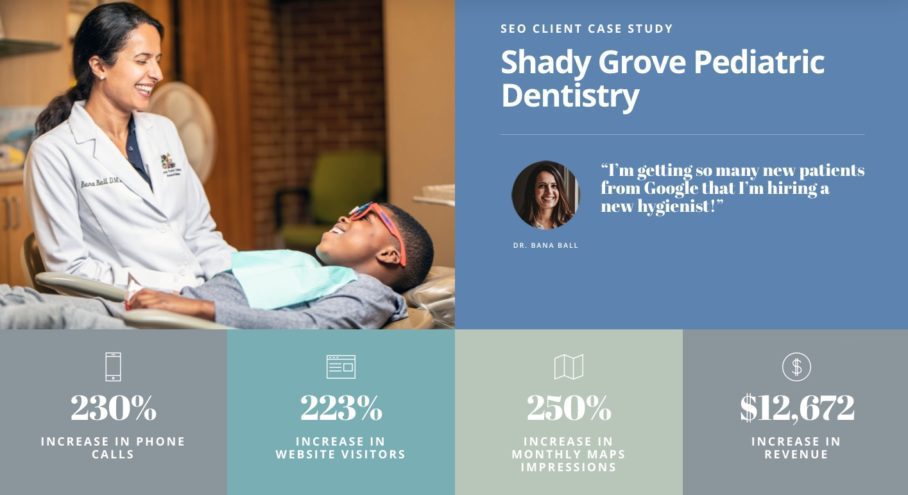
Yes. Our pediatric dental SEO case study shows what consistent local SEO did for Shady Grove Pediatric Dentistry. During the final six months of the study, the practice received 373 phone calls from Google Maps, a 230% increase, and 925 clicks from Google Maps to its website, a 223% increase, compared with the six months before the study began.

Should you do your own dental SEO or hire an agency?
You can do your own SEO with tools like Yoast, Surfer SEO, or Semrush, but like pulling your own tooth, being able to doesn’t mean you should. When you hire an agency, you’re paying for content creation, on-page and technical optimization, link building, tracking and reporting, and, most of all, time and expertise.
You didn’t train for years in dentistry to spend your evenings compressing images and auditing metadata. My Social Practice works exclusively with dental and specialty practices, combining technical SEO, local SEO, Google Business Profile optimization, content, and AI search optimization into one strategy built around new-patient growth. If you’d rather focus on your patients, request a personalized, no-obligation dental SEO analysis and we’ll show you where you stand and what to fix first.
Frequently Asked Questions
How much does dental SEO cost?
Dental SEO cost depends on how competitive your market is, how many locations you have, and how much work your site needs. A single office in a small town needs far less than a multi-location group competing for implant cases in a major metro. Most practices pay a monthly retainer, because SEO compounds over months rather than finishing in one project.
How do you choose a dental SEO company?
Look for a company that specializes in dentistry, integrates SEO with your website, reviews, and social media, and optimizes for AI search as well as Google. Ask for case studies and transparent reporting, and walk away from anyone guaranteeing instant #1 rankings. My Social Practice works only with dental and specialty practices for exactly these reasons.
How long does dental SEO take to work?
Most practices see early movement in three to six months, with more meaningful gains around six to twelve months. Google Business Profile fixes can lift Maps visibility fastest, while content and links compound more slowly. Sequencing the fastest wins first helps you see momentum early. For the month-by-month view, see how long dental SEO takes.
Why isn't my dental SEO working?
The usual culprits are technical errors that block crawling or indexing, an incomplete or inactive Google Business Profile, inconsistent name, address, and phone details across directories, thin or duplicate content, and too few recent reviews. Timing matters too: if you started less than three to six months ago, it may simply be too early to judge.
What's the difference between local SEO and general SEO for dentists?
Local SEO focuses on your area: the Google Maps pack, “near me” searches, your Google Business Profile, reviews, and local citations. General SEO aims to rank your website in standard organic results, often for broader informational terms. Dentists need both, but local SEO usually drives the most new-patient calls, so it’s typically the first priority.
What's the difference between organic and paid search results for dentists?
Organic results appear based on relevance and SEO, and you don’t pay Google for the placement. Paid results are ads, usually labeled “Sponsored” at the top of the page. Paid search can drive traffic immediately but stops the moment you stop paying, while organic SEO builds lasting visibility that keeps working over time.
Do backlinks still matter for dental SEO?
Yes. Backlinks from reputable, relevant sites remain one of Google’s strongest trust signals, and they help AI engines gauge credibility too. Quality beats quantity: a few links from respected local and dental-industry sources outweigh dozens of low-value ones. Focus on citations, referral-network relationships, and community links rather than bought links.
Is it okay to use AI to write dental website content?
Yes, with limits. AI is useful for ideas, outlines, and first drafts, not as a replacement for a human. Always have someone edit and personalize the final version for accuracy, voice, and compliance, especially on health topics where trust matters. For sensitive topics, see our note on YMYL and E-E-A-T for dental SEO.

Adrian Lefler is the CEO and Co-Founder of My Social Practice and a recognized dental marketing expert with nearly two decades of experience. He is a trusted voice in dental marketing, AI in dentistry, and emerging technology, and he hosts BYTE SIZED, a podcast focused on dental AI, innovation, and technology.